
Engine
MAN ES to deliver world’s most powerful methanol marine engine in June
Engine is the first of 12 bound for a series of 12 × 24,000 TEU container vessels currently under construction for Orient Overseas Container Line and COSCO Shipping Lines.

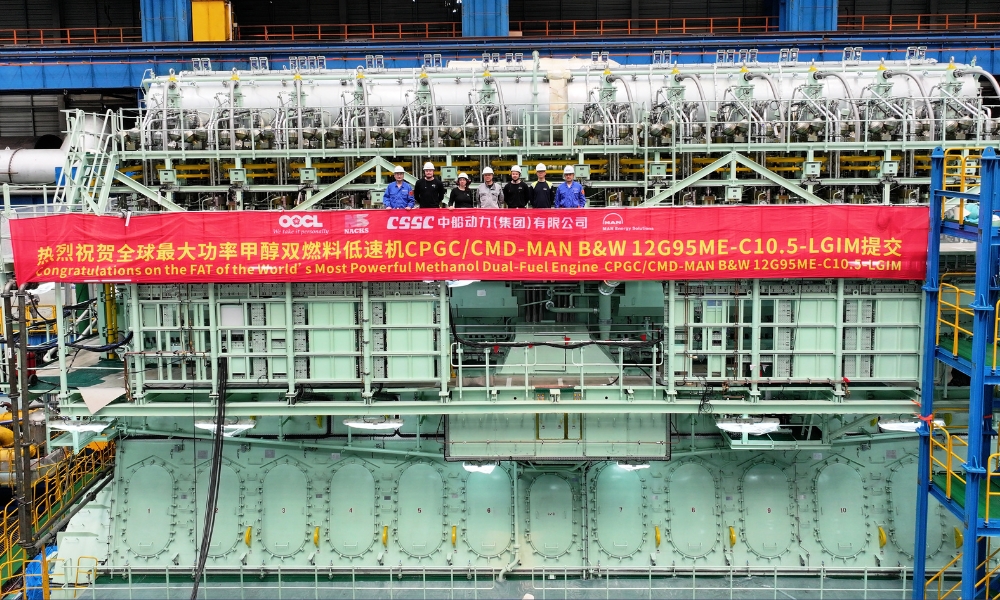
MAN Energy Solutions (MAN ES) recently announced that it will deliver the world’s most powerful two-stroke methanol engine in June.
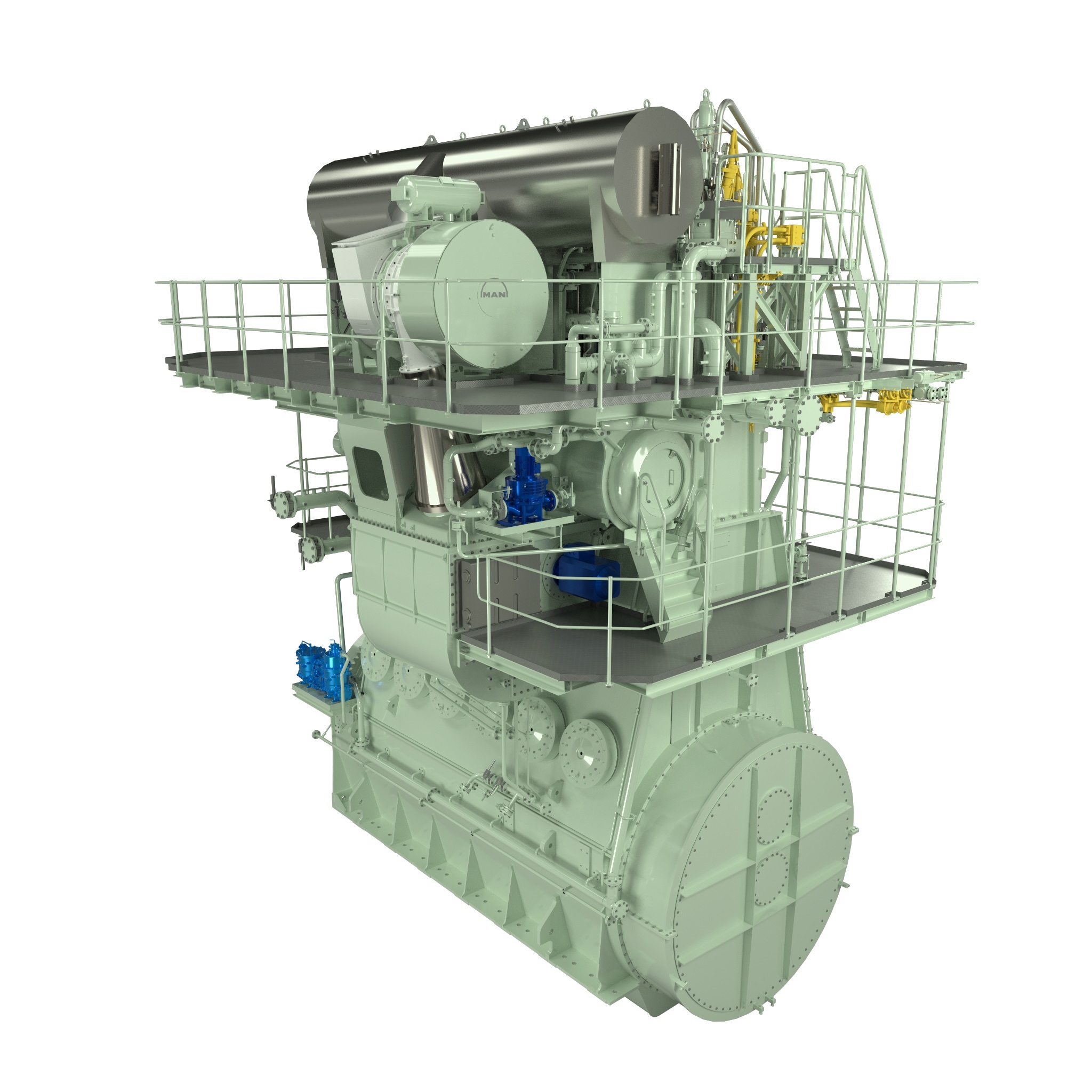
The engine, an MAN B&W 12G95ME-C10.5-LGIM (-Liquid Gas Injection Methanol) type rated at 82,440 kW at 80rpm, is currently being built by Chinese licensee, CSSC-MES Diesel Co., Ltd. (CMD).
The engine is the first of 12 bound for a series of 12 × 24,000 TEU container vessels currently under construction: seven at Nantong COSCO KHI Ship Engineering (NACKS) for shipowner Orient Overseas Container Line (OOCL); and five at Dalian COSCO KHI Ship Engineering (DACKS) for shipowner, COSCO Shipping Lines.
Each engine will also feature MAN Energy Solutions’ proprietary EGRTC (Exhaust Gas Recirculation Turbocharger Cut-out) emissions system, the largest two-string EGR system on a two-stroke engine to date.
Bjarne Foldager – Head of Two-Stroke Business – MAN Energy Solutions, said: “At MAN Energy Solutions, our vision of ‘Moving Big Things to Zero’ motivates everything we do in developing the engine technology to operate on those fuels vying for prominence in the future market.”
“This latest, remarkable milestone – the world’s most powerful methanol engine – is just the latest fulfilment of that. By harnessing the potential of methanol, we are bringing the maritime industry closer to zero-emission solutions and we fully expect methanol to figure prominently as a future-fuel across all segments.”
“Our thanks go to CMD, OOCL and COSCO Shipping, valued partners with whom we continue to share so many highlights.”
Christian Ludwig – Head of Two-Stroke Sales and Promotion – MAN Energy Solutions, said: “As we move towards a multi-fuel future, interest in methanol has grown steadily. To date, between newbuild engines and retrofits, we have won over 230 ME-LGIM references that have accumulated over 600,000 hours running on methanol alone.”
“With ME-LGIM technology reaching 10 years in the market, it represents mature, proven technology and reflects MAN Energy Solutions’ ability to develop attractive technology to enable shipping’s carbon transition.”
“Furthermore, while methanol produced from renewable sources is an attractive marine-fuel option due to its low carbon-intensity, an engine using green methanol can even provide carbon-neutral propulsion – adding to the benefits the ME-LGIM brings to the table.”
MAN Energy Solutions developed the ME-LGIM dual-fuel engine for operation on methanol, as well as conventional fuel. The engine is based on the company’s proven ME-series, with its approximately 8,500 engines in service, and works according to the Diesel principle. When operating on green methanol, the engine offers carbon-neutral propulsion for large merchant-marine vessels.
Photo credit: MAN Energy Solutions
Published: 26 May, 2025
Alternative Fuels
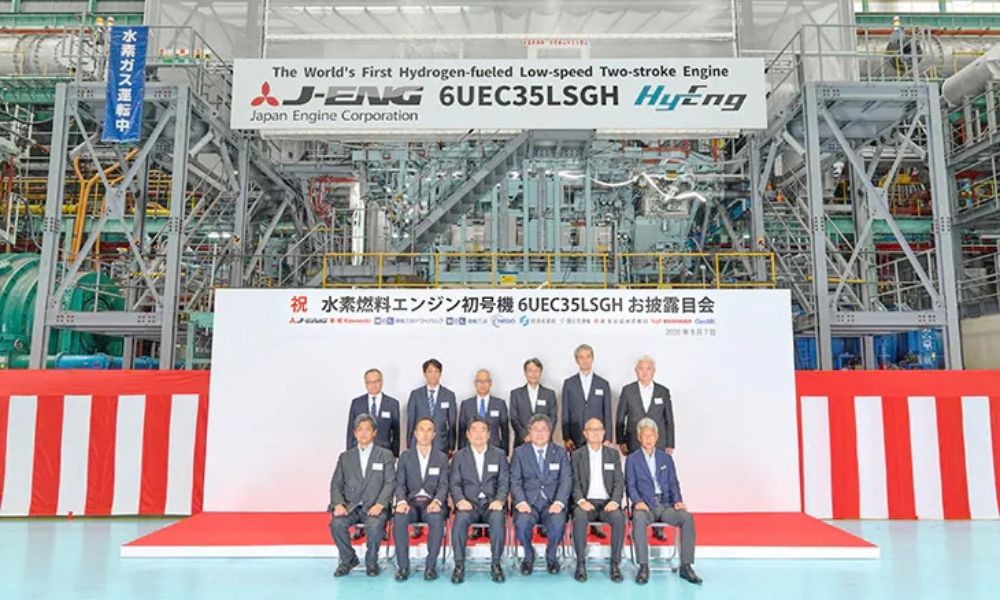
J-ENG completes land-based testing of hydrogen-fuelled marine engine
Engine will be installed on a 17,500 DWT multipurpose vessel to be built by Onomichi Dockyard for MOL and MOL Drybulk, with onboard demonstration testing scheduled to begin in April 2028.
Alternative Fuels
GCMD, BCG: Engine choices today to shape shipping’s fuel pathways through 2050
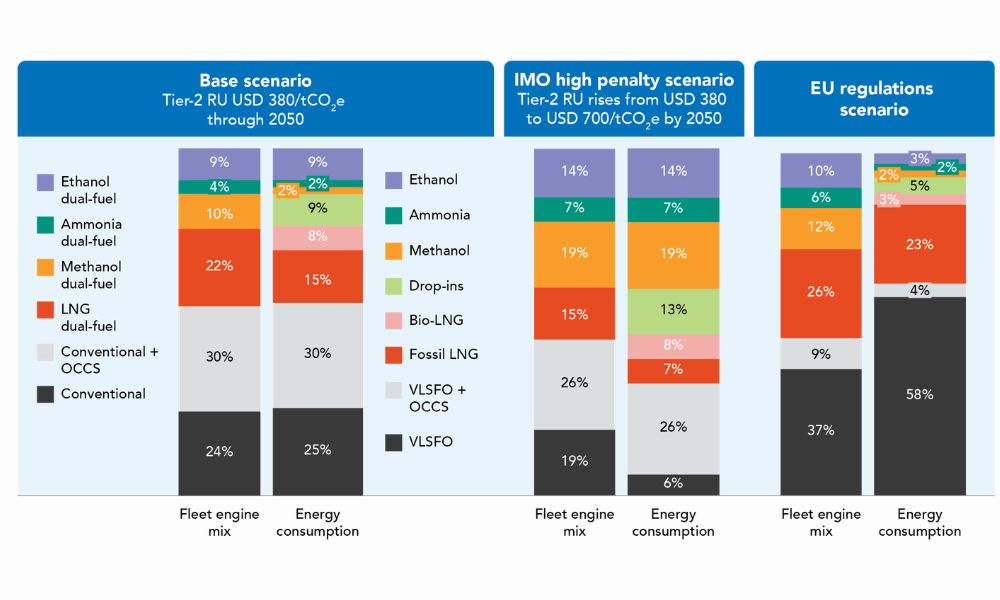
New fuels could reach around 60% of fleet energy consumption under a sufficiently strong carbon price signal, modelled at USD 700/tCO2e by 2050.
With vessels operating for 25 to 30 years and only around 4% of the fleet renewed annually, newbuild decisions made over the coming decade will establish much of the engine capacity available in 2050, Global Centre for Maritime Decarbonisation said on Thursday (17 September).
Yet having the capacity to consume a new fuel does not guarantee its uptake. Dual-fuel engines allow shipowners to switch between conventional fuels and the selected new fuel as economics and regulations evolve; continued fuel competitiveness is therefore critical to what vessels ultimately consume.
These are among the findings of Navigating the maritime fuel transition: How fuel economics, regulations, and fleet decisions shape the future bunkering landscape, based on a model jointly developed by the GCMD and Boston Consulting Group (BCG).
The model illustrates this dynamic in its base scenario. With the Tier-2 penalty under the IMO Net-Zero Framework held at USD 380/tCO2e through 2050, methanol dual-fuel engines account for around 10% of fleet engine capacity in 2050, but methanol represents just 2% of fleet energy consumption. With conventional fuels remaining more economical under this regulatory regime, methanol dual-fuel vessels continue to operate on fuels cheaper than methanol (Figure 1).
A global carbon price of USD 700/tCO2e materially changes the transition
The base scenario demonstrates how fuel economics can limit uptake even when vessels have the capacity to use new fuels. This picture changes if the IMO Tier-2 penalty rises to USD 700/tCO2e by 2050, at which point new fuels, including dropins, reach approximately 61% of fleet energy consumption (Figure 1).
By contrast, EU regulations alone will not drive a marked global shift, as they cover only around 20% of international shipping’s energy demand.
Overall cost of using e-methanol and e-ammonia is near parity
While a stronger global carbon price can accelerate the shift towards new fuels, the model does not point to a clear cost winner between e-methanol and e-ammonia.
E-ammonia’s production cost advantage is largely offset by higher logistics costs arising from its toxicity, including specialised crew training, larger exclusion zones, and more complex bunkering. As a result, the overall cost (Figure 2) of using e-ammonia and e-methanol is near parity through to 2050.
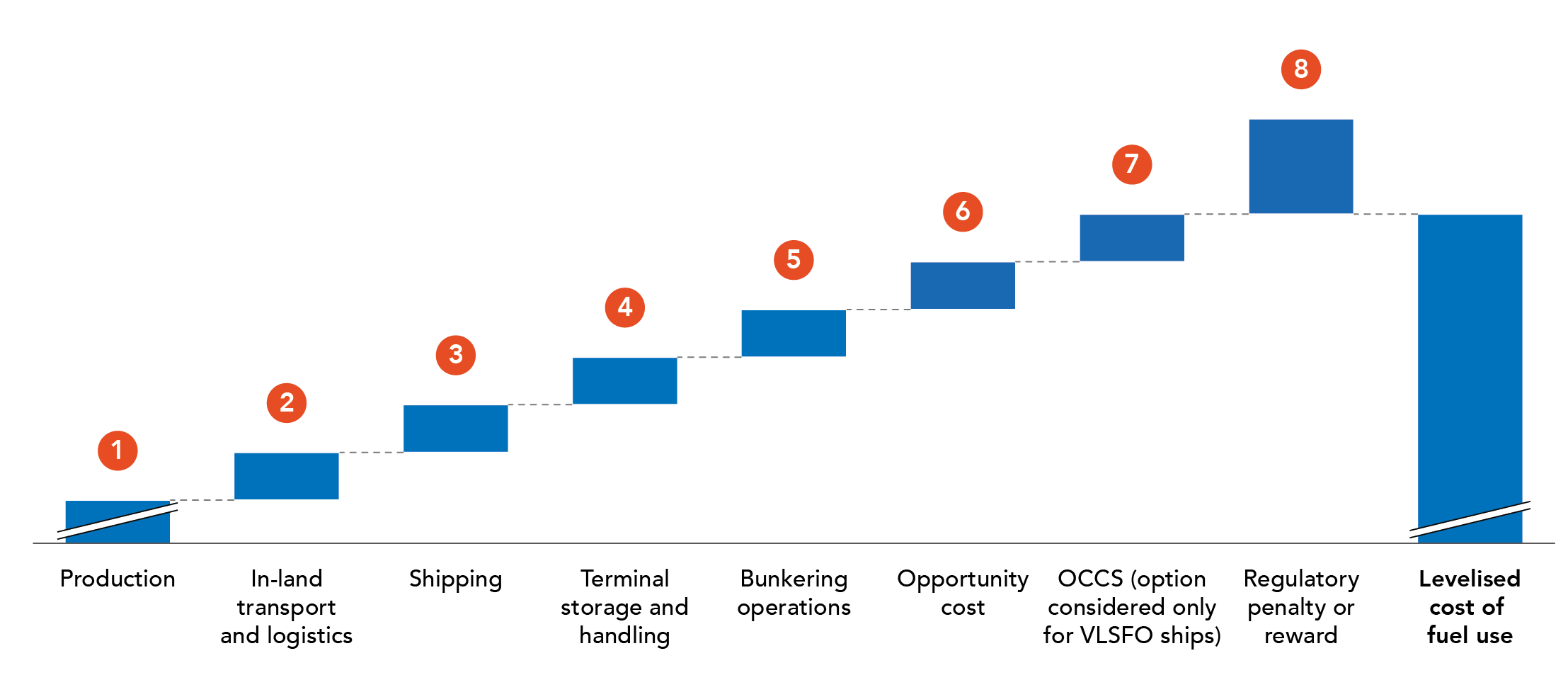
Professor Lynn Loo, CEO of GCMD, said: “Many vessels ordered over the coming decade will still be operating in 2050. Shipowners are therefore making long-lived engine choices before the relative economics of future fuels are clear.
“Our modelling puts into perspective just how difficult closing the cost gap between new and conventional fuels will be. The carbon price required to close this gap is substantial. And achieving it will be particularly challenging in today’s geopolitical environment. Understanding the signposts that could change these economics will be critical to the decisions the industry makes today.”
Anand Veeraraghavan, Managing Director & Senior Partner at BCG, said: “The maritime fuel transition is being shaped as much by policy and cost uncertainty as by technology readiness.
“Rather than offer a single prediction, our approach with GCMD maps how sensitive each fuel pathway’s competitive position is to a handful of critical variables — policy scenarios, key cost drivers, and potential restrictions. Our hope is that this gives shipowners, fuel suppliers, port operators, and infrastructure investors a practical tool to stress-test their own fuel strategies as conditions change.”
Photo credit: Global Centre for Maritime Decarbonisation
Published: 18 September, 2026
Engine
Polaris Shipping orders WinGD engines capable of running on methanol, ethanol
Ability to operate on either fuel gives Polaris Shipping greater flexibility to respond to changes in fuel availability, pricing and regulatory requirements over the vessels’ operating lives.


OUR INDUSTRY PARTNERS

Shell Singapore charged over Pulau Bukom oil leaks, reporting delays

MPA probes Singapore Strait collision involving fishing vessel, bulk carrier

TFG Marine deploys first MFM-equipped bunker barge in Jamaica

Seascale Energy names Gaetan Perret co-CEO as Olivier Josse prepares to retire

DNV: New research shows how regulation could reshape shipping

Stena Line orders two new hybrid ferries for Sweden – Denmark route

ENGINE: Americas Bunker Fuel Availability Outlook (24 Sep 2026)

Singapore: Marine fuel testing firm CCIC Singapore faces winding up application

High Court of Singapore issues winding up order against Hengli Petrochemical International

APPEC 2026: Digitalisation in bunkering not merely a ‘paper-to-screen’ swap, states panellists

APPEC 2026: Panellists navigate maritime decarbonisation and alternative marine fuel strategies

LDA’s methanol-powered “Spirit of Toulouse” gets Norsepower rotor sail in Shanghai

Goldwind green methanol facility completes trial production, ships first 500 mt

Singapore: Bunker fuel sales down by 4% on year in August 2026
-
 Winding up2 weeks ago
Singapore: Marine fuel testing firm CCIC Singapore faces winding up application
-
 Winding up2 weeks ago
High Court of Singapore issues winding up order against Hengli Petrochemical International
-
 Technology2 weeks ago
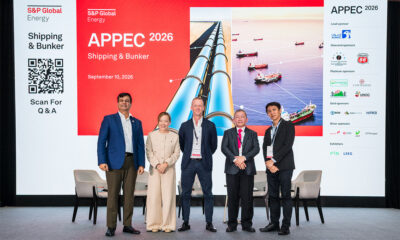
APPEC 2026: Digitalisation in bunkering not merely a ‘paper-to-screen’ swap, states panellists
-
 Alternative Fuels2 weeks ago
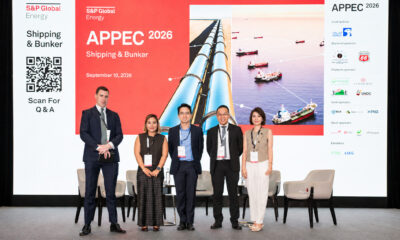
APPEC 2026: Panellists navigate maritime decarbonisation and alternative marine fuel strategies
-
 Wind-assisted2 weeks ago
LDA’s methanol-powered “Spirit of Toulouse” gets Norsepower rotor sail in Shanghai
-
 Methanol2 weeks ago
Goldwind green methanol facility completes trial production, ships first 500 mt
-
 Alternative Fuels2 weeks ago
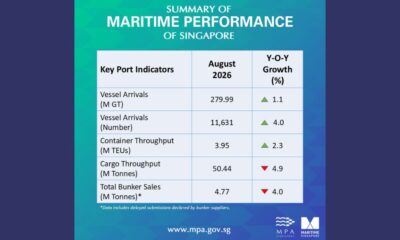
Singapore: Bunker fuel sales down by 4% on year in August 2026
-
 Bunker Fuel2 weeks ago
APPEC 2026: Equatorial and Kuwait Petroleum Corporation discuss Middle East bunker market dynamics