Connect with us
DNV Decarbonization Insight Series August 2026 - What maritime professionals should know about AI Training

Alternative Fuels

ABS and partners launch hydrogen fuel cell harbour craft pilot study in Singapore

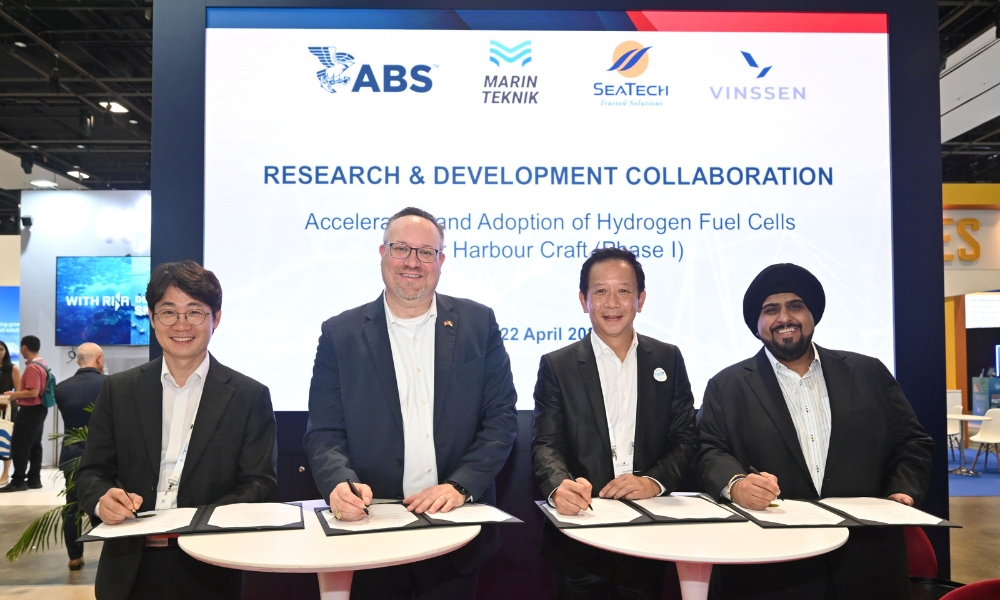
ABS, Marinteknik Shipbuilders, SeaTech Solutions International, and VINSSEN signed a research collaboration agreement to advance the development of a hydrogen fuel cell-powered harbour craft.

Admin

Published

on

ABS and partners launch hydrogen fuel cell harbour craft pilot study in Singapore

Classification society ABS recently said it signed a research collaboration agreement with Marinteknik Shipbuilders (S) Pte Ltd, SeaTech Solutions International (S) Pte Ltd, and VINSSEN to advance the development of a hydrogen fuel cell-powered harbour craft in Singapore.

The agreement brings together complementary expertise across vessel ownership, ship design, fuel cell propulsion and marine technology to advance hydrogen as a viable marine fuel for harbour operations.

Patrick Ryan, ABS Senior Vice President and Chief Technology Officer, said: “ABS is uniquely positioned to support this promising pilot. Our Singapore office is one of our largest, reflecting years of investment to deliver advanced technology and engineering services and survey operations in the Pacific. 

“This concentration of capability in Singapore makes ABS a true innovation teammate for a project of this ambition. We look forward to working with Marinteknik, SeaTech, VINSSEN and the MPA to help prove out hydrogen fuel cell technology as a viable pathway for harbour craft and the broader maritime industry,” said 

Ng Yi Han, Senior Director, Innovation, Technology and Talent Development/Chief Transformation Officer, Maritime and Port Authority of Singapore, said: “The Port of Singapore is home to about 1,600 harbour craft. Decarbonising the fleet requires solutions that can meet different vessel types and operating profiles. MPA is working with ABS and industry partners to develop and pilot new technologies under this project. 

“These efforts will build capabilities and support the adoption of practical, lower-emission solutions across the sector.”

In phase one, the consortium will conduct desktop studies covering the feasibility of implementing hydrogen-powered harbour craft in Singapore, including vessel concept design, design evaluation and optimization, techno-economic analysis, risk assessment and mitigation and commercial viability for broader adoption. Depending on the outcomes from phase one, a second phase could include construction and sea trials of the vessel.  

“Having delivered two fully electric harbour crafts, Marinteknik is thrilled to embark on this milestone project: the first hydrogen-powered vessel for the Singapore maritime sector. We are conducting in-depth studies with local harbour craft operators, analysing their specific operating profiles and requirements so that we can tailor our vessel’s design to meet the practical, real-world demands of the industry,” said Alex Wong, General Manager of Marinteknik.

ABS’ Singapore office is home to the global ABS Electrification Center to support and explore battery and hybrid sources of energy, as well as the ABS Singapore Innovation and Research Center. 


Photo credit: ABS
Published: 29 April, 2026

Continue Reading

LNG Bunkering

Singapore: Equatorial Marine Fuel among eight selected for new LNG bunkering licences

Other recipients include Aramco Trading Singapore, ExxonMobil Asia Pacific, PetroChina International (Singapore), Shell Eastern Trading, Vitol Bunkers (S) and Sinopec Fuel Oil (Singapore).

Admin

Published

on

By

RESIZED bunker tanker singapore

The Maritime and Port Authority of Singapore (MPA) on Thursday (30 July) said it will issue eight new licences to supply liquefied natural gas (LNG) as a marine fuel in Singapore from 1 September.

MPA said the new licences will expand Singapore’s LNG bunkering capacity, strengthen the supporting ecosystem to meet growing demand for LNG bunkering services, and support Singapore’s continued development as a multi-fuel bunkering hub. 

The licences will be awarded to Aramco Trading Singapore, Equatorial Marine Fuel Management Services, ExxonMobil Asia Pacific, PetroChina International (Singapore), Shell Eastern Trading, Sinopec Fuel Oil (Singapore), TotalEnergies Gas & Power Asia (TEGPA)-Sembcorp Fuels (Singapore) Joint Venture, and Vitol Bunkers (S).

“The eight successful applicants were selected following an evaluation of their supply capabilities, commercial plans, operational experience, and safety standards,” MPA said in a statement.

The evaluation also considered their capabilities to monitor and mitigate methane slip and support the supply of methane-based alternatives with lower lifecycle greenhouse gas emissions, including liquefied bio-methane and e-methane.

The licences will be valid for five years, from 1 September 2026 to 31 August 2031, subject to licensees continuing to meet the relevant licensing conditions. Licensees are required to provide end-to-end LNG bunkering services, including fuel supply, storage, cargo transfer and delivery to vessels. 

The issuance of these licences concludes the Call for Applications launched on 14 January.

To further strengthen safe and reliable LNG bunkering operations, MPA and Enterprise Singapore, through the Singapore Standards Council, will upgrade the existing Technical Reference for LNG Bunkering (TR56) into a Singapore Standard (SS) in August 2026. 

“The new SS will strengthen safety requirements, bunkering procedures, custody transfer and crew competencies, and serve as a common industry reference for LNG bunkering operations in Singapore,” MPA added.

“The SS will enhance Singapore’s LNG bunkering ecosystem and reinforce Singapore’s position as a trusted bunkering hub.”

Related: Singapore: MPA invites applications for new LNG bunkering licences


Photo credit: Manifold Times
Published: 31 July, 2026

Continue Reading

Biofuel

Brazil launches public consultation on biofuel bunkering rules overhaul

Law firm Mayer Brown says Brazil’s ANP has launched a 45-day public consultation on proposed revisions to the country’s marine fuel specifications, paving the way for routine use of up to 100% biofuel.

Admin

Published

on

By

Jeff Doria on Unsplash

Law firm Mayer Brown on Tuesday (28 July) said Brazil’s National Agency of Petroleum, Natural Gas and Biofuels (ANP) has launched a 45-day public consultation on proposed revisions to the country’s marine fuel specifications, paving the way for routine use of up to 100% biofuel (B100) in vessels while streamlining biofuel blending requirements

On July 27, 2026, Brazil’s National Agency of Petroleum, Natural Gas and Biofuels (“ANP”) published Public Consultation and Hearing Notice No. 15/2026, for the review of ANP Resolution No. 903/2022, which establishes the specifications for waterborne fuels marketed in Brazilian territory (marine diesel oil and marine fuel oil).

The purpose is to incorporate biofuels and renewable fuels into Brazilian waterborne transport, in the context of the energy transition and the International Maritime Organization’s (“IMO”) international decarbonization targets.

The proposal (i) aligns national specifications with ISO 8217/2024; and (ii) is encouraged by the progress of IMO discussions on carbon pricing and incentives for new fuels.

In terms of market context, operations involving the use of biofuels in Brazilian waterborne transport already exist, such that harmonizing national rules with ISO 8217 and the MARPOL Convention will standardize the regulatory treatment applicable to these operations.

The main changes proposed in the draft resolution are as follows.

  • The specification tables for waterborne fuels will be restructured, including classes for fuels containing biodiesel.
  • Limits and test methods from ISO 8217/2024 will be selectively incorporated, on a partial basis, in line with Brazilian market realities.
  • Biodiesel content of up to 100% (“B100”) for regular use in vessels (no longer as an exception), which could be sold directly to the end user.
  • Green diesel (“HVO”) and synthetic/GTL (Gas-to-Liquids) fuels will be treated as “drop-in” components, meaning chemically similar to fossil fuels and capable of replacing them without requiring engine or infrastructure adaptation.
  • Agents authorized to carry out biofuel blending will be defined, which eliminates the requirement for prior ANP authorization to use blends, replacing it with a simple notification to the Agency.
  • Quality control, document traceability, sampling, certification, and fuel identification rules will be improved, in line with the MARPOL Convention.
  • Prior experimental authorization from ANP will be provided for alternative fuels not covered by ISO 8217 (ethanol, methanol, ammonia, and hydrogen).
  • A prior authorization regime will be established for liquefied natural gas (“LNG”), without an experimental character, given the existence of well-established technical standards and the early stage of Brazil’s national LNG transport and supply infrastructure.

The public consultation will run for 45 days, from July 28 to September 10, 2026. On September 23, 2026, a public hearing will be held to discuss the matter with civil society and regulated agents.


Photo credit: Jeff Doria on Unsplash
Published: 31 July, 2026

Continue Reading

Ammonia

New report calls for standardised approach to Safe Havens on ammonia-fuelled ships

The Decarb Hub report identifies an opportunity to build a shared, evidence-based approach to Safe Havens as the industry applies new regulatory requirements to ammonia-fuelled vessels.

Admin

Published

on

By

RESIZED william william on Unsplash

Lloyd’s Register Maritime Decarbonisation Hub (The Decarb Hub) on Thursday (30 July) called for a standardised approach to the design and assessment of Safe Havens on ammonia-fuelled vessels, highlighting that inconsistent interpretations of emerging regulatory requirements could result in differing safety outcomes across the future ammonia fleet.

This is set out in a new report, ‘Safe Havens for ammonia-fuelled ships’, which examines how the maritime sector can apply lessons from offshore oil and gas, chemical processing and other safety-critical industries to address a new requirement introduced under the International Maritime Organization’s (IMO) Interim Guidelines for the Safety of Ships using Ammonia as Fuel. The new guidelines now require vessels to incorporate Safe Havens to protect crew in the event of an ammonia release.

However, the report highlights that, as is often the case with interim, goal-based guidance for a new safety concept, the guidelines set high-level requirements that leave room for differing interpretations of what makes an effective Safe Haven. It proposes a shared framework to help vessel designers, operators, classification societies and flag administrations apply these requirements consistently as ammonia-fuelled vessels enter service.

The Decarb’s Hub research found that Safe Havens should not be viewed as standalone spaces designed solely to prevent ammonia exposure. Instead, they should be treated as human-centred systems that form part of a vessel’s wider emergency response strategy.

The report identifies three core functions that every maritime Safe Haven should provide: protection, command and control, and accessibility. Together they are intended to ensure that all crew remain protected from ammonia and other hazards, while enabling the execution of the vessel’s emergency response plan.

Drawing on established practices from industries that routinely manage toxic gas hazards, the report recommends that Safe Haven performance is assessed against realistic worst-case scenarios. It also highlights the importance of calculating Safe Haven endurance periods, assessing accessibility, regular testing and maintenance and human factors considerations to ensure systems continue to perform as intended throughout a vessel’s operational life.

The report concludes that the industry should focus on developing standardised methods for demonstrating Safe Haven performance. Establishing a consistent basis for assessment will help ensure Safe Havens deliver the intended level of protection across the future ammonia-fuelled fleet while supporting regulatory certainty and long-term operational confidence.

Jonathan Bolton, Decarbonisation Risk Analyst at the Lloyd’s Register Maritime Decarbonisation Hub, said: “Ammonia has the potential to play an important role in shipping’s decarbonisation journey, but its adoption must be supported by safety solutions that are robust, practical and consistently applied. Safe Havens are a new requirement for ammonia-fuelled ships and as with any new safety concept, the industry needs practical guidance to build a shared understanding of how Safe Havens should be designed and assessed.

“Our report brings together decades of experience from industries that have long managed toxic gas risks and translates those lessons into a maritime context. By identifying the critical functions that Safe Havens must perform and proposing a common framework for their assessment, we hope to support designers, operators, classification societies and regulators as they work towards the safe deployment of ammonia-fuelled vessels.”

The findings are intended to support shipowners, designers, regulators and classification societies as they develop the first generation of ammonia-fuelled vessels and contribute to the long-term evolution of international regulations governing ammonia safety. 

Note: A copy of the report can be downloaded at Safe Havens for ammonia-fuelled ships. 


Photo credit: william william on Unsplash
Published: 31 July, 2026

Continue Reading

Trending