Connect with us
DNV Decarbonization Insight Series August 2026 - What maritime professionals should know about AI Training

Milestone

Singapore: Equatorial conducts its first bio-blended LSMGO bunker fuel delivery of 2025

Several key challenges including product sourcing, sustainability certification, product handling, and logistics & planning had to be addressed to execute the complex operation, notes COO of Equatorial.

Admin

Published

on

Singapore: Equatorial conducts its first bio-blended LSMGO bunker fuel delivery of 2025

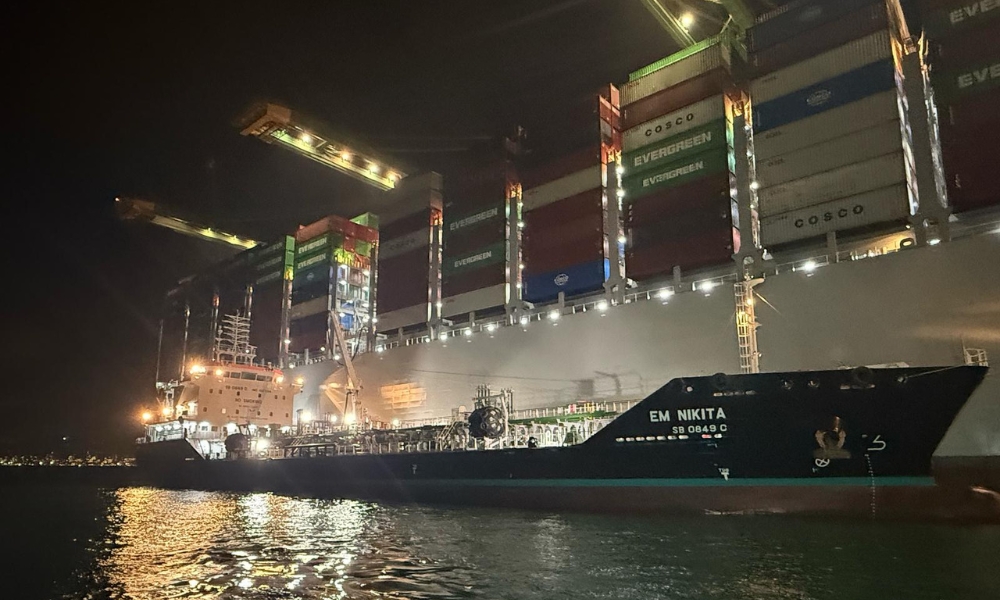
Singapore bunker supplier Equatorial Marine Fuel Management Services Pte Ltd (Equatorial) in early May carried out its first bio-blended B24 Low Sulphur Marine Gas Oil (LSMGO) bunker fuel delivery of 2025.

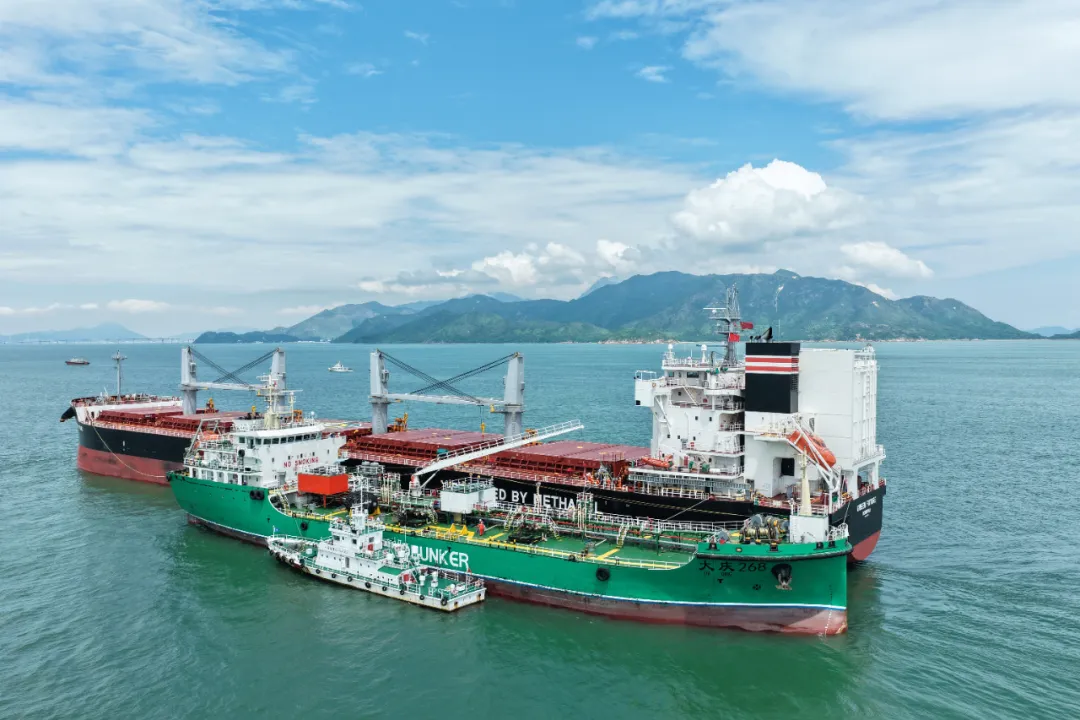
The milestone saw Equatorial’s Singapore-flagged 7,999 dwt IMO Type II bunker tanker EM Nikita delivering Used Cooking Oil Methyl Ester (UCOME) based LSMGO, blended to B24 spec, to an Orient Overseas Container Line (OOCL) operated vessel with its electronic bunker delivery note (eBDN).

“This milestone represents not just Equatorial’s first B24 LSMGO delivery, but also a significant step forward for sustainable marine fuel adoption in Singapore,” Choong Sheen Mao, Chief Operating Officer at Equatorial, told Manifold Times.

“It showcases our capability to evolve alongside the market and our commitment to providing certified, traceable, and high-quality biofuels to our customers.”

According to So Kah Meng, Sustainable Energy Manager at Equatorial, several key challenges including product sourcing, sustainability certification, product handling, and logistics & planning had to be addressed to execute the complex operation.

“Bio-blended LSMGO is significantly rarer in the market than bio-blended VLSFO due to limited production capacity, stricter blending requirements, and limited downstream demand. Equatorial secured supply through advanced procurement planning and leveraging trusted ISCC-certified upstream partners,” he explained.

“ISCC EU certification was essential to ensure traceability and regulatory compliance. Equatorial worked closely with its supply chain to ensure full documentation and sustainability verification ahead of the delivery schedule.

“Unlike bio-VLSFO, bio-blended LSMGO’s lower viscosity and pour point demanded additional considerations in tank pre-treatment and temperature control during transfer. Equatorial implemented specialised cleaning protocols and temperature monitoring to maintain fuel integrity.

“Coordination between our UCOME supplier, storage facility, barge planning, and receiving vessel was critical. Equatorial’s in-house technical and commercial teams worked closely with the Maritime and Port Authority of Singapore (MPA) and classification societies to ensure regulatory compliance and operational safety.”

Moving forward, Patrick Ng, Assistant Marketing Manager at Equatorial, believed the milestone operation was made possible by the favourable commercial maritime landscape under the supervision of MPA.

“Singapore’s strong regulatory framework, established bunkering infrastructure, and growing customer interest in low-carbon fuels have made it possible for projects like this to be commercially viable,” he stated.

“Equatorial is proud to contribute to Singapore’s decarbonisation leadership.”

Related: Singapore: President of Equatorial Marine Fuel Management Services receives ‘Industry Icon Award’
Related
: Singapore: Equatorial Marine Fuel launches sustainable energy business unit, commits towards multi-fuel future
Related: Singapore: Equatorial Marine Fuel conducts carbon credit trial with Carbon Management Solutions
Related: Singapore-registered bunker tankers can transport up to B30 biofuels from 7 March


Photo credit: Equatorial Marine Fuel Management Services
Published: 20 May 2025

Continue Reading

LNG Bunkering

Shanghai Port surpasses 2 million m³ LNG bunkering milestone with PIL vessel

Achievement was reached on 25 July when PIL’s “Kota Eagle” vessel received 4,549 m3 of LNG marine fuel from SIPG Energy’s LNG bunkering vessel at the Lvhuashan Anchorage off the coast of Shanghai.

Admin

Published

on

By

Shanghai Port surpasses 2 million m³ LNG bunkering milestone with PIL vessel

Shanghai Port has surpassed 2 million cubic metres (m³) of cumulative LNG bunkering volume, with Pacific International Lines’ (PIL) Kota Eagle participating in the milestone operation, the Singapore-based container operator said on Monday (3 August). 

The company said the achievement was reached on 25 July when PIL’s Kota Eagle vessel received 4,549 m3 of LNG marine fuel from SIPG Energy’s LNG bunkering vessel at the Lvhuashan Anchorage off the coast of Shanghai, China.

“As part of our commitment to decarbonisation, PIL is modernising our fleet by investing in LNG dual-fuel vessels,” it said.

“Delivered in 2024, Kota Eagle is PIL’s first LNG dual-fuel container vessel, and it also completed its maiden LNG bunkering operation at Shanghai’s Yangshan Port. To date, we have taken delivery of nine LNG dual-fuel newbuild vessels.” 

PIL added that the landmark achievement by Shanghai Port reflects its rapidly growing bunkering capabilities, which provide the critical support needed for the efficient operation of our expanding fleet of greener vessels. 


Photo credit: Pacific International Lines
Published: 3 August, 2026

Continue Reading

LNG Bunkering

Seaspan Energy hits 150 LNG bunkering milestone in 18 months

Company is now ranked seventh globally by LNG bunkering volume, according to the latest LANSDOWNE Moritz rankings.

Admin

Published

on

By

Seaspan Energy to offer renewable LNG bunker fuel along West Coast

Canadian low-carbon marine fuel provider Seaspan Energy on Wednesday (29 July) said it has completed its 150th ship-to-ship LNG bunkering less than two years after launching operations.

The company is now ranked seventh globally by LNG bunkering volume, according to the latest LANSDOWNE Moritz rankings. LANSDOWNE Moritz is a boutique advisory business specialising in the energy industry, with specific focus on the natural gas, LNG and maritime sectors. 

Since completing its first ship-to-ship LNG bunkering at the Port of Long Beach in December 2024, Seaspan Energy has all three of their LNG bunker vessels operating on the West Coast and is now averaging 12 LNG bunkering operations per month. 

Working closely with key stakeholders to obtain all necessary authorisations, Seaspan Energy serves cruise ships, container ships, car carriers and tankers across the ports of Vancouver, Nanaimo, Royal Roads, Long Beach, and Seattle.

More than half of Seaspan Energy’s LNG bunkering operations have taken place in the Port of Vancouver, reinforcing the port’s position as a leading gateway for LNG-powered vessels and alternative marine fuels.

Seaspan Energy delivers made-in-BC LNG sourced from FortisBC’s Tilbury LNG facility to help meet the growing global demand for lower-emission marine fuels.

Harly Penner, President, Seaspan Energy, said: “Completing 150 LNG bunkering operations in just 18 months is an incredible achievement for our team. This milestone reflects the hard work and commitment of our vessel crews and shoreside staff, who have built a reputation for delivering safe, reliable LNG bunkering. I am incredibly proud of what we have accomplished together and grateful for the trust our global customers continue to place in our team.”

Gary Regan, Managing Consultant, LANSDOWNE Moritz, said: “Seaspan Energy has become one of the world’s leading LNG bunker suppliers in a relatively short period of time. The company is now ranked seventh globally by LNG bunkering volume according to our data and is well positioned for future growth given its access to dedicated SSLNG loading facilities and competitive value proposition.”


Photo credit: Seaspan Energy
Published: 30 July, 2026

Continue Reading

Milestone

GCMD: Project CAPTURED achieves two regulatory milestones for onboard captured CO2

CO2 captured onboard during the project has been formally recognised for compliance under the EU ETS while a proposal submitted to MEPC 84, based on the project, has received IMO’s in-principle support.

Admin

Published

on

By

RESIZED venti views

Global Centre for Maritime Decarbonisation (GCMD) on Wednesday (21 July) said Project CAPTURED has achieved two regulatory milestones that strengthen the commercial case for onboard carbon capture and storage (OCCS).

This comes following its world’s first demonstration of an end-to-end value chain for onboard captured and liquefied CO2 (LCO2).

Completed in June 2025, the pilot showed that CO2 captured onboard a vessel can be offloaded ship-to-ship, transported overland and permanently bound through carbon mineralisation—a process that converts captured CO₂ into stable materials for industrial use.

The CO2 captured onboard during Project CAPTURED has been formally recognised for compliance under the European Union Emissions Trading System (EU ETS). This means the verified tonnage of captured CO2 can be deducted from emissions requiring the surrender of EU Allowances (EUAs).

To qualify for this recognition, the CO2 must be chemically bound permanently in eligible products. Project CAPTURED demonstrated that CO2 captured onboard vessels can meet this requirement through carbon mineralisation.

The data and learnings from the same demonstration formed the basis of a proposal submitted to MEPC 84. This proposal received in-principle support from the International Maritime Organization (IMO) for recognising carbon mineralisation as a form of permanent CO₂ storage.

Complementing geological sequestration, which is already accepted by the IMO, this recognition broadens the downstream options for CO2 captured onboard vessels, and supports the development of maritime carbon value chains. Beyond providing a permanent storage pathway, carbon mineralisation also creates the potential for captured CO2 to serve not only as a waste stream requiring permanent storage, but also as a feedstock for industrial applications through carbon mineralisation, extending emissions reductions beyond the shipping value chain.

Professor Lynn Loo, CEO, GCMD, said, “Project CAPTURED has moved OCCS beyond technical demonstration. The acceptance of the EU ETS deduction gives captured CO₂ a compliance value. At the same time, IMO’s in-principle support for carbon mineralisation will help clarify how captured CO2 can be treated after it leaves the vessel. Together, these milestones turn a pilot into a verified reference case for maritime carbon logistics, one that links regulatory recognition, commercial value and emissions impact.”


Photo credit: Venti Views on Unsplash
Published: 22 July, 2026

Continue Reading

Trending