Connect with us

Alternative Fuels

DNV: Alternative-fuelled ship orders rebound in April after early-year lull

‘After a slow start to the year, it is encouraging to see an uptick in orders for alternative-fuelled vessels in April, says Jason Stefanatos, Global Decarbonization Director at DNV Maritime.

Admin

Published

on

DNV: Alternative-fuelled ship orders rebound in April after early-year lull

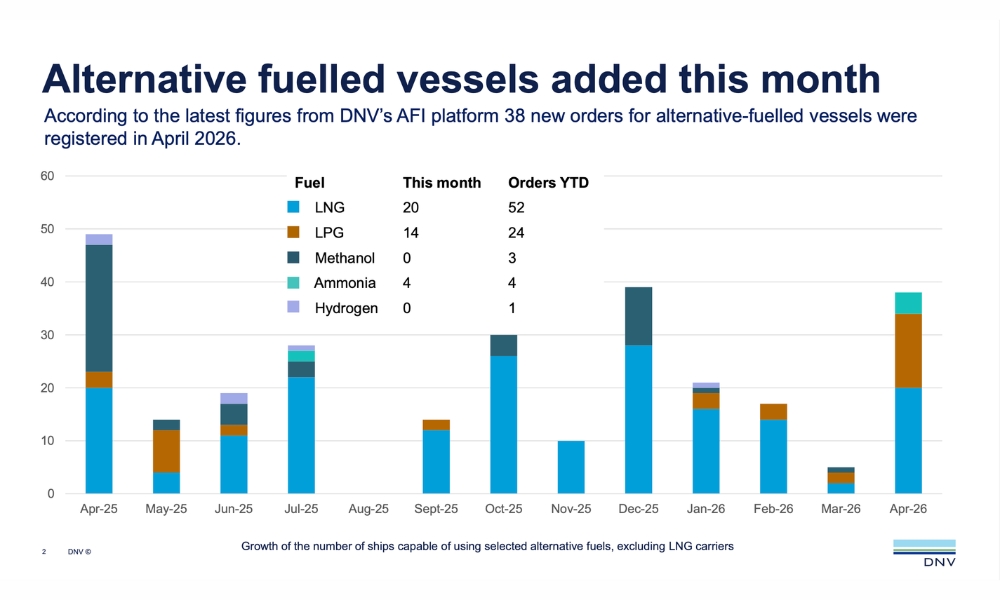
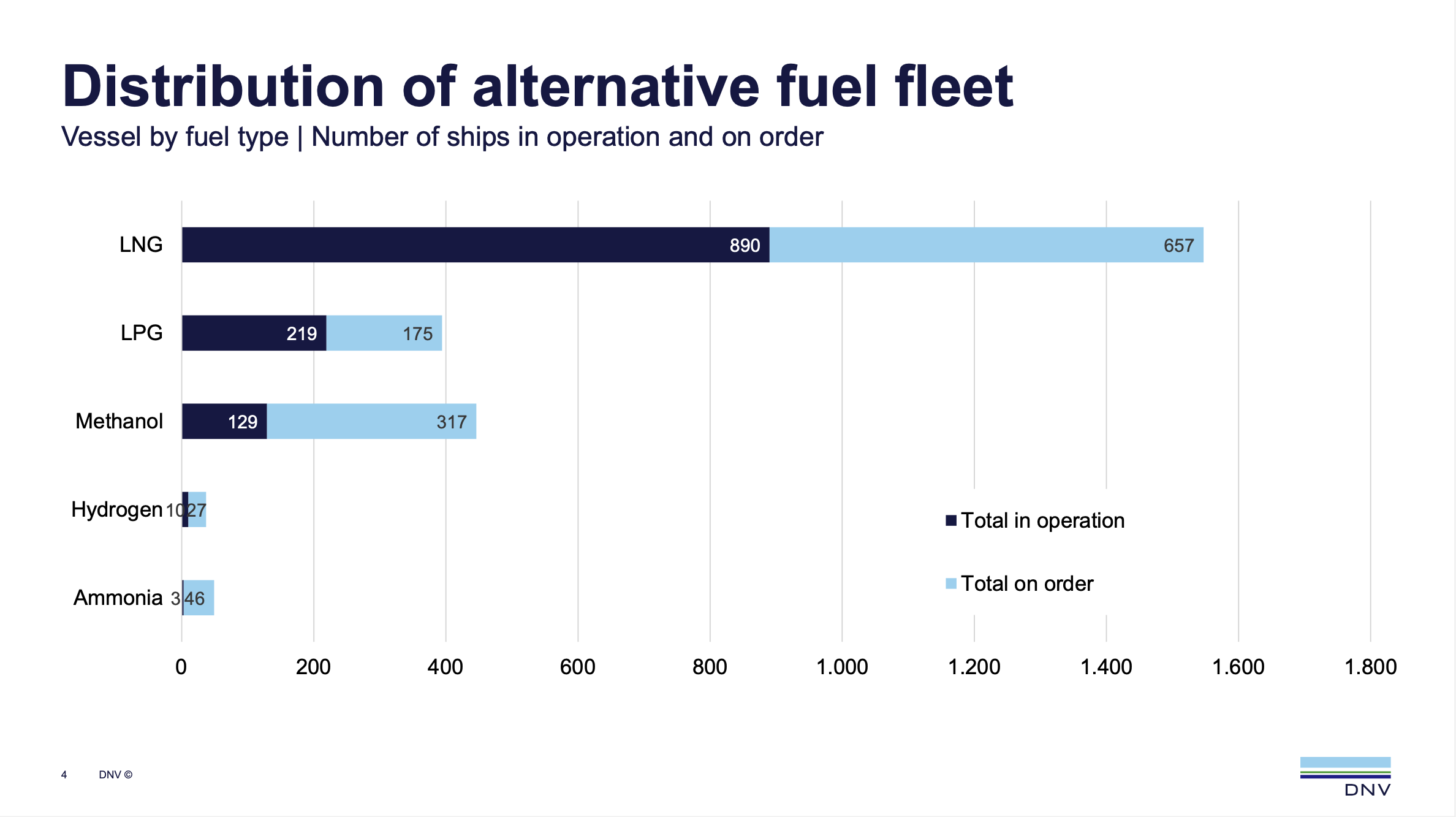
Latest data from classification society DNV’s Alternative Fuels Insight (AFI) platform showed a total of 38 new orders for alternative-fuelled vessels were placed in April 2026.

The majority of these orders (20) were for LNG-fuelled vessels. Eight of these were for vessels in the car carrier segment, six for container vessels, four for crude oil tankers, and two for cruise vessels. 

A further 14 orders were placed for LPG/ethane carriers.

The remaining four orders were for ammonia-fuelled vessels in the bulk carrier segment. A total of 83 orders for alternative-fuelled vessels have been ordered in the first four months of 2026.
DNV: Alternative-fuelled ship orders rebound in April after early-year lull

Jason Stefanatos, Global Decarbonization Director at DNV Maritime, said: “After a slow start to the year, it is encouraging to see an uptick in orders for alternative-fuelled vessels in April. While the broader trend towards LNG remains evident in the data, it is also interesting to see a wider spread among the segments this month, with notable uptake in the tanker and cruise segments.

“The ordering of four ammonia-fuelled vessels in the bulker segment also stands out. While ammonia is still at an early stage as a marine fuel, projects like this – and the operational experience gained from them – are essential for moving the industry from concept to capability and taking practical steps towards wider adoption.” 


Photo credit: DNV
Published: 6 May, 2026

Continue Reading

Bunker Fuel

Bunker One strengthens Aberdeen presence with dedicated bunker barge

Addition of this unit strengthens the company’s supply position in Aberdeen and provides customers with reliable access to MGO and biofuel blends through a dedicated physical presence in the harbour.

Admin

Published

on

By

Bunker One

Bunker Holding’s physical supply division, Bunker One, on Monday (22 June) said it has positioned a dedicated supply barge in the Port of Aberdeen’s South Harbour, with operations commencing in July 2026.

The company said the addition of this unit strengthens its supply position in Aberdeen and provides customers with reliable access to Marine Gas Oil (MGO) through a dedicated physical presence in the harbour.

“South Harbour continues to play an increasingly important role in regional maritime activity,” the company said.

“Establishing local supply capability enhances security of supply, increases operational flexibility, and enables a more responsive service for customers operating in the area.”

Bunker One added that this investment forms part of its ongoing strategy to strengthen physical supply capabilities across key locations and ensure dependable fuel availability where it matters most. 


Photo credit: Bunker One
Published: 23 June, 2026

Continue Reading

Alternative Fuels

Axpo completes its first ship-to-ship bio-LNG bunkering operation in Barcelona

MOL vehicle carrier “Lapis Ace” received bio-LNG from Axpo’s bunkering vessel “Green Pearl”, marking another milestone in the development of alternative marine fuels in Spain.

Admin

Published

on

By

Axpo completes its first ship-to-ship bio-LNG bunkering operation in Barcelona

Switzerland’s energy producer Axpo on Monday (22 June) said the company completed its first ship-to-ship bio liquefied natural gas (LNG) bunkering operation in the port of Barcelona. 

Mitsui OSK Lines’s (MOL) vehicle carrier Lapis Ace received bio-LNG from Axpo’s bunkering vessel Green Pearl, marking another milestone in the development of alternative marine fuels infrastructure and services in Spain. 

Reinforcing its commitment to supporting the maritime industry’s transition to lower-emission fuels, this latest ship-to-ship bio-LNG bunkering operation demonstrates Axpo’s expanding capability to serve leading shipping operators across major ports in Spain. 

Axpo’s Head of Small-Scale LNG Daniele Corti, said: “The refuelling operation with MOL in Barcelona represents another key moment for LNG adoption in Spain. We’re not only developing infrastructure. We’re proving that alternative marine fuels can be operationally reliable and cost-effective. 

“As demand for LNG and bio-LNG continues to increase, Axpo’s growing operations in Málaga, Algeciras and now Barcelona demonstrate that this is no longer a niche market. It is a critical stepping stone in the maritime industry’s transition to a lower-carbon future.”

Axpo has been selected to supply bio-LNG fuel to MOL across the Mediterranean, providing bunkering services at the Spanish ports of Málaga and Barcelona. The agreement expands Axpo’s role in lower-emission maritime transport and builds on its existing Western European supply partnership with MOL, which began in March 2025.

Axpo’s presence in Spanish ports has grown substantially over the past year. In April 2025, the company completed its first LNG delivery in Málaga, followed by successful operations in Algeciras and Sines (Portugal). 

These milestones were made possible by Axpo’s 7,500-cubic-metre small-scale LNG vessel Green Pearl, improving the speed, flexibility and efficiency of bunkering operations across the Mediterranean. Axpo currently also holds a licence to operate in the port of Valencia.

In Italy, Axpo conducted the country’s first ship-to-ship bio-LNG refuelling in December 2025. Shortly afterwards, in March 2026, the bunkering vessel Alisios LNG, chartered by Axpo, was launched at the port of Huelva in southwestern Spain. 

Axpo’s ten-year charter of the Green Pearl and ongoing expansion of its bio-LNG portfolio reflect the company’s belief that industry collaboration is essential to achieving global emissions targets. By partnering with leading shipping operators like MOL and MSC, Axpo is demonstrating how coordinated action can accelerate the maritime sector’s shift toward cleaner fuels.

Related: MOL inks bio-LNG bunker fuel supply deals with Titan and Axpo for car carriers in Europe


Photo credit: Daniele Corti
Published: 23 June, 2026

Continue Reading

Alternative Fuels

DNV: How low‑GHG methane can future‑proof LNG-capable vessels

DNV summarises key findings of its Methane in shipping paper, helping shipowners of LNG-capable vessels to meet stricter GHG reduction requirements, and optimise LNG‑based fuel strategies for future compliance.

Admin

Published

on

By

DNV: How low‑GHG methane can future‑proof LNG-capable vessels

Classification society DNV on Monday (22 June) published a Maritime Impact article, summarising the key findings of its Methane in shipping paper, helping shipowners of LNG-capable vessels to meet stricter GHG reduction requirements, and optimise LNG‑based fuel strategies for future compliance: 

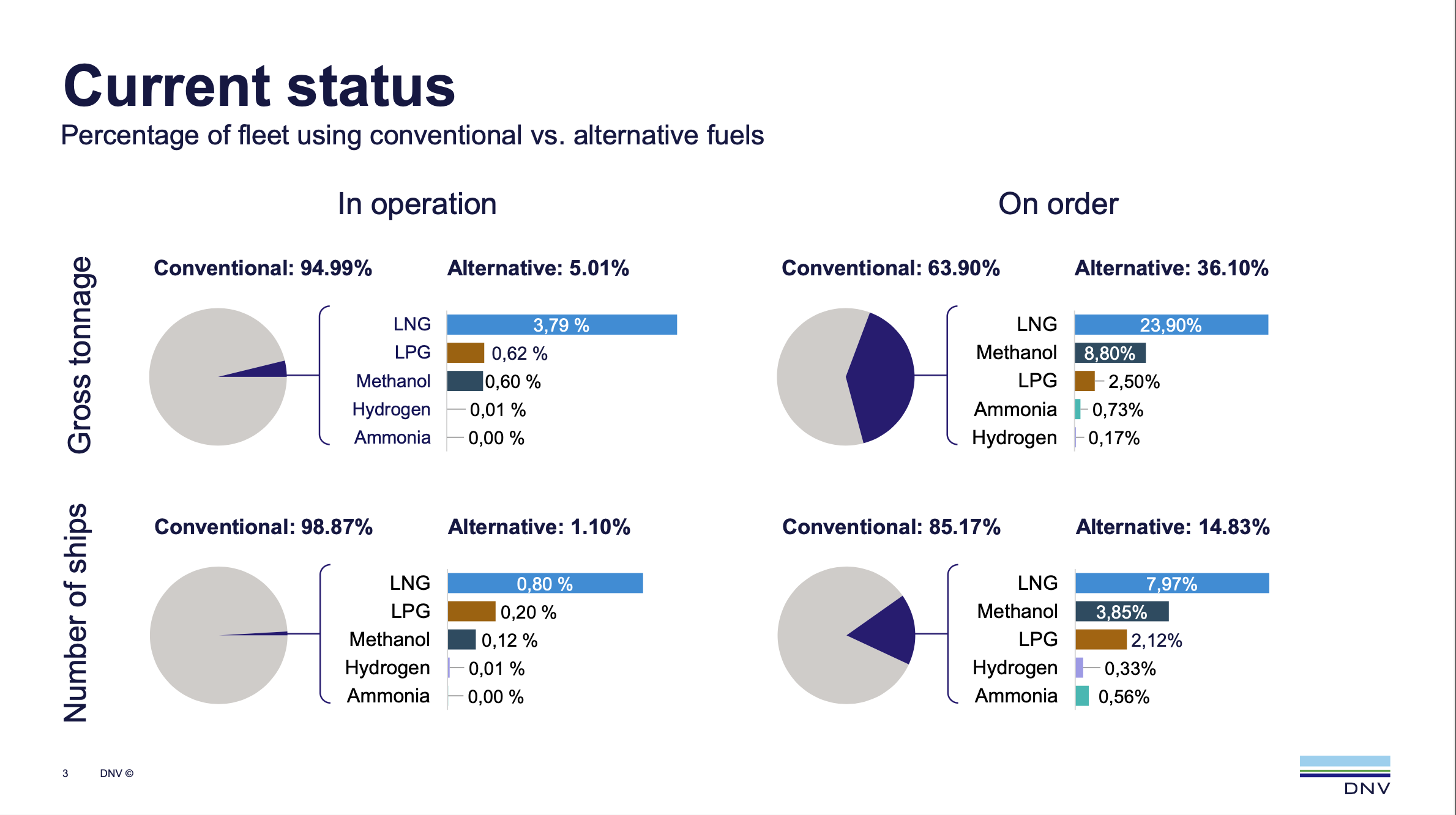
Excluding LNG carriers, more than 800 ships can run on LNG using mature, proven technology and established infrastructure, with over 600 more on order.

Under the FuelEU Maritime regulation, LNG‑capable ships can remain compliant on fossil LNG until around 2035, depending on engine configuration. Ships fitted with two‑stroke high‑pressure dual‑fuel engines can remain compliant longer than those using four‑stroke low‑pressure dual‑fuel engines, which are more common in cruise ships and RoPax vessels.

Extending LNG compliance with low-GHG options

DNV’s Methane in Shipping white paper indicates that a potential compliance pathway is the use of LNG-compatible low-GHG fuels. LNG ships are compatible with alternatives such as liquefied bio-methane and e-methane. With tightening GHG intensity requirements, these ships are thus well positioned to transition towards lower GHG emission fuels without major retrofits for these alternatives.

t1 ind 636 main drop in fuel options

“Bio-methane and e-methane can achieve very low, or even negative, life cycle emissions depending on how they are produced. LNG-fuelled vessels can progressively decarbonize by blending in or switching to these fuels,” explains Øyvind Sekkesæter, Senior Consultant at DNV and lead author of the paper.

Demand for low-GHG methane will grow with tightening regulations

According to demand projections outlined in the paper, compliance-driven low-GHG methane demand under FuelEU Maritime alone could reach 2–4 million tonnes by 2040, rising to as much as 40–95 million tonnes under the proposed IMO Net Zero Framework’s base target.

t2 ind 636 projected demand for low ghg methane

On the supply side, current production of low-GHG methane is limited, but still higher than many other low-GHG fuel alternatives. Global bio-methane production reached around 7 million tonnes in 2024 and is projected to increase to about 15 million tonnes by 2030. E-methane remains nascent, with only 0.01 million tonnes of operational capacity today, but announced projects could lift this to 0.9 million tonnes by 2030.

t3 ind 636 bio methane production in key markets

While there is significant potential to expand the global supply of low-GHG methane beyond today’s production levels, shipping will compete with other sectors for this supply. Most available supply is already absorbed by power generation and road transport, meaning access for shipping will largely depend on its willingness to pay relative to other users.

Note: The full DNV article can be read here

Related: DNV paper: Existing LNG bunkering infrastructure will ease transition to low‑GHG methane


Photo credit: FueLNG and DNV
Published: 23 June, 2026

Continue Reading

Trending