Connect with us

Alternative Fuels

DNV on IMO CCC 12: Revised guidelines for methanol as marine fuel

CCC 12 finalized the revision of the interim guidelines for use of methyl/ethyl alcohol as fuel while work continued on guidelines for low-flashpoint oil fuels and onboard carbon capture and storage systems.

Admin

Published

on

RESIZED Chris Pagan

Classification society DNV on Monday (21 September) highlighted progress made on several regulatory and technical matters at the 12th session of the IMO Sub-Committee on Carriage of Cargoes and Containers (CCC 12), held from 14 to 18 September. 

This includes alternative fuels, cargo securing, onboard carbon capture systems, and battery carriage: 

Amendments to the IGF Code and development of guidelines for alternative fuels and related technologies

Methyl/ethyl alcohols

CCC 12 finalized the revision of the Interim Guidelines for the Safety of Ships Using Methyl/Ethyl Alcohol as Fuel (MSC.1/Circ.1621). The amendments revise all sections of the existing guidelines, taking into account experience gained to date.

The revised guidelines:

  • provide more flexibility in fuel tank placement and leakage-handling arrangements;
  • introduce a new concept for ventilation of fuel spaces;
  • expand guidance on the design of bunkering stations and fire extinguishing; and
  • add new guidance on bunkering operations and personal protective equipment.

Low-flashpoint oil fuels

CCC 12 continued work on the interim guidelines for ships using low-flashpoint oil fuels (fuel with a flashpoint between 52°C and 60°C). It was agreed not to develop detailed provisions for the “temperature-controlled engine room concept” but focus on a safety concept more aligned with the existing guidelines under the IGF code, however with major simplifications of the safety barriers. Work on the interim guidelines will continue in a Correspondence Group aiming for finalization at CCC 13 in 2027.  

Fuel cell power installations and IGF Code amendments

The revision of the Interim Guidelines for the Safety of Ships Using Fuel Cell Power Installations (MSC.1/Circ.1647), and other proposals for amendments to the IGF Code were not discussed in detail, but work will continue in a Correspondence Group reporting to CCC 13 in 2027.  

Development of a safety regulatory framework to support the reduction of GHG emissions from ships using new technologies and alternative fuels

Onboard carbon capture and storage (OCCS)

CCC 12 started the discussion to develop guidelines for the safety of ships fitted with OCCS. The guidelines should contain a technology-neutral main body for common ship-level requirements, while technology-specific safety requirements will be placed in individual annexes. Work on the guidelines will continue in a Correspondence Group reporting to CCC 13 in 2027. The guidelines are expected to be finalized in 2028.

Note: The full technical and regulatory news by DNV can be found here


Photo credit: Chris Pagan on Unsplash
Published: 22 September, 2026

Continue Reading

Biofuel

ENGINE on Biofuel Bunker Snapshot: B30-VLSFO prices drop across global hubs

B100 price surges in Rotterdam this week; Gibraltar’s B30-VLSFO price drops sharply; Singapore’s bio-blended bunker volumes rose sharply.
Admin

Published

on

By

ENGINE on Biofuel Bunker Snapshot: B30-VLSFO prices drop across global hubs

Once a week, bunker intelligence platform ENGINE will publish a snapshot of biofuel bunker prices in Europe, Fujairah and Singapore. The following is the latest snapshot:

  • B100 price surges in Rotterdam this week
  • Gibraltar’s B30-VLSFO price drops sharply
  • Singapore’s bio-blended bunker volumes rose sharply

Europe

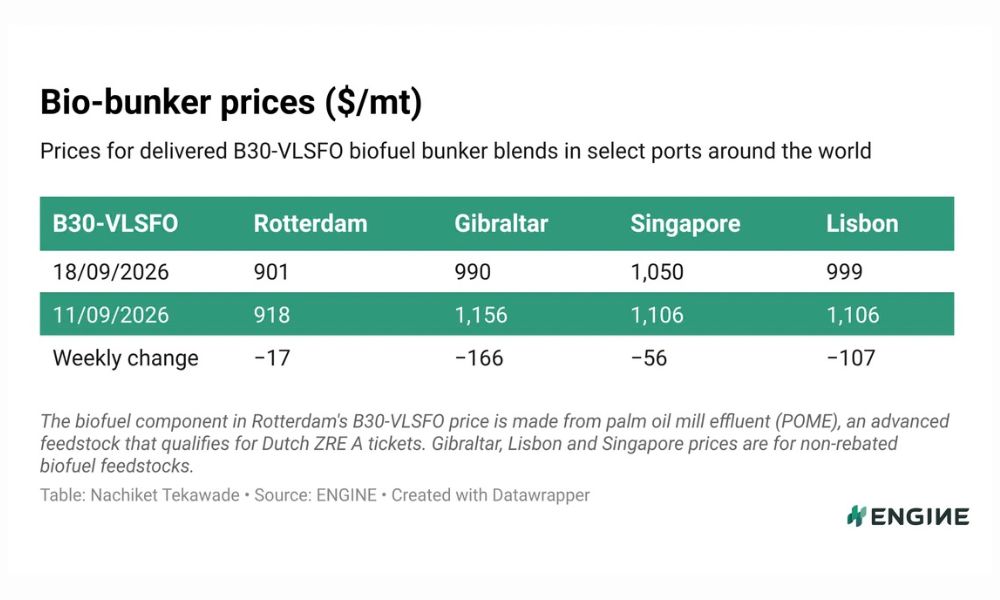
Rotterdam’s B30-VLSFO (POMEME) price has dropped $17/mt in the past week, most probably pressured by a $24/mt drop in the Dutch port’s conventional VLSFO price during the same period.

Rotterdam’s B30-LSMGO (POMEME) price has gained by $17/mt to $1,476/mt, which has been similar to a $19/mt gain in the port’s conventional LSMGO price.

B100 has been priced at $1,418/mt in Rotterdam today, a sharp $209/mt increase compared to last week.

Prima Markets’ POMEME barge price, which is an indicator of feedstock sourcing costs, has gone up by $35/mt to $2,059/mt.

Dutch suppliers can generate ZRE A tickets for selling low carbon fuels, which can be traded with other suppliers. The price of these tickets has dropped from €200/mtCO2e ($230/mtCO2e) last Friday to €190/mtCO2e ($218/mtCO2e) on Thursday this week.

Gibraltar’s B30-VLSFO (UCOME) price has slumped $166/mt lower in the past week. The port’s conventional VLSFO price has remained largely unchanged during this period.

This has cut the port’s B30-VLSFO price premium over conventional VLSFO by $172/mt in a single week to $250/mt.

Lisbon’s B30-VLSFO price has dropped $107/mt during the week. It has flipped to a modest $9/mt premium over Gibraltar’s B30-VLSFO price, coming from a $50/mt discount last Friday.

Lisbon’s B30-LSMGO price has slumped $115/mt to $1,600/mt, while the B100 price in the Portuguese port has plunged $215/mt lower to $1,665/mt.

Asia

Singapore’s B30-VLSFO (UCOME) price has dropped $56/mt since last Friday, while the port’s conventional VLSFO price has gained only $5/mt over the same period.

This has narrowed the port’s B30-VLSFO price premium by $61/mt in a single week.

Data this week showed Singapore’s bio-blended bunker sales rose by 48% in August to 57,000 mt, which was the highest monthly volume since April.

B30-VLSFO is priced at $1,015/mt in Hong Kong, which is a $35/mt price discount to Singapore.

Hong Kong’s B30-VLSFO price is at a $109/mt premium over its conventional VLSFO price.

By Nachiket Tekawade


Photo credit and source: ENGINE
Published: 22 September, 2026

Continue Reading

Biofuel

Petrochina International blends over 30,000 mt of marine biofuel since March

Company has been developing marine biofuel blending operations at China (Zhejiang) Pilot Free Trade Zone, leveraging storage and logistics facilities at its Aoshan base.
Admin

Published

on

By

Zhoushan completes China’s first batch of marine biofuel blending under pilot programme

Petrochina International Co Ltd recently said it has blended more than 30,000 metric tonnes (mt) mt of biofuel since completing the country’s first biofuel marine fuel blending operation on 13 March.

The company said the milestone demonstrates its ability to conduct continuous and large-scale biofuel marine fuel blending operations.

The company has been developing marine biofuel blending operations at China (Zhejiang) Pilot Free Trade Zone, leveraging storage and logistics facilities at its Aoshan base.

Its latest product, B24 marine fuel containing 24% biofuel component, meets relevant International Maritime Organization (IMO) requirements and marine fuel standards, according to the company. It said the product can be supplied for bunkering vessels operating on international routes.

It has used its global trading network to secure feedstock supplies and support cost control and supply security for the blending operations, it added.

The company said the large-scale blending of its marine biofuel products marks a development in China’s marine biofuel blending market.

It plans to work with upstream and downstream businesses within its group to support the development of Zhoushan Port as a major bonded marine fuel bunkering hub and contribute to its parent group’s transition towards lower-carbon energy.

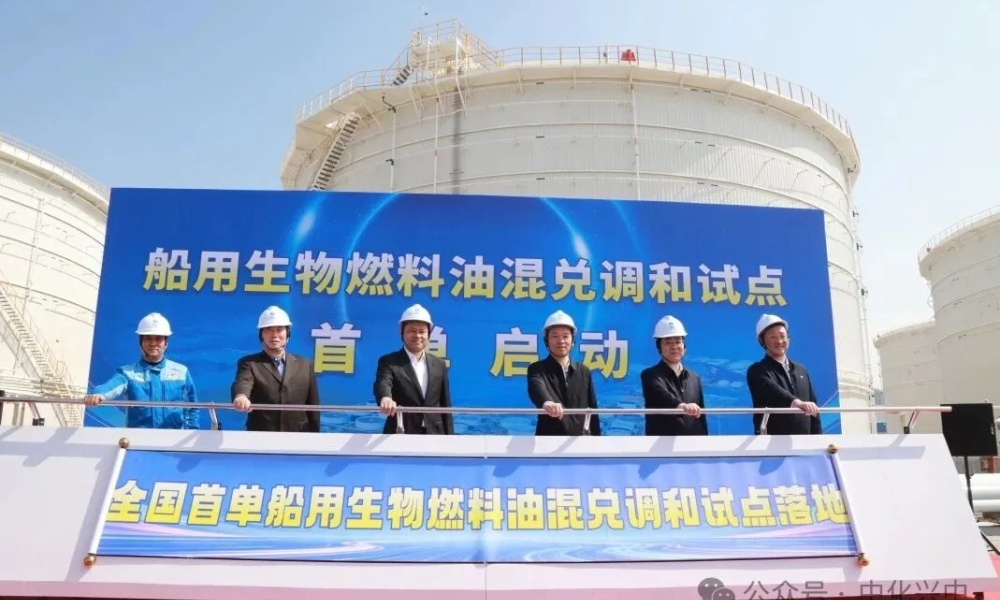
Manifold Times previously reported China (Zhejiang) Pilot Free Trade Zone launching the first pilot programme for marine biofuel blending in China with the completion of the first batch of B24-HSFO. 

The launch was marked with the blending of 2,000 mt of biodiesel and 6,300 mt of high sulphur fuel oil (HSFO) in storage tank F-02 of Sinochem-Xingzhong Oil Staging (Zhoushan), producing 8,300 mt of B24-HSFO. 

Manifold Times also reported the first cross-regional bonded bunkering operation of blended biofuel in East China was successfully completed at the Meishan Port Area of ​​Ningbo-Zhoushan Port. 

The B24-HSFO used in the bunkering operation was supplied by the Aoshan Petroleum Base in Zhoushan from the first pilot programme for marine biofuel blending in China. 

Related: Zhoushan completes China’s first batch of marine biofuel blending under pilot programme
Related: Ningbo wraps up East China’s first cross-regional biofuel blending and bunkering
Related: China debuts first marine biofuel blending pilot programme in Zhoushan
Related: China’s first batch of domestically blended marine biofuel delivered to Qingdao for bunkering


Photo credit: Sinochem-Xingzhong Oil Staging (Zhoushan)
Published: 21 September, 2026

Continue Reading

Ammonia

NYK wraps up first STS ammonia bunkering operation in Japan

Ammonia fuel was transferred from the ammonia carrier “Shoei Maru” via the STS method to an ammonia-fuelled medium gas carrier, scheduled for delivery in November 2026.
Admin

Published

on

By

NYK wraps up first STS ammonia bunkering operation in Japan

NYK Line, on Thursday (17 September) with Japan Marine United Corporation, Nihon Shipyard Co Ltd, Mitsubishi Gas Chemical Company, and Kokuka Sangyo Co Ltd, has completed the world’s first ship-to-ship (STS) ammonia bunkering operation to an ammonia-fuelled vessel. 

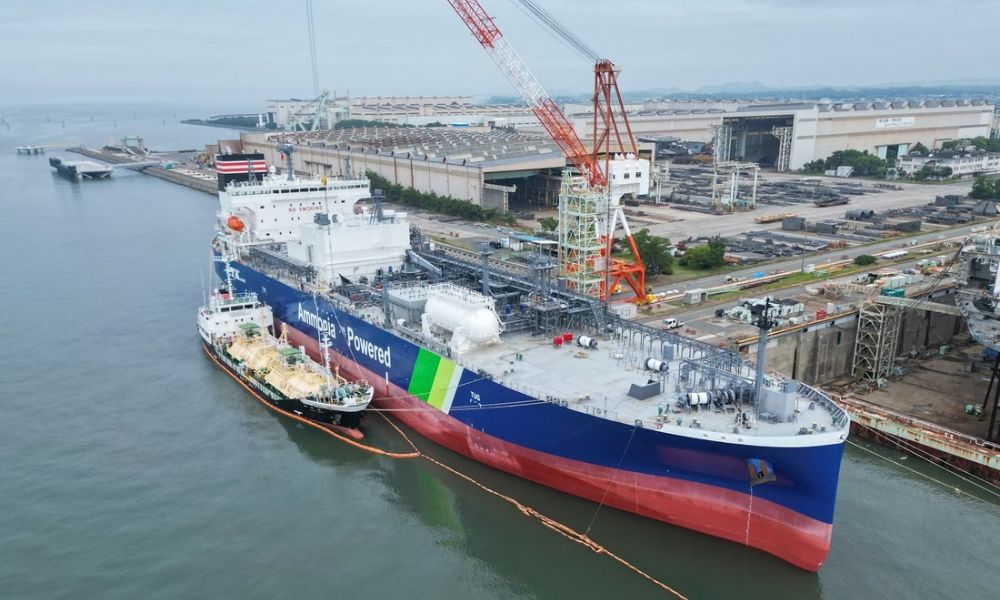
At a quay within Japan Marine United Corporation’s Ariake Shipyard, ammonia fuel was transferred from the ammonia carrier Shoei Maru via the STS method to an ammonia-fuelled medium gas carrier (AFMGC) scheduled for delivery in November 2026. 

The operation was conducted in preparation for sea trials of the AFMGC using fuel ammonia.

“This achievement represents an important initiative that has put into practice an operation essential for the future practical deployment of ammonia-fuelled vessels,” the company said. 

The bunkering operation was conducted following extensive discussions among the companies involved. Safe operating procedures and work processes were established prior to the operation, enabling the transfer to be completed safely. Through this initiative, we have accumulated practical insights regarding safe fuel supply operations.

This operation serves as a pioneering example of the fuel-supply framework that will be required for the widespread adoption of ammonia-fuelled vessels. 

The AFMGC is currently in the final stage of construction and is scheduled for delivery in November 2026. 

“The successful completion of this operation marks a significant milestone toward the broader commercial use of fuel ammonia and the practical deployment of ammonia-fuelled vessels. It also represents an important step forward in establishing an ammonia supply chain,” the company added. 


Photo credit: NYK
Published: 21 September, 2026

Continue Reading

Trending