Connect with us

Alternative Fuels

DNV: Maritime fuel mix by 2050 projected to consists of 84% alternative bunker fuels

Maritime fuel mix composition by 2050 will be shifting away from the predominantly oil-based fuel mix of today and mainly encompass 84% of low- and/or zero-carbon marine fuels, says new DNV report.


Admin

Published

on

284

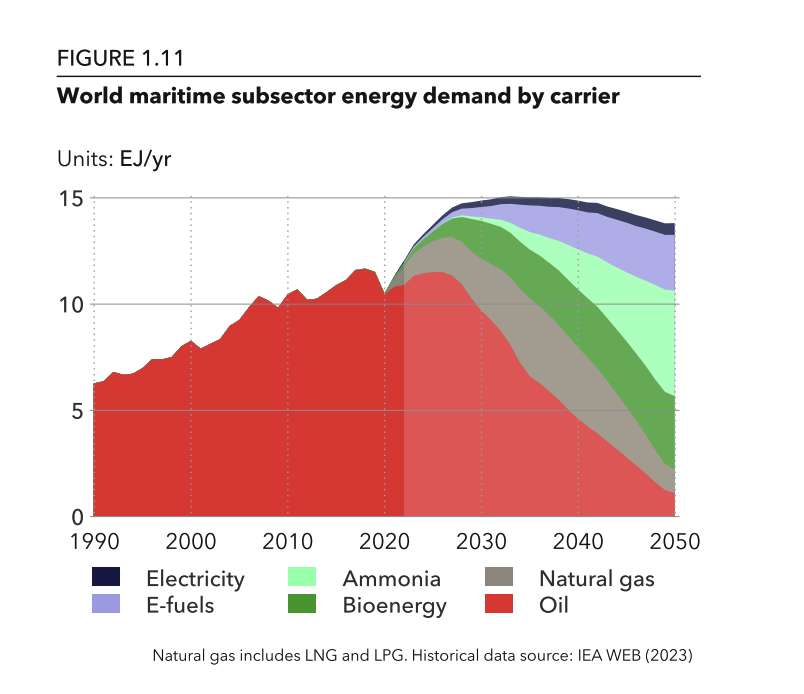
The composition of the maritime fuel mix by 2050 will be shifting away from the predominantly oil-based fuel mix today and mainly encompass 84% of low- and/or zero-carbon fuels, according to classification society DNV’s Energy Transition Outlook report.

Among the low- and zero-carbon fuels, ammonia is projected to command the largest share (36%), followed by biofuel at 25% and e-fuels at 19%, according to the report, which was published on Wednesday (11 October).

The role of electricity is anticipated to be minimal at 4%. This extensive shift in fuel types will be bolstered by region-specific decarbonization initiatives.

DNV noted the view on the maritime sector’s ability to decarbonize has progressed rapidly over the last five years, pushed by the IMO’s decarbonization strategy introduced in 2018 and revised in 2023.

“A shift in mindset within the sector towards shouldering its part of the net-zero challenge is evident, and will help to drive a significant change in fuel composition over the coming decades,” it said in the report.

However, DNV said the fuel switch in the maritime industry depends on many factors such as advanced biofuel availability and sufficient availability of renewable hydrogen for e-fuel production. 

Those uncertainty factors are captured in DNV’s 2022 version of the Maritime Forecast to 2050 where 24 scenarios for the maritime sector’s future fuel mix are outlined.

“Based on the updated IMO strategy and a push from both charterers and regulators such as the EU, our main ETO 2023 has a more decarbonized fuel mix than last year’s forecast. Nevertheless, this forecast acknowledges that the IMO ambitions lack enforcement mechanisms and might not be fully met, as the ambitions have yet to be translated to ship-specific regulations,” it said.

“Nevertheless, this forecast acknowledges that the IMO ambitions lack enforcement mechanisms and might not be fully met, as the ambitions have yet to be translated to ship-specific regulations.”

DNV said the fuel mix forecast for maritime illustrated in Figure 1.11 is a result of its best estimate assessment and not the result of a cost competition-based model output. 
Screenshot 2023 10 12 at 12.10.56 PM

“This implies that our view on the maritime fuel mix to 2050 holds significant uncertainties, partly described above and more fully detailed in DNV’s Maritime Forecast to 2050.

The report also found that limiting global warming to 1.5°C warming is less likely than ever.

“To reach the goals of the Paris Agreement, CO2 emissions would need to halve by 2030, but DNV forecasts that this will not even happen by 2050. CO2 emissions will be only 4% lower than today in 2030 and 46% lower by midcentury. Energy related CO2 emissions are still hitting record highs and are only likely to peak in 2024, which is effectively the point at which the global energy transition begins,” the classification society said.

“Globally, the energy transition has not started, if, by transition, we mean that clean energy replaces fossil energy in absolute terms,” said Remi Eriksen, Group President and CEO of DNV. 

“Clearly, the energy transition has begun at a sector, national, and community level, but globally, record emissions from fossil energy are on course to move even higher next year.”

Note: The full report of DNV’s Energy Transition Outlook can be found here while the executive summary can be found here.

Related: DNV ‘Maritime Forecast to 2050’ report examines shipping’s energy future and role of technology in energy transition
Related: DNV Maritime CEO urges shipping industry to take more action and move faster in bid to decarbonise
Related: DNV urges cross-industry collaboration to overcome ‘ultimate hurdle’ of fuel availability

Photo credit: DNV
Published: 12 October, 2023

Continue Reading

Methanol

Seaspan and Hapag-Lloyd complete first of five methanol vessel retrofit

Following “Seaspan Yangtze”, the remaining vessels planned for retrofit under the methanol retrofit programme are “Seaspan Amazon”, “Seaspan Ganges”, “Seaspan Thames”, and “Seaspan Zambezi”.

Admin

Published

on

By

Seaspan and Hapag-Lloyd complete first of five methanol vessel retrofit

Seaspan Corporation (Seaspan) and Hapag-Lloyd on Wednesday (3 June) announced the successful completion of the first of the five vessel conversions under their methanol retrofit programme with the delivery of Seaspan Yangtze.

From the early SAVER (Seaspan Action for Vessel Energy Reduction) programme to today’s CleanBlue initiative, Seaspan has committed over USD 230 USD million across 86 vessels, executing more than 550 efficiency and retrofit projects.

Following Seaspan Yangtze, the remaining vessels planned for retrofit under the programme are Seaspan Amazon, Seaspan Ganges, Seaspan Thames, and Seaspan Zambezi. Each retrofit is expected to reduce well-to-wake CO₂e emissions by approximately 30,000 to 50,000 metric tonnes per vessel annually when operating on low-carbon methanol, while also extending vessel lifespan and enhancing fuel flexibility.

“Decarbonisation is not just about building the fleet of tomorrow, it is also about unlocking the full potential of the fleet we have today. Retrofitting and upgrades on existing fleets play a practical, immediate, and economical role in accelerating shipping’s decarbonization journey,” said Bing Chen, Chairman, President and CEO of Seaspan. 

“Project SAVER CleanBlue highlights Seaspan’s strong customer partnerships, deep technical expertise, and unique platform integrated with JV partners, such as WattSpan Maritime Technology, in executing complex and large-scale retrofit projects.”

“The successful conversion of the Seaspan Yangtze together with the planned retrofit of its four sister vessels is another important step on our ambitious path towards net-zero fleet operations by 2045,” said Silke Lehmköster, Managing Director, Fleet, Hapag-Lloyd. 

“Together with Seaspan, we are demonstrating that retrofitting existing vessels for low-carbon methanol can be a practical way to reduce emissions in shipping.”


Photo credit: Seaspan
Published: 4 June, 2026

Continue Reading

Nuclear

South Korean-led nuclear car carrier design secures LR backing

LR is working with HHI, KSOE, Hyundai Glovis, G- Marine Service and KAERI on a joint development project exploring an advanced small modular reactor (SMR) installation on a PCTC.

Admin

Published

on

By

South Korean-led nuclear car carrier design secures LR backing

Classification society Lloyd’s Register (LR) on Tuesday (2 June) said it has teamed up with South Korean shipbuilding, marine services and nuclear research organisations to advance the development of a nuclear‑assisted car carrier concept. 

LR is working with Hyundai Heavy Industries, Korea Shipbuilding & Offshore Engineering (KSOE), Hyundai Glovis, G- Marine Service and the Korea Atomic Energy Research Institute (KAERI) on a joint development project (JDP) exploring an advanced small modular reactor (SMR) installation on a pure car and truck carrier (PCTC). 

The study focused on how a Molten Salt Reactor (MSR) could be physically and operationally integrated into a large vehicle carrier. Work examined the internal arrangement and segregation of the reactor system, shielding requirements, and the impact on cargo deck layout and vehicle capacity, alongside stability and trim implications linked to the reactor’s weight and positioning. 

The partners also assessed propulsion system configuration and power delivery, as well as operational flexibility compared with conventionally fuelled PCTCs, where trade routes and port calls can be tightly constrained. 

A key focus of the project has been safety. LR led hazard identification (HAZID) and preliminary risk assessment work, focusing on containment, onboard safety systems and potential operability constraints tied to nuclear technology at sea. 

The partners will mark the project milestone with an Approval in Principle (AiP) granting ceremony on 2 June at the LR stand during Posidonia 2026. 

Sung-Gu Park, President – North East Asia, Lloyd’s Register, said: “While nuclear propulsion is still at an early stage of development, this project shows the importance of building technical understanding now to support future progress. 

“Establishing feasibility at concept stage is a valuable step forward, particularly in areas such as cargo optimisation, vessel stability and integrated safety design.” 

Hong-Ryeul Ryu, CTO and Senior Executive Vice President at HD HHI, said: “With global environmental regulations becoming increasingly stringent and no definitive net-zero fuel yet available, SMR-powered ships can serve as a highly effective alternative, representing a pioneering next-generation maritime technology capable of complying with GHG emission regulations while allowing lifetime operation without refuelling, and HD HHI will remain at the forefront of sustainable maritime technology development.”


Photo credit: Lloyd’s Register
Published: 4 June, 2026

Continue Reading

Alternative Fuels

Shipfinex: The green fleet transition has a financing problem

Capt. Vikas Pandey, Founder & CEO, Shipfinex argues green shipping progress is uneven: major carriers can finance alternative-fuel vessels, while smaller owners face capital constraints.

Admin

Published

on

By

Shipfinex: The green fleet transition has a financing problem

By Capt. Vikas Pandey, Founder & CEO, Shipfinex

The numbers on alternative-fuel orders look encouraging. Seventy-two percent of newbuild capacity ordered in the first ten months of 2025 was for alternative-fuel vessels, with LNG dual-fuel accounting for 60% of that figure. More than 1,369 LNG dual-fuel vessels are now in operation or on order globally. By most measures, the transition appears to be happening.

Look at who is actually placing those orders. MSC. Hapag-Lloyd. CMA CGM. Carriers with balance sheets large enough to absorb the cost premium of alternative-fuel newbuilds and relationships with Chinese leasing companies that extend leverage ratios unavailable to most of the industry. The Strait of Hormuz disruption this March accelerated that activity further: LNG tanker charter rates spiked above $200,000 per day and carriers with deep pockets moved to lock in fuel flexibility. Meanwhile, for vessels under 6,000 TEU, orders for conventionally fuelled tonnage rose to 28% of capacity ordered in 2025, up from 19% the year before. That is not a story of broad commitment to green fuels. It is a story about who has access to capital.

An alternative-fuel newbuild costs materially more than a conventional equivalent. Methanol-ready designs, ammonia-ready structures, LNG dual-fuel systems, each carries a cost premium above the base vessel price. For an independent shipowner financing through a traditional bank, that gap is increasingly difficult to bridge. Top-40 bank lending to shipping fell from $454.9 billion in 2011 to $284.3 billion by end-2023. The Chinese leasing companies that absorbed part of that contraction are structurally oriented toward Chinese-built vessels under long-term contracts with tier-one counterparties. Independent bulk owners, mid-tier tanker operators, feeder container companies: they are working with a materially shrunken pool of willing lenders at precisely the moment they are being asked to upgrade their fleets.

This bifurcation deserves more attention from the marine fuels industry than it currently receives. Bunkering infrastructure investment follows demand signals. Alternative-fuel bunkering at secondary ports, methanol at regional hubs, LNG outside the major transhipment centres, requires a broader fleet base of alternative-fuel vessels to justify the investment. If green fuel adoption stays concentrated among a handful of majors rather than spreading across the independent owner fleet, the economics of scaling bunkering supply infrastructure outside the primary corridors remain thin.

Capital market structure and marine fuel adoption are connected, and pretending otherwise slows both. Digital instruments representing economic exposure to vessel-owning Special Purpose Vehicles, structured within regulated frameworks like VARA in Dubai, can extend the base of capital available to shipowners below the tier-one threshold. That capital base does not replace bank lending. It reaches operators that bank lending currently does not.

The Hormuz disruption reminded the industry that fuel supply chains carry geopolitical risk. The financing gap raises a quieter but equally structural point: the demand side of the green fuel equation depends on shipowners being able to afford the vessels that create that demand. Alternative-fuel bunkering infrastructure will scale when the fleet ordering those vessels does. Right now, that fleet is smaller than the order book numbers suggest.

About the Author

Vikas Pandey is a Master Mariner with decades at sea across various vessel categories. He is Founder and CEO of Shipfinex FZCO, a maritime asset tokenization platform operating under VARA In-Principle Approval (IPA/26/01/002) in Dubai and registered as a Virtual Asset Service Provider in Poland.

Disclaimer: This article is for informational purposes only and does not constitute financial advice or a solicitation to buy or sell any financial instrument or virtual asset. Maritime Asset Tokens are virtual assets; values may decline materially below purchase price. VARA In-Principle Approval does not constitute a final licence.

Linkedin: https://ae.linkedin.com/in/capt-vikaspandey
Website: https://www.shipfinex.com/


Photo credit: Shipfinex
Published: 4 June, 2026

Continue Reading

Trending