Connect with us

MoU

SMW 2024: MPA and IEA to advance transition to zero and near-zero emission bunker fuels

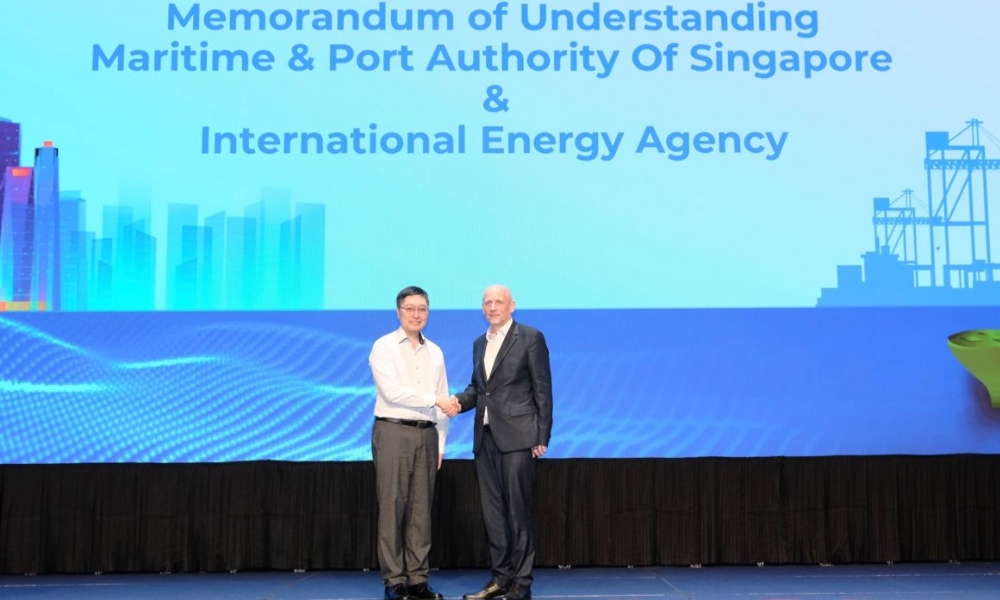
MPA and IEA signed a MoU to advance the development and transition to zero and near-zero emission marine fuels, technologies that support maritime decarbonisation, as well as digital technologies.

Admin

Published

on

SMW 2024: MPA and IEA to advance transition to zero and near-zero emission bunker fuels

The Maritime and Port Authority of Singapore (MPA) and the International Energy Agency (IEA) have signed a Memorandum of Understanding (MoU) to deepen the partnership between the two organisations and accelerate maritime decarbonisation and digitalisation. 

Singapore became an IEA Association Country in 2016. The MoU was signed by Mr Teo Eng Dih, Chief Executive of MPA, and Dr Fatih Birol, Executive Director of IEA, and was announced at the Singapore Maritime Week 2024.

In line with the goals of the International Maritime Organization (IMO) and international energy and climate targets, the MPA and IEA will collaborate to advance the development and transition to zero and near-zero emission fuels, technologies that support maritime decarbonisation, as well as digital technologies that support sustainability solutions.

The MoU will also enable the sharing of best practices across maritime and energy industries, support the adoption and transition of zero and near-zero emission fuels by these industries through capacity building training programmes, and contribute to relevant fuel-related projects and initiatives such as the IMO-Singapore NextGEN and NEXTGen Connect Initiatives. 

The IEA will benefit from MPA’s networks and expertise as input to its analysis on global and regional development of hydrogen and hydrogen derivatives, and in turn will support broader knowledge and experience sharing by facilitating staff on loan from the MPA to IEA.

Mr Teo Eng Dih, Chief Executive, MPA, said, “Greater international collaboration in maritime and energy industries is critical for international shipping to meet international decarbonisation goals. MPA looks forward to accelerating maritime decarbonisation and digitalisation with IEA, and supporting the work of the new IEA Regional Cooperation Centre to be established in Singapore.”

Mr Tim Gould, Chief Energy Economist, IEA, said, “Shipping is one of the hardest sectors to decarbonise and we need to spur development and deployment of new technologies to slow and then reverse the rise in its emissions.”

“This will require strong collaboration at a national and international level. We are committed to a close partnership with Southeast Asia, as witnessed by the recent announcement of our new IEA Regional Cooperation Centre in Singapore, the IEA’s first office outside of its headquarters in Paris, France.”

“We now warmly welcome this MoU as a major step forward in our cooperation with the Maritime and Port Authority of Singapore, a critical player in the region and the world, to improve access to low-emission fuels.”

Related: SMW 2024: Ken Energy and Green COP partner to advance bio bunker fuels in Singapore
Related: SMW 2024: Seatrium, A*STAR to explore new energies and AI for offshore and marine uses
Related: SMW 2024: Pacific Environment, Ulsan Port Authority to accelerate zero-emission shipping and ports
Related: SMW 2024: Singapore is preparing port for multi-fuel future, says Transport Minister
Related: SMW 2024: MPA partners with S&P Global and Bunkerchain in digital ship identity
Related: SMW2024: 18th Singapore Maritime Week opens with ‘Actions meet Ambition’ theme
Related: SMW 2024: MPA to set up facility for maritime workforce to train in handling new bunker fuels
Related: SMW 2024: Singapore-Rotterdam Green and Digital Shipping Corridor partners to implement first-mover pilot projects


Photo credit: Maritime and Port Authority of Singapore
Published: 18 April 2024

Continue Reading

Alternative Fuels

Singapore-Brazil green shipping corridor to support alternative bunker fuel supply chains

Both inked a MOU to establish the Singapore-Brazil GDSC, bringing together their complementary strengths to support the development of alternative marine fuel supply chains.
Admin

Published

on

By

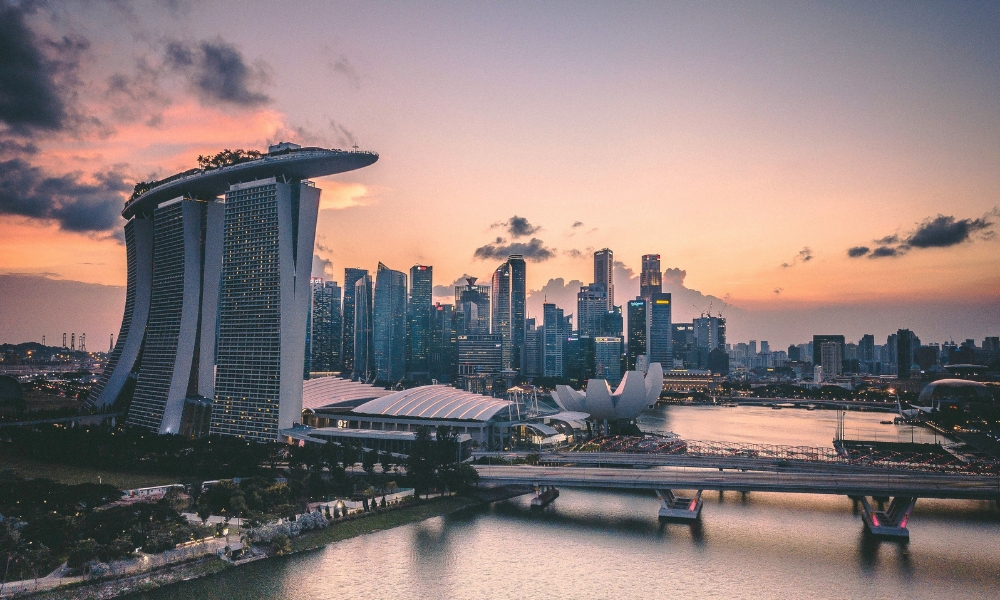
Swapnil Bapat on Unsplash

Singapore and Brazil have signed a Memorandum of Understanding (MOU) to establish the Singapore-Brazil Green and Digital Shipping Corridor (GDSC), according to the Maritime and Port Authority of Singapore (MPA) on Friday (28 August). 

The MOU was signed by Singapore’s Minister for Transport, Mr Jeffrey Siow, and Brazil’s Minister of Ports and Airports, Mr Tomé Franca.

MPA said the partnership will strengthen cooperation between Singapore and Brazil on maritime decarbonisation and digitalisation, and support more sustainable and efficient international shipping.

Brazil has significant renewable energy resources and production capabilities that could support the production of zero- and near-zero greenhouse gas emission marine fuels, while Singapore is the world’s largest bunkering port and a leading global hub port with a vibrant innovation ecosystem. 

“The GDSC will bring together these complementary strengths to support the development of alternative marine fuel supply chains,” MPA added. 

Under the MOU, Singapore and Brazil will also explore digital information exchanges to improve maritime and port operations. The two countries will work with industry to advance the research, development and adoption of emerging maritime technologies and solutions.


Photo credit: Swapnil Bapat on Unsplash
Published: 31 August, 2026

Continue Reading

Decarbonisation

CSA and MFA partner to support shipowners, bunker suppliers on emissions compliance

Clean Shipping Alliance and the Marine Fuels Alliance signed a MoU to also advance transition to alternative bunker fuels and emissions reduction technologies.
Admin

Published

on

By

CSA and MFA partner to support shipowners, bunker suppliers on emissions compliance

The Clean Shipping Alliance (CSA) and the Marine Fuels Alliance (MFA) on Wednesday (19 August) said they have signed a Memorandum of Understanding (MoU) to support the shipping industry and bunker suppliers in meeting regulatory requirements on emissions, and to advance the transition to alternative fuels and emissions reduction technologies.

The agreement will see CSA’s expertise in exhaust gas cleaning systems and marine environmental technology brought together with MFA’s network and knowledge across the marine fuels supply chain. 

Both organisations share an interest in supporting the maritime industry’s transition toward a sustainable, compliant and lower-emission future, and the agreement sets out a structure for the two bodies to share technical insight and coordinate on regulatory pathways.

Through the collaboration, the two associations intend to encourage dialogue between technology providers, fuel suppliers and ship operators, share technical insights and support the development of practical regulatory pathways.

Under this framework, the two associations will:

  • Share technical data and research: on MARPOL compliance, alternative fuels and emissions reduction technologies.
  • Coordinate joint advocacy: including at the International Maritime Organization (IMO) level and alongside sessions of the IMO’s Marine Environment Protection Committee (MEPC).
  • Support industry events: on fleet modernisation, retrofitting and fuel quality standards.
  • Develop practical operational guidance: linking technology providers, fuel suppliers and ship operators.

Andreas Chrysostomou, Executive Director of the Clean Shipping Alliance, said: “Shipping’s compliance and availability challenges won’t be solved by one technology or one fuel. It needs ongoing communication between different elements of the value chain, and that’s why CSA and MFA have signed this MoU. Technologies, fuels and regulation cannot be considered in isolation, and by working together we can bring together complementary expertise, improve the exchange of technical knowledge and contribute to solutions that are both environmentally effective and operationally realistic.”

Anthony Mollet, Executive Officer of the Marine Fuels Alliance, said: “The CSA brings a wealth of technical knowledge and first-hand industry experience, particularly in relation to emissions, environmental regulation and the technologies being adopted by shipowners and operators. This partnership will give our members an important additional source of expertise and insight, helping them better understand the challenges facing the industry and make informed decisions as the transition towards cleaner shipping continues.

“For companies across the contractual chain in bunkers, it is increasingly important to understand the decisions being made by shipowners and operators around fuel choice, emissions technologies and the future fuels they intend to use. 

“The selection of a particular fuel grade or technology can have significant implications throughout the bunker supply chain, from contractual arrangements and fuel specifications to supply and operational considerations. This is a key area of focus for the MFA, and we are committed to providing our members with clear, practical and relevant resources to help them navigate these developments.”

The non-binding MoU will initially remain in effect for two years, with both associations designating points of contact to coordinate joint initiatives and regularly review the collaboration.


Photo credit: Clean Shipping Alliance and Marine Fuels Alliance
Published: 20 August, 2026

Continue Reading

Decarbonisation

Yang Ming and PSA to develop integrated sea-land decarbonisation solutions

Both will explore solutions spanning emissions measurement and verification, a digital Book-and-Claim framework, and a joint maritime-land inset token package.
Admin

Published

on

By

Yang Ming and PSA to develop integrated sea-land decarbonisation solutions

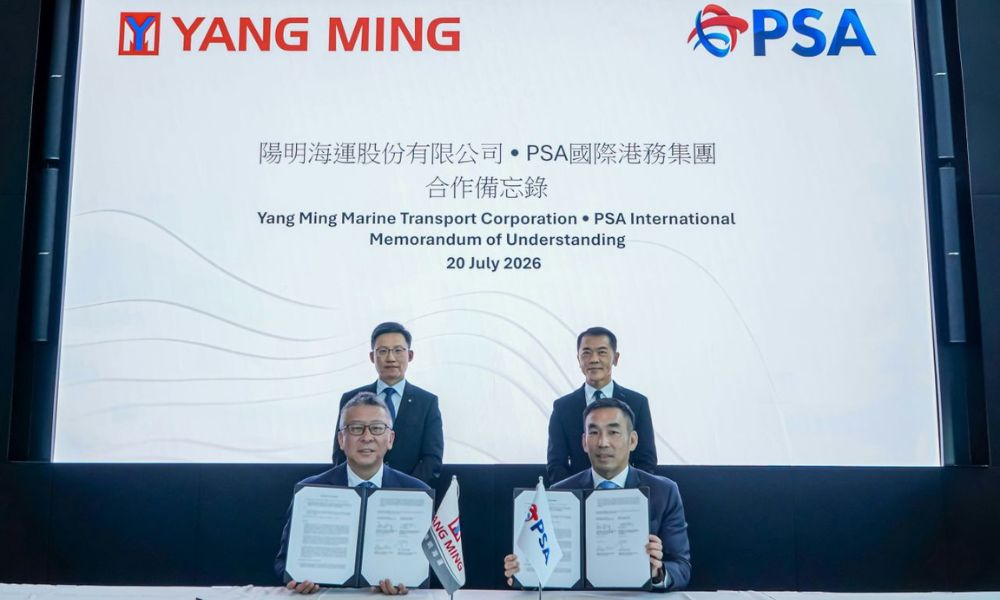
PSA International (PSA) on Monday (20 July) said it has signed a Memorandum of Understanding (MoU) with Yang Ming Marine Transport Corporation (Yang Ming) to jointly accelerate the adoption of low-carbon solutions across the maritime value chain.

Beyond emissions measurement and verification, the collaboration will focus on a digital Book-and-Claim framework and a joint maritime-land based inset token package. 

“This synergy provides cargo stakeholders with a transparent and accountable sea-land pathway to achieve their decarbonisation targets,” PSA said on its website. 

Yang Ming launched the green transport service, EcoSea+. This initiative integrates Yang Ming’s low-carbon navigation capabilities to empower customers with a flexible and transparent strategy to effectively reduce their Scope 3 transportation emissions. By joining forces with PSA, Yang Ming is able to expand the impact of these sustainability actions beyond the ocean.

Building on its position as a global port operator, PSA advances its Node to Network strategy through integrated port and supply chain capabilities that enable a green network of terminal and landside operations to reduce end-to-end supply chain emissions.

The agreement was officially signed by Mr Ivan Chiang, Chief Logistics Officer & Senior Vice President of Yang Ming, and Mr Eddy Ng, Group Head of Operations, Technology and Sustainability of PSA International. 

Mr Ong Kim Pong, PSA International Group CEO, said, “As responsible stewards of tomorrow, PSA is committed to delivering sustainable impact across the global port and supply chain ecosystem. 

“Tackling the challenges arising from climate change will require the collective efforts of all players in the maritime supply chain sector. We are excited to partner Yang Ming on the decarbonisation of global supply chains and support the transition towards a more sustainable global economy.”


Photo credit: PSA International
Published: 23 July, 2026

Continue Reading
Advertisement

OUR INDUSTRY PARTNERS


Trending