Connect with us

Technology

SMW 2024: MPA partners with S&P Global and Bunkerchain in digital ship identity

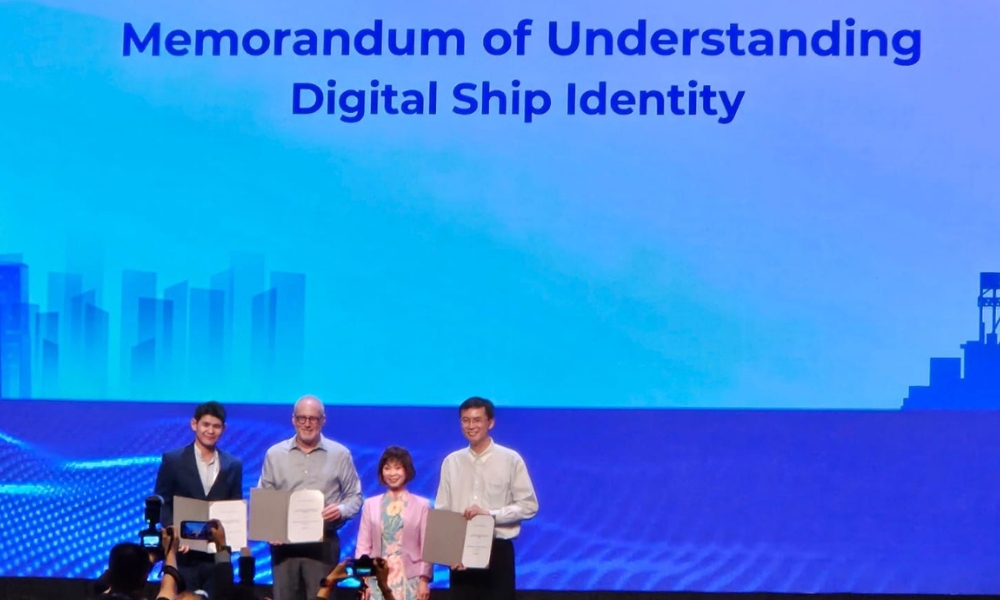
MPA signed a MoU with S&P Global and Bunkerchain to use Singapore as test bed to trial and pilot use of digital ship identity in maritime applications such as digital port clearance and digital bunkering.

Admin

Published

on

SMW 2024: MPA partners with S&P Global and Bunkerchain in digital ship identity

The Maritime and Port Authority of Singapore (MPA) on Tuesday (16 April) announced it signed a Memorandum of Understanding (MoU) with S&P Global Market Intelligence and Bunkerchain to pilot the use of digital ship identity in the republic. 

The signing took place at the ‘Accelerating Digitalisation and Decarbonisation Conference’ at Singapore Maritime Week (SMW) on the same day.

The parties agreed to use the Port of Singapore as the test bed to trial and pilot the use of digital ship identity in maritime applications such as digital port clearance and digital bunkering.

Digital identity refers to the unique representation of an entity in the digital world, which consists of various attributes and data that distinguishes it from others.

“Electronic transactions may be vulnerable to various risks as such identity fraud and data integrity breaches,” MPA said.

“Digital ship identity plays a crucial role in making electronic transactions more secure, trusted, and efficient in the maritime sector. When deployed in tandem with electronic signatures, these digital technologies will eliminate the need for physical ship stamps and wet ink signatures, and accelerate the transition towards a truly digital, secure, and paperless operations.”

MPA, together with Esri Singapore, the Agency for Science, Technology and Research’s Institute of High Performance Computing and the Technology Centre for Offshore and Marine, Singapore, also developed a digital twin proof-of-concept of a methanol bunkering leak incident. 

“The digital twin runs on an interactive web application that integrates weather and ocean current predictions and AIS data to present visualisation of chemical plume dispersions in the event of a bunkering incident involving alternative fuels,” it said.  

“The capability can help enhance planners’ understanding of the behaviour of the plume clouds under various conditions and guide the development of safety and incident response plans and standards.”

The port authority also announced a collaboration with Amazon Web Services (AWS), an Amazon.com company, to support the maritime industry’s digital transformation and green transition. 

MPA will tap on AWS services including cloud, artificial intelligence (AI), and digital twins to enhance the industry’s efficiency, safety, and sustainability outcomes. 

As part of the collaboration, MPA and AWS will develop the maritime Artificial Intelligence and Machine Learning (AI–ML) Digital Hub, the first-of-its-kind in ASEAN region. 

The AI–ML Digital Hub will leverage AWS cloud to enable the maritime industry to pilot innovative AI and generative AI (GenAI) capabilities to trial on the Green and Digital Shipping Corridors, optimising routes and fuel consumption, carbon emissions accounting, and just-in-time arrivals to help ships operate more efficiently, reduce greenhouse gases emissions, and enhance safety of operations.

A memorandum of understanding was signed between Mr David Foo, Assistant Chief Executive (Operations Technology), MPA and Ms Elsie Tan, Country Manager, Worldwide Public Sector, Singapore, AWS.

Related: SMW2024: 18th Singapore Maritime Week opens with ‘Actions meet Ambition’ theme
Related: SMW 2024: MPA to set up facility for maritime workforce to train in handling new bunker fuels
Related: SMW 2024: Singapore-Rotterdam Green and Digital Shipping Corridor partners to implement first-mover pilot projects


Photo credit: Bunkerchain
Published: 16 April 2024

Continue Reading

Alternative Fuels

Auramarine: Marine fuel flexibility will be key to shipping’s energy transition

Operators who adapt best will be the ones who built in the flexibility to their marine fuel strategy to respond as conditions change, says CEO John Bergman.
Admin

Published

on

By

31 1

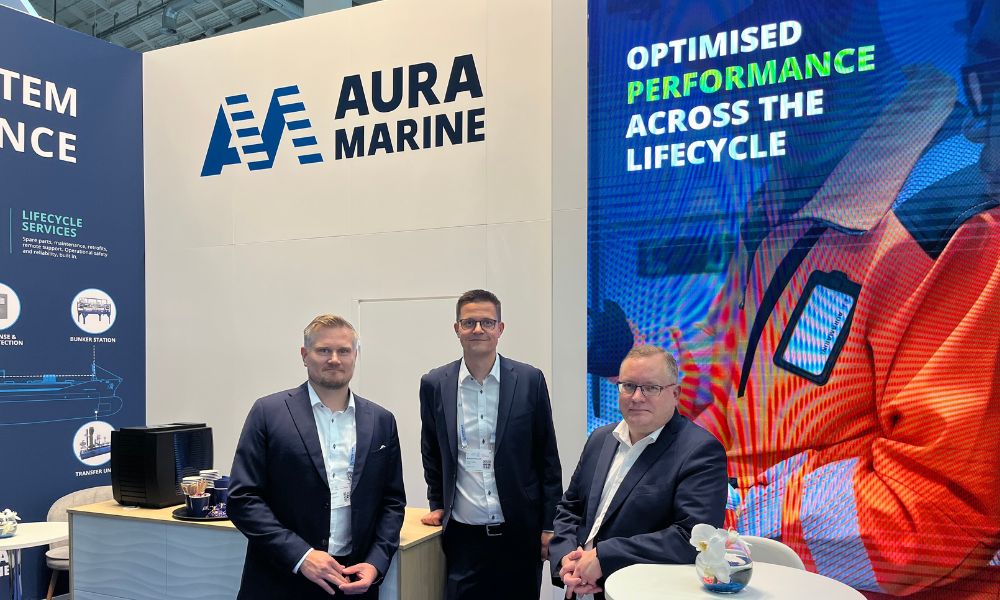
Finland-based fuel supply systems provider Auramarine on Wednesday (2 September) said it believes shipping’s energy transition is entering a phase where flexibility, not fuel choice, will determine which operators adapt successfully. 

With fuel price volatility, inconsistent alternative availability and tightening environmental regulation at different speeds across regions, Auramarine argued that the right approach to fuel supply infrastructure is now as strategically important as the fuel itself.

“The industry has spent years asking which fuel will win,” said John Bergman, CEO, Auramarine. 

“That may be the wrong question. No operator today can predict with confidence what will be available, compliant or commercially viable in five years. The operators who adapt best will be the ones who built in the flexibility to their fuel strategy to respond as conditions change.”

Auramarine’s own fuel split technology, first delivered in 2019 and now installed on around 20 vessels, reflects this thinking in practice. The retrofit system adds a fuel booster module onboard, allowing a ship to run different fuels through the same engine without the extended changeover procedures dual-fuel systems typically require.

This lets operators switch to MGO or biofuel, for example, to meet an ECA requirement, support maintenance schedules, or respond to fuel pricing shifts, without taking a vessel out of service. Delivered in sections through existing doors and hatches, it can be retrofitted to vessels already in operation.

Bergman sees this need for adaptability sharpening in sectors under the most operational and regulatory pressure. 

“Cruise and ferry operators feel this earliest and most acutely,” he said. 

“These vessels constantly move between regulatory zones and environmentally sensitive waters, so the ability to switch fuel supply without disrupting a schedule is an operational necessity. What’s notable is how many operators in this space still don’t know infrastructure like this exists, despite how directly it addresses what they’re already dealing with.”

Reliable flexibility requires a tailored approach, not just adding equipment. “The best results come from scoping flexibility to an owner’s actual fuel strategy, not adding complexity for its own sake,” Bergman added. 

Automated fuel changeover systems are designed to keep multi-fuel operations straightforward for crews, while a structured maintenance approach ensures inspection, testing and servicing can be carried out safely throughout the vessel’s lifecycle. This is where Auramarine’s lifecycle services play a central role, supporting operators well beyond initial installation with the ongoing servicing, spares and technical support needed to keep flexible fuel systems performing reliably for the long term, whatever the fuel landscape looks like in years to come.

“Over the next few years, operators who succeed will be the ones who stopped waiting for certainty and started building optionality instead,” Bergman added

“In a transition this uncertain, adaptability matters more than any single fuel bet. That’s the conversation we want the industry to have.”


Photo credit: Auramarine
Published: 7 September, 2026

Continue Reading

Mass Flowmeter

TFG Marine advances global MFM rollout with two US Gulf bunker barges

“Buffalo B414” and “Buffalo B304”, were recently fitted with the equipment, with both supply barges receiving ISO 22192 certification for their newly installed MFMs last month.
Admin

Published

on

By

TFG Marine advances global MFM rollout with two US Gulf bunker barges

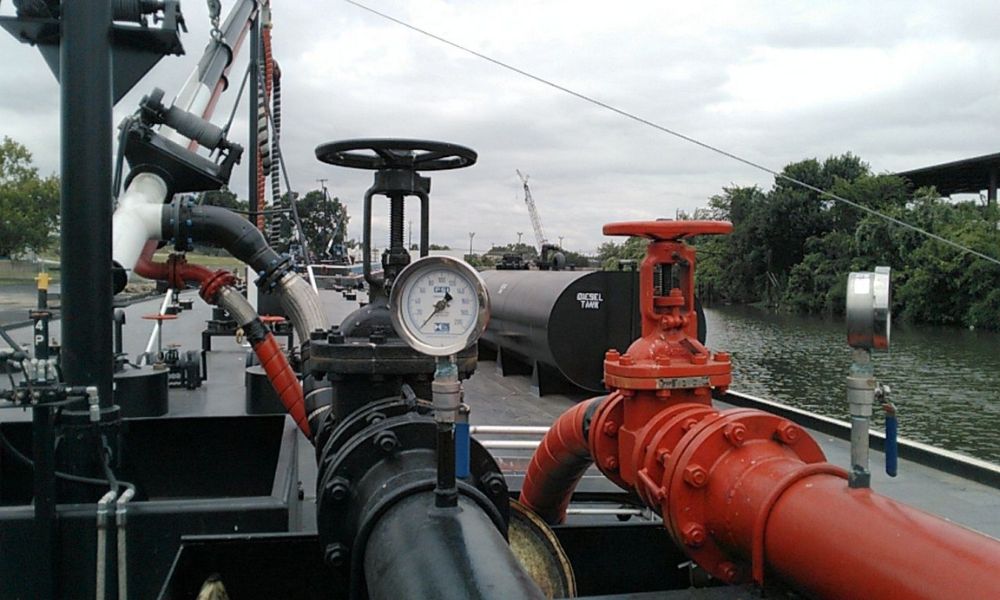
Global marine fuel supply and procurement firm TFG Marine on Wednesday (2 September) said it continued to expand mass flow meter (MFM) technology across its US Gulf Coast bunker fleet.

The company said two more vessels, Buffalo B414 and Buffalo B304, were recently fitted with the equipment.

“Both supply barges received ISO 22192 certification for their newly installed MFMs last month, giving customers greater confidence in bunker quantity measurement while supporting a more accurate, transparent and efficient delivery process,” TFG Marine said in a social media post. 

“This marks the latest step in TFG Marine’s ongoing investment in technology and best practice across its global bunkering operations, and forms part of a broader push by our North America team to help drive progress across the region’s bunkering industry.”

Last year, TFG Marine announced it reached a key milestone in its global digitalisation programme with the installation of an ISO 22192-compliant MFM on the Buffalo 404, a barge on time charter from American bunker barge company Buffalo Marine Service Inc.

This was the first ISO-certified MFM-equipped bunkering barge operating in the US Gulf.

The installation was part of TFG Marine’s wider strategy to equip close to 90% of its global bunkering fleet with MFMs by 2026 as a commitment towards improving data integrity, streamlining operations and strengthening trust in marine fuel transactions.

Related: TFG Marine installs first ISO-certified mass flow meter on US Gulf bunkering barge


Photo credit: TFG Marine
Published: 4 September, 2026

Continue Reading

FuelEU

Ahti Climate and DNV connect verified emissions data to FuelEU pooling platform

New integration connects Ahti’s FuelEU pooling platform with DNV’s verification services, Veracity, helping customers reduce manual administration and streamline compliance.

Admin

Published

on

By

Ahti Climate brings DNV-verified emissions data into FuelEU pooling platform

Ahti Climate on Monday (31 August) announced a new integration with Veracity, DNV’s independent industry cloud platform, enabling shipowners and operators to seamlessly transfer DNV-verified emissions data into Ahti’s FuelEU pooling platform. 

The integration simplifies emissions reporting by connecting operational data verification with FuelEU compliance workflows, helping customers reduce manual administration, improve data quality and confidently meet regulatory requirements.

For customers such as shipping company Bore Ltd, the integration streamlines the flow of emissions data between verification and compliance systems. Raw fuel consumption data is automatically converted into the required OVD format and submitted for DNV verification through Veracity. Once verified, the emissions figures are securely shared with Ahti’s FuelEU pooling platform, creating a more efficient workflow with less manual administration and greater confidence in reported emissions data.

“Being on one of the surplus generators of the pool, trust in the data is everything for us – we need to know the numbers we’re selling hold up to scrutiny. With verified emissions data flowing straight from Veracity by DNV into the Ahti Pooling Platform, we no longer have to manually cross-check figures before every transaction. It gives us confidence that what we’re bringing to the pool is accurate, and that our partners can rely on it too,” said Marcus Strand ICT Manager at Bore Ltd. 

The integration enables customers to:

  • Reduce manual data entry and administrative workload
  • Improve data quality and reduce the risk of reporting errors
  • Securely exchange verified emissions data across systems and stakeholders
  • Increase transparency and confidence in compliance reporting
  • Connect commercial, operational and compliance workflows
  • Reduce turnaround times for reporting and voyage settlements

“Every partnership we build comes back to the same question: does this make compliance easier for shipowners? With Veracity by DNV, the answer is clearly yes – verified data, connected systems, and one less thing for our customers to worry about,” said Risto-Juhani Kariranta, CEO of Ahti Climate. 

With connectivity to the majority of the world fleet, Veracity’s trusted partner ecosystem, combined with Ahti’s expertise in FuelEU pooling, gives shipowners a more connected approach to emissions verification and compliance. By enabling verified data to flow securely between systems, the partnership helps customers reduce complexity and get greater value from their data and access a growing network of digital solutions.


Photo credit: Ahti Climate
Published: 1 September, 2026

Continue Reading
Advertisement

OUR INDUSTRY PARTNERS


Trending