

Bunker Fuel
JLC China Bunker Market Monthly Report (April 2026)
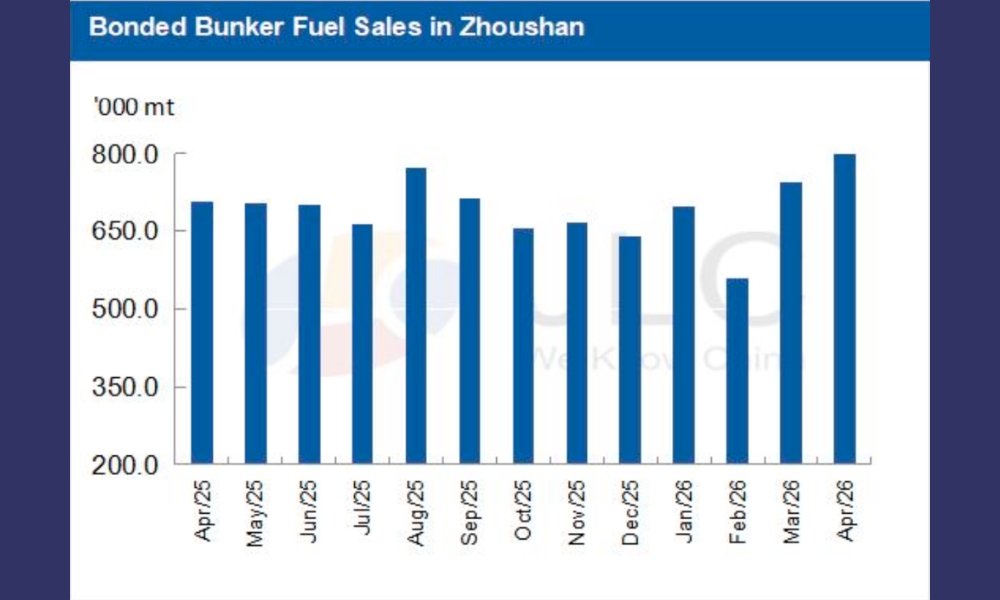
China’s bonded bunker fuel sales continued to grow in April, as the country’s LSFO supply increased and its bonded bunker fuel prices were still competitive, according to JLC.

Beijing-based commodity market information provider JLC Network Technology Co. recently shared its JLC China Bunker monthly report for April 2026 with Manifold Times through an exclusive arrangement:
Bunker Fuel Demand
China’s bonded bunker fuel sales continue to grow in April
China’s bonded bunker fuel sales continued to grow in April, as the country’s low-sulfur fuel oil (LSFO) supply increased and its bonded bunker fuel prices were still competitive.
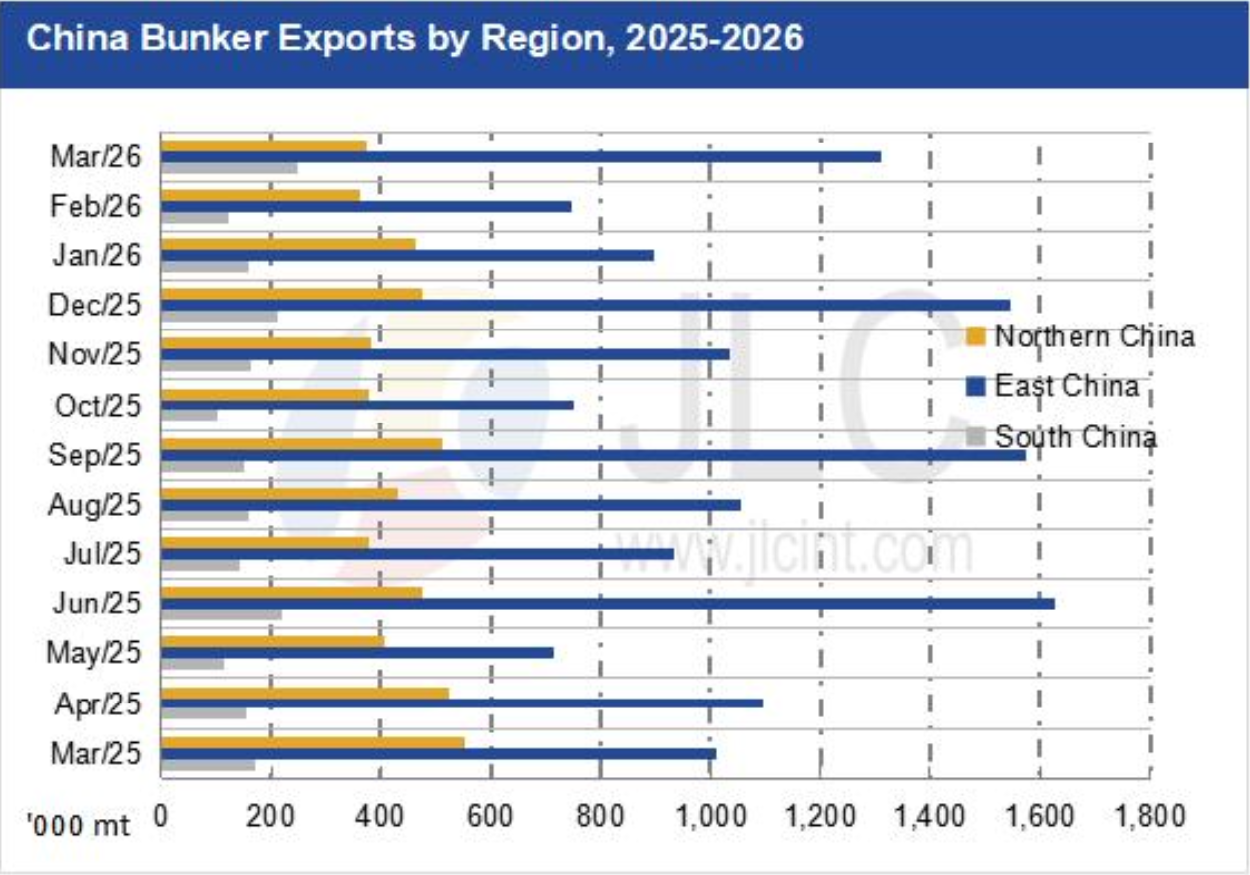
The country sold about 1.88 million mt of bonded bunker fuel in April, with the daily sales at 62,700 mt, up by 4.93% month on month and 6.71% year on year, JLC’s data shows.
Specifically, the sales of the ports in East China, including Zhoushan Port and Shanghai Port, increased significantly amid price advantages and good weather, while those of northern ports slipped as their bonded bunker fuel prices were relatively high.
Regarding the sales by supplier, the sales by Chimbusco, Sinopec (Zhoushan), SinoBunker, and China Changjiang Bunker (Sinopec) respectively settled at 470,000 mt, 570,000 mt, 85,000 mt, and 15,000 mt in the month, while those by suppliers with regional bunkering licenses settled at 741,000 mt. China’s LSFO output surges in April
China’s LSFO output surged in April, as global bunkering demand improved and domestic refiners saw considerable production margins.
Chinese refiners produced roughly 1.22 million mt of LSFO in the month, with the daily output at 40,733 mt, surging by 27.55% month on month and 17.16% year on year, JLC’s data shows.
The ongoing conflict in the Middle East forced many ships to continue detours, pushing up their consumption of bunker fuels. Meanwhile, more shipowners chose to refuel in Chinese ports where bonded bunker fuel prices were more competitive. In addition, domestic refiners showed higher production enthusiasm amid considerable margins.
Sinopec’s LSFO output climbed in the month. Most refineries, including Qingdao Petrochemical, Shengli Oilfield, Shanghai Petrochemical, Shanghai Gaoqiao Petrochemical, Maoming Petrochemical, and ZhongKe (Guangdong) Refinery & Petrochemical, ramped up their production.
PetroChina’s LSFO output increased as well, with Liaohe Petrochemical, Jinzhou Petrochemical, Jinxi Petrochemical, and Dagang Petrochemical boosting output. CNOOC’s Daxie Petrochemical resumed normal LSFO production and delivery in April, while Taizhou Petrochemical raised its output. Meanwhile, Huizhou Petrochemical maintained stable production. Zhongjie Petrochemical did not produce any LSFO in the month.
ZPC and Sinochem did not produce any LSFO in April, but the latter produced and exported 10,000 mt of MGO.

Domestic-trade heavy bunker fuel demand weakens in April
Domestic-trade heavy bunker fuel demand slid to 320,000 mt in April, with the daily demand at 10,667 mt, down by 2.75% month on month, JLC’s data shows.
Shipowners stood on the sidelines as bunker fuel prices continued to rise and downstream transportation demand was weak. Meanwhile, trade in North China was tepid as the operation of local ports was hindered to some extent.
On the other hand, domestic-trade light bunker fuel demand settled at 140,000 mt in April, with the daily demand at 4,667 mt, a rally of 11.28% month on month, the data shows. Bunkering demand from marine diesel engines increased amid warmer weather and more active coastal shipping.
Bunker Fuel Supply
China’s bonded bunker fuel imports continue to rise in March
Chinese bunker suppliers continued to increase their bonded bunker fuel imports in March.
They imported 823,000 mt of bonded bunker fuel in the month, a boost of 8.48% month on month and 23.61% year on year, calculations show, based on data from the GACC.
The arrivals of imported high-sulfur fuel oil (HSFO) increased as the economic efficiency of HSFO bunkering remained high, while those of imported LSFO decreased amid larger domestic production.
China’s bonded bunker fuel imports mainly came from Asian countries, and the impact of the geopolitical conflicts in the Middle East on the overall imports was relatively limited. In addition, most import orders were made in early to mid-February, before the outbreak of the conflict.
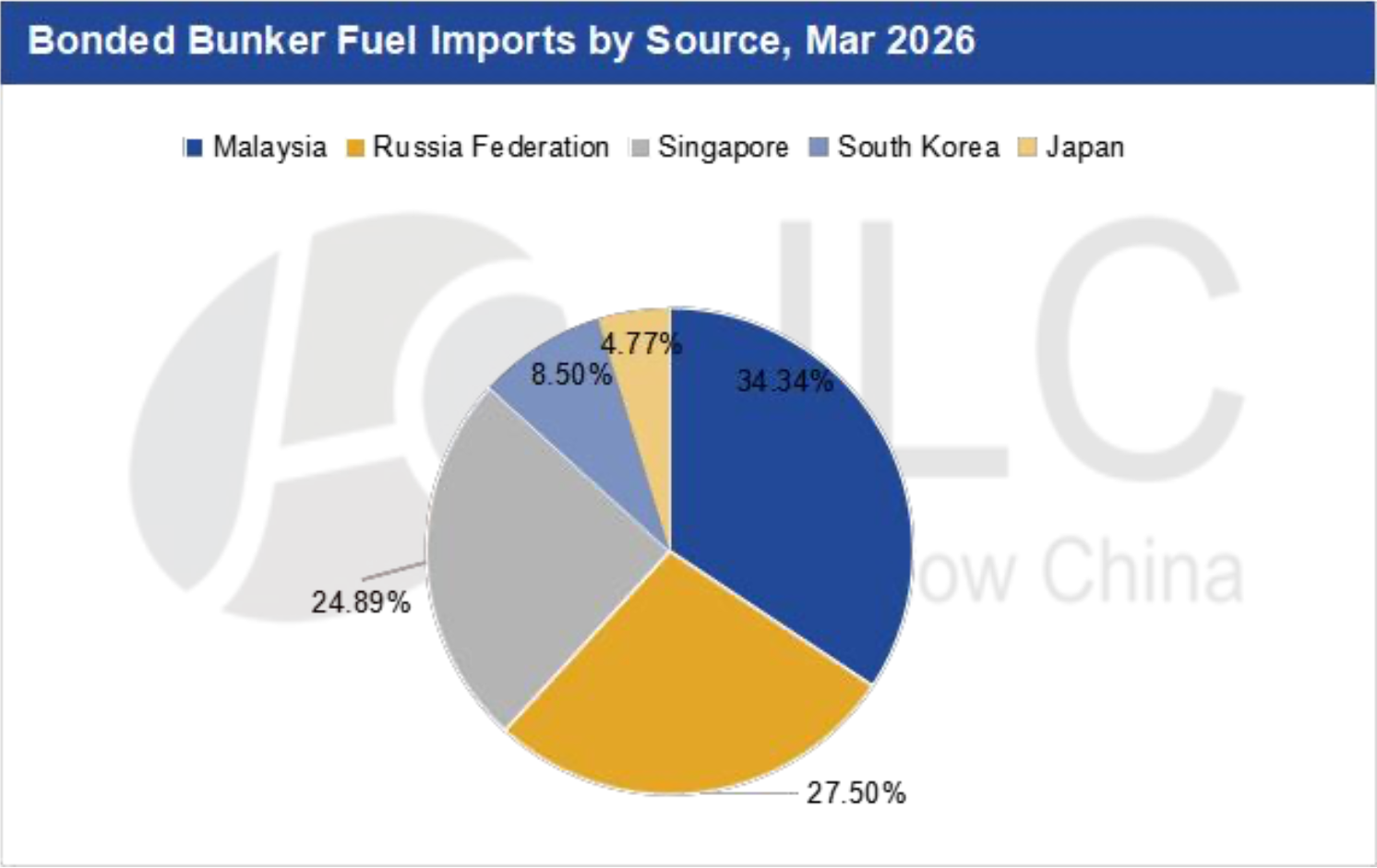
Regarding the imports by source, Malaysia became the largest supplier by shipping 282,600 mt of bonded bunker fuel to China, accounting for 34.34% of the latter’s total imports. Russia climbed to the second place with 226,300 mt, accounting for 27.50%, while Singapore slipped to the third place with 204,800 mt, representing 24.89%. The imports from South Korea and Japan settled at 70,000 mt and 39,300 mt, accounting for 8.50% and 4.77%, respectively.
China’s bonded bunker fuel imports totaled 2.04 million mt in the first quarter of this year, a surge of 33.64% year on year, calculations show.
Domestic-trade heavy bunker fuel supply tightens in April
Chinese blenders supplied 350,000 mt of domestic-trade heavy bunker fuel in April, with the daily supply at 11,667 mt, a decline of 4.82% month on month, JLC’s data shows.
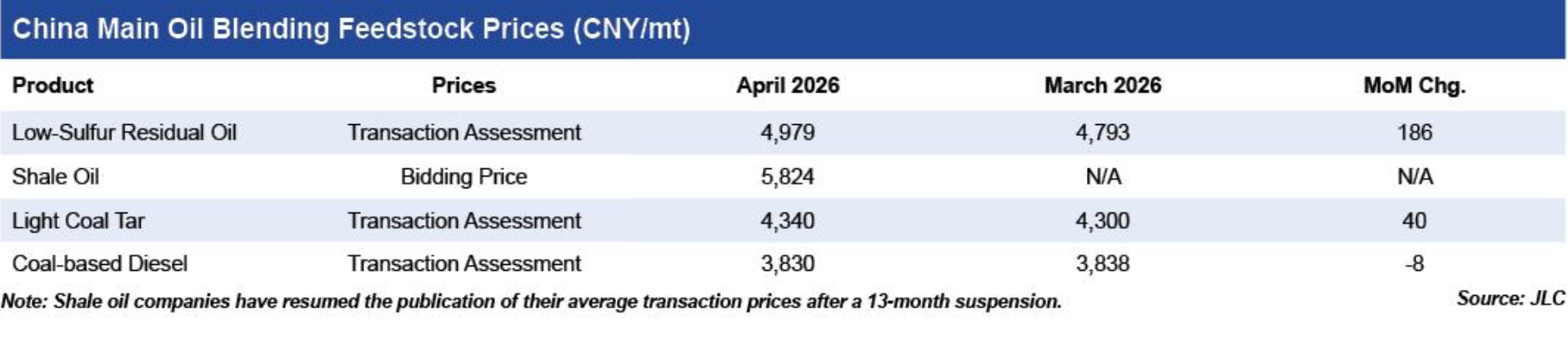
Downstream buying interest in heavy bunker fuel was low, coupled with high blendstock prices, limiting blenders’ production enthusiasm.
By contrast, domestic-trade marine gas oil (MGO) supply settled at 180,000 mt in April, with the daily supply at 6,000 mt, soaring by 16.25% from the previous month, the data shows. Downstream demand improved, and refineries raised their MGO yields.

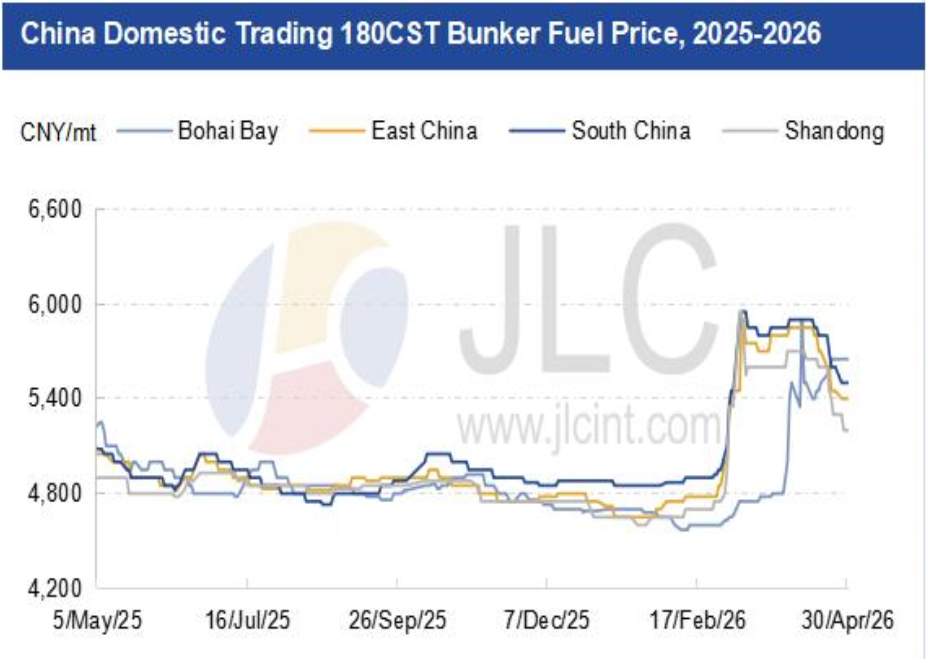
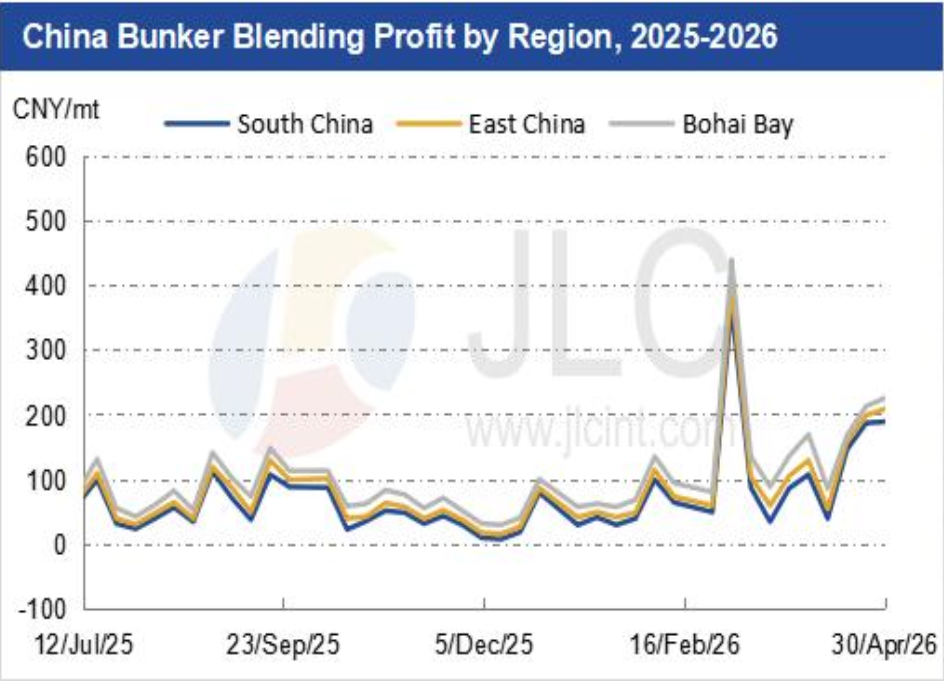
Bunker Prices, Profits
Editor
Yvette Luo
+86-020-38834382
[email protected]
Sales (Beijing)
Tony Tang
+86-10-84428863
[email protected]
Sales (Singapore)
Ginny Teo
+65-31571254
[email protected]
[email protected]
JLC Network Technology Co., Ltd is recognised as the leading information provider in China. We specialise in providing the transparent, high-value, authoritative market intelligence and professional analysis in commodity market. Our expertise covers oil, gas, coal, chemical, plastic, rubber, fertilizer and metal industry, etc.
JLC China Bunker Fuel Market Monthly Report is published by JLC Network Technology Co., Ltd every month on China bunker market, demand, supply, margin, freight index, forecast and so on. The report provides full-scale & concise insight into China bunker oil market.
All rights reserved. No portion of this publication may be photocopied, reproduced, retransmitted, put into a computer system or otherwise redistributed without prior authorization from JLC.
Related: JLC China Bunker Market Monthly Report (March 2026)
Related: JLC China Bunker Fuel Market Monthly Report (February 2026)
Related: JLC China Bunker Market Monthly Report (December 2025)
Related: JLC China Bunker Market Monthly Report (November 2025)
Related: JLC China Bunker Fuel Market Monthly Report (October 2025)
Related: JLC China Bunker Fuel Market Monthly Report (September 2025)
Related: JLC China Bunker Fuel Market Monthly Report (July 2025)
Related: JLC China Bunker Fuel Market Monthly Report (June 2025)
Related: JLC China Bunker Fuel Market Monthly Report (May 2025)
Related: [Updated 15 May] JLC China Bunker Market Monthly Report (April 2025)
Related: JLC China Bunker Market Monthly Report (February 2025)
Related: JLC China Bunker Fuel Market Monthly Report (January 2025)
Related: JLC China Bunker Fuel Market Monthly Report (December 2024)
Related: JLC China Bunker Fuel Market Monthly Report (November 2024)
Related: JLC China Bunker Fuel Market Monthly Report (October 2024)
Related: JLC China Bunker Fuel Market Monthly Report (September 2024)
Related: JLC China Bunker Fuel Market Monthly Report (August 2024)
Related: JLC China Bunker Fuel Market Monthly Report (July 2024)
Related: JLC China Bunker Fuel Market Monthly Report (June 2024)
Related: JLC China Bunker Fuel Market Monthly Report (May 2024)
Related: JLC China Bunker Market Monthly Report (April 2024)
Related: JLC China Bunker Market Monthly Report (March 2024)
Related: JLC China Bunker Fuel Market Monthly Report (February 2024)
Related: JLC China Bunker Market Monthly Report (January 2024)
Note: China-based commodity market information provider JLC Technology has been providing Singapore bunkering publication Manifold Times China bunker volume data since 2020. Data from earlier periods are available here.
Photo credit: JLC Network Technology
Published: 13 May, 2026
Business
IBT Bunkering & Trading appoints Kevin Döhmen to lead Singapore expansion
Döhmen will lead the new Singapore office, with responsibility for managing and developing the operation and strengthening relationships with customers and partners.

Bunker Alerts
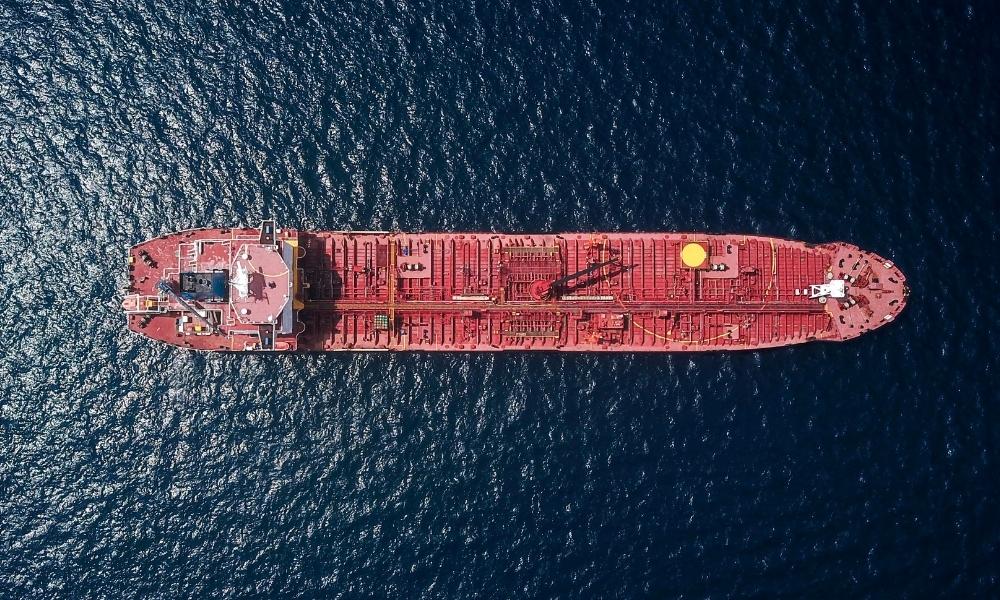
Low flashpoint found in Indonesia bunker fuels, alerts Maritec-Naias
Firm tested eight bunker samples representing LSMDO and B40 fuel grade from vessels that took fuel oil /bunkered in Indonesia ports, which indicated flashpoints as low as 39.5°C.
Methanol
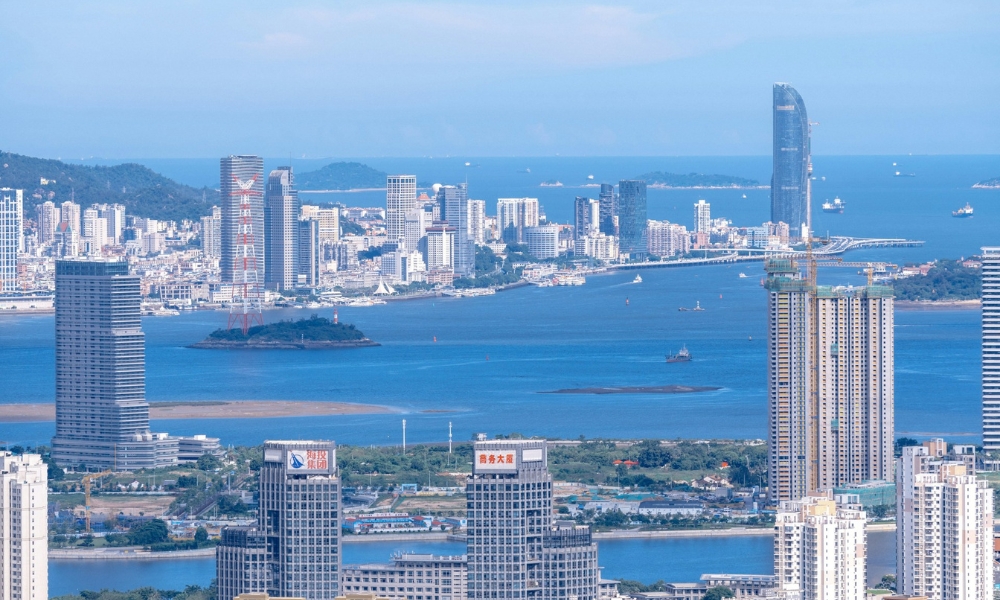
China: Xiamen issues safety guidelines for methanol bunkering operations
New guidelines establish safety requirements across the full methanol bunkering process, supporting the expansion of green marine fuel supplies at Xiamen Port.

OUR INDUSTRY PARTNERS

IBT Bunkering & Trading appoints Kevin Döhmen to lead Singapore expansion

Low flashpoint found in Indonesia bunker fuels, alerts Maritec-Naias

China: Xiamen issues safety guidelines for methanol bunkering operations

South Korea’s Polaris Shipping orders tri-fuel bulk carriers for Vale charter deal

Axpo and Vitol debut LNG bunkering operation at Italy’s largest cruise port

London forum to address critical bottlenecks holding back maritime decarbonisation

ENGINE: Europe & Africa Bunker Fuel Availability Outlook (12 August 2026)

Q&A: DNV’s Piyush Raj on building AI capabilities for maritime professionals

Singapore: Company, director to be charged over flag registration services for UN-sanctioned ship

ENGINE: East of Suez Fuel Availability Outlook (4 Aug 2026)

Singapore: Equatorial Marine Fuel among eight selected for new LNG bunkering licences
ENGINE: Europe and Africa Fuel Availability Outlook (5 August 2026)

ENGINE: Americas Fuel Availability Outlook (6 August 2026)

Singapore: Yuantai Fuel Trading sues Wee Tiong for over USD 1.1 million in unreturned vessel deposit
-
 Technology2 weeks ago
Q&A: DNV’s Piyush Raj on building AI capabilities for maritime professionals
-
 Legal2 weeks ago
Singapore: Company, director to be charged over flag registration services for UN-sanctioned ship
-
 Bunker Fuel Availability1 week ago
ENGINE: East of Suez Fuel Availability Outlook (4 Aug 2026)
-
 LNG Bunkering2 weeks ago
Singapore: Equatorial Marine Fuel among eight selected for new LNG bunkering licences
-
 Bunker Fuel Availability1 week ago
ENGINE: Europe and Africa Fuel Availability Outlook (5 August 2026)
-
 Bunker Fuel Availability6 days ago
ENGINE: Americas Fuel Availability Outlook (6 August 2026)
-
 Legal1 week ago
Singapore: Yuantai Fuel Trading sues Wee Tiong for over USD 1.1 million in unreturned vessel deposit
-

 Interview7 days ago
Exclusive: Caroline Yang takes helm on future of IBIA Asia