Connect with us

Methanol

Singapore releases new standard on methanol bunkering, gears up for multi-fuel future

MPA and EnterpriseSG, through SSC, have published a new TR 129 on Methanol Bunkering to provide a comprehensive framework for the safe and efficient use of methanol for bunkering operations.

Admin

Published

on

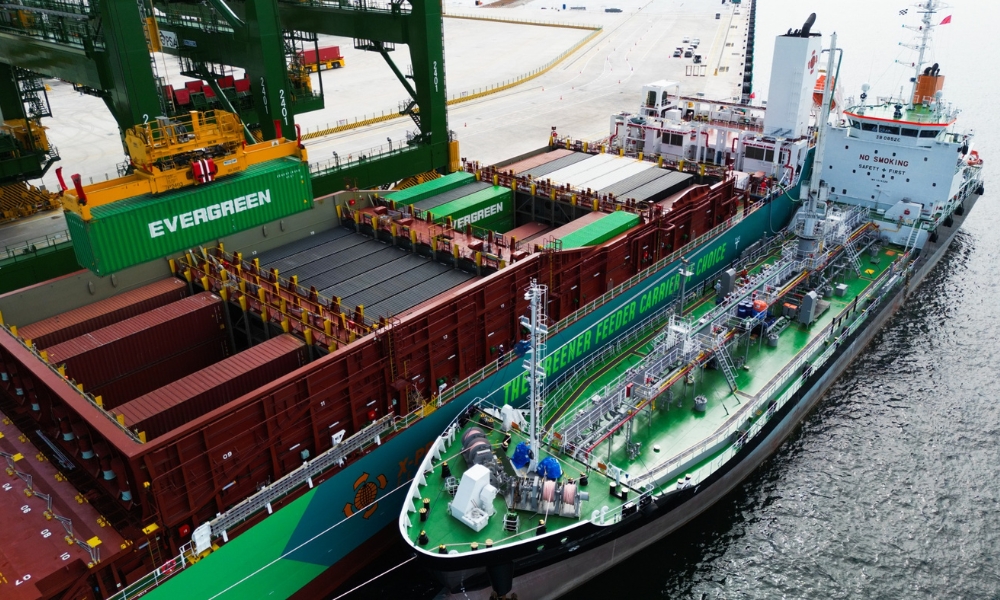
First SIMOPS methanol bunkering operation completed in Singapore on 27 May.
First SIMOPS methanol bunkering operation completed in Singapore on 27 May 2024

The Maritime and Port Authority of Singapore (MPA) and Enterprise Singapore (EnterpriseSG), through the Singapore Standards Council (SSC), on Monday (10 March) have published a new Technical Reference (TR) 129 on Methanol Bunkering to provide a comprehensive framework for the safe and efficient use of methanol as an alternative fuel for bunkering operations. 

Both said this marked an important step towards operationalising methanol bunkering at scale and driving Singapore’s ambitions as a sustainable, multi- fuel bunkering hub.

TR 129 sets out requirements covering safe handling, transfer, and measurement of methanol in bunkering operations. These include:

  • Custody transfer requirements, comprising quantity and quality measurements for ship-to-ship methanol bunkering operations;
  • Operational and safety requirements for the delivery of methanol from a bunker tanker to receiving vessels, including a framework for crew training and competencies; and
  • Guidance on the use of mass flow meters (MFM) to ensure accurate quantity management and digital documentation for bunkering.

TR 129 was developed by the Working Group (WG) on Methanol Bunkering, supported by the Standards Development Organisation at Singapore Chemical Industry Council (SDO@SCIC). The WG comprises government agencies, research institutes, and industry stakeholders such as bunker suppliers, bunker craft operators, engine manufacturers, testing and certification bodies, shipowners and operators, among others.

Mr David Foo, MPA Assistant Chief Executive (Operations/Operations Technology), said, “The development of the Technical Reference 129 on the safe and efficient use of methanol for bunkering in Singapore is the result of the collective efforts by government agencies, industry partners, and research institutes.”

“It provides clear guidelines to support the safe adoption of methanol as a marine fuel and gives the industry greater confidence in their transition to use of sustainable fuels.”

Ms Choy Sauw Kook, Director-General (Quality & Excellence), Enterprise Singapore, said: “Singapore’s reputation as one of the world’s leading bunkering hubs has always been underscored by our commitment to deliver safe, reliable and industry- first bunkering services.”

“TR 129 will help to equip our local operators with not only the capabilities, but confidence to carry out methanol bunkering operations, and pave the way towards a multi-fuel future in Singapore.”

Following the completion of the world’s first ship-to-container ship methanol bunkering operation in July 2023, MPA also conducted the first simultaneous methanol bunkering and cargo operations in May 2024 at Tuas Port with the use of the MFM system for methanol and digital bunkering. The learnings and experience gained, including in fuelling procedure, crew training, and emergency responses, contributed to the development of TR 129.

Interested parties can learn more on the standard and its implementation at an upcoming seminar, taking place on the sidelines of the Singapore Maritime Week 2025. More information on this can be found here

TR 129 can be purchased from the Singapore Standards e-shop here.

Manifold Times previously reported EnterpriseSG launching two new bunkering standards while revising a third benchmark at the 23rd Singapore International Bunkering Conference and Exhibition (SIBCON 2024).

It introduced TR on Methanol bunkering, SS on Specification for digital bunkering supply chain documentation, SS 648 Code of practice for bunker mass flow metering.

Related: SIBCON 2024: Singapore launches two new bunkering standards, revises third benchmark
Related: Singapore bunkering sector enters milestone with first methanol marine refuelling op
Related: First SIMOPS methanol bunkering operation completed in Singapore


Photo credit: Maritime and Port Authority of Singapore
Published: 10 March, 2025

Continue Reading

Methanol

World Fuel and partners complete first green methanol bunkering of car carrier in Shanghai

Operation involved the delivery of approximately 2,800 MT of green methanol to “Arctic Tern” via a ship-to-ship transfer using SIPG Energy’s dedicated methanol bunkering vessel “M/V Hai Gang Zhi Yuan”.

Admin

Published

on

By

World Fuel and partners complete first green methanol bunkering of car carrier in Shanghai

Marine fuel provider World Fuel on Tuesday (21 July) said it successfully completed the first green methanol bunkering of M/V Arctic Tern, with EUKOR Car Carriers and SIPG Energy at the Port of Shanghai. 

Arctic Tern is the first vessel in the new Shaper Class series of car carriers. 

The operation involved the delivery of approximately 2,800 MT of green methanol to Arctic Tern via a ship-to-ship transfer using SIPG Energy’s dedicated methanol bunkering vessel M/V Hai Gang Zhi Yuan, the largest vessel of its kind in operation. 

The bunkering operation was carried out at Haitong Terminal, Waigaoqiao Port Area, Shanghai Port, with cargo handling operations conducted simultaneously during bunkering.

This marks EUKOR Car Carriers’ first green methanol operation and the first time Arctic Tern has bunkered methanol since its delivery on 9 July. The operation marked the first bunkering at Shanghai Port of green methanol produced locally in Shanghai for an international PCTC operator. 

It also demonstrated the city’s integrated green methanol value chain, spanning local production, storage and bunkering, and established a replicable “Shanghai Model” for green methanol supply.

World Fuel arranged the supply and delivery of the fuel on behalf of EUKOR Car Carriers, working with SIPG Energy as the physical supplier at the Port of Shanghai.

The green methanol supplied was produced from municipal solid waste, ISCC-EU certified, and had a carbon intensity value below 25 gCO₂e/MJ.

Arctic Tern is the first of fourteen Shaper Class vessels ordered by Wallenius Wilhelmsen. With a capacity of 9,300 car equivalent units and methanol dual-fuel capability, the vessel will be operated by EUKOR Car Carriers, jointly owned by Wallenius Wilhelmsen and Hyundai Motor Group. Following her first green methanol bunkering, Arctic Tern will continue her maiden voyage from Asia to Europe.

Xavier Leroi, COO Shipping Services at Wallenius Wilhelmsen and CEO of EUKOR Car Carriers, said: “Completing Arctic Tern’s first green methanol bunkering shortly after delivery is a significant milestone towards our decarbonisation ambition for both EUKOR Car Carriers and Wallenius Wilhelmsen. It demonstrates how investments in next-generation vessel technology and fuel flexibility are being translated into real-world operations. 

“This achievement reflects the strong collaboration between all parties involved. Together, we have shown how partnerships across the maritime value chain can help make lower-emission fuels available and operationally viable at scale.”

Mark Tamsitt, SVP Global Marine Sales at World Fuel, said, “The first bunkering event with a new fuel is a significant moment for any shipowner, and our role is to make it as seamless as possible. By connecting EUKOR Car Carriers with SIPG Energy’s proven green methanol capability at the Port of Shanghai, we were able to deliver on reliable supply, fuel quality, and safe processes. As more of our customers bring methanol dual-fuel tonnage into service, we are committed to being the partner that makes these kinds of operations routine.”

Mr. Zhang Da, General Manager of SIPG Energy, said, “Welcoming Arctic Tern to the Port of Shanghai for her first green methanol bunkering demonstrates the strength and maturity of our supply capability. Building on our well-established methanol ship-to-ship bunkering services for container vessels, we have already extended such services to pure car and truck carriers (PCTCs). This bunkering sets a new record for the largest single SIMOPs green methanol bunkering for PCTCs in China, marking another step in building Shanghai’s position as a global green energy hub for international shipping.”

This operation follows Wallenius Wilhelmsen’s announcement on 9 July that Arctic Tern would complete her first methanol bunkering shortly after delivery. The vessel entered service on routes between Asia and Europe immediately following handover from China Merchants Jinling Shipyard in Nanjing.


Photo credit: World Fuel
Published: 22 July, 2026

Continue Reading

Methanol

Western Baltic Engineering unveils green methanol bunkering vessel design for Klaipėda

Designed for flexible operations in shallow waters and local bunkering routes, the concept features an 800-metric-tonne green methanol capacity and the potential to supply up to 250,000 mt annually.

Admin

Published

on

By

Western Baltic Engineering unveils green methanol bunkering vessel design for Klaipėda

Ship design and engineering service provider Western Baltic Engineering on Thursday (16 July) showcased its latest concept design for a green methanol bunkering vessel, developed for the operational needs of the Port of Klaipėda.

Designed for flexible operations in shallow waters and local bunkering routes, the concept features an 800-metric-tonne green methanol capacity and the potential to supply up to 250,000 metric tonnes (mt) annually. 

“It is Western Baltic Engineering’s first concept dedicated exclusively to green methanol bunkering, expanding our portfolio of alternative-fuel vessel solutions,” the company said in a social media post.

“Building on our experience in methanol-ready vessel design, it reflects our continued focus on enabling the industry’s transition to cleaner fuels.”

“As the maritime sector evolves, engineering companies have a responsibility not only to respond to market needs but also to anticipate future challenges,” said Marius Arkusauskas, Director at Western Baltic Engineering.

“By exploring emerging technologies and alternative fuel applications, we help our partners prepare for the next generation of maritime operations while contributing to a more sustainable future.”


Photo credit: Western Baltic Engineering
Published: 20 July, 2026

Continue Reading

Methanol

China launches methanol shipping supply chain alliance to accelerate green transition

Marine fuel suppliers in the alliance include Sinopec Fuel Oil Sales, China Marine Bunker (PetroChina), SIPG Energy (Shanghai), and Shenzhen Port Energy Development.

Admin

Published

on

By

China Flag

China Waterborne Transport Research Institute under the Ministry of Transport and China Transport News recently jointly launched a Methanol Fuel Shipping Supply Chain Innovation Alliance with 20 organisations spanning the shipping, port, energy, equipment, research and industry association sectors.

The alliance was officially announced during the main event of China Maritime Day 2026 on 11 July, where members also released a joint initiative to develop a collaborative methanol-fuelled shipping supply chain.

The alliance aims to implement China’s national strategy for green economic transformation and support the Ministry of Transport’s “One Network, Four Modernisations” initiative by building a safe, efficient, economical and reliable methanol marine fuel supply chain

Under the joint initiative, alliance members pledged to align with China’s national decarbonisation strategy by promoting methanol as a key pathway for the shipping sector’s green transition and optimising the industry’s energy mix.

The members also pledged to strengthen collaboration across the supply chain to improve coordination between bunker fuel production, transportation and end users while advancing technological innovation.

Lastly, the alliance will support the development of policies, planning and technical standards, promote resource sharing and joint research, and accelerate the large-scale adoption of methanol as a marine fuel.

The alliance brings together companies and organisations representing the entire methanol shipping supply chain.

Members include shipping and port members such as China Changjiang National Shipping (Group) Corporation, COSCO Shipping Bulk Co., Ltd., Shandong Port Group, and Wuhan Chuangxin Jianghai Shipping Co., Ltd.

Energy companies in the alliance include Sinopec Chemical Commercial Holding Company Limited and Methanex Corporation.

Marine fuel suppliers including Sinopec Fuel Oil Sales, China Marine Bunker (PetroChina), SIPG Energy (Shanghai) Co Ltd and Shenzhen Port Energy Development Co Ltd are also part of the alliance. 

Equipment manufacturers in the alliance are CSSC 711th Research Institute, CSSC Power (Group) Corporation Ltd and Chongqing Hongjiang Machinery Co Ltd.

Research, media and industry organisations participating in the alliance include the China Waterborne Transport Research Institute, China Transport News, and the Methanol Institute.

The Methanol Institute said methanol is moving beyond individual projects towards coordinated action across the entire value chain. 

“And China continues to play a leading role in advancing methanol as a marine fuel,” it said in a social media post.  

“We’re proud to work alongside our fellow alliance members to help strengthen the methanol supply chain and support the continued growth of methanol as a marine fuel.”


Photo credit: David Yu from Pixabay
Published: 17 July, 2026

Continue Reading

Trending