Connect with us

Hydrogen

Fincantieri to build two new hydrogen-powered ships for MSC Explora Journey fleet

“EXPLORA V” and “EXPLORA VI” will have new energy efficiency measures and will also be capable of using alternative bunker fuels such as bio and synthetic gas and methanol.

Admin

Published

on

277 2

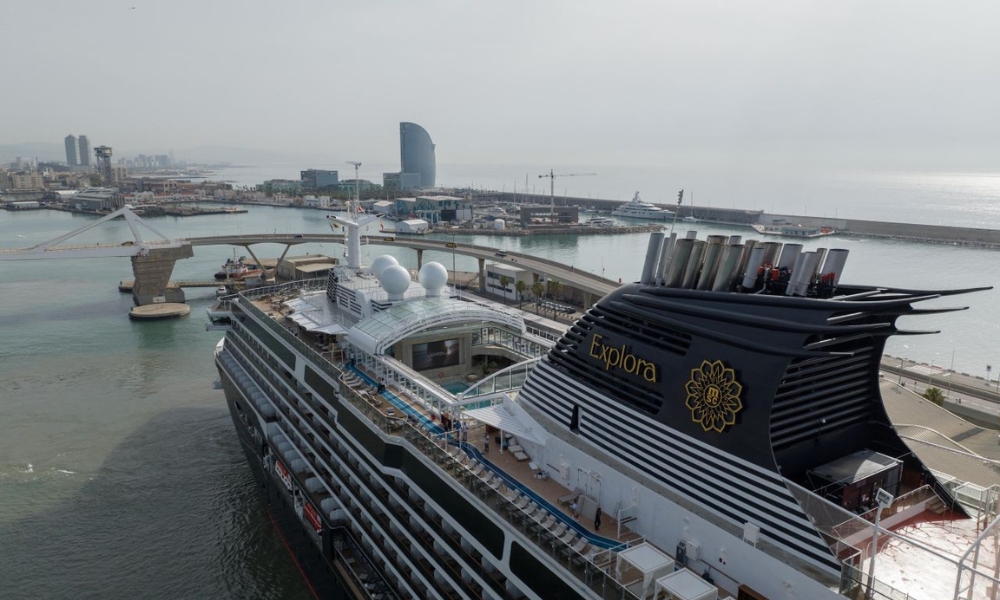
Italian shipbuilder Fincantieri on Thursday (21 September) said the Cruise Division of MSC Group confirmed firm orders for two hydrogen-powered vessels for its luxury travel brand Explora Journeys.

The deal completes a total investment of EUR 3.5 billion in six luxury ships for Explora Journeys. The contracts are subject to access to financing as per industry practice.

EXPLORA V and EXPLORA VI will have new energy efficiency measures and will also be capable of using alternative bunker fuels such as bio and synthetic gas and methanol and the Cruise Division will work in the future with Fincantieri to equip the ships with future technologies including carbon capture, and more advanced waste management systems. The two confirmed additions to Explora Journeys’ fleet will be delivered in 2027 and 2028.

Pierfrancesco Vago, Executive Chairman – Cruise Division, MSC Group, said, “With Explora Journeys we have created a luxury brand that has been successful at redefining luxury at sea. We are seeing continued growth in the luxury segment and the investment in these two new ships shows our commitment to continue to grow within this sector as well as to invest in ships of the future.”

“Together with Fincantieri we will study the newest technology that the world has to offer and continue with our commitment to introduce these technologies to drive efficiencies across the whole spectrum of ship performance.  And of course we will continue to deliver the very best luxury travel experience, immersing our guests in the ocean state of mind with an sustainable soul.”

Pierroberto Folgiero, Chief Executive Officer, Fincantieri, said “This new contract with MSC is a sign of the growing vitality of the cruise sector, in line with what we had predicted. In strategic terms, our future will depend on our ability to lead the evolution of the sector towards all energy and digital transition technologies with the entrepreneurship required to validate, industrialise and commercialise new solutions.”

“The relevance of the partnership with MSC in this sense is a great strategic stimulus towards the future in line with the technological development goals set out in our new business plan. We are therefore particularly proud that the Explora project will mark the acceleration of this new phase, which with the fifth and sixth ships, will reach the highest level of advancement, making Fincantieri’s vision of the ship of the future ever more concrete.”

The two new ships will pursue the use of liquid hydrogen with fuel cells for their hotel operations while docked in ports to eliminate carbon emissions with the vessels’ engines switched off. The ships will also feature a new generation of LNG engines that will further tackle the issue of methane slip with the use of containment systems.

Explora Journeys’ first ship, EXPLORA I was delivered by Fincantieri in July 2023 and is currently operating in Northern Europe.  The ship will spend the autumn in North America, and the winter in the Caribbean Sea.  She will sail during the spring 2024 off the U.S. West Coast and Hawaii before returning to Europe in summer 2024 for a series of journeys in the Mediterranean Sea.

EXPLORA II will enter service in summer 2024 and operate until April 2025 in the Mediterranean Sea, the Middle East, the Indian Ocean and Africa visiting 82 ports in 26 countries.  EXPLORA II first ‘touched water’ on 6 September 2023 at a ‘float out’ ceremony near Genoa in Italy.

EXPLORA III will enter service in summer 2026 and construction of the LNG-powered vessel started on 6 September 2023 with a steel-cutting ceremony.  Construction of LNG-powered EXPLORA IV will begin in January 2024 and will be completed in early 2027.

All six ships in Explora Journeys’ fleet will be equipped with the latest environmental and marine technologies and will also feature the latest selective catalytic reduction technology to enable a reduction of nitrogen oxide emissions by 90 per cent, be equipped with shore power plug-in connectivity to reduce emissions in port and fitted with underwater noise management systems to help protect marine life.  

All six vessels will also have a comprehensive range of onboard energy efficient equipment to optimise engine use to further reduce emissions.

Photo credit: Fincantieri
Published: 22 September, 2023

Continue Reading

Alternative Fuels

DNV: Alternative-fuelled vessel orders hit highest monthly level since October 2024

LNG-fuelled vessels accounted for the vast majority of August activity while the strong summer performance marked a significant acceleration in ordering activity after a relatively slow start to the year.
Admin

Published

on

By

DNV: Alternative-fuelled vessel orders hit highest monthly level since October 2024

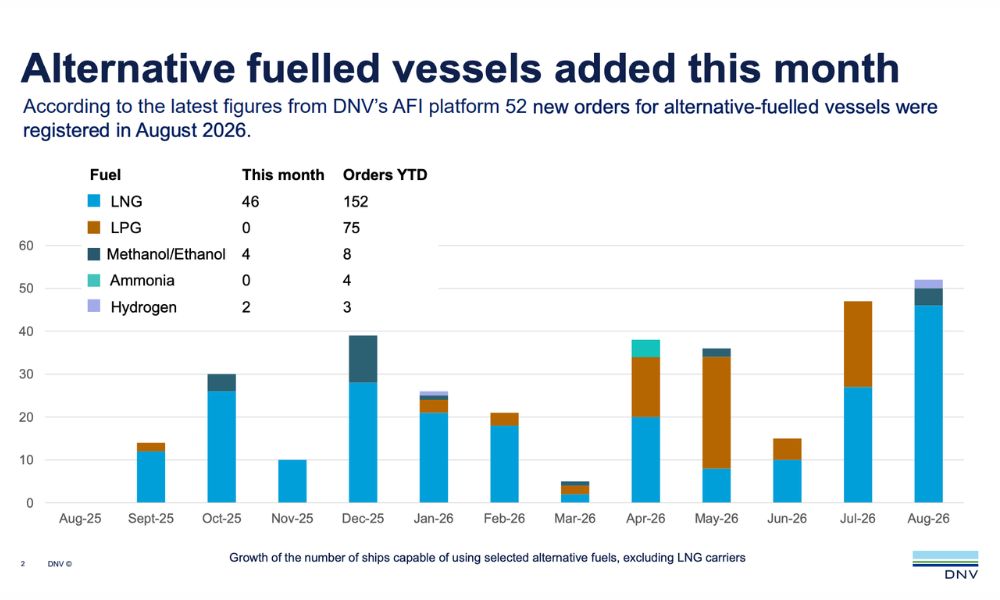
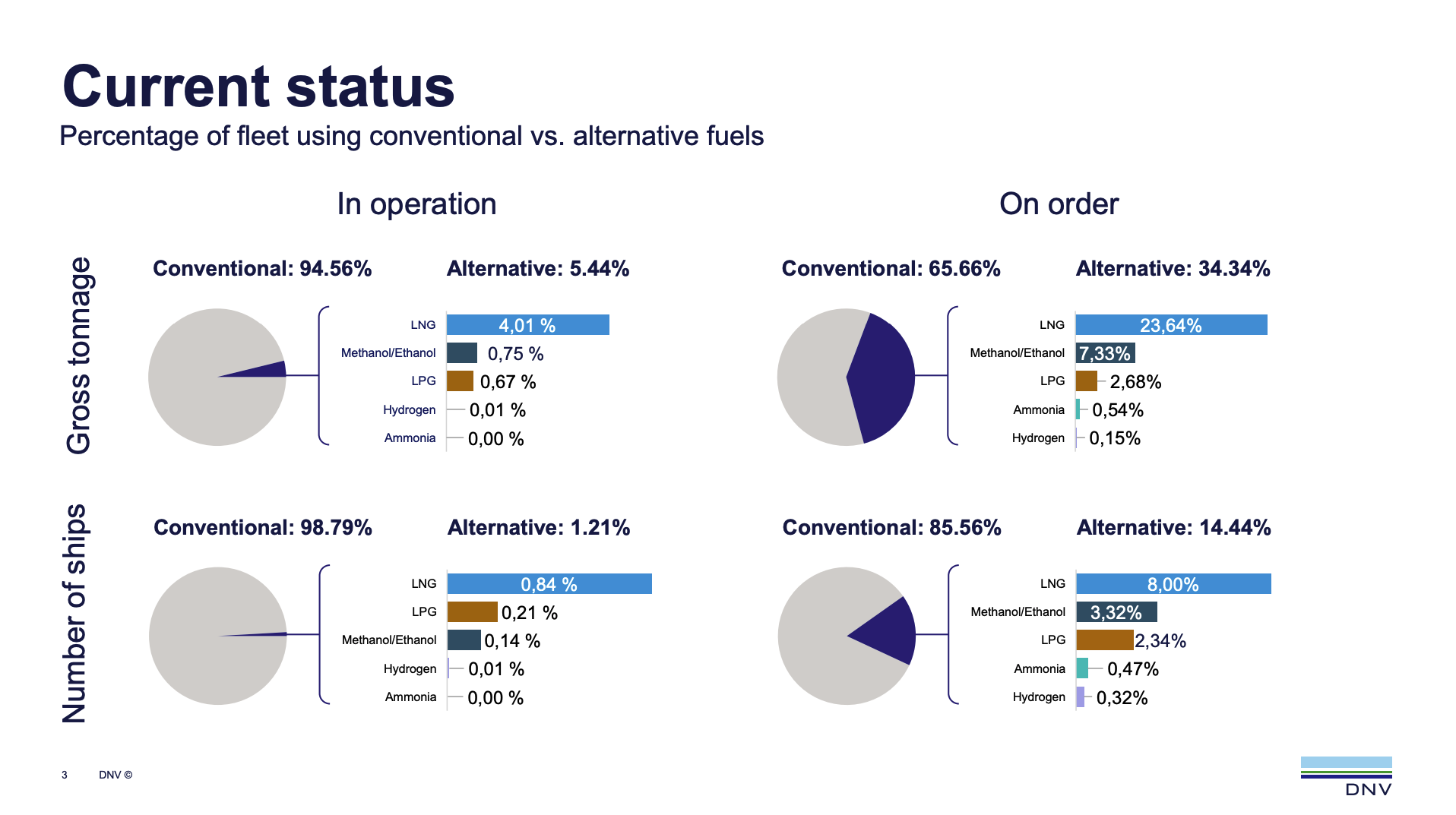
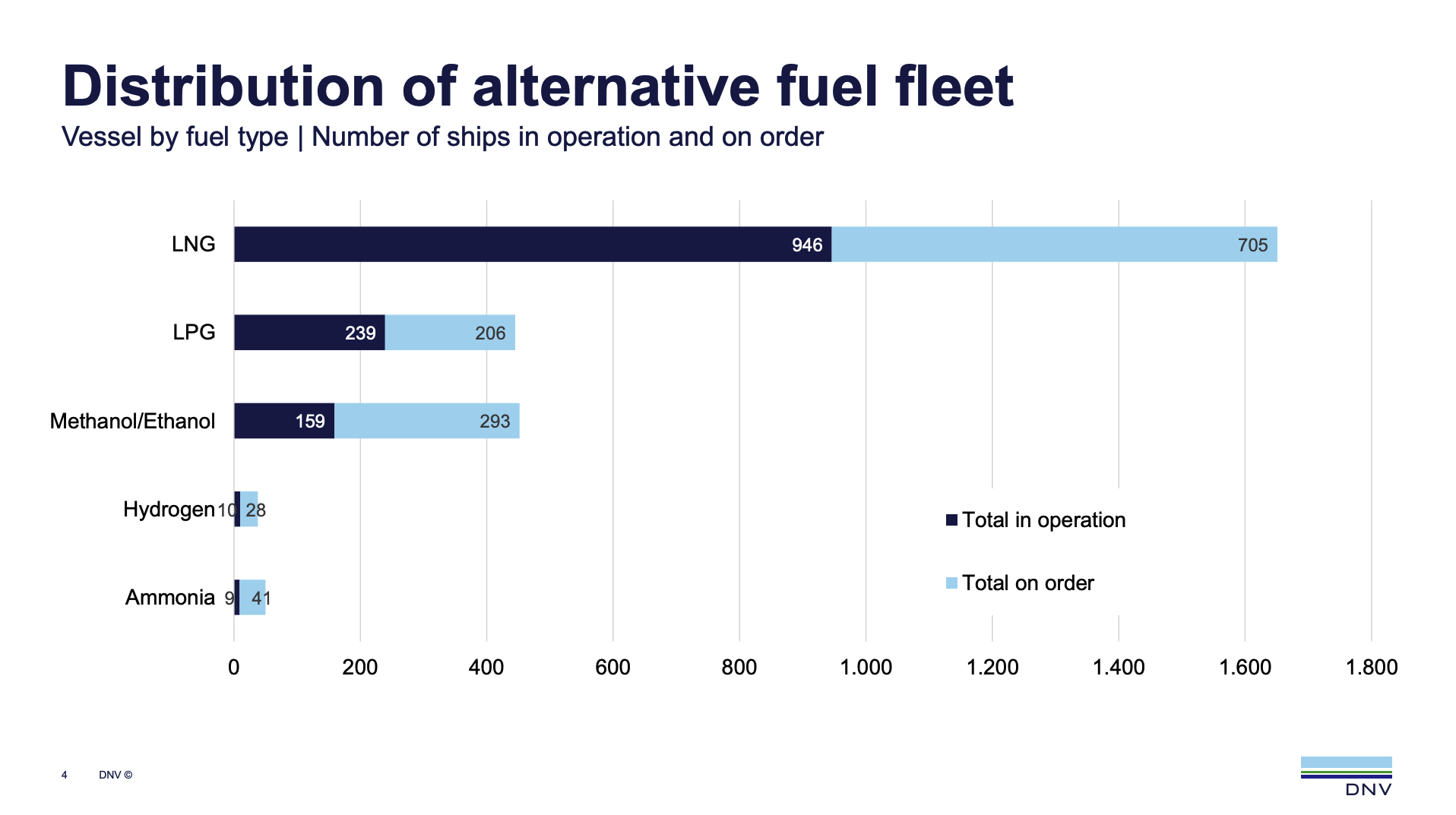
Latest data from classification society DNV’s Alternative Fuels Insight (AFI) platform alternative-fuelled vessel ordering was strong in August, with 52 new vessels added to the platform.

This is the highest monthly total since October 2024 and follows another active month in July, when 47 vessels were added to the database.

LNG-fuelled vessels accounted for the vast majority of August activity, with 46 orders recorded. The container segment led the way with 30 orders, while the car carrier segment contributed a further 12 LNG-fuelled vessels. In addition, four ethanol-fuelled bulk carriers and two hydrogen-powered bulk carriers were added during the month, as well as one LNG bunker vessel.

The strong summer performance marked a significant acceleration in ordering activity after a relatively slow start to the year. In total, 242 alternative-fuelled vessel orders have been placed in the first eight months of 2026, representing a 27% increase compared with the same period in 2025.

LNG remains the dominant fuel choice, accounting for 63% of all alternative-fuelled vessel orders registered so far this year. Container vessels represent the largest share of these LNG orders (59%), followed by car carriers (30%).

Jason Stefanatos, Global Decarbonization Director at DNV Maritime, said: “The past two months have been particularly strong for alternative-fuelled vessel ordering, with August recording the highest monthly total we’ve seen since October 2024. This has helped lift year-to-date orders to a level well above the same period last year.

“LNG remains the leading fuel choice, driven largely by activity in the container and car carrier segments. These sectors have been among the earliest adopters of alternative fuels, supported by predictable liner operations and increasing demand from cargo owners to reduce emissions across supply chains. 

“For many owners, LNG offers a combination of emissions reductions, fuel availability and future flexibility while the longer-term fuel landscape continues to evolve. 

“At the same time, the latest figures include orders for ethanol- and hydrogen-fuelled vessels, highlighting that owners continue to explore a range of decarbonization pathways. Different segments are making different fuel choices, but the overall level of activity demonstrates continued investment in lower-emission shipping.”
Screenshot 2026 09 04 at 12.29.26 PM Screenshot 2026 09 04 at 12.29.36 PM


Photo credit: DNV
Published: 4 September, 2026

Continue Reading

Alternative Fuels

ClassNK updates safety guidelines for alternative-fuelled ships

The classification society says it has revised the safety requirements within its guidelines for ships using methanol, ethanol and hydrogen as marine fuels.
Admin

Published

on

By

RESIZED Venti Views on Unsplash

Classification society ClassNK on Tuesday (18 August) said it has revised the safety requirements within its guidelines for ships using methanol, ethanol and hydrogen as marine fuels. 

In Part D of the guidelines, covering hydrogen-fuelled ships, the revision incorporates the Interim Guidelines for the Safety of Ships Using Hydrogen as Fuel (MSC.1/Circ.1701) issued by the IMO this year, and additionally introduces a hydrogen leak frequency table that can be used for the safety assessments required under the IMO guidelines. 

In Part A, covering methanol and ethanol-fuelled ships, new structural strength requirements for methanol/ethanol fuel tanks—which are not addressed in the IMO guidelines—have been established. 

“Through this revision, shipyards, designers, and shipowners can carry out design and safety assessments in line with the latest international standards, and by utilizing ClassNK’s own leak frequency estimates and the relevant requirements, they can proceed the development of alternative-fuelled ships in a more rationally,” ClassNK said in a statement. 

As the building of alternative-fuelled ships advances in response to the global challenge of reducing GHG emissions, ClassNK has comprehensively compiled the safety requirements for ships using methanol, ethanol, LPG, ammonia, and hydrogen—fuels regarded as promising alternatives—and has issued the guidelines. 

“Taking into account the risks that the use of alternative fuels poses to the environment, seafarers, and ships, the guidelines set out requirements for equipment, controls, and safety devices to minimize such risks,” it added. 

With the issuance of the IMO guidelines for hydrogen-fueled ships (MSC.1/Circ.1701), ClassNK said it has fully incorporated the IMO guidelines to make the guidelines more user-friendly for shipyards, designers, and shipowners, while also enhancing the requirements serving as design and assessment guidance for other alternative fuels. 

In the development of the IMO guidelines, now reflected in Part D, ClassNK participated as a member of the Japanese delegation to the IMO Sub-Committee CCC 11 and contributed to the discussions.

Note: The Guidelines for Ships Using Alternative Fuels (Edition 3.1)  can be viewed under “Guidelines” on My Page by registering as a user on the ClassNK website. 


Photo credit: Venti Views on Unsplash
Published: 20 August, 2026

Continue Reading

Alternative Fuels

Germany launches EUR 70 million funding programme for green inland shipping corridors

Eligible projects include the installation of zero- or low-emission propulsion systems on newbuild and existing cargo vessels, as well as investments in port infrastructure for alternative fuels.
Admin

Published

on

By

Maxime Vandenberge on Unsplash

Germany’s Federal Ministry for Transport (BMV) recently opened the first funding call under its new programme for green inland navigation, with up to EUR 70 million (USD 81 million) available for projects to develop green inland shipping corridors.

The funding will support the deployment of zero- and low-emission inland vessels and the development of associated infrastructure. 

Eligible projects include the installation of zero- or low-emission propulsion systems on newbuild and existing cargo vessels, as well as investments in port infrastructure for alternative fuels such as hydrogen, ammonia and methanol.

Funding will also cover facilities for producing renewable electricity and renewable hydrogen, along with storage systems. Infrastructure at transhipment and berthing facilities outside ports, including charging, refuelling and mobile supply equipment, is also eligible.

Companies, municipalities and other economically active organisations based in Germany can apply under the first funding call, which focuses exclusively on establishing green inland shipping corridors. Applications opened on 17 August through the German government’s easy-Online funding portal.

The initiative is also intended to encourage a greater shift of freight and passenger transport to inland waterways, while supporting Germany’s climate targets, European alternative-fuels infrastructure requirements and the long-term competitiveness of the country’s inland shipping sector.


Photo credit: Maxime Vandenberge on Unsplash
Published: 18 August, 2026

Continue Reading

Trending