Connect with us

Alternative Fuels

Anglo-Eastern launches LNG and ammonia bunkering station skid for training

Skid, which is placed in India, is designed to provide hands-on training in the safe and efficient fuelling of LNG- and ammonia-powered vessels and to replicate real-world bunkering operations.

Admin

Published

on

Anglo-Eastern launches LNG and ammonia bunkering station skid for training

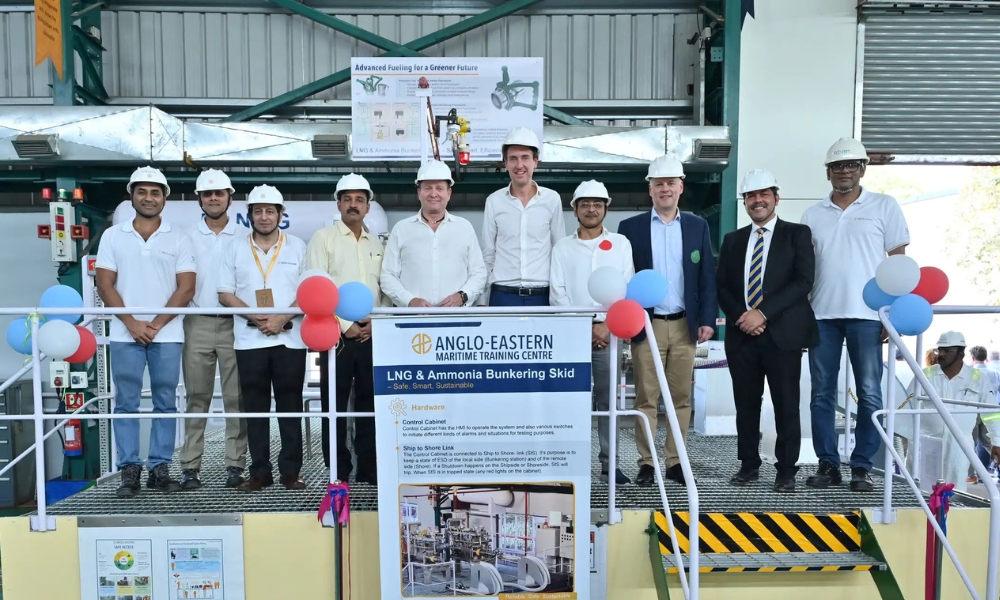
Anglo-Eastern, global provider of independent ship management services, on Monday (3 March) announced the establishment of a new Liquefied Natural Gas (LNG) and ammonia bunkering station skid at Anglo-Eastern Maritime Academy (AEMA) located in Karjat, Mumbai.

The skid is designed to provide hands-on training in the safe and efficient fuelling of LNG- and ammonia-powered vessels. 

Equipped with the latest cryogenic fuelling technology and safety systems, the skid provides a controlled environment for training in LNG and ammonia transfer operations, emergency response procedures, and regulatory compliance. 

It is designed to replicate real-world bunkering operations, delivering essential education and skill development for those working in the rapidly expanding field of alternative marine fuels.

The bunkering station skid is the newest addition to the dual-fuel centre of excellence at Anglo-Eastern Maritime Academy and was inaugurated by Alexander Saverys, CEO at CMB.TECH on 20 Feb.

Capt. Aalok Sharma, Group Director of Training at Anglo-Eastern, said: “We are thrilled to introduce this LNG/Ammonia bunkering station skid as part of our commitment to shaping the future of maritime fuel safety and efficiency.”

“As the industry transitions toward sustainable fuels, the need for well-trained professionals has never been greater. This new facility will equip maritime personnel with the knowledge and hands-on experience required to meet the challenges of LNG and ammonia bunkering.”

The training programme, utilising the newly launched bunkering station skid, provides exposure to not only seafarers but also to stakeholders based ashore, placing them in a better position to support their onboard teams.


Photo credit: Anglo-Eastern
Published: 5 March, 2025

Continue Reading

Alternative Fuels

TMD Energy and Double Corporate extend MOA to advance green bioenergy collaboration

Malaysia- and Singapore-based marine fuel bunkering services provider TMD Energy announced a two-year extension of its MOA with bioenergy firm Double Corporate.
Admin

Published

on

By

TMD Energy logo

Malaysia- and Singapore-based marine fuel bunkering services provider TMD Energy Limited (TMDEL), together with its subsidiaries on Monday (8 June) announced a two-year extension of its Memorandum of Agreement (MOA) with bioenergy firm Double Corporate Sdn Bhd (Double Corporate) to explore strategic collaboration for the EU and Asia markets.

Initially signed on 18 June 2025, the MOA establishes a framework for a proposed collaboration on sustainable bioenergy fuel solutions by both parties. While the original agreement was set for a one-year term, this extension adds an additional two years to the MOA from its current expiry date, maintaining all original terms and conditions.

This extension grants both parties additional time to continue discussions, comprehensively evaluate the proposed collaboration and explore potential participation in Malaysia and global markets with a two-year exclusivity period, and negotiate toward the execution of definitive agreements.

“We are pleased to extend our partnership with Double Corporate,” said Dato’ Sri Kam Choy Ho, Director and Chief Executive Officer of the Company. 

“This extended timeframe allows us to continue advancing discussions on a potential collaboration that integrates Double Corporate’s innovative waste-to-energy technologies and our expanding footprint in the global marine fuel market.”

Double Corporate is a ISCC-EU certified Malaysian-based bioenergy company specialising in waste-based bioenergy and it involves converting waste into high-yield sustainable fuels and lubricants using proprietary, ISCC-EU-approved technology. 

Related: TMD Energy and Double Corporate to negotiate on bioenergy sustainable fuel solutions deal


Photo credit: TMD Energy
Published: 10 June, 2026

Continue Reading

Decarbonisation

Aderco: Sustainable shipping without the spin

Esteve Servajean says maritime industry commitment must extend to delivering greater data transparency and measurable action to prevent decarb projects from becoming mere exercises in optics.

Admin

Published

on

By

Esteve Servajean, Head of Marine, Aderco

To meet the IMO’s emissions reduction targets, maritime industry commitment must extend to delivering greater data transparency and measurable action to prevent decarb projects from becoming mere exercises in optics, writes Esteve Servajean, Head of Marine at fuel treatment technology specialist Aderco:

While the maritime sector often expresses its commitment to the International Maritime Organization’s (IMO’s) Net Zero ambitions and 2030/2050 targets, rhetoric and reality also frequently diverge. In many respects, our sector is a laggard among global industries where emissions are concerned and needs to take a hard, honest look at itself  – or risk falling even further behind by clinging to outdated concepts, strategies and technologies.

Conventionally, ship ‘efficiency’ has been measured in fuel cost per tonne-mile. However, although many have yet to grasp the fact,  this metric is becoming obsolete. Today, the true efficiency of a ship is measured in multiple parameters, which encompass fuel cost and emissions from the stack but also include lifecycle emissions (plus upstream fuel production and vessel disposal), real-time carbon transparency, and the social and regulatory requirements for navigating relationships with ports, financial institutions and cargo owners.

At Aderco, we see this transformation daily. Five years ago, operators primarily spoke to us about fuel savings; today, they demand proven emissions reduction solutions, compatibility with future fuels and verifiable contributions to ESG performance. Companies still measuring efficiency on a single axis are already falling behind.

The future is multi-fuel

Let’s dispel another outdated misperception causing more harm than good: the belief that a single, specific alt-fuel will deliver Net Zero for maritime within the next two decades. The future is multi-fuel, and shipowners must accept and plan for that, ensuring a high degree of flexibility when assessing their options.

Accepting this proposition, it is still fair to ask what the point is of investing in a specific fuel if the ship may operate in regions where the portside infrastructure for that fuel is lacking. The truth is, the availability of green methanol, bio-LNG and ammonia at scale is years behind schedule, even at the major ports that drive global trade. For this reason, shipowners should lean towards investments into dual-fuel configurations where commercially viable and avoid long-term supply contracts tied to a single fuel.

It is not all about fuel selection; operational optimisation remains the most actionable lever today, from engine condition management and real-time fuel consumption monitoring to efficient voyage planning. Even simpler measures, including the application of high-performance anti-fouling coatings, wind-assisted propulsion systems and underwater turbines, are now part of the conversation. Various practical and complementary solutions can be implemented immediately without waiting for new fuel infrastructure to catch up.

The industry must therefore resist the temptation to standardise too early. Instead, it should build flexible, adaptive strategies that can evolve as the landscape changes. Most importantly, while some uncertainty regarding future fuels is natural, it must never become an excuse for inaction.

Regulatory fragmentation

On the regulatory side, FuelEU Maritime, the Carbon Intensity Indicator (CII) and the IMO’s revised greenhouse gas reduction strategy have created a framework shipowners cannot ignore. However, while shipowners are pragmatic investors, they need a clear regulatory framework and a long-term vision before they commit capital with confidence.

At present, regulatory fragmentation is a serious obstacle. The IMO sets global ambitions, but the EU is advancing on its own timeline and with its own instruments. This is forcing shipowners operating under multiple jurisdictions to navigate numerous, sometimes contradictory regulatory frameworks simultaneously.

The skills and data gap is also severely underestimated. Achieving 2030 and 2050 milestones will require not just new hardware, but new competencies in fleet management, data analytics and carbon accounting. The maritime sector is only starting to take this human capital challenge seriously.

Equally important is investment in data infrastructure. Reliable energy consumption, emissions and performance data is a crucial competitive asset, regardless of the alt-fuel selected. Unavoidably, the answer must make economic sense.

Get off the sidelines

To resolve regulatory fragmentation, only IMO can implement a carbon levy framework on a global basis. A credible, maritime-specific carbon credit scoring system could unlock capital, reward early adopters and create genuine behavioural incentives across the supply chain.

To be credible, though, this system must be built on real, verifiable data, not theoretical models, and must connect meaningfully to financial instruments to have actual market impact. We have seen too much greenwashing in other sectors, with initiatives often prioritising optics over actual emissions reductions. Maritime must therefore acknowledge its historically poor emissions data quality, get off the sidelines and take urgent action to fix it.

Fortunately, European green finance is proving a major accelerator. Instruments such as green bonds, sustainability-linked loans and the Poseidon Principles have moved into the mainstream and are now influencing key boardroom decisions. While stranded asset risk is real, so is the danger of losing competitive ground. The best approach is to focus on what can be actioned today, build flexibility into investment choices and stay closely aligned with regulatory and customer expectations. Any successful drive towards Net Zero relies on a fine balancing act between regulation and market forces.

The companies that help define credible standards will be far better positioned than those that react to them later. However, and it cannot be overemphasised, the bar for ‘credible’ must be high, incorporating transparency, independent verification and a direct link to measurable emissions outcome. Without that, we risk creating another layer of complexity with no clear impact.


Photo credit: Aderco
Published: 10 June, 2026

Continue Reading

Alternative Fuels

Maersk advances ethanol fuel trials with larger-scale Rotterdam bunkering

Its first dual‑fuel vessel, “Laura Maersk”, is operating on 100% ethanol for the second time after being supplied through a larger-scale delivery by barge.
Admin

Published

on

By

image 5

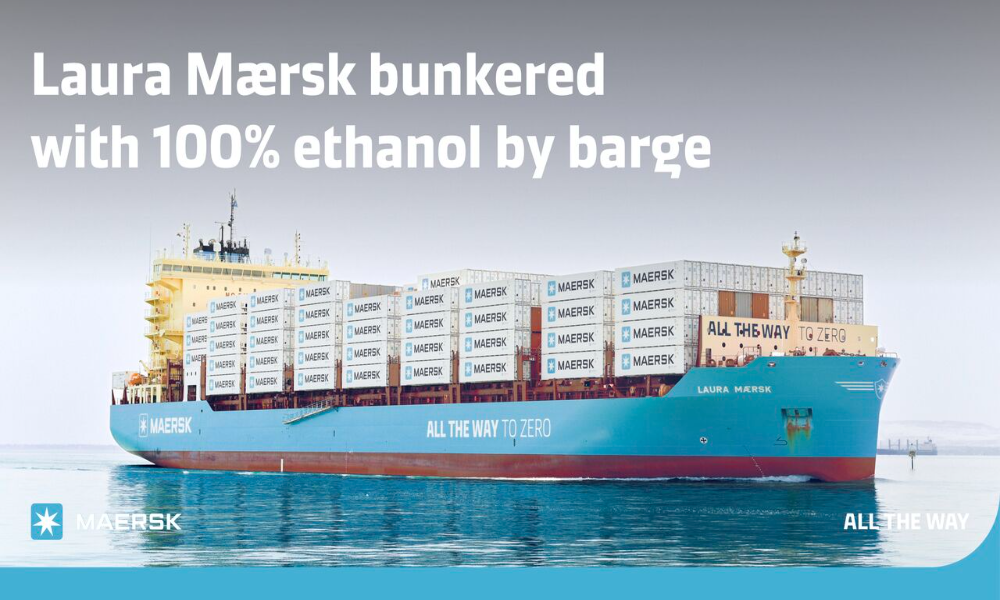
Shipping giant A.P. Moller – Maersk (Maersk) on Friday (5 June) said a new milestone in its marine fuel trials, with its dual-fuel feeder vessel Laura Maersk successfully operating on 100% ethanol for a second time.

The latest trial marked a significant step forward from earlier tests, as the vessel was supplied through a larger-scale bunkering operation conducted by barge in Rotterdam.

“The bunkering, which took place in Rotterdam, involved larger‑scale delivery by barge, allowing us to test operational handling, supply chains and procedures closer to real‑world conditions than in earlier, smaller‑scale trials,” it said. 

The company said ethanol is one of several pathways being explored as it works to diversify its low‑emission portfolio. 

“With a growing dual‑fuel fleet, we continue to learn and to build flexibility and optionality by testing different solutions,” Maersk added. 


Photo credit: A.P. Moller – Maersk
Published: 9 June, 2026

Continue Reading

Trending