Connect with us
DNV Decarbonization Insight Series August 2026 - What maritime professionals should know about AI Training

Bunker Fuel

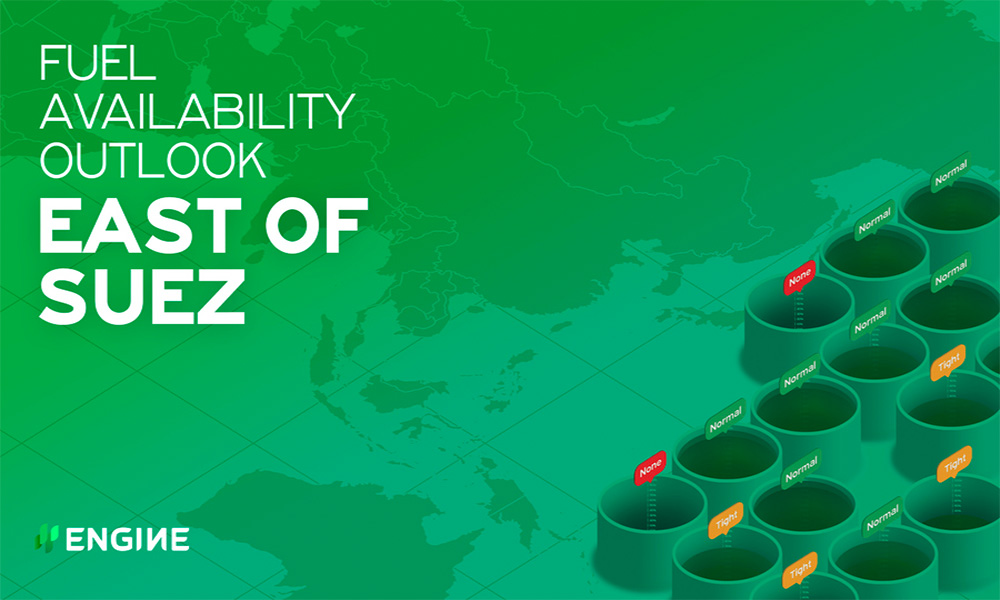
ENGINE: East of Suez Bunker Fuel Availability Outlook (9 June 2026)

VLSFO availability tight in Singapore; VLSFO and LSMGO availability good across several Taiwanese ports; bunker demand low in several South Korean ports.

Admin

Published

on

RESIZED ENGINE East of Suez

The following article regarding regional bunker fuel availability outlook for the East of Suez region has been provided by online marine fuels procurement platform ENGINE for publication on Singapore bunkering publication Manifold Times:

  • VLSFO availability tight in Singapore
  • VLSFO and LSMGO availability good across several Taiwanese ports
  • Bunker demand low in several South Korean ports

Singapore and Malaysia

VLSFO supply in Singapore remains constrained, with suppliers advising lead times of 8–14 days, a slight improvement from 10–15 days reported last week. HSFO availability has improved marginally, with lead times shortening to 5–12 days from 10–15 days previously. By contrast, LSMGO supply has tightened, with recommended lead times extending from around seven days last week to 9–14 days.

In Malaysia’s Port Klang, VLSFO availability remains broadly stable, particularly for smaller prompt requirements. LSMGO remains difficult to secure due to tight supply, while HSFO availability is still limited, leaving both grades under pressure.

East Asia

Bunker availability in Zhoushan remains under pressure despite subdued demand, with VLSFO lead times unchanged at 7–10 days. Supply conditions for LSMGO and HSFO have improved, with recommended lead times easing to 3–5 days from 4–7 days a week ago.

Elsewhere in northern China, supply conditions vary by port. Suppliers in Dalian and Qingdao have ample stocks of VLSFO and LSMGO, although HSFO remains difficult to secure in Qingdao. All fuel grades are in tight supply in Tianjin, while VLSFO and HSFO availability is tight in Shanghai. LSMGO supply in Shanghai remains comparatively stable.

In southern China, VLSFO and LSMGO supply remains constrained in Fuzhou. Xiamen has adequate VLSFO supply, but LSMGO availability is tighter. Similar supply pressures persist in Yangpu and Guangzhou, where both grades remain limited.

Hong Kong’s bunker market remains largely stable, with lead times for all grades holding steady at around seven days in recent weeks.

Meanwhile, Taiwan’s state-owned supplier CPC Corporation has temporarily halted new VLSFO nominations at Keelung port due to urgent maintenance work on its storage tanks and pipeline infrastructure. The restriction applies to deliveries scheduled on or before 14 June. LSMGO supply at the port remains unaffected.

Supply conditions at Taiwan’s other major ports – Hualien, Taichung and Kaohsiung – remain stable. Recommended lead times for both VLSFO and LSMGO are around two days, largely unchanged from last week.

In South Korea, bunker demand has weakened as elevated prices encourage buyers to source fuel from neighbouring markets, according to a local trader. Across southern ports including Busan, Ulsan, Masan, Onsan, Yeosu and Kwangyang, VLSFO and LSMGO lead times have extended to 3–10 days from about three days previously. HSFO availability has tightened considerably, with lead times widening to 9–11 days.

Supply conditions have also deteriorated across western ports, including Incheon, Daesan, Dangjin, Pyeongtaek and Taean. Lead times for VLSFO and LSMGO have increased to 3–9 days, while HSFO is now available only upon enquiry.

Weather-related disruptions remain a concern in the country, with operational delays forecast in Yeosu on 11 June and in Daesan between 13–14 June.

Japan’s bunker market has shown modest signs of improvement. Fuel oil remains available in Tokyo Bay, Nagoya and parts of western Japan, including Oita, Tokuyama and Mizushima, although supply is still limited to a small number of suppliers. Despite the broader market remaining tight, these pockets of availability indicate some easing of supply constraints.

Across major Japanese ports such as Tokyo, Chiba, Kawasaki, Nagoya, Mizushima, Tokuyama, Oita and Yokkaichi, recommended lead times stand at 7–10 days for HSFO and 10–12 days for VLSFO. In Osaka, Kobe and Kashima, both grades continue to be supplied only on a case-by-case basis.

By contrast, Indonesia’s bunker market remains relatively well supplied. VLSFO availability is steady in Jakarta, Surabaya, Balikpapan and Cigading, with suppliers generally recommending lead times of around three days.

Oceania

In Western Australia, VLSFO remains available at Kwinana and Fremantle, with suppliers generally recommending lead times of about seven days. Bunker deliveries at both ports are carried out by barge and are currently supported by a single supplier.

Supply dynamics vary along Australia’s east coast. In New South Wales, Port Kembla can receive VLSFO through truck or pipeline deliveries, while Sydney continues to maintain sufficient stocks of both VLSFO and LSMGO. HSFO availability in Sydney remains limited, with suppliers typically requiring around seven days’ notice.

In Queensland, VLSFO and LSMGO are available in Brisbane and Gladstone, where lead times are also around seven days. Further south, Melbourne and Geelong continue to report healthy VLSFO inventories. However, bunker operations at both ports rely on a single barge, resulting in recommended lead times of roughly one week.

HSFO stocks are running critically low in both Melbourne and Brisbane.

One supplier recommends lead times of approximately five days for all fuel grades across Brisbane, Sydney and Melbourne. In Dampier, bunker operations continue to depend on truck-assisted pipeline deliveries, making advance booking and berth confirmation particularly important, according to a source.

New Zealand’s bunker market remains largely unchanged. VLSFO is readily available in Tauranga and Auckland, with suppliers recommending lead times of around four days. At Marsden Point, both VLSFO and LSMGO can be delivered directly to vessels via pipeline.

Weather remains a key operational risk across New Zealand. Bunker deliveries are particularly susceptible to disruptions in Wellington and at ports across the South Island.

South Asia

Lead times of approximately seven days are currently recommended for all three bunker fuel grades across several Indian ports, according to a source.

Adverse weather conditions are expected to affect operations at several Indian ports over the coming days, potentially causing disruptions to bunker deliveries. Delays are forecast at Kandla and Sikka between 9–13 June, while high waves are expected to impact Cochin and Visakhapatnam during the same period. Similar weather-related challenges are also anticipated in Mumbai between 10–13 June.

In Sri Lanka, bunker supply conditions remain steady. Colombo and Hambantota continue to maintain healthy inventories across all fuel grades, with at least one supplier able to deliver stems within approximately five days, broadly in line with last week.

However, weather-related disruptions remain a risk, with bunker operations in Colombo and Trincomalee likely to face intermittent impacts until 13 June.

Middle East

Bunker supply in the UAE’s Fujairah port has tightened considerably. HSFO and LSMGO availability is extremely tight, while VLSFO is being offered only on an enquiry basis. Similar supply constraints are being reported at nearby Khor Fakkan.

Elsewhere in the UAE, port operations at Jebel Ali, Hamriyah and Sharjah continue without disruption, according to Inchcape Shipping. Ports in Ras Al Khaimah are also operating normally, although the RAK Ports Authority has continued to impose a marine risk surcharge on vessels calling at its ports, harbours and anchorages since March.

In Kuwait, port operations at Shuaiba and Shuwaikh continue without disruption despite ongoing tensions in the Middle East.

No formal operational advisories have been issued by Saudi Arabian ports. In Jeddah, VLSFO availability remains constrained, while LSMGO supply is comparatively stable. However, rough weather conditions could disrupt bunker operations in Yanbu between 10–13 June.

Qatar restored round-the-clock maritime navigation for all vessel types at the start of May, according to Inchcape Shipping. Availability of VLSFO and LSMGO remains tight at Ras Laffan.

Oman continues to offer strong prompt supply of LSMGO. One supplier is recommending lead times of just 1–2 days across key ports including Duqm, Muscat, Sohar and Salalah.

Egyptian ports are functioning normally. At Port Suez, VLSFO stocks are nearing depletion, while inventories of LSMGO and HSFO remain sufficient.

Availability of VLSFO and LSMGO remains tight in Djibouti. Meanwhile, port and bunker operations across Jordan, Iraq, Cyprus, Pakistan and Lebanon continue to proceed normally, according to Inchcape Shipping.

By Tuhin Roy


Photo credit and source: ENGINE
Published: 10 June, 2026

Continue Reading

LNG Bunkering

Shanghai Port surpasses 2 million m³ LNG bunkering milestone with PIL vessel

Achievement was reached on 25 July when PIL’s “Kota Eagle” vessel received 4,549 m3 of LNG marine fuel from SIPG Energy’s LNG bunkering vessel at the Lvhuashan Anchorage off the coast of Shanghai.

Admin

Published

on

By

Shanghai Port surpasses 2 million m³ LNG bunkering milestone with PIL vessel

Shanghai Port has surpassed 2 million cubic metres (m³) of cumulative LNG bunkering volume, with Pacific International Lines’ (PIL) Kota Eagle participating in the milestone operation, the Singapore-based container operator said on Monday (3 August). 

The company said the achievement was reached on 25 July when PIL’s Kota Eagle vessel received 4,549 m3 of LNG marine fuel from SIPG Energy’s LNG bunkering vessel at the Lvhuashan Anchorage off the coast of Shanghai, China.

“As part of our commitment to decarbonisation, PIL is modernising our fleet by investing in LNG dual-fuel vessels,” it said.

“Delivered in 2024, Kota Eagle is PIL’s first LNG dual-fuel container vessel, and it also completed its maiden LNG bunkering operation at Shanghai’s Yangshan Port. To date, we have taken delivery of nine LNG dual-fuel newbuild vessels.” 

PIL added that the landmark achievement by Shanghai Port reflects its rapidly growing bunkering capabilities, which provide the critical support needed for the efficient operation of our expanding fleet of greener vessels. 


Photo credit: Pacific International Lines
Published: 3 August, 2026

Continue Reading

Methanol

China’s first domestically developed Ultramax methanol dual-fuel bulker pair named

SDARI says two 65,000 dwt methanol dual-fuel bulk carriers, “LEM AZALEA” and “LEM PLUMERIA”, were named on 27 July at Guangzhou’s Nansha district.

Admin

Published

on

By

China's first domestically developed Ultramax methanol dual-fuel bulker pair named

Shanghai Merchant Ship Design and Research Institute (SDARI) on Wednesday (29 July) said two 65,000 dwt methanol dual-fuel bulk carriers, LEM AZALEA and LEM PLUMERIA, were named on 27 July at Guangzhou’s Nansha district.

The vessels were designed by the SDARI, part of China State Shipbuilding Corporation (CSSC), for Cyprus-based Lemissoler Navigation and built by CSSC Huangpu Wenchong Shipbuilding.

According to SDARI, the vessels are the institute’s first methanol dual-fuel bulk carrier design and China’s first domestically developed Ultramax methanol dual-fuel bulk carriers.

The bulk carriers are equipped with a methanol dual-fuel propulsion system comprising a conventional fuel tank and two dedicated high-capacity methanol fuel tanks, allowing operators to switch flexibly between fuels while meeting current and anticipated IMO requirements on carbon reduction and sulphur emissions.

The vessels are also fitted with an auxiliary lithium battery system to supply onboard lighting power, reducing overall energy consumption.

Compared with conventionally fuelled bulk carriers, the methanol dual-fuel design is expected to significantly reduce carbon dioxide, sulphur oxide, nitrogen oxide and particulate matter emissions.

SDARI said the project fills a gap in China’s domestically developed methanol dual-fuel bulk carrier segment in the 65,000 dwt class and provides a mature and scalable design that can be replicated for future vessels.


Photo credit: CSSC Huangpu Wenchong Shipbuilding
Published: 3 August, 2026

Continue Reading

Alternative Fuels

T&E: EU risks losing green marine fuels race to China

Through its e-fuels tracker, T&E found three operational projects in China, but said these are producing 10 times what the operational plants in Europe are producing.

Admin

Published

on

By

T&E: EU risks losing green marine fuels race to China

Transport & Environment (T&E) on Thursday (30 July) said its updated e-fuels tracker showed that Europe is home to 69 e-fuel projects that could serve the maritime sector but only six are operational. 

This highlights the difficulty Europe is having in getting big projects off the ground. Effective financial support combined with clean fuel targets at the EU level would ensure the EU remains competitive in this strategic new market, said T&E.

The introduction of an e-fuel target for shipping in the EU in 2023 – FuelEU Maritime – has been followed by the conception of a number of projects across Europe. Spain leads the way, followed by Denmark, Finland and France. If all projects were to become operational, they could produce up to 4.09 Mtoe of e-fuels by 2033 – 14% of European shipping’s fuel needs. 

“While progress is slow, things could be moving in the right direction with the Andalusian Green Hydrogen Valley project reaching FID in February with a projected production of 474,000 toe/year of e-ammonia and e-methanol,” it said. 

T&E found three operational projects in China, but these are producing 10 times what the operational plants in Europe are producing. This ability to scale more quickly could see Europe lose ground. Chinese production without competition from Europe risks flooding the European market. Europe must invest in local e-fuels production to ensure it stays ahead, said T&E.

Constance Dijkstra, maritime policy manager at T&E, said: “While Europe hesitates, China is actually getting e-fuels off the ground. If Europe wants to be a leading e-fuels producer, it needs to bridge the price gap between EU-made e-fuels and fossil fuels, and get shipping companies to start using those fuels instead of defaulting to imported LNG or biofuels.”


Photo credit: Transport & Environment
Published: 3 August, 2026

Continue Reading

Trending