Connect with us

Engine

Rolls-Royce cuts emissions by switching to HVO for engine tests

Company is now operating key mtu engine test benches in Germany using hydrogenated vegetable oil (HVO) instead of fossil diesel.

Admin

Published

on

Rolls-Royce cuts emissions by switching to HVO for engine tests

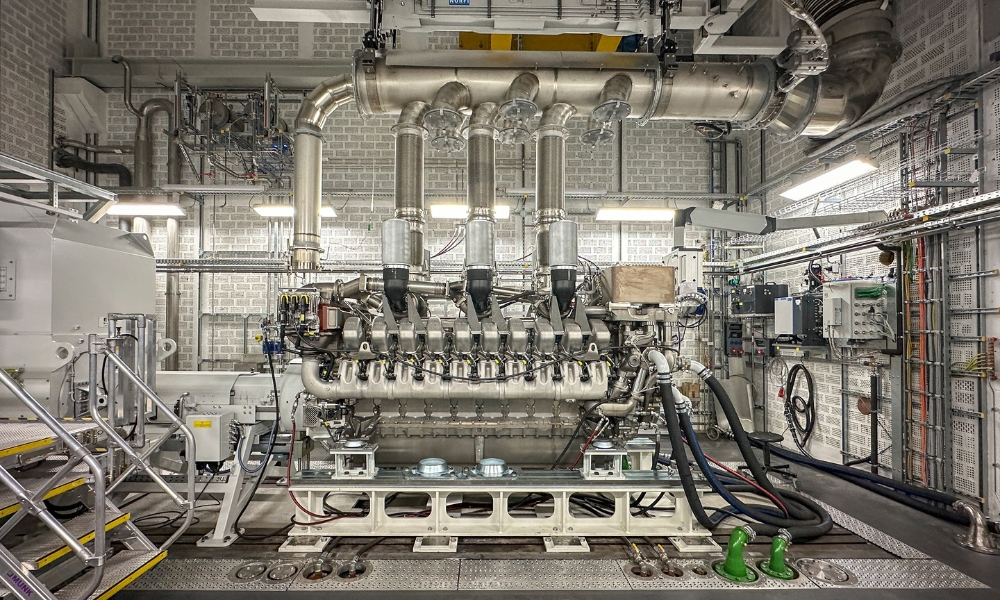
Rolls-Royce on Thursday (16 April) said the company is now operating key mtu engine test benches in Friedrichshafen, Augsburg and Ruhstorf in Germany using hydrogenated vegetable oil (HVO) instead of fossil diesel. 

By the end of 2025, the company had saved around 3,200 tonnes of CO2 as a result of switching to renewable diesel derived from vegetable oils and waste materials. Emissions of soot particles and nitrogen oxides also fell significantly.

The switch began with initial test runs in September 2024, with further facilities switching over the following year until, finally, the key diesel engines of the mtu Series 4000 for ships, trains and energy systems were all being tested with HVO in Germany.

 In Friedrichshafen, this reduced CO2 emissions from testing facilities – called test benches – by around 25 per cent in 2025, compared to operation with fossil diesel. In 2026, Rolls-Royce expects even greater savings, as the test benches will be operated with sustainable fuel all year round.

“Decarbonising our operations is a clear corporate priority for us. Through our solutions, we are also supporting our customers’ sustainability goals,” said Nicholas Templin, Executive Vice President of Production, Logistics and Quality Management at Rolls-Royce Power Systems. 

“The switch to HVO is an important step towards even more sustainable manufacturing of our products. Our experience has been entirely positive: using HVO makes the production of our products even more sustainable and has proven its worth in operational use.”

In 2025, the average price difference between HVO and B7 diesel was around ten cents per litre.

Rolls-Royce has been testing and approving its key mtu engine series for HVO and other sustainable fuels compliant with DIN EN 15940, since 2021. The major advantage is that HVO can replace fossil diesel without the need for technical modifications to the engines.

In addition to reducing CO2 emissions, HVO offers further environmental benefits. The fuel burns more cleanly, reducing particulate emissions by 40 per cent or more and nitrogen oxide emissions by up to eight per cent. Depending on the production process and raw materials used, CO2 emissions over the entire lifecycle can be reduced by up to 90 per cent compared to fossil diesel. As HVO is produced from renewable raw materials and, in part, from waste, the greenhouse gases emitted across production, transport and use amount to no more than those previously sequestered during the growth of the biomass.

Rolls-Royce added that numerous customers are already successfully using HVO with mtu engines – including in trains, ships, mining machinery, data centres and energy systems. 


Photo credit: Rolls-Royce
Published: 20 April, 2026

Continue Reading

Retrofit

DNV on key lessons learned from a 20,000 TEU methanol retrofit delivered by global partners

DNV demonstrated how complex methanol retrofits can be carried out in practice through a project involving COSCO Shipping, CHI Shanghai, MARIC, suppliers, and DNV.

Admin

Published

on

By

DNV on key lessons learned from 20,000 TEU methanol retrofit

Classification society DNV recently highlighted how complex methanol retrofits can be carried out in practice through a project involving COSCO Shipping, CHI Shanghai, MARIC, suppliers, and DNV. 

Its latest Maritime Impact article detailed challenges in design integration, construction, commissioning, and operations, while demonstrating how close collaboration and early planning support more efficient delivery and knowledge transfer: 

The world’s first methanol conversion project for a mega container carrier was completed at CHI‑Shanghai’s yard in September 2025. At nearly 400 metres in length and with a capacity of 20,000 TEU, the seven‑year‑old vessel became the first ship of its kind to be retrofitted to run on methanol. 

Delivered through close coordination between COSCO Shipping, CHI Shanghai, designers, suppliers, and DNV, and supported by a process of continuous learning, the project demonstrated that deep, first‑of‑a‑kind retrofits can be executed safely, on time, and at industrial scale.

Designing a methanol conversion for a megaship

The vessel’s fuel system, designed only for conventional fuels, required fundamental changes to enable safe and compliant methanol operation across propulsion, auxiliaries, storage, and safety systems.

The general design was developed by MARIC, while CHI Shanghai carried out the detailed engineering and served as EPC contractor. The scope included conversion of the ship’s MAN B&W 11S90 main engine and two of its four Wärtsilä auxiliary engines to dual‑fuel operation. In parallel, new methanol fuel tanks with a total capacity exceeding 15,000 cubic metres were installed forward of the engine room, together with new fuel preparation and supply systems.

Coordinating the complexity of retrofitting

Delivering this as a retrofit rather than a newbuild added complexity that is often underestimated. Existing structural arrangements could not simply be replaced, and new systems had to be integrated into confined spaces, requiring innovative construction sequences and tight interface management between suppliers. 

“This was a very complex project involving many parties, including engine makers, fuel system suppliers, and automation and safety specialists,” says Yan Hao, Commercial Director at CHI‑Shanghai. “It was also the first time all of these suppliers had worked together on a methanol retrofit of this scale. Coordination was critical.”

Note: The full article by DNV can be read here.


Photo credit: DNV and COSCO Shipping
Published: 15 June, 2026

Continue Reading

Engine

WinGD lands debut ethanol-fuelled engine orders for Vale-chartered ore carriers

Engines will be the first of the X-DF-M/E platform optimised for primarily ethanol use with the fuel supply and injection pressure will be modified from WinGD’s methanol-fuelled engine concept.

Admin

Published

on

By

WinGD lands debut ethanol engine orders for Vale-chartered ore carriers

Swiss marine power company WinGD on Tuesday (19 May) said its first ethanol-fuelled X-DF-M/E engines have been ordered for two ore carriers to be built for Chinese owner Shandong Shipping Corporation and to operate under long-term charters for Brazil-headquartered global mining company Vale. 

The two Newcastlemax (325,000 DWT) vessels will be built by Beihai Shipbuilding in China, and will each be powered by a six-cylinder, 820mm-bore 6X82DF-M/E engine intended to run primarily on ethanol fuel.

The engines will be the first of the X-DF-M/E platform optimised for primarily ethanol use. The fuel supply and injection pressure will be modified from WinGD’s methanol-fuelled engine concept already in service to account for the difference in energy density between the two fuels, which otherwise share very similar properties and combustion characteristics. The contract includes options for further engine deliveries should the vessel series be extended.

WinGD Executive Director Sales Volkmar Galke, said: “These first ethanol-fuelled X-DF-M/E engines build on more than a decade of intensive investigation into alcohol fuels including ethanol and methanol. Securing orders for a top-tier charterer and ship operator is the best possible validation of those efforts. This is a clear signal that the shipboard technology and fuel infrastructure around ethanol as a marine fuel are ready, giving confidence to others considering ethanol as an option for maritime decarbonisation.”

Ethanol is gaining attention as a ship fuel due to its widespread and cost-competitive availability in several markets. These markets include Brazil, from where the vessels will deliver iron ore to China. According to Vale’s own investigations, the use of ethanol can reduce greenhouse gas emissions by around 90% compared with heavy fuel oil, depending on the fuel type and lifecycle assumptions.

Vale Director of Shipping Rodrigo Bermelho, said: “The adoption of ethanol as an alternative fuel is part of Vale’s strategy to combine flexibility and efficiency in the ships that transport our ore and places the company in a unique position for the energy transition in global shipping over the coming decades, whilst driving similar initiatives in the sector.  We are pleased to partner with Shandong and WinGD on the world’s first newbuilding order for ethanol-fueled ocean-going vessels.”

With the addition of ethanol-fuel capability for its X-DF-M/E platform, WinGD now offers unparalleled fuel flexibility across Diesel-cycle two-stroke engines. X-DF-M/E, alongside the ammonia-fuelled X-DF-A and high-pressure LNG-fuelled X-DF-HP platforms, are all based on the same robust engine architecture and injection concept – ensuring efficient conversion capability that does not lock owners into a single fuel option.

The engine deliveries are scheduled to take place in early 2029 depending on shipyard requirements.


Photo credit: WinGD
Published: 20 May, 2026

Continue Reading

Engine

Everllence Mk10.7 engine orders rise as shipowners prioritise bunker fuel flexibility

Mk10.7 platform represents Everllence’s latest generation of two‑stroke engine design that supports conventional fuel operation (ME‑C) as well as dual‑fuel configurations, including methanol.

Admin

Published

on

By

Everllence Mk10.7 engine orders rise as shipowners prioritise bunker fuel flexibility

Engine manufacturer Everllence on Tuesday (19 May) reported continued momentum for its Mk10.7 two‑stroke engine platform, reflecting a market where shipowners are increasingly seeking to balance long‑term decarbonisation ambitions with near‑term energy security, fuel availability and operational resilience.

The Mk10.7 platform represents Everllence’s latest generation of two‑stroke engine design, developed around classic design principles and a modular architecture that supports conventional fuel operation (ME‑C) as well as dual‑fuel configurations, including methanol (ME‑LGIM) and methane (ME‑GI). 

This approach enables shipowners to make robust investment decisions today, while retaining the flexibility to adapt to evolving fuel supply-chains, regulatory frameworks and decarbonisation pathways over a vessel’s lifetime.

Bjarne Foldager, Head of Two-Stroke Business, Everllence, said: “Today’s shipowners are navigating a dual challenge: advancing the energy transition while safeguarding energy security and commercial resilience. What we are seeing with Mk10.7 is not a shift towards a single fuel but a clear preference for flexibility. Owners want solutions that allow them to move forward on decarbonisation without locking themselves into one pathway prematurely.”

Recent orders confirm the strong uptake of Mk10.7 single‑fuel engines, alongside adoption of dual‑fuel variants within the same engine architecture. As of April 2026, Everllence’s orderbook comprises more than 160 × Mk10.7 engines, underscoring strong market confidence in the platform. Everllence views this momentum as clear validation of the Mk10.7 platform’s role as a strategic foundation for modern newbuilding projects.

Most recently, the Yantai CIMC Raffles shipyard in China ordered 8 × 6G70ME-C 10.7 LGIM (Liquid Gas Injection Methanol) engines in connection with the construction of eight containerships for Hapag-Lloyd. Hanwha Engine will build the engines in Korea; an option for six further engines exists.

Christian Ludwig, Vice President, Head of Global Sales & Promotion, Two-Stroke Business, Everllence, said: “The Mk10.7 platform is designed precisely for this flexible market reality. By offering a common, robust engine architecture across conventional fuel and multiple dual‑fuel options, we enable shipowners to balance efficiency, reliability and future optionality. This combination is increasingly becoming a cornerstone of energy security in newbuilding projects.”


Photo credit: Everllence
Published: 20 May, 2026

Continue Reading

Trending