Connect with us
DNV Decarbonization Insight Series August 2026 - What maritime professionals should know about AI Training

Biofuel

Bunker brokerage Norwegian Energy Trading renews ISCC certification for biofuel trading

‘Our biofuel volumes have been growing steadily, and we’re committed to keeping pace with where the market is genuinely heading — not where it’s announced to be heading,’ says firm.

Admin

Published

on

Bunker brokerage Norwegian Energy Trading renews ISCC certification for biofuel trading

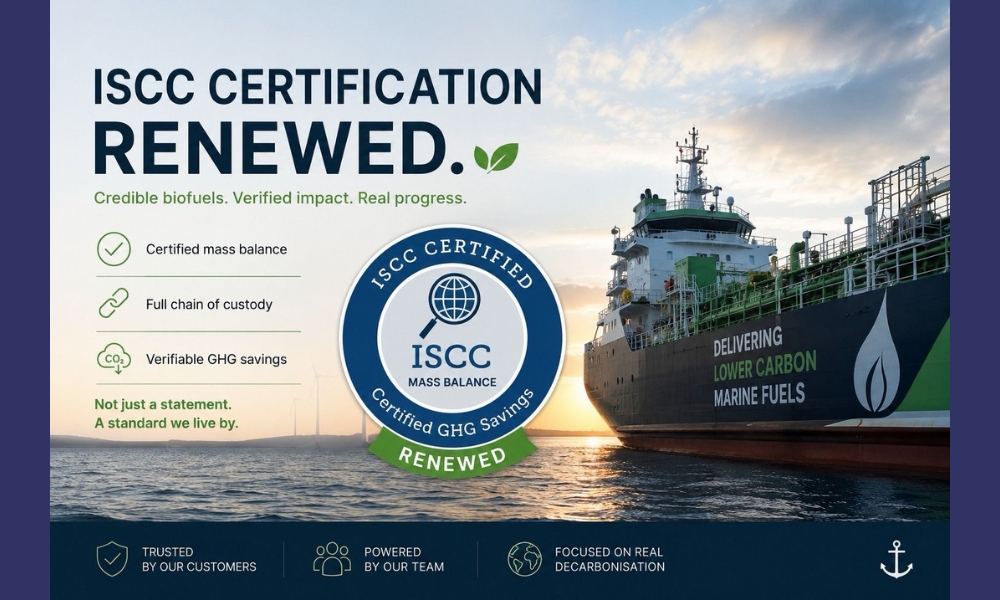
Bunker brokerage Norwegian Energy Trading (NET) recently announced that its International Sustainability and Carbon Certification (ISCC) certification for biofuel trading has been renewed for another year.

NET said certified mass balance, full chain of custody, and verifiable GHG savings are the foundation of any credible bio offering.

The company added that the renewal comes at the right time.

“Our biofuel volumes have been growing steadily, and we’re committed to keeping pace with where the market is genuinely heading — not where it’s announced to be heading,” it added.


Photo credit: Norwegian Energy Trading
Published: 15 June, 2026

Continue Reading

Biofuel

Brazil launches public consultation on biofuel bunkering rules overhaul

Law firm Mayer Brown says Brazil’s ANP has launched a 45-day public consultation on proposed revisions to the country’s marine fuel specifications, paving the way for routine use of up to 100% biofuel.

Admin

Published

on

By

Jeff Doria on Unsplash

Law firm Mayer Brown on Tuesday (28 July) said Brazil’s National Agency of Petroleum, Natural Gas and Biofuels (ANP) has launched a 45-day public consultation on proposed revisions to the country’s marine fuel specifications, paving the way for routine use of up to 100% biofuel (B100) in vessels while streamlining biofuel blending requirements

On July 27, 2026, Brazil’s National Agency of Petroleum, Natural Gas and Biofuels (“ANP”) published Public Consultation and Hearing Notice No. 15/2026, for the review of ANP Resolution No. 903/2022, which establishes the specifications for waterborne fuels marketed in Brazilian territory (marine diesel oil and marine fuel oil).

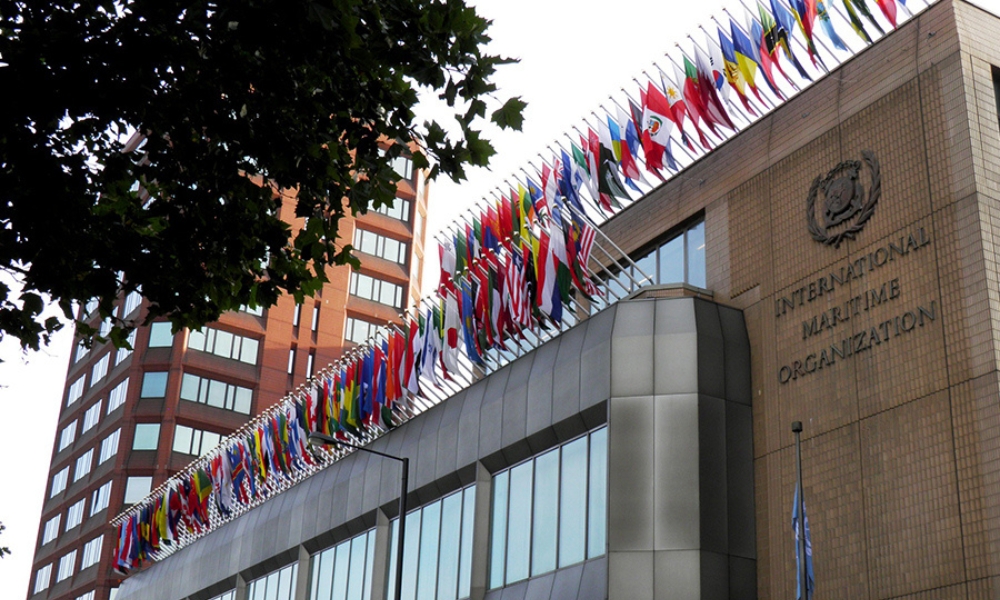
The purpose is to incorporate biofuels and renewable fuels into Brazilian waterborne transport, in the context of the energy transition and the International Maritime Organization’s (“IMO”) international decarbonization targets.

The proposal (i) aligns national specifications with ISO 8217/2024; and (ii) is encouraged by the progress of IMO discussions on carbon pricing and incentives for new fuels.

In terms of market context, operations involving the use of biofuels in Brazilian waterborne transport already exist, such that harmonizing national rules with ISO 8217 and the MARPOL Convention will standardize the regulatory treatment applicable to these operations.

The main changes proposed in the draft resolution are as follows.

  • The specification tables for waterborne fuels will be restructured, including classes for fuels containing biodiesel.
  • Limits and test methods from ISO 8217/2024 will be selectively incorporated, on a partial basis, in line with Brazilian market realities.
  • Biodiesel content of up to 100% (“B100”) for regular use in vessels (no longer as an exception), which could be sold directly to the end user.
  • Green diesel (“HVO”) and synthetic/GTL (Gas-to-Liquids) fuels will be treated as “drop-in” components, meaning chemically similar to fossil fuels and capable of replacing them without requiring engine or infrastructure adaptation.
  • Agents authorized to carry out biofuel blending will be defined, which eliminates the requirement for prior ANP authorization to use blends, replacing it with a simple notification to the Agency.
  • Quality control, document traceability, sampling, certification, and fuel identification rules will be improved, in line with the MARPOL Convention.
  • Prior experimental authorization from ANP will be provided for alternative fuels not covered by ISO 8217 (ethanol, methanol, ammonia, and hydrogen).
  • A prior authorization regime will be established for liquefied natural gas (“LNG”), without an experimental character, given the existence of well-established technical standards and the early stage of Brazil’s national LNG transport and supply infrastructure.

The public consultation will run for 45 days, from July 28 to September 10, 2026. On September 23, 2026, a public hearing will be held to discuss the matter with civil society and regulated agents.


Photo credit: Jeff Doria on Unsplash
Published: 31 July, 2026

Continue Reading

Biofuel

Burando Energies holds 30% of Rotterdam’s biofuel blend market in H1 2026

Company supplied approximately 30% of all biofuel blended marine fuel and B100 volumes bunkered in the Port of Rotterdam in the first half of 2026, based on data from the Rotterdam Port Authority.

Admin

Published

on

By

Burando Energies holds 30% of Rotterdam's biofuel blend market in H1 2026

European marine fuel supplier Burando Energies on Wednesday (29 July) said it supplied approximately 30% of all biofuel blended marine fuel and B100 volumes bunkered in the Port of Rotterdam in the first half of 2026, based on data from the Rotterdam Port Authority. 

This excludes alternative fuels such as methanol, ethanol and LNG.

The company said Rotterdam remains one of the most cost-competitive locations in Europe to bunker biofuels.

The Netherlands is currently the only major bunkering hub in the ARA region where RED III has been transposed for marine, creating an ERE-based discount mechanism that makes blended fuels in Rotterdam meaningfully cheaper than equivalent products in other ports outside the Netherlands.

For shipowners focused on EU ETS and FuelEU Maritime compliance, the economics of bunkering biofuels in Rotterdam are the most cost-effective.

“We have positioned ourselves to capture this demand through deliberate infrastructure investment, including our dedicated, company-owned biofuel blending terminal at AFT Amsterdam,” it added. 

Backed by its wholly owned fleet of biofuel barges, the company said it ensures reliable and timely delivery, while its in-house sustainability team issues all compliance documentation accurately and promptly.

Burando Energies supply an array of biofuel blends across all Dutch and Belgian ports, including Zeebrugge.

Its portfolio includes HSFO, VLSFO and Marine Gasoil/Diesel-based blends alongside B100 FAME, B100 HVO and B100 FAME Residue products.

“We are extremely proud to see the trust of our new and repeat customers supporting the growth of our operation and enabling us to continuously improve both our physical products and associated compliance documents,” said Nick de Haan, Head of Decarbonisation Strategies at Burando Energies.

Biofuel uptake in Rotterdam is growing and Burando Energies expects that trajectory to continue as FuelEU Maritime obligations increase and the EU ETS cost of conventional fuel rises.

“Among other initiatives, we continue to invest in shore- and water-based logistics capacity for low-carbon methanol,” the firm added. 

“Our ambition is to continue to grow and further diversify our market position while continuing to deliver the reliability and documentation quality our clients depend on.” 


Photo credit: Burando Energies
Published: 30 July, 2026

Continue Reading

Bunker Fuel

Port of Rotterdam publishes bunker fuel sales data for Q2 2026

Ethanol as a bunker fuel was reported in Rotterdam for the first time with 1,025 mt delivered in Q2 2026, following an ethanol-methanol blend bunkering operation of container vessel Eco Levant in May.

Admin

Published

on

By

RESIZED port of rotterdam

The Port of Rotterdam Authority recently published bunker fuel sales data for the second quarter (Q2) of 2026.

Deliveries of ultra low sulphur fuel oil, very low sulphur fuel oil, high sulphur fuel oil, marine gas oil and marine diesel oil in Q2 2026 (against on year) recorded respectively 123,190 metric tonnes (mt) (+33%  from 162,142 mt), 354,448 mt (-9.1% from 439,804 mt), 704,637 mt (+10.9% from 619,010 mt), 266,570(+18% from 273,696 mt), 64,777 mt (-8.2% from 86,821 mt). 

Bio-blended variants of ultra low sulphur fuel oil, very low sulphur fuel oil, high sulphur fuel oil, marine gas oil and marine diesel oil in Q2 2026 (against on year) recorded respectively 22,032 mt (-28.3% from  24,573 mt), 144,665 mt (-57% from 68,271 mt), 30,191 mt (+15.3% from 38,490 mt), 34,574 mt (+627.7% from 31,663 mt) and 8,413 mt (-30.2% from 2,223 mt).

Port data showed 273,021 m3 of liquefied natural gas (LNG) being delivered as a marine fuel in Q2 2026, down by 17.4% from 207,658 m3 in Q2 2025. Bio-methanol and bio-blended LNG recorded 2,845 mt and 7,506 m3 respectively in Q2 2026.

Ethanol as a bunker fuel was reported in Rotterdam for the first time with 1,025 mt delivered in Q2 2026,  following an ethanol-methanol blend bunkering operation of container vessel Eco Levant in May.

Manifold Times previously reported Evos Rotterdam holding a ground-breaking ceremony for its methanol and ethanol expansion project at the Port of Rotterdam, formally starting the construction phase of a major investment in additional terminal capacity.

Once operational in early 2028, the expansion will give Evos Rotterdam greater capacity to handle methanol and ethanol for industrial customers, as well as for the developing market in cleaner, low-carbon marine fuels and bunkering.

Shipping giant A.P. Moller – Maersk (Maersk) recently announced a new milestone in its marine fuel trials, with its dual-fuel feeder vessel Laura Maersk successfully operating on 100% ethanol for a second time.

The latest trial marked a significant step forward from earlier tests, as the vessel was supplied through a larger-scale bunkering operation conducted by barge in Rotterdam.

Related: X-Press Feeders, METHANAVE complete first ethanol-methanol bunkering op in Rotterdam
Related: Maersk advances ethanol fuel trials with larger-scale Rotterdam bunkering


Photo credit: Port of Rotterdam
Published: 29 July, 2026

Continue Reading

Trending