Connect with us
DNV Decarbonization Insight Series August 2026 - What maritime professionals should know about AI Training

Newbuilding

Drewry: LNG newbuild orders halve in 2025—a likely rebound in the near term

New orders were impacted by the slower pace of FIDs in 2024 and 1H25, along with high newbuild prices and increasing uncertainty related to USTR 301, as well as stringent emission regulations.

Admin

Published

on

Drewry: LNG newbuild orders halve in 2025—a likely rebound in the near term

Maritime research and research provider Drewry recently analysed the trends of LNG newbuild orders, comparing 2024 and 2025 as well as its outlook for new orders in 2026:

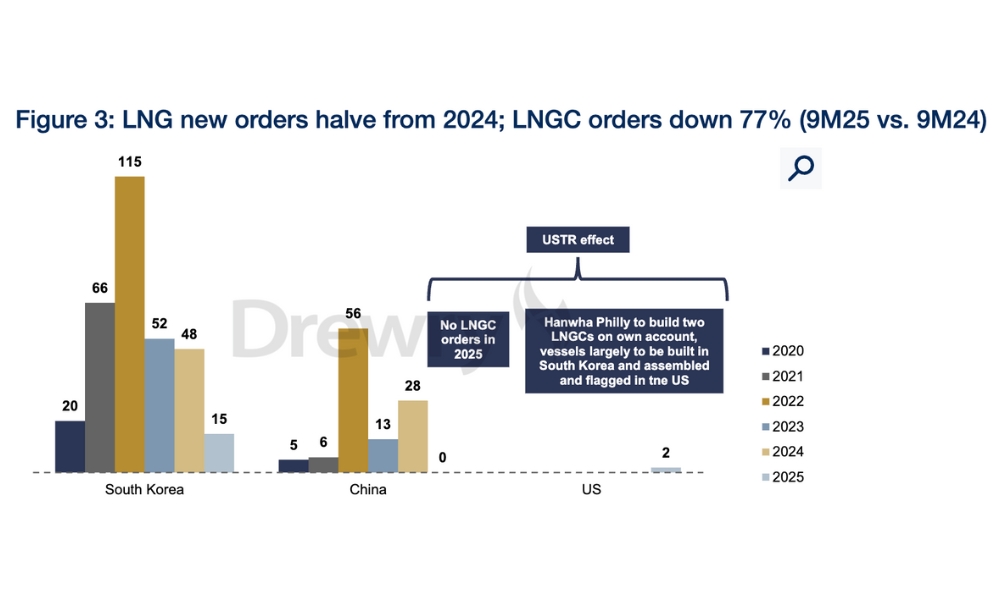
Only 38 vessels were ordered in 9M25 compared to 86 in 9M24, with the orderbook-to-fleet ratio continuing to weaken in 2025, deflated by higher deliveries and low new orders. New orders were impacted by the slower pace of FIDs (in 2024 and 1H25), along with high newbuild prices and increasing uncertainty related to USTR 301, as well as stringent emission regulations such as the EU ETS and FuelEU Maritime (FEM).

New orders suffer, while deliveries thrive 

By end-3Q25, 38 vessels were ordered, down 56% from 9M24. The LNGC tally was even lower, with only 17 carriers ordered in 9M25 compared to 73 in 9M24, while LNGBVs have been stealing the show with 19 vessels ordered so far. Two FLNGs were also ordered in 3Q25 by Mexico’s Amigo LNG at the UAE’s Dubai Drydocks.

Drewry expects about 50 vessels to be ordered in 2025, compared to 96 in 2024. The current orderbook comprises 335 vessels (289 LNGCs, 37 LNGBVs, 4 FSRUs and 5 FLNGs), with an orderbook-to-fleet ratio of 41%. We expect the orderbook to deflate further till new ordering resumes, which appears to revive from the next year only.

New ordering revives in 3Q25

LNGC ordering gained momentum in 3Q25, with nine vessel orders, exceeding the eight ordered in 1H25. The quarter also saw five LNG bunker vessels (LNGBVs) and two floating LNG units (FLNGs) added to the orderbook. A notable development was Hanwha’s unexpected decision to commission two LNGCs under its own account, one in July and another in August. These ships are registered to be built at Hanwha’s Philly shipyard, marking the first LNGC orders in the US since the 1970s. While the core construction will take place in South Korea, final assembly and flagging will occur in the US. This move is widely interpreted as a strategic response to the USTR 301 regulation, which mandates that 1% of US LNG exports be carried on US-built and flagged LNGCs, a requirement considered economically challenging given the reported $250 million price tag per carrier.

Chinese shipyards bear the brunt of increasing scrutiny from the West 

As of end-September 2025, South Korean yards constitute 65% of the current orderbook, followed by Chinese yards, accounting for 33%. There have been no LNGC orders at Chinese yards so far in 2025 mainly due to the uncertainty created by the USTR regulations on Chinese-built vessels. However, Chinese yards have secured 58% of the LNGBV orders placed so far this year. The regulations with potential port fees on Chinese-built LNGCs and other geopolitical developments have increased commercial uncertainty for shipowners over where to place orders.

Note: The full article by Drewry can be read here.


Photo credit: Drewry Maritime Research
Published: 30 October, 2025

Continue Reading

Methanol

CMA CGM names new 15,000 TEU methanol-powered vessel “ROI ARTHUR”

Joining the company’s REX2 service, the ship will strengthen its fleet of new-generation vessels designed to support the decarbonisation of shipping.

Admin

Published

on

By

8 1

French shipping giant CMA CGM on Monday (3 August) said its new 15,000 TEU methanol-powered vessel, CMA CGM ROI ARTHUR, has officially been named and is ready to begin its journey at sea.

Joining the company’s REX2 service, the ship will strengthen its fleet of new-generation vessels designed to support the decarbonisation of shipping. 

“Powered by methanol, she contributes to reducing atmospheric emissions and advancing the energy transition of our industry,” the company said in a social media post. 

The vessel was welcomed by her Master, Captain Roman DIDENKO, and her godmother, Ms. Sun Lijun, Vice Chairman of Tianjin Bridge Welding Materials Group Co., Ltd. and Vice President of the Tianjin Women Entrepreneurs Association.

In January, the company announced the arrival in its fleet of its 400th owned vessel, the CMA CGM MONTE CRISTO, the first in a series of six methanol container ships.

The Group is preparing to operate, by 2031, around 200 dual-fuel LNG and methanol container ships that can be powered with low-carbon energy.

Related: CMA CGM marks 400-vessel milestone as methanol-powered boxship joins fleet


Photo credit: CMA CGM
Published: 4 August, 2026

Continue Reading

Methanol

China’s first domestically developed Ultramax methanol dual-fuel bulker pair named

SDARI says two 65,000 dwt methanol dual-fuel bulk carriers, “LEM AZALEA” and “LEM PLUMERIA”, were named on 27 July at Guangzhou’s Nansha district.

Admin

Published

on

By

China's first domestically developed Ultramax methanol dual-fuel bulker pair named

Shanghai Merchant Ship Design and Research Institute (SDARI) on Wednesday (29 July) said two 65,000 dwt methanol dual-fuel bulk carriers, LEM AZALEA and LEM PLUMERIA, were named on 27 July at Guangzhou’s Nansha district.

The vessels were designed by the SDARI, part of China State Shipbuilding Corporation (CSSC), for Cyprus-based Lemissoler Navigation and built by CSSC Huangpu Wenchong Shipbuilding.

According to SDARI, the vessels are the institute’s first methanol dual-fuel bulk carrier design and China’s first domestically developed Ultramax methanol dual-fuel bulk carriers.

The bulk carriers are equipped with a methanol dual-fuel propulsion system comprising a conventional fuel tank and two dedicated high-capacity methanol fuel tanks, allowing operators to switch flexibly between fuels while meeting current and anticipated IMO requirements on carbon reduction and sulphur emissions.

The vessels are also fitted with an auxiliary lithium battery system to supply onboard lighting power, reducing overall energy consumption.

Compared with conventionally fuelled bulk carriers, the methanol dual-fuel design is expected to significantly reduce carbon dioxide, sulphur oxide, nitrogen oxide and particulate matter emissions.

SDARI said the project fills a gap in China’s domestically developed methanol dual-fuel bulk carrier segment in the 65,000 dwt class and provides a mature and scalable design that can be replicated for future vessels.


Photo credit: CSSC Huangpu Wenchong Shipbuilding
Published: 3 August, 2026

Continue Reading

Alternative Fuels

EC clears EUR 103 mil Dutch funding for renewable methanol and hydrogen-powered ships

Scheme will support purchase of vessels powered by renewable methanol or renewable hydrogen and retrofitting of existing vessels to enable them to use renewable methanol and renewable hydrogen.

Admin

Published

on

By

Guillaume Périgois on Unsplash

The European Commission recently said it has approved a EUR 103 million (USD 119 million) State aid scheme by the Netherlands to accelerate the greening of the Dutch maritime fleet. 

The scheme will support the purchase of new clean and zero-emission vessels powered by renewable methanol or renewable hydrogen and the retrofitting of existing vessels to enable them to use renewable methanol and renewable hydrogen. 

It covers different types of vessels, including passenger, cargo and work vessels, mainly operating in the short-sea shipping segment. The support will take the form of direct grants awarded under an open, transparent and non-discriminatory selection process.

The scheme aims to help companies overcome high upfront investment costs and limited market incentives that currently slow the uptake of clean shipping technologies. The aid will be granted between 2027 and 2031 and will help bridge the investment gap in line with the objectives of EU legislation such as the FuelEU Maritime and the EU Emission Trading System.

The Commission assessed the measure under EU State aid rules, in particular Article 107(3)(c) of the Treaty on the Functioning of the EU and the 2022 Climate, Environmental Protection and Energy Aid Guidelines (CEEAG). 

“The Commission concluded that the scheme is necessary and appropriate as the supported investments would not take place without public support at the same scale and within the same timeframe. The measure is also proportionate as it has limited effects on competition and trade in the internal market,” it said. 


Photo credit: Guillaume Périgois on Unsplash
Published: 3 August, 2026

Continue Reading

Trending