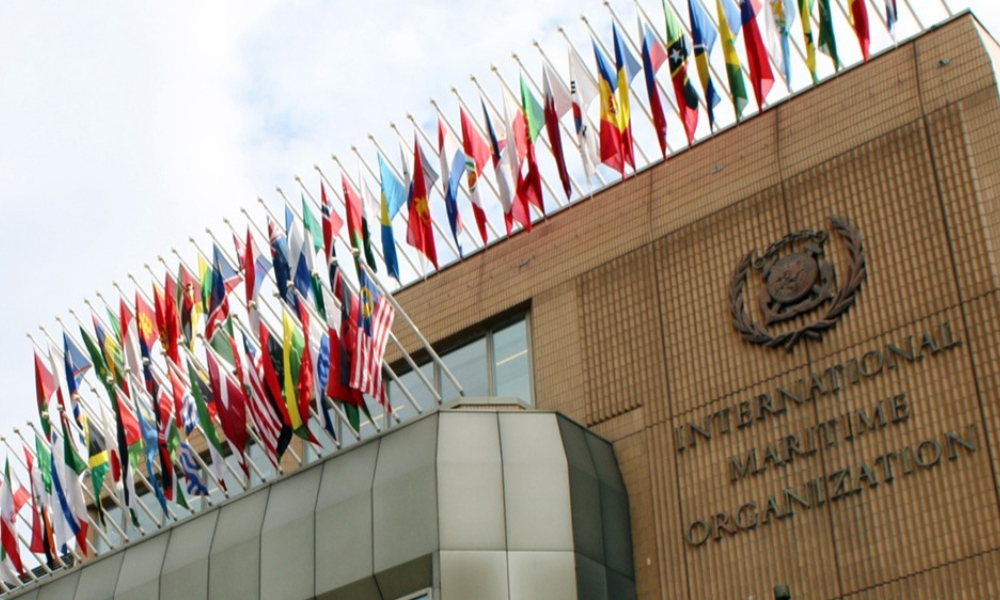
The International Maritime Organization (IMO) on Wednesday (16 April) released a detailed meeting summary of the Marine Environment Protection Committee (MEPC) which met for its 83rd session in person at IMO Headquarters in London from 7 to 11 April 2025.
The meeting approved the draft legal text for the IMO Net-Zero Framework, which is the first in the world to combine mandatory emissions limits and GHG pricing across an entire industry sector. The measures include a new fuel standard for ships and a global pricing mechanism for emissions.
These measures, set to be formally adopted in October 2025 before entry into force in 2027, will become mandatory for large ocean-going ships over 5,000 gross tonnage, which emit 85% of the total CO2 emissions from international shipping.
MEPC 83 was preceded by the 19th meeting of the Intersessional Working Group on Reduction of Greenhouse Gas Emissions from Ships (ISWG-GHG 19), from 31 March to 1 April and the first meeting of the Intersessional Working Group on Air Pollution and Energy Efficiency (ISWG-APEE 1), from 2 to 4 April.
MEPC 83 highlights:
- Tackling climate change – Mid-term measures to reduce GHG emissions from international shipping approved
- Review of the short-term GHG reduction measures – Phase 1 completed
- Report on the annual carbon intensity and energy efficiency of the fleet
- Onboard Carbon Capture and Storage (OCCS) and other energy efficiency matters
- Addressing marine plastic litter – Action Plan approved
- North-East Atlantic Ocean Emissions Control Area approved and Particularly Sensitive Sea Areas off Peru agreed in principle
- Review of the Ballast Water Management Convention – ongoing
- Air pollution prevention – various developments
- Amendments to NOx Technical Code adopted
- Pollution prevention and response – actions taken
- Reports from other Sub-Committees approved
- New outputs approved – including development of a legally binding instrument on biofouling as well as assessment of the implementation of the Hong Kong Ship Recycling Convention and development of amendments and clarifications as appropriate.
Tackling climate change – Mid-term measures to reduce GHG emissions approved
The Committee finalized and approved the draft legal text for the “IMO Net-Zero Framework”, to be included as a new chapter in Annex VI to the International Convention for the Prevention of Pollution from Ships (MARPOL). The draft amendments to MARPOL Annex VI were circulated to Member States immediately after the meeting, with a view to adoption at an extra-ordinary session of MEPC in October 2025. (See Circular Letter: CL No.5005 – Draft Revised MARPOL Annex VI )
The IMO Net-Zero Framework includes a set of “mid-term measures” aimed at reducing greenhouse gas emissions from international shipping, in line with the reduction targets set out in the 2023 IMO GHG Strategy. These measures consist of:
- a technical element: a goal-based marine fuel standard designed to gradually lower the GHG intensity of marine fuels;
- and an economic element: a pricing mechanism for maritime GHG emissions.
Following adoption, the measures are expected to enter into force 16 months later, under the “tacit acceptance” procedure, in accordance with the amendment provisions in MARPOL. (More details: IMO approves net-zero regulations for global shipping)
Food security
The Committee agreed that in the period between the adoption of the IMO Net-Zero Framework and its entry into force, further assessment (qualitative and quantitative, as appropriate) of the potential impacts of an increase in maritime transport costs on food security resulting from the adopted framework should be conducted. The Committee agreed to keep the potential impact on food security under continuous review.
Review of the short-term measure to reduce GHG emissions – Phase 1 completed
The Committee finalized Phase 1 of the review of IMO’s short-term GHG reduction measures, which were adopted in 2021 and entered into force in 2022. Key elements of the short-term measures include: Energy Efficiency Existing Ship Index (EEXI), enhanced Ship Energy Efficiency Management Plan (SEEMP), and Carbon Intensity Indicator (CII) rating scheme. The measures aim to improve ship energy efficiency and reduce carbon intensity by at least 40% by 2030 compared to 2008.
The review of the effectiveness of the short-term measures began in July 2023 (MEPC 80). Under Phase 1, the Committee gathered data from Member States about their experience implementing the short-term measures, analyzed this data and identified a list of challenges and/or gaps. At MEPC 83, the Committee took the following actions:
- Carbon intensity (CII) reduction factors for 2027-2030 – amendments adopted
The Committee adopted amendments to the 2021 Guidelines on the operational carbon intensity reduction factors relative to reference lines (CII reduction factors guidelines, G3). These Guidelines outline the methods for determining the annual operational carbon intensity reduction factors and their values from 2023 to 2030 (indicating how much carbon intensity need to be reduced by ships over this period to meet targets), as referred to in Regulation 28 of MARPOL Annex VI. The amendments include newly defined CII reduction factors for 2027 to 2030.
- Access to the IMO Data Collection System for ship fuel consumption – amendments approved
The Committee approved draft amendments to Regulation 27 of MARPOL Annex VI to make the IMO’s data collection system (IMO DCS) on ship fuel consumption more accessible to the public. The IMO DCS requires ships to record and report their fuel oil consumption, which is then used to calculate ships’ operational carbon intensity (CII). The amendments will ensure that all reported data in the IMO DCS are accessible to Parties to Annex VI, in a non-anonymized form. An anonymized database (i.e., identification of a specific ship will not be possible) will be made accessible to public users.
- Workplan for Phase 2 of the review of short-term GHG reduction measures agreed
The Committee agreed on a work plan for Phase 2 of the review of the short-term GHG reduction measures, to run from Spring 2026 to Spring 2028. Phase 2 will look at enhancing the SEEMP framework, further developing CII metrics, as well as ensuring synergies between the IMO carbon intensity/energy efficiency framework and the IMO Net-Zero Framework.
- Ship Energy Efficiency Management Plan (SEEMP) framework – amendments adopted
The Committee adopted Amendments to the 2024 Guidelines for the development of a Ship Energy Efficiency Management Plan (SEEMP) (resolution MEPC.395(82)), to allow the possible development of other CII metrics at future MEPC sessions, as envisaged in the work plan for the review of the short-term GHG reduction measures.
Report on the annual carbon intensity and efficiency of the fleet
The Committee noted the report by the IMO Secretariat on the carbon intensity of the international shipping fleet for the year 2023 (both demand- and supply-based), including a summary of carbon intensity developments of the fleet from 2019 to 2023. The report showed reductions in the carbon intensity of shipping ranging from 4.8% to 9.9% (depending on the method of calculation) from 2019 to 2023, and a decrease in total fuel consumption from 213 million tonnes in 2019 to 211 million tonnes in 2023.
The report also indicated that, compared to 2008 levels, the average carbon intensity of shipping in 2023 has fallen by 31.0% (calculated based on supply measurement) and by 36.5% (based on demand measurement). Download the report here.
North-East Atlantic Ocean Emissions Control Area approved and Particularly Sensitive Sea Areas off Peru agreed in principle
The Committee approved a proposal to designate the North-East Atlantic Ocean as an Emissions Control Area for Sulphur oxide emissions (SOX), particulate matter (PM) and nitrogen oxide emissions (NOX). The associated draft amendments to MARPOL Annex VI will be submitted to the extraordinary MEPC session in October 2025, with a view to adoption as part of the revised MARPOL Annex VI.
The Committee agreed in principle to the designation of the “Reserva Nacional Dorsal de Nasca” (Nasca Ridge National Reserve) and the “Reserva Nacional Mar Tropical de Grau” (Grau Tropical Sea National Reserve) as Particularly Sensitive Sea Areas (PSSAs). The Committee invited Peru to further develop the proposed associated protective measures and submit them to MEPC for consideration and approval at MEPC 84.
Note: The full meeting summary of MEPC 83 can be viewed here.
Related: IMO MPEC 83 approves net-zero regulations for global shipping
Photo credit: International Maritime Organization
Published: 17 April, 2025










 Decarbonisation2 weeks ago