
Decarbonisation
DNV Decarbonisation Insights: Speed up energy transition, shipping industry must move faster towards net zero goal
Classification society DNV gives an overview on highlights from its top leaders during DNV Singapore Energy Transition Conference, Gastech and CO2 Shipping and CCS Conference; turns spotlight on CCS technology.

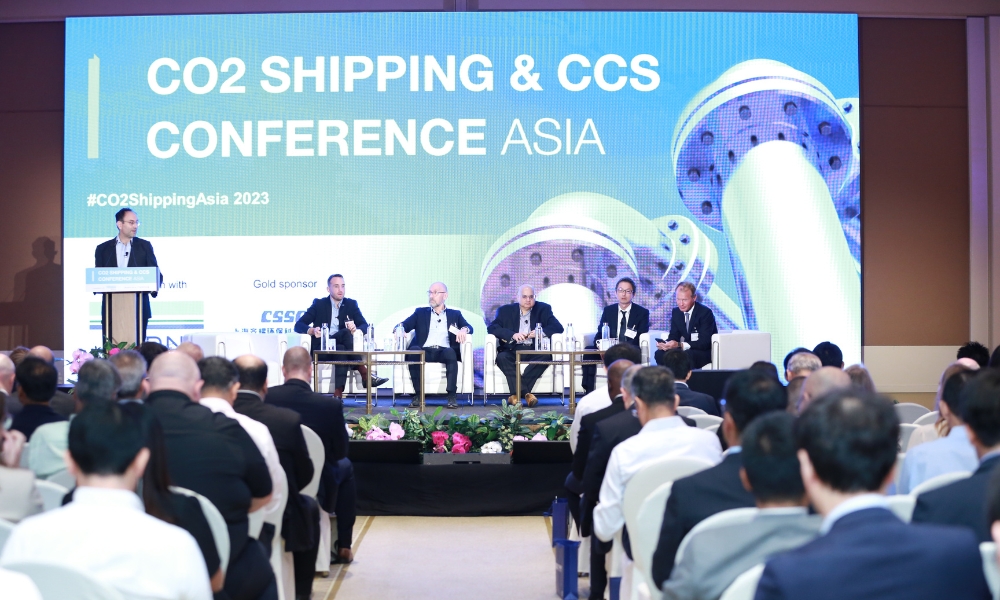
Greater energy and transport industry collaboration, as well as the need to put in place “fossil disincentives” was the call from DNV’s Group President and CEO Remi Eriksen, setting the scene at the third DNV Singapore Energy Transition Conference (SETC) on 4 September, leading up to Gastech 2023.
Eriksen made it clear that “no major economy has moved fast enough” in the last 24 months if we are to have any hope of achieving what’s required in the Paris Agreement or getting to Net Zero by 2050.
He praised efforts in Southeast Asia to capitalise on its great potential for solar and wind power but cautioned that the region was going to be very dependent on coal for a long time to come.
Mr Eriksen called for more “policy choices” to put the environment first when it comes to investments in infrastructure and services in this region and everywhere.
Knowing that the world has to move from being 90% dependent of fossil fuels now to a situation where non-fossil fuels will account for 90% of our energy by 2050, means we have to speed up the energy transition.
He pointed out that this is not an insurmountable problem. The costs of renewables are coming down. But political leadership is needed. The hard to abate sectors of industry and transport have to be addressed, and that’s where DNV sees that carbon capture and storage (CCS) could play a key role.
Decisive decade for shipping
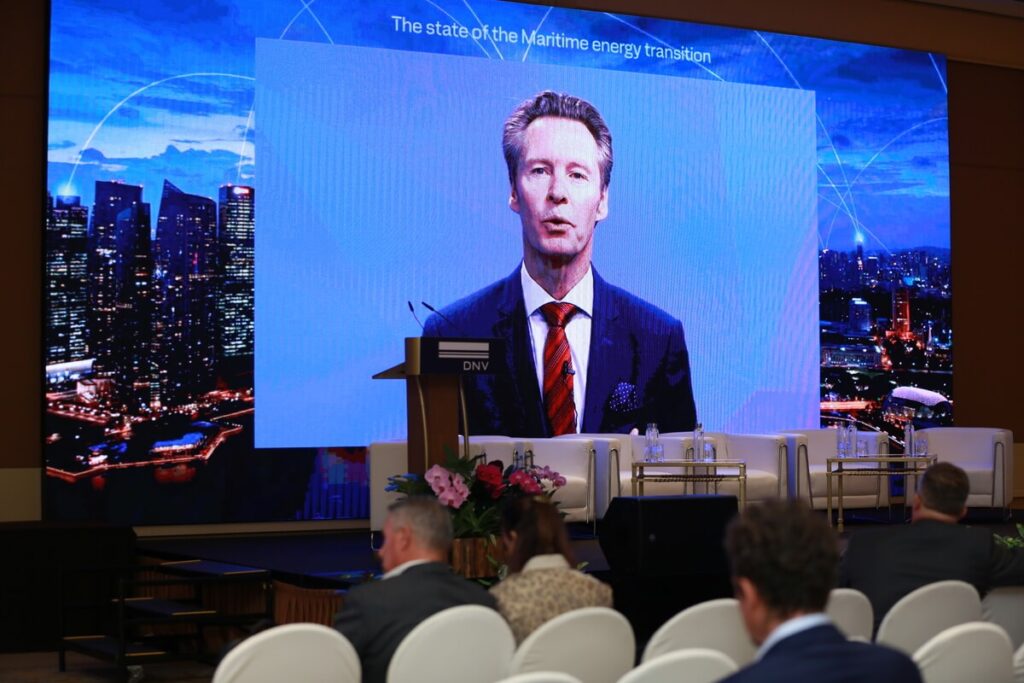
Remi Eriksen was joined at SETC, before Gastech 2023 got underway, by an equally compelling call to action from DNV Maritime CEO Knut Ørbeck-Nilssen, in what he described as the “decisive decade for shipping”.
“There is no time to waste. We must move faster,” Ørbeck-Nilssen addressed an audience of 300 industry professionals who attended the event in person, while many more following the conference online.
A key aspect of his presentation was the importance of curtailing energy consumption while advancing the process of decarbonisation and the adoption of cleaner, low-carbon fuel sources.
Mr Ørbeck-Nilssen urged maritime decision-makers “to leave no stone unturned” in the quest to decarbonise, advocating for the exploration of green shipping corridors and the revival of wind-powered vessels, reminiscent of the historical era of sailing ships.
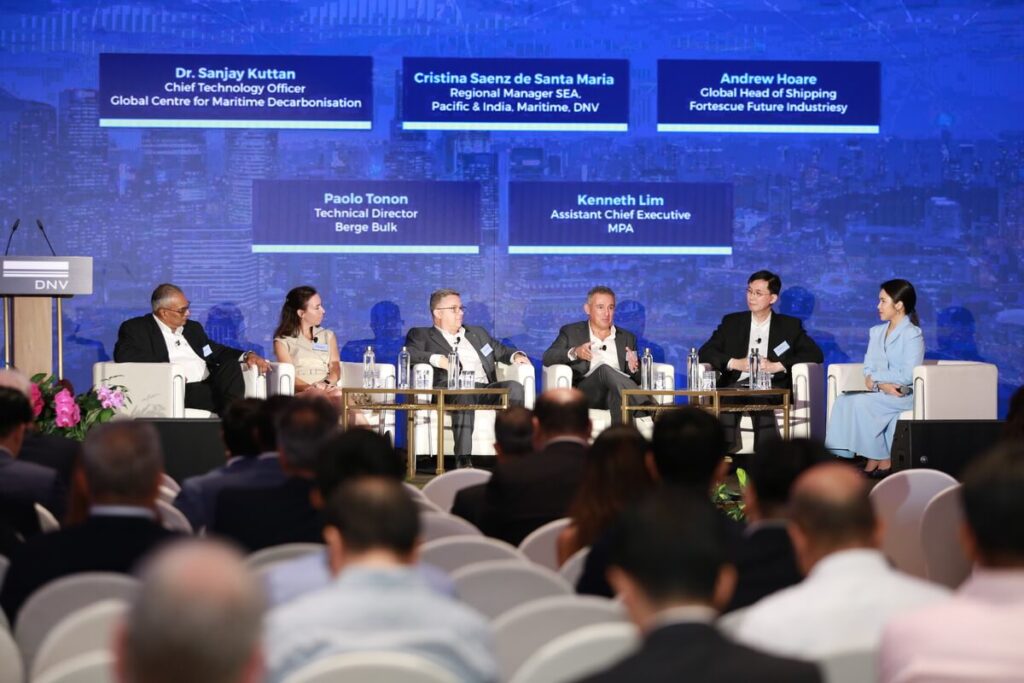
DNV’s Regional Manager Cristina Saenz de Santa Maria was joined by Fortescue Energy’s Andrew Hoare and Berge Bulk’s Paolo Tonon, to echo the prevailing sentiment of urgency, while concurrently exploring and assessing decarbonisation technologies for a greener tomorrow in close cross-sector collaboration.
The united call from practically all SETC speakers was the urgent need to embark on this transformative journey together, optimizing the use of natural resources, and championing energy efficiency.
How CCS fits into the maritime decarbonisation mix
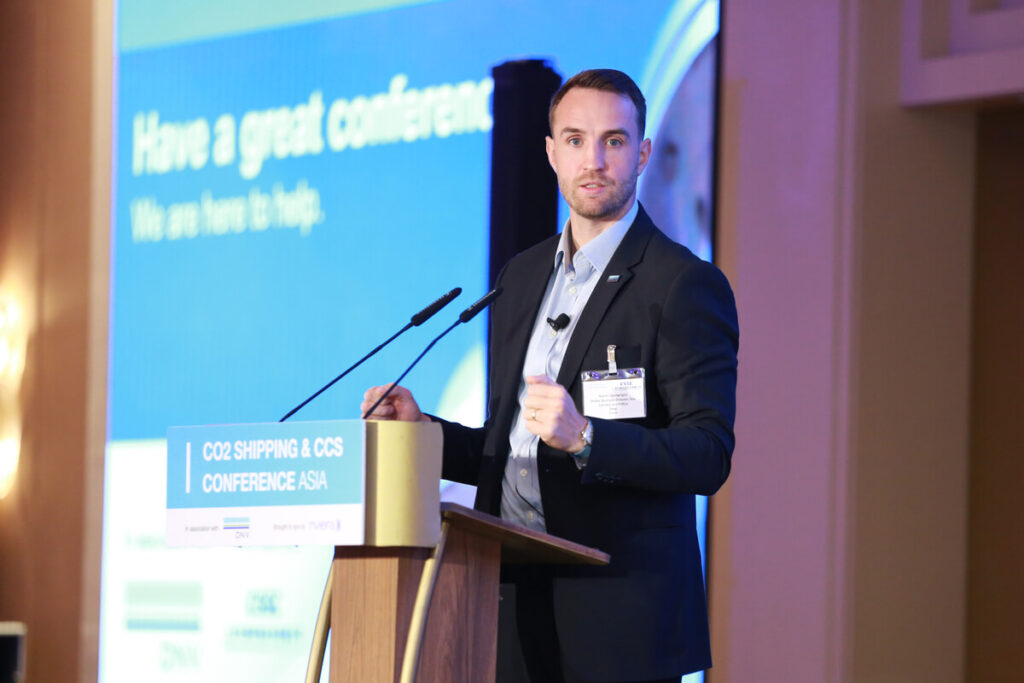
What is required to deploy carbon capture and storage technology at scale was the central theme of the CO2 Shipping and CCS Conference, jointly organised by Riviera Maritime Media and DNV in conjunction with SETC on the eve of Gastech 2023.
DNV’s Business Director Gas Carriers & FSRU Martin Cartwright emphasised that while CCS has been discussed for decades, large-scale implementation is still in its infancy.
Currently only about 40 million tons of CO2 per year is being captured globally through CCS projects. However, the IEA and IPCC estimate that billions of tons will need to be captured annually by 2050 to reach net zero emissions.
Mr Cartwright noted the significant shortage of infrastructure and distribution challenges with storage sites scattered worldwide. Today there are only a handful of Liquified CO2 (LCO2) vessels operating to transport pure CO2 for the food and beverage industry.
The transportation of CO2 for the purpose of storage will require a massive investment in new vessels dedicated for this specific trade.
The first vessels for CCS purpose are already under construction and will be delivered in 2024, dedicated for the Northern Light project in Norway. In addition, this summer, the Greek owner Capital Maritime Group placed an order for two 22k LCO2/LPG/ammonia vessels at HMD in Korea.
Responding to a question about ordering low pressure CO2 ships and availability timelines, Mr Cartwright said the qualification of material suited for LCO2 is essential to cut cost for large LCO2 carriers.
DNV, together with Shell, Equinor, Total and Gassco, is addressing this, along with other challenges, with large CO2 carriers through the CETO (CO2 Efficient Transport via Ocean).
The CETO project is a large joint industry project (JIP) funded partly by the project partners and partly by a Norwegian governmental funding scheme dedicated to support the development of CCS technologies.
Mr Cartwright was equally clear that calls for converting existing LPG tankers were misguided, stating “we need new vessels to support this market which are designed for the specific properties of liquid CO2”.
See CO2 as a tradable commodity to catalyse fleet growth
Turning CO2 into a tradable commodity will help catalyse fleet growth, he said, as there are many who still regard CO2 as waste with no commercial value.
Returning to CCS, Mr Cartwright said the permanent storage of CO2 underground poses challenges. While oil companies do have decades of experience injecting and monitoring CO2 in depleted gas fields, there is still work to do on public perceptions of risk around large-scale storage.

DNV Regional Sales Head of Sales, Energy Systems, James Laybourn, noted: “We are confident that there is large potential capacity for global storage of CO2 in depleted fields and saline aquifers. In each case, the potential site needs to undergo rigorous evaluation and testing to ensure that the site is suitable and safe for the permanent storage of CO2.”
Such assessment and verification processes are utilised to ensure that all key stakeholders can be confident of the storage site integrity during the CO2 injection process and also after the site is sealed.
Mr Laybourn emphasised that governments and companies are putting rigorous monitoring regimes in place to ensure safe, secure containment of injected CO2.
Could Singapore be a major hub in the CCS value chain?
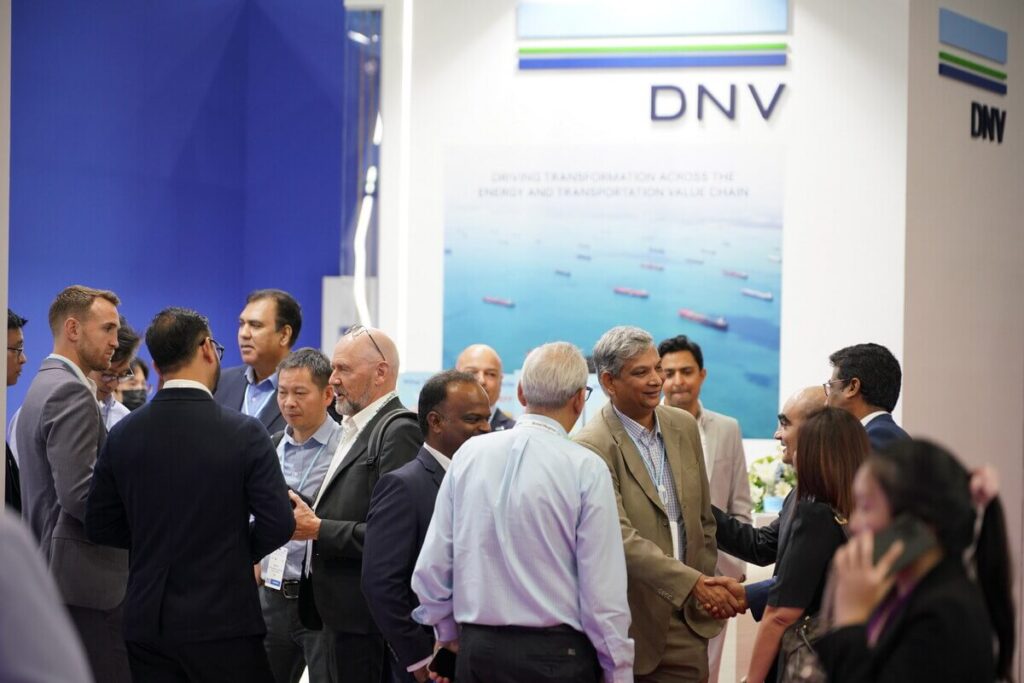
Speakers at the conference also discussed opportunities to develop regional CCS hubs, especially in Southeast Asia. This involves aggregating CO2 from multiple industrial facilities via ships to centralised injection sites – a model being pioneered in Northern Europe’s Northern Lights project.
Mr Laybourn explained that realising a CCS hub for Singapore would require the development of a full value chain, including pipelines, liquefaction plants, jetties, and CO2 carriers to get captured emissions to offshore storage sites. Singapore is seen at an advantage as sequestration sites are already being developed in the surrounding region.
“I think the value chain needs to consider two parts,” he said. “The first part is the development of the sequestration sites themselves.
“The second part is the infrastructure to capture and transport the CO2 to the field. All of these elements of the value chain need to be developed to support CCS in Singapore.
“The transport will depend on adequate shipping infrastructure and the regulatory framework to enable international transport of CO2”, Mr Laybourn advised.
Presenters also emphasised that cost is critical to ensure a commercially viable value chain. Government incentives like carbon pricing can be critical to spurring CCS given the high costs.
While carbon prices in Europe are approaching levels that make projects economically viable, carbon taxes in Asia remain far lower, and therefore greater efforts will be required to reduce the cost of the value chain such as sharing infrastructure between multiple sources (as a hub) and repurposing existing infrastructure.
Various regulatory drivers and policies are also pushing CCS forward. Mr Cartwright noted: “We need to focus on the areas where we are actually emitting the CO2.
“There are technologies and massive companies who are recording and reporting all the emissions of CO2 globally. We also see that areas with mature oil and gas industries in place are taking the lead, as it is much easier for them to capture CO2.”
Overall, the conference highlighted the scale of the challenge in ramping up CCS to meet climate goals.
Key next steps include building out shipping capabilities, aggregating infrastructure into hubs, proving storage site capacities, and enacting policies to improve project economics.
While CCS is not a silver bullet, the conference consensus was CCS and CO2 shipping will play an indispensable role in decarbonising hard-to-abate sectors.
Important to tackle the ‘energy penalty’ to make CCS viable at sea
Besides the CCS endorsement in the Maritime Forecast to 2050, also at Gastech, Martin Cartwright presented results of a recent JIP for an LNG carrier which demonstrated that there is a robust business case for Carbon Capture & Storage (CCS) as value chains and regulations develop.
The study determined that technology exists right now to effectively capture CO2 onboard an LNG carrier, indicating potential for application in other vessels.
The challenge is to manage the ‘energy penalty’ – the amount of fuel that must be dedicated to CCS for a fixed quantity of work output – so as to make CCS economically viable on board.
It also depends on a range of other factors, including the level of carbon tax applied in different regions, along with the costs involved in offloading CO2 for eventual permanent storage or utilisation.
To reach the industry target of net-zero, CCS for shipping must be applied in association with other decarbonisation measures, including energy efficiency and alternative low carbon fuels.
References:
- Techno-economic evaluation of onboard carbon capture and nuclear propulsion in DNV 2023 Maritime Forecast: https://www.dnv.com/maritime/publications/maritime-forecast-2023/index.html
- Investigating carbon capture and storage for an LNG carrier: https://www.dnv.com/expert-story/maritime-impact/investigating-carbon-capture-and-storage-for-an-lng-carrier.html
- Shipping’s future role in carbon capture and storage (January 2022): https://www.dnv.com/expert-story/maritime-impact/Shippings-future-role-in-carbon-capture-and-storage.html
Photo credit: DNV
Published: 15 September, 2023
Methanol
World Fuel and partners complete first green methanol bunkering of car carrier in Shanghai
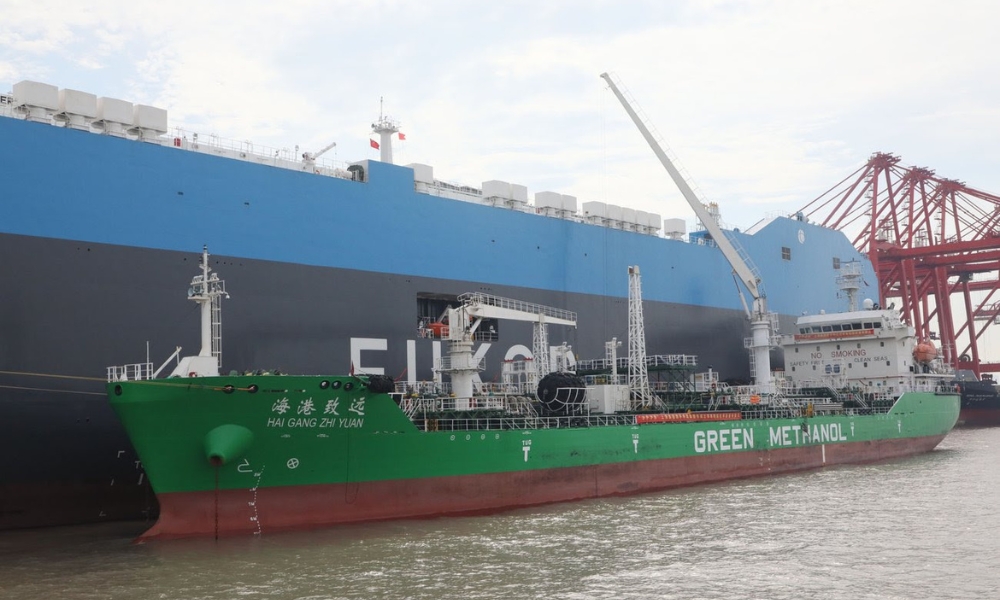
Operation involved the delivery of approximately 2,800 MT of green methanol to “Arctic Tern” via a ship-to-ship transfer using SIPG Energy’s dedicated methanol bunkering vessel “M/V Hai Gang Zhi Yuan”.
Ammonia
HPA and MB Energy develop safety concept for STS ammonia bunkering
HPA says the Port of Hamburg will become “bunker ready” for ammonia, laying the groundwork for safe and reliable ammonia bunkering in the future.
Milestone
GCMD: Project CAPTURED achieves two regulatory milestones for onboard captured CO2
CO2 captured onboard during the project has been formally recognised for compliance under the EU ETS while a proposal submitted to MEPC 84, based on the project, has received IMO’s in-principle support.

OUR INDUSTRY PARTNERS

Singapore: High Court to hear Norvic Shipping Asia winding up application on 31 July

World Fuel and partners complete first green methanol bunkering of car carrier in Shanghai

HPA and MB Energy develop safety concept for STS ammonia bunkering

GCMD: Project CAPTURED achieves two regulatory milestones for onboard captured CO2

Alkagesta highlights key insights of Malta bunkering market in 2026

ENGINE: East of Suez Fuel Availability Outlook (22 July 2026)

Singapore: Ofiniti, ONE trial direct platform integration to streamline bunker workflows

Malaysia: Maharani Freeport to implement MFM and e-BDN technologies for enhanced bunkering transparency

ENGINE: Europe and Africa Fuel Availability Outlook (8 July 2026)

Evergreen Marine director questioned, offices searched in Taiwan insider trading probe

Singapore retains world’s leading maritime centre ranking in 2026 ISCD Index

Singapore: MPA issues circular on resolutions adopted by IMO MEPC 84

Singapore: Bunker fuel sales up by 1.6% on year in June 2026

Malaysia: MMEA detains tugboat with undocumented 10,000 litres of diesel in Kuala Langat
-
 Technology1 week ago
Malaysia: Maharani Freeport to implement MFM and e-BDN technologies for enhanced bunkering transparency
-
 Bunker Fuel Availability2 weeks ago
ENGINE: Europe and Africa Fuel Availability Outlook (8 July 2026)
-
 Legal2 weeks ago
Evergreen Marine director questioned, offices searched in Taiwan insider trading probe
-
 Business2 weeks ago
Singapore retains world’s leading maritime centre ranking in 2026 ISCD Index
-
 Port & Regulatory1 week ago
Singapore: MPA issues circular on resolutions adopted by IMO MEPC 84
-
 Bunker Fuel1 week ago
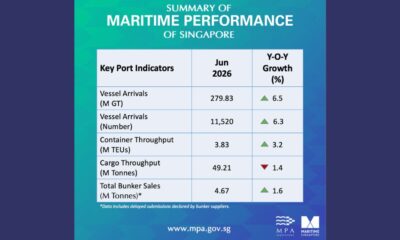
Singapore: Bunker fuel sales up by 1.6% on year in June 2026
-
 Vessel Arrest1 week ago
Malaysia: MMEA detains tugboat with undocumented 10,000 litres of diesel in Kuala Langat
-
 Bunker Fuel1 week ago
ENGINE: East of Suez Fuel Availability Outlook (14 July 2026)