Connect with us

Business

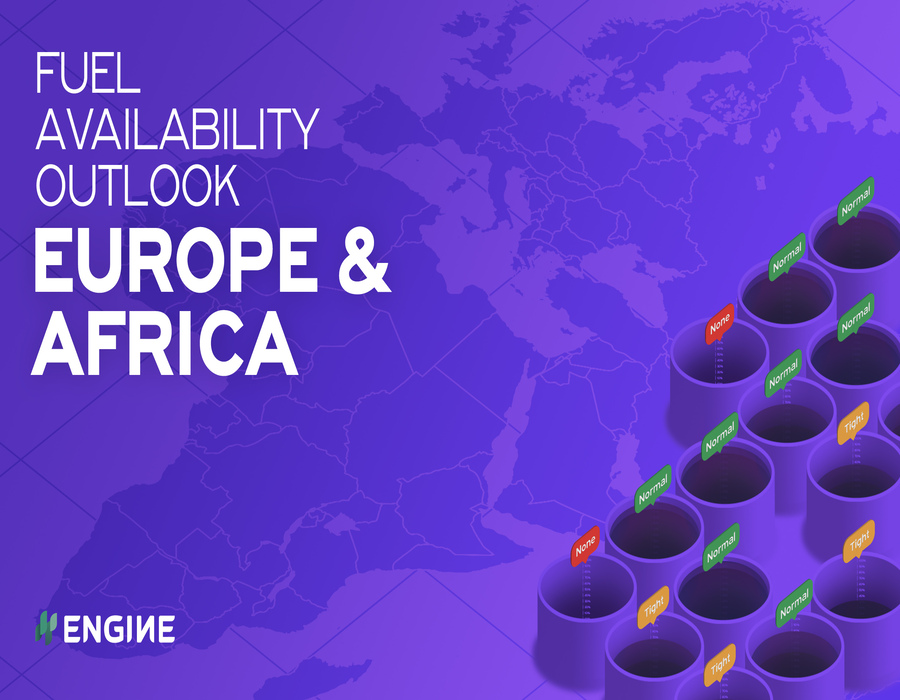
ENGINE: Europe & Africa Bunker Fuel Availability Outlook

ExxonMobil’s Antwerp refinery undergoes maintenance; Gibraltar and Algeciras suffer massive congestion; Swedish dockworkers to block Russian vessels and cargo.

Admin

Published

on

ENGINE Europe

The following article regarding Europe and Africa bunker fuel availability has been provided by online marine fuel procurement platform ENGINE for post on Singapore bunkering publication Manifold Times:

  • ExxonMobil’s Antwerp refinery undergoes maintenance
  • Gibraltar and Algeciras suffer massive congestion
  • Swedish dockworkers to block Russian vessels and cargo

VLSFO and LSMGO availability has improved somewhat in the ARA and Gibraltar Strait bunkering hubs this week, while HSFO remains relatively tighter, sources say. Recommended lead times for VLSFO and LSMGO is 4-6 days, and HSFO is around 7-10 days.

ExxonMobil announced last week that its Antwerp refinery is undergoing maintenance works. The company has not officially confirmed the duration of the maintenance, but traders expect it could take a month before the works are complete and production has normalised again. The refinery has a total nameplate capacity of 320,000 b/d, and produces fuel oil and gasoil for the local bunker market.

The refinery enters a turnaround at a time when Shell’s Pernis refinery in Rotterdam is already undergoing a major maintenance, scheduled to last until June.

TotalEnergies announced this week it will no longer enter into or renew contracts to purchase Russian oil and oil products, following several other European oil and gas firms in phasing out Russian oil imports.

Shell, BP, Equinor, Galp, Repsol, ENI and others have made similar announcements since Russia’s invasion of Ukraine started a month ago, moves that could impact production at their refineries.

ARA’s independent gasoil stocks fell by 2% last week and remain close to recent multi-year lows, while fuel oil stocks held roughly steady below their five-year average, Insights Global data showed.

Availability of HSFO and LSMGO is tight in Hamburg, while VLSFO is normal. Demand is said to have been slow in recent days. Recommended lead times are around 3-5 days for VLSFO.

In nearby Bremerhaven, HSFO and VLSFO availability is better compared to LSMGO, which requires 4-5 days of lead time.

HSFO and LSMGO is “super tight” across Italian most ports. The tightness is largely due to the slowdown of Russian imports, which has also affected production at local refinery, sources say. VLSFO availability is fine in Genoa and prompt deliveries are possible.

Bunker fuel availability in Piraeus is normal but deliveries could be affected due to barge availability. “Suppliers are able to find one way or other to deliver the fuel, however prompt deliveries are difficult,” sources say. Recommended lead times are around 5-7 days.

The Swedish Dockworkers Union has notified Ports of Sweden that its workers will not handle any vessels or cargo from or to Russia in any Swedish ports from 28 March.

Around 85% of Sweden’s fuel oil imports come from Russia. Together with fuel oil imports from Norway (11%) and Finland (4%), the Russian fuel oil has supplemented domestic Swedish refinery production of fuel oil as a by-product, or as processed VLSFO.

Bunker operations outside Gibraltar’s outer port limits were suspended on Wednesday morning due to high swells and strong wind.

Similarly, bunkering at Algeciras’ outer C and D anchorages are likely to be affected due to strong winds and swell, says MH Bland. Bunker operations are possible at outer anchorages but are subject to decisions from the harbour master and barge operators.

The recent deteriorating weather conditions in Gibraltar and Algeciras will possibly add to existing congestion. A total of 35 vessels were waiting to bunker in the two ports on Wednesday.

Port all operations are also suspended in the bay of Ceuta, MH Bland says. Two vessels were waiting to bunker at anchorage in Ceuta on Wednesday, with another three vessels expected to arrive throughout the day, according to shipping agent Jose Salama & Cia.

Maersk announced on Tuesday it has stopped accepting any laden export containers in Ireland’s Dublin port- Marine Terminal Ltd (MTL), as the terminal is over-congested.


Photo credit and source: ENGINE
Published: 24 March, 2022

Continue Reading

Winding up

Singapore: Notice of intended dividend issued for Xihe Holdings’ subsidiaries

Creditors will need to produce proofs of debt to liquidators of Da Xin Tankers and Nan Chiau Maritime by 5 August, according to Government Gazette notice.

Admin

Published

on

By

calculator steve pb from Pixabay

Two notices to declare the intended dividend of  Xihe Holdings’ subsidiaries to their creditors have been posted on the Government Gazette on Wednesday (22 July).

The subsidiaries are Da Xin Tankers Pte Ltd and Nan Chiau Maritime Pte Ltd. 

The following are the details of the notices of intended dividend:

Name of Company : Da Xin Tankers (Pte) Ltd (In Creditors’ Voluntary Liquidation)
Unique Entity No. / Registration No. : 198400895W
Address of Registered Office : c/o Grant Thornton Singapore Private Limited, 8 Marina View, #40-04/05 Asia Square Tower 1, Singapore 018960
Last Day for Receiving Proofs : 5 August 2026 at 5:00 pm by email to [email protected]
Name of Liquidators : Paresh Tribhovan Jotangia and Ho May Kee
Address : c/o Grant Thornton Singapore Private Limited, 8 Marina View, #40-04/05 Asia Square Tower 1, Singapore 018960


Name of Company : Nan Chiau Maritime (Pte.) Ltd. (In Creditors’ Voluntary Liquidation)
Unique Entity No. / Registration No.: 200814296Z
Address of Registered Office : c/o Grant Thornton Singapore Private Limited, 8 Marina View, #40-04/05 Asia Square Tower 1, Singapore 018960
Last Day for Receiving Proofs : 5 August 2026 at 5:00 pm by email to [email protected]
Name of Liquidators : Paresh Tribhovan Jotangia and Ho May Kee
Address : c/o Grant Thornton Singapore Private Limited, 8 Marina View, #40-04/05 Asia Square Tower 1, Singapore 018960


Photo credit: steve pb from Pixabay
Published: 23 July, 2026

Continue Reading

Biofuel

South Korea: S-Oil launches B30-VLSFO bio bunker fuel supply

Company says it has established an integrated operating system in the Ulsan region covering the entire value chain, from feedstock procurement and blending to supply.

Admin

Published

on

By

South Korea: S-Oil launches B30-VLSFO bio bunker fuel supply

South Korean petroleum and refining company S-Oil on Wednesday (22 July) said it has started supplying B30 very low sulphur fuel oil (VLSFO), as the company seeks to support shipping’s decarbonisation efforts and growing demand for lower-carbon bunker fuels.

The company said its B30 VLSFO contains 30% sustainable biofuel blended with conventional VLSFO and can be used without requiring modifications to existing vessels, enabling shipowners to comply more readily with emissions regulations from the International Maritime Organization (IMO) and the European Union (EU).

S-Oil said it has established an integrated operating system in the Ulsan region covering the entire value chain, from feedstock procurement and blending to supply. The system combines VLSFO produced at its Onsan refinery with biofuel production facilities and storage infrastructure in the Ulsan region, allowing the entire process to be carried out within a single logistics hub.

According to the company, the integrated supply chain reduces transportation requirements during production while improving supply efficiency and reliability.

S-Oil also highlighted Ulsan Port as a strategic location for marine biofuel supply, noting the port has strong demand for bio-bunker fuels, particularly from car carriers, enabling prompt and stable deliveries to key customers.

An S-Oil official stated: “In the bio-marine fuel market, not only product quality but also securing a stable supply of raw materials and an efficient supply system are important competitive advantages.

“Based on our existing bunkering business capabilities and the excellent supply infrastructure in the Onsan area, we plan to supply stable and competitive low-carbon fuel.”


Photo credit: S-Oil
Published: 23 July, 2026

Continue Reading

Decarbonisation

Yang Ming and PSA to develop integrated sea-land decarbonisation solutions

Both will explore solutions spanning emissions measurement and verification, a digital Book-and-Claim framework, and a joint maritime-land inset token package.

Admin

Published

on

By

Yang Ming and PSA to develop integrated sea-land decarbonisation solutions

PSA International (PSA) on Monday (20 July) said it has signed a Memorandum of Understanding (MoU) with Yang Ming Marine Transport Corporation (Yang Ming) to jointly accelerate the adoption of low-carbon solutions across the maritime value chain.

Beyond emissions measurement and verification, the collaboration will focus on a digital Book-and-Claim framework and a joint maritime-land based inset token package. 

“This synergy provides cargo stakeholders with a transparent and accountable sea-land pathway to achieve their decarbonisation targets,” PSA said on its website. 

Yang Ming launched the green transport service, EcoSea+. This initiative integrates Yang Ming’s low-carbon navigation capabilities to empower customers with a flexible and transparent strategy to effectively reduce their Scope 3 transportation emissions. By joining forces with PSA, Yang Ming is able to expand the impact of these sustainability actions beyond the ocean.

Building on its position as a global port operator, PSA advances its Node to Network strategy through integrated port and supply chain capabilities that enable a green network of terminal and landside operations to reduce end-to-end supply chain emissions.

The agreement was officially signed by Mr Ivan Chiang, Chief Logistics Officer & Senior Vice President of Yang Ming, and Mr Eddy Ng, Group Head of Operations, Technology and Sustainability of PSA International. 

Mr Ong Kim Pong, PSA International Group CEO, said, “As responsible stewards of tomorrow, PSA is committed to delivering sustainable impact across the global port and supply chain ecosystem. 

“Tackling the challenges arising from climate change will require the collective efforts of all players in the maritime supply chain sector. We are excited to partner Yang Ming on the decarbonisation of global supply chains and support the transition towards a more sustainable global economy.”


Photo credit: PSA International
Published: 23 July, 2026

Continue Reading

Trending