Connect with us

Business

SSY: Implications on shipping from MEPC75 and market uncertainties

The combination of low newbuilding deliveries and a potential rebound in demand suggests the shipping industry cannot deliver a reduction in emissions by 2030, it said.

Admin

Published

on

Screen Shot 2020 11 27 at 2.19.37 PM

World’s largest independent shipbrokerage Simpson Spence Young (SSY) on Thursday (26 November) said Newbuilding orderbooks have dipped to historically low levels relative to existing fleets, with the dry bulk carrier sector one of the most extreme examples.

“The current bulker orderbook of 56.1 Mdwt represents just 6.3% of the existing capacity, the lowest percentage in almost 30 years,” said Derek Langston, Head of Research at leading shipbrokers SSY.

“At the same time, the dry bulk carrier fleet is ageing: the ratio of 15+ year old vessels to the orderbook is the highest since 2003.”

SSY noted while these trends are partly due to uncertainties over the direction of the market, they also reflect doubts over the speed at which financially viable designs for new low carbon ships can be developed.

Last week’s draft approvals at the IMO’s Marine Environment Committee (MEPC) could compound, rather than reverse, these trends for several more years as there seems little prospect of an immediate regulatory-driven acceleration in demolition (and replacement newbuilding demand), added SSY.

SSY listed the following implications for both the dry bulk sector’s supply/demand balance and CO2 emissions due to such developments:

  • Alongside limited scrapping activity until enforcement takes effect, the new IMO measures raise the prospect of continued slow steaming by much of the existing dry bulk carrier fleet.
    • This is at a time when a ‘middle-age spread’ is developing in the fleet’s age profile.
    • The biggest five-year concentration of dwt capacity was built in the years 2009-13 and will, therefore, be 13-17 years of age when IMO enforcement measures could begin to bite in 2026.
    • Without sharply increased anticipatory newbuilding orders, or a decline in dry bulk trade volumes, in the intervening years, a large portion of the middle-aged fleet will have to continue trading towards the end of the decade (at potentially slower speeds) in order to avoid a squeeze in cargo carrying capacity.

  • Carbon emissions, meanwhile, could continue to trend up.
    • A recent report by Marine Benchmark showed a net increase in maritime greenhouse gas emissions since 2011 as the effects of an expanding global fleet have exceeded efficiency gains.
    • In the case of dry bulk carriers, Marine Benchmark estimates annual average growth in emissions of close to 3% p.a. since 2011.

“The combination of low newbuilding deliveries, a potential rebound in demand and an ageing fleet implies that CO2 emissions are more likely to track fleet growth this decade, which suggests that the shipping industry cannot deliver an absolute reduction in CO2 emissions by 2030,” cautioned Torbjorn Rydbergh, Managing Director of Marine Benchmark.


Photo credit: Simpson Spence Young
Published: 27 November, 2020

Continue Reading

Biofuel

Petrochina International blends over 30,000 mt of marine biofuel since March

Company has been developing marine biofuel blending operations at China (Zhejiang) Pilot Free Trade Zone, leveraging storage and logistics facilities at its Aoshan base.
Admin

Published

on

By

Zhoushan completes China’s first batch of marine biofuel blending under pilot programme

Petrochina International Co Ltd recently said it has blended more than 30,000 metric tonnes (mt) mt of biofuel since completing the country’s first biofuel marine fuel blending operation on 13 March.

The company said the milestone demonstrates its ability to conduct continuous and large-scale biofuel marine fuel blending operations.

The company has been developing marine biofuel blending operations at China (Zhejiang) Pilot Free Trade Zone, leveraging storage and logistics facilities at its Aoshan base.

Its latest product, B24 marine fuel containing 24% biofuel component, meets relevant International Maritime Organization (IMO) requirements and marine fuel standards, according to the company. It said the product can be supplied for bunkering vessels operating on international routes.

It has used its global trading network to secure feedstock supplies and support cost control and supply security for the blending operations, it added.

The company said the large-scale blending of its marine biofuel products marks a development in China’s marine biofuel blending market.

It plans to work with upstream and downstream businesses within its group to support the development of Zhoushan Port as a major bonded marine fuel bunkering hub and contribute to its parent group’s transition towards lower-carbon energy.

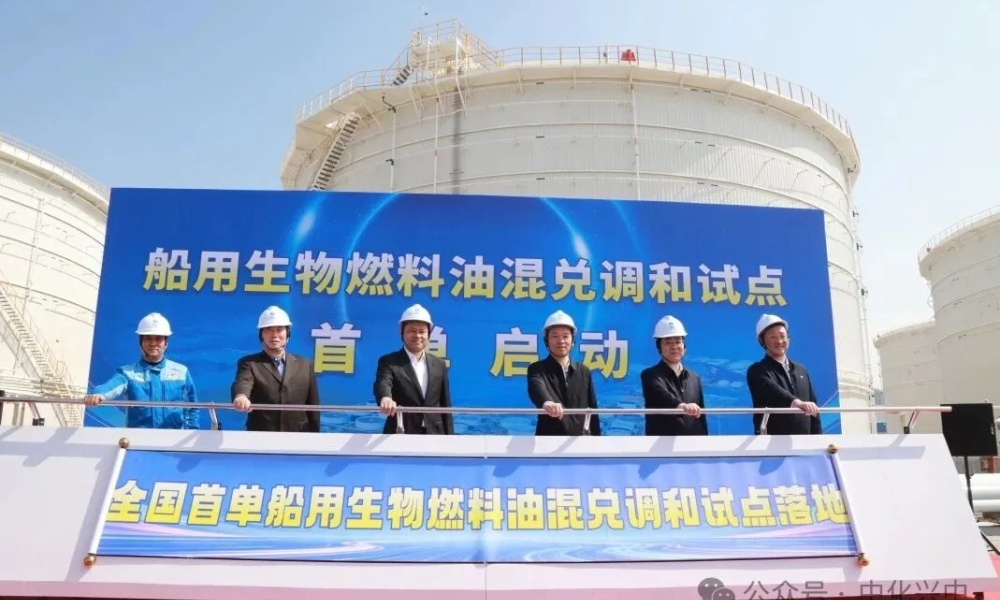
Manifold Times previously reported China (Zhejiang) Pilot Free Trade Zone launching the first pilot programme for marine biofuel blending in China with the completion of the first batch of B24-HSFO. 

The launch was marked with the blending of 2,000 mt of biodiesel and 6,300 mt of high sulphur fuel oil (HSFO) in storage tank F-02 of Sinochem-Xingzhong Oil Staging (Zhoushan), producing 8,300 mt of B24-HSFO. 

Manifold Times also reported the first cross-regional bonded bunkering operation of blended biofuel in East China was successfully completed at the Meishan Port Area of ​​Ningbo-Zhoushan Port. 

The B24-HSFO used in the bunkering operation was supplied by the Aoshan Petroleum Base in Zhoushan from the first pilot programme for marine biofuel blending in China. 

Related: Zhoushan completes China’s first batch of marine biofuel blending under pilot programme
Related: Ningbo wraps up East China’s first cross-regional biofuel blending and bunkering
Related: China debuts first marine biofuel blending pilot programme in Zhoushan
Related: China’s first batch of domestically blended marine biofuel delivered to Qingdao for bunkering


Photo credit: Sinochem-Xingzhong Oil Staging (Zhoushan)
Published: 21 September, 2026

Continue Reading

Winding up

Singapore: Final general meetings scheduled for Dromond Shipping, related firms

A member is entitled to attend the meetings and should notify the liquidators’ team office via email no later than 48 hours prior to the meeting.

Admin

Published

on

By

steve pb from Pixabay

The final general meetings of Dromond Shipping Pte Ltd  and related companies have been scheduled to take place on 19 October, according to the company’s liquidator on a notice posted on Friday (18 September) on the Government Gazette.

The other companies are Tidewater Emergency Response Services Pte Ltd, Tidewater Production Solutions Pte Ltd and Tidewater Salvage Pte Ltd. 

The final general meetings of the members of the companies will be held via electronic means on 19 October 2026 at 2.00 pm, 2.30 pm, 3.00 pm and 3.30 pm (Singapore time), respectively.

The meetings are being held for the purpose of having accounts laid before the members showing the manner in which the winding up of the respective companies has been conducted and how the property of the respective companies has been disposed of and to hear any explanation that may be given by the liquidators. 

The details of the liquidator is as follows:

Tan Kim Han
Joint and Several Liquidators
137 Amoy Street, #02-03, Far East Square
Singapore 049965

Note: A member is entitled to attend the above meeting and should notify the Liquidators’ team office via email to [email protected] or [email protected] no later than 48 hours prior to the meeting.


Photo credit: steve pb from Pixabay
Published: 21 September, 2026

Continue Reading

Ammonia

NYK wraps up first STS ammonia bunkering operation in Japan

Ammonia fuel was transferred from the ammonia carrier “Shoei Maru” via the STS method to an ammonia-fuelled medium gas carrier, scheduled for delivery in November 2026.
Admin

Published

on

By

NYK wraps up first STS ammonia bunkering operation in Japan

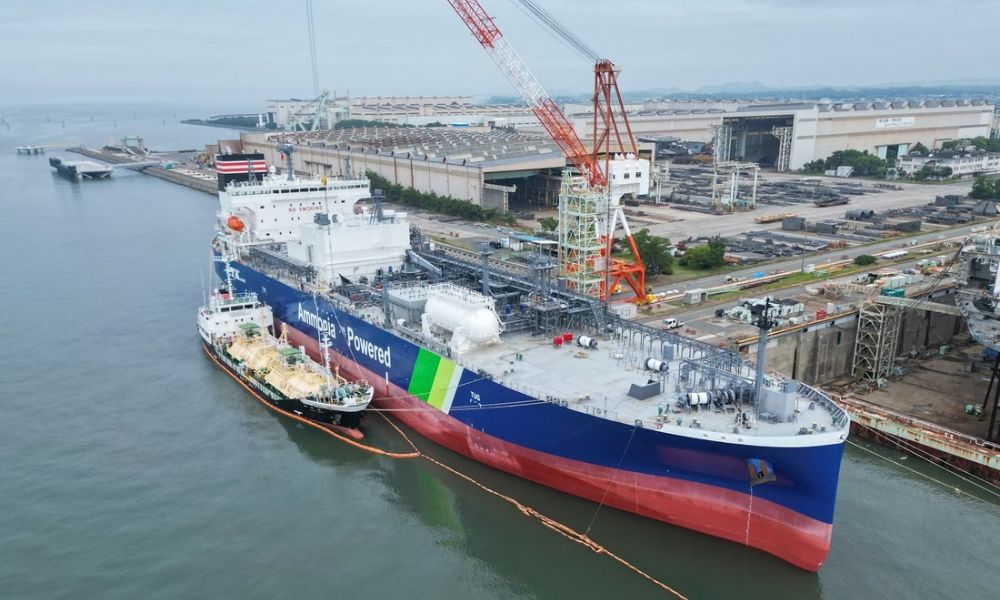
NYK Line, on Thursday (17 September) with Japan Marine United Corporation, Nihon Shipyard Co Ltd, Mitsubishi Gas Chemical Company, and Kokuka Sangyo Co Ltd, has completed the world’s first ship-to-ship (STS) ammonia bunkering operation to an ammonia-fuelled vessel. 

At a quay within Japan Marine United Corporation’s Ariake Shipyard, ammonia fuel was transferred from the ammonia carrier Shoei Maru via the STS method to an ammonia-fuelled medium gas carrier (AFMGC) scheduled for delivery in November 2026. 

The operation was conducted in preparation for sea trials of the AFMGC using fuel ammonia.

“This achievement represents an important initiative that has put into practice an operation essential for the future practical deployment of ammonia-fuelled vessels,” the company said. 

The bunkering operation was conducted following extensive discussions among the companies involved. Safe operating procedures and work processes were established prior to the operation, enabling the transfer to be completed safely. Through this initiative, we have accumulated practical insights regarding safe fuel supply operations.

This operation serves as a pioneering example of the fuel-supply framework that will be required for the widespread adoption of ammonia-fuelled vessels. 

The AFMGC is currently in the final stage of construction and is scheduled for delivery in November 2026. 

“The successful completion of this operation marks a significant milestone toward the broader commercial use of fuel ammonia and the practical deployment of ammonia-fuelled vessels. It also represents an important step forward in establishing an ammonia supply chain,” the company added. 


Photo credit: NYK
Published: 21 September, 2026

Continue Reading

Trending