Connect with us
DNV Decarbonization Insight Series August 2026 - What maritime professionals should know about AI Training

Engine

BeHydro secures LR’s first class approval for 100% hydrogen marine engine

Engine has been developed and tested at ABC Engines’ facility in Ghent and is designed to operate entirely on hydrogen, without the need for pilot fuels.

Admin

Published

on

BeHydro secures LR’s first class approval for 100% hydrogen marine engine

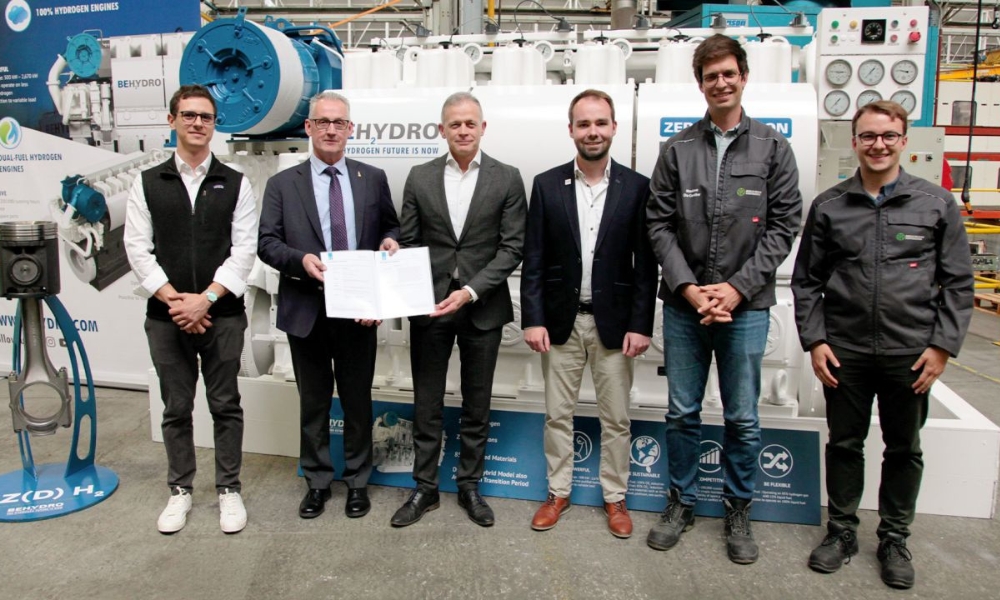
Classification society Lloyd’s Register (LR) on Wednesday (17 June) said it has issued the first Type Approval Certificate for a 100% hydrogen-fuelled, spark-ignited marine engine.

The approval has been awarded to the hydrogen engine developed by BeHydro and confirms the design meets LR’s requirements for safety, performance and reliability in marine applications.

The engine has been developed and tested at ABC Engines’ facility in Ghent and is designed to operate entirely on hydrogen, without the need for pilot fuels. This simplifies system design and removes onboard carbon emissions at source, positioning the technology as a practical option for operators exploring zero-carbon propulsion.

Claudene Sharp-Patel, Global Technical Director, Lloyd’s Register, said: “The issue of this Type Approval Certificate demonstrates that hydrogen-fuelled internal combustion engine technology is continuing to mature as a viable option for maritime applications.

“For shipowners and operators, independent certification is essential in building confidence that emerging fuel technologies can meet the industry’s expectations for safety, reliability and operational performance.”

Tim Berckmoes, CEO at ABC Engines, said: “This LRS type approval of our BeHydro 100% hydrogen engines with zero emissions is a confirmation of the future proof technology that BeHydro can offer to innovative shipowners worldwide.

“The 100% hydrogen engine range is available from 900 kW till 2670 kW for different marine applications.”

LR previously awarded Type Approval to BeHydro for its hydrogen-powered dual-fuel engine in 2023, which was the first Type Approval for a dual-fuel hydrogen engine. 


Photo credit: Lloyd’s Register
Published: 19 June, 2026

Continue Reading

Engine

Japan’s first WinGD methanol dual-fuel marine engine passes FAT at MITSUI E&S

Company successfully completed the Factory Acceptance Test of the DU-WinGD 6X82DF-M-1.0 LP-SCR, the first methanol dual-fuel WinGD large marine engine built in Japan.

Admin

Published

on

By

MITSUI E&S completes FAT of Japan's first WinGD methanol dual-fuel engine

MITSUI E&S on Monday (3 August) announced that Mitsui E&S DU, a group company of MITSUI E&S, has successfully completed the Factory Acceptance Test (FAT) of the DU-WinGD 6X82DF-M-1.0 LP-SCR, the first methanol dual-fuel WinGD large marine engine built in Japan.

The engine is also the first WinGD large marine engine manufactured at MITSUI E&S Tamano Works.

“The engine is scheduled to be installed on the first vessel in a series of four vessels being built for a domestic shipowner,” the company said on its website. 

By utilising green methanol as fuel, it will contribute to a substantial reduction in greenhouse gas (GHG) emissions from shipping operations.

“To meet the expected increase in marine engine demand under the Japanese government’s Shipbuilding Industry Revitalisation Roadmap, the MITSUI E&S Group is working to enhance production efficiency for large marine engines through integrated operation at MITSUI E&S Tamano and Mitsui E&S DU Aioi,” the company added.


Photo credit: MITSUI E&S
Published: 4 August, 2026

Continue Reading

Methanol

Tsuneishi Solutions Tokyobay delivers first methanol fuel supply system for bulker

The LFSS is the first unit of T-SOL’s proprietary LFSS developed in-house and will be installed on a Kamsarmax bulk carrier, marking its first application on an actual vessel following a ClassNK AiP.

Admin

Published

on

By

Tsuneishi Solutions Tokyobay delivers first methanol fuel supply system for bulker

Tsuneishi Solutions Tokyobay (T-SOL) on Friday (24 July) said it delivered the first Low-flashpoint Fuel (MeOH) Supply System (LFSS) for medium- and low-speed diesel engines at the end of May 2026. 

The LFSS received Approval in Principle (AiP) from ClassNK in April 2024. It is the first unit of T-SOL’s proprietary LFSS developed in-house and will be installed on a Kamsarmax bulk carrier, marking its first application on an actual vessel following the AiP granted by ClassNK.

An LFSS is designed to safely and reliably supply alternative fuels with low flashpoints, such as methanol, to a vessel’s main engine.

The LFSS delivered by T-SOL has been developed specifically for medium- and low-speed diesel engines and features a simple and compact design in terms of its main components, dimensions and weight. The system is equipped with key components manufactured by Japanese suppliers, enabling the provision of instruction manuals in Japanese as well as prompt and flexible responses to customer enquiries.

As the LFSS is assembled in Japan, customers adopting T-SOL’s LFSS are not required to attend Factory Acceptance Tests (FAT) overseas or arrange for engineers from overseas equipment manufacturers to travel to Japan, thereby helping reduce both costs and operational burdens for customers. T-SOL also provides on-site technical support during commissioning and testing.

With the tightening and introduction of environmental regulations, marine fuels are entering a period of transition from heavy fuel oil to alternative fuels, including methanol. 

“The transition requires new expertise and considerable time for technical evaluation, increasing the burden on customers. Drawing on the expertise of its experienced engineers, T-SOL provides comprehensive support throughout each customer’s transition to alternative fuels,” the company said. 

Following the delivery of its first LFSS, T-SOL will continue to work to ensure a stable supply of LFSS units while advancing the research and development of technologies that contribute to greenhouse gas (GHG) emissions reduction, including engineering solutions for other alternative fuels. 


Photo credit: Tsuneishi Solutions Tokyobay
Published: 27 July, 2026

Continue Reading

Bunker Fuel Quality

VPS on lifeboat fuel quality: A safety of life at sea critical risk

Neil Chapman and Steve Bee said regular fuel testing, correct fuel selection, and proactive fuel management are essential to ensure lifeboats are ready when they’re needed most.

Admin

Published

on

By

RESIZED VPS logo

Neil Chapman, Managing Director of Americas, and Steve Bee, Group Marketing and Strategic Projects Director of marine fuels testing company VPS, on Monday (13 July) said regular fuel testing, correct fuel selection, and proactive fuel management are essential to ensure lifeboats are ready when they’re needed most: 

Performance when its most critical

In an emergency, a lifeboat engine is not simply a mechanical asset, it is a life-saving system. If the fuel in that system is of poor quality due to degradation, contamination, or simply unsuitable for the operating environment, then the result may be failure to launch, manoeuvre, or sustain operation, when human lives depend on it. Fuel failures in lifeboats onboard Cruise Liners are high-consequence life-safety risk as the engine may be the only power source available during an emergency. It is a key SOLAS (Safety of Life at Sea) requirement that lifeboats should hold sufficient fuel to enable them to run at 6 knots for no less than 25 hours.

The primary consequence of a lifeboat failure is not the commercial  loss, but the potential failure of a safety-critical system during an abandon-ship scenario. Financial, legal and reputational consequences will undoubtedly follow but the immediate risk is to life.

Now with the inclusion of Biofuels and FAME in the marine fuel mix and assuming the same fuel used in the main engines may be used in the emergency systems, how do you verify the operability of the lifeboats in times of crisis?

Fuel grade DMX within the ISO8217 specification is specifically intended for use within emergency equipment. However, since this is not a mandatory requirement, marine gas oil (MGO grade DMA) used for other purposes on board, is often used to fill up lifeboat fuel tanks. This could lead to hazardous outcomes as the DMA grade fuel might not be suitable for its intended use. DMA fuel whilst acceptable for general machinery use, will unlikely provide the same assurance of low-temperature operability, ignition quality, storage reliability, or starting reliability required for emergency craft. The quality of the fuel in the lifeboat tanks may also deteriorate during storage. Hence it is essential to test and ensure that the quality of the fuel being taken into the tanks is ’fit for purpose’ and monitored at regular intervals. DMX fuel should be chosen due to its ability to operate at a lower temperature, superior ignition quality and  improved starting capabilities. However, this fuel only accounts for approximately 1-2% of the global supply, compared to the regular DMA grade.

Failure Modes in Emergency Operations

SOLAS compliance should not be viewed only in terms of carrying the required quality of fuel. The fuel must also remain fit-for-purpose regarding stability, cleanliness and be capable of supporting reliable engine operation throughout the vessel’s operation. Lifeboat failures are rarely a singular dramatic event, rather a chain of events. These are typically caused by degraded fuel, filter blockages or storage issues.  Incorrect handling and storage can result in the ingress of water, which with modern fuels, can promote the growth of filter blocking bacteria rendering the engine inoperable.  So rather than the issue being no fuel, it is more likely to be an issue of fuel that is of poor quality. As lifeboat engines may sit idle for long periods it potentially allows the fuel to degrade, if the correct due care and attention is not paid to this key piece of emergency equipment.

The handling and storage of fuel, coupled with the observance of quality operating procedures can lessen the risk of these failures, but are unlikely to eliminate them completely. However, the failure to follow established procedures can result in issues that are likely to cause catastrophic financial and reputational damage to the cruise line operator.

The most common failure modes in emergency lifeboats can be categorised as follows:

  • Fuel Starvation
  • Contamination
  • Degraded Fuel
  • Blocked Filter/Injectors

Contamination in the engine due to the presence of water, as previously mentioned, can be catastrophic as this can induce corrosion and oxidation, along with promoting microbial growth which results in filter blocking and fuel starvation to the engine.

If an engine fails to start, or runs poorly under load, due to fuel related issues this would likely cause a secondary emergency, compounding the reason the lifeboat was required in the first instance.

The danger with degraded fuel is that the risk is often hidden. A lifeboat may appear available, inspected and compliant, whilst he fuel inside its tank is steadily losing the properties required for reliable emergency operation.

IMO guidelines indicate that inspectors and regulators are increasingly looking at emergency systems for fuel compliance, highlighting its importance in the operation of a vessel.

Seasonal & Regional Fuel Requirements

Often overlooked are the cold flow properties of diesel and biofuels.  While hydrocarbon-based diesel has very good (low temperature) cold flow properties, this is not the case for biofuels, so lifeboats fuelled in the Caribbean for the summer season may be completely inoperable if the vessels are transferred to the Northeast or higher location, for a winter period.

Root Cause Failure Mechanisms

The failure to follow the appropriate standards which result in engine failure can be categorised as follows:

image 45

The Effect of Biofuels on Marine Fuel Quality

In a study recently completed by a major shipping line, blends of biofuels were tested for a wide range of parameters.  The findings were:

Biological growth appeared within the first month, increasing rapidly with exposure to light.

Within 3 months oxidative corrosion started to occur requiring regular monitoring.

46 CFR § 169.837 states:

“(2) The fuel tanks of motor propelled lifeboats have been emptied, and fuel changed once every twelve months.”

Yet the evidence shows fuel stability effectively starts to deteriorate within the first month and can be unusable by month 3.

Prevention Strategy

Fuel testing should be viewed as part of the vessel’s safety assurance programme. It provides evidence that the lifeboat fuel remains fit-for-purpose, not only on the day it was supplied, but throughout storage and across changing operational conditions. A strong housekeeping policy requires a multi-pronged approach to ensure operability in times of crisis; such steps include:

  • Housekeeping – ensuring the fuel system remains closed when not in use to eliminate the ingress of water.
  • Operation – frequently run the engines so that fuel and lubricants are cycled through the units.
  • Testing program – likely to be cheaper and more efficient than changing out the fuel. A well-developed fuel testing program can eliminate the need to change the fuel.
  • Documentation – by recording all the actions taken to protect the emergency systems historic data can be tracked.

Advanced Testing Programs

Due to the importance of these emergency assets several different tests should be considered to ensure the suitability of the fuel.  Testing should include:

  • Cold-Flow properties using Pour Point, Cold Filter plugging Point, Cloud Point
  • Water content for moisture
  • BYF for Microbial testing
  • Acid Number for corrosion tendencies
  • FAME for biofuels content
  • Sulphur for MARPOL Annex VI compliance
  • Visual Appearance
  • Viscosity for flow properties
  • Density
  • Flash Point for SOLAS compliance
  • Cetane Index

Conclusion

It is possible to avoid engine failures, but this can only be achieved with a well-documented and well-followed operating procedure.  Regular fuel sampling and testing along with general good housekeeping techniques will ensure these units are ready go when they are most needed. Once they are seen as an active safety-critical asset rather than a dormant emergency component the value in this process will be realized.

Lifeboat fuel quality is not a housekeeping detail, it is a Safety of Life at Sea issue. Emergency craft must be capable of starting manoeuvring and operating for the required duration whenever called upon. Sub-standard, degraded, contaminated, or unsuitable fuel can compromise that capability and turn an emergency response into a secondary emergency. Regular testing, correct fuel choice, controlled storage and documented fuel management provide the evidence and assurance that lifeboats remain ready when lives depend on them.


Photo credit: VPS
Published: 14 July, 2026

Continue Reading

Trending