Connect with us

Hydrogen

LH2 Shipping wins Enova funding for two more liquid hydrogen-powered bulk carriers

Company secured USD 36 million for the development and construction of two additional liquid hydrogen-powered bulk carriers.

Admin

Published

on

LH2 Shipping wins Enova funding for two more liquid hydrogen-powered bulk carriers

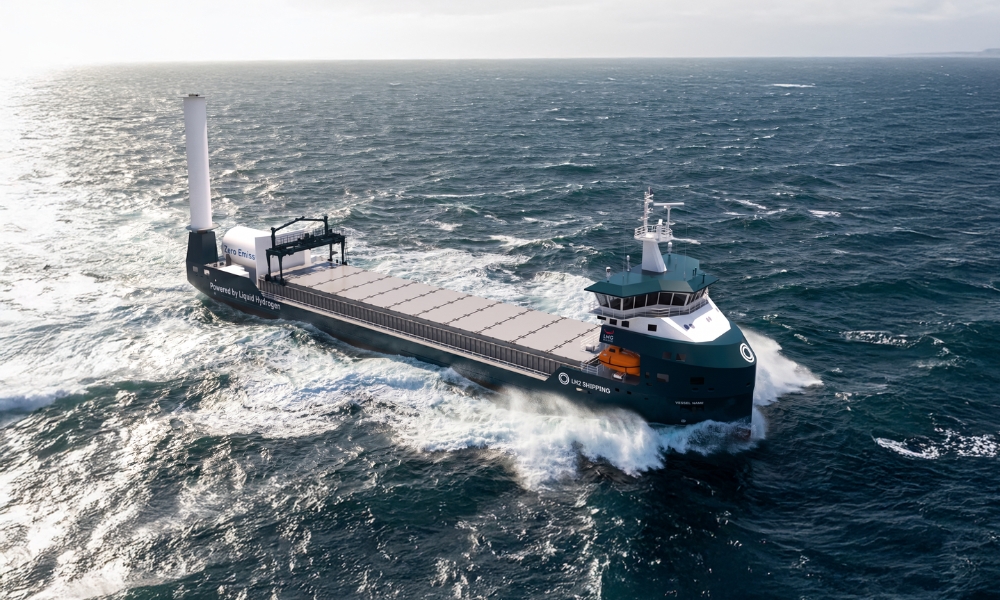
Norway’s LH2 Shipping on Tuesday (16 June) said it has been awarded Enova support of NOK 344.3 million (USD 36 million) for the development and construction of two additional liquid hydrogen-powered bulk carriers.

With the latest award, LH2 Shipping is now involved in the development of six hydrogen-powered bulk carrier projects. The announcement builds on previous Enova-supported vessel initiatives and reflects growing momentum for liquid hydrogen as a viable fuel alternative for short-sea shipping to meet decarbonising policy goals.

The new projects represent a continuation of LH2 Shipping’s long-term strategy to establish commercially viable hydrogen-powered vessels while contributing to the development of the supporting fuel and bunkering infrastructure required for large-scale adoption.

“This award is an important strategic milestone for LH2 Shipping,” stated Ivan Østvik, CEO of LH2 Shipping. 

“It strengthens our position as a developer of liquid hydrogen-based zero-emission vessel solutions and brings us yet another step closer to our ambition of enabling a substantial fleet of hydrogen-powered vessels that can help establish a complete maritime liquid hydrogen value chain.”

Since introducing the world’s first hydrogen-powered bulk carrier projects, LH2 Shipping has focused on moving beyond demonstration concepts toward commercially deployable vessels. The addition of vessels five and six further expands the project portfolio and supports continued industrial learning across ship design, fuel systems, operations, and infrastructure.

The Enova support will indirectly enable LH2 Shipping to continue their work developing additional zero-emission solutions for passenger transport and offshore operations, supporting Norway’s broader transition toward a low-emission maritime sector.

“If we are to succeed in the transition to low and zero emission solutions in the maritime sector, we depend on players who dare to go first. LH2 Shipping shows how shipping companies can take the lead and adopt new technology. This is crucial to accelerating development and reducing emissions from shipping,” said Head of Hydrogen and Ammonia Initiatives, Elin Ulstad Stokland at Enova.

This latest Enova award brings total support for the six vessels to more than NOK 800 million and reinforces the momentum behind hydrogen-powered shipping in Norway. Through these projects, LH2 Shipping is offering ship operators to decarbonise bulk transport at scale while contributing to the development of the infrastructure and experience needed for wider industry adoption.


Photo credit: LH2 Shipping
Published: 17 June, 2026

Continue Reading

Hydrogen

Klaipėda Port launches Lithuania’s first green hydrogen production, refuelling facility

New station will supply green hydrogen for passenger vehicles, heavy-duty transport, ships and port operations, laying the foundation for a new low-emission transport ecosystem in Lithuania.

Admin

Published

on

By

Klaipėda Port launches Lithuania’s first green hydrogen production, refuelling facility

Klaipėda Port recently opened Lithuania’s first green hydrogen production and refuelling facility, marking a significant milestone in the country’s transition to clean energy. 

The new station will supply green hydrogen for passenger vehicles, heavy-duty transport, ships and port operations, laying the foundation for a new low-emission transport ecosystem in Lithuania.

Algis Latakas, Director General of Klaipėda Port Authority, said: “Only a few years ago, green hydrogen at Klaipėda Port was little more than an ambitious vision. It led us into unexplored territory, where we often found ourselves among the first to tackle challenges that had no clear solutions. 

“The journey was demanding, but it gave us invaluable experience. Today, we are proud to open Lithuania’s first green hydrogen facility and contribute to a new chapter in the country’s energy transition. Klaipėda Port has always connected sea and land routes; now it is also becoming a gateway to future energy solutions.”

Development of the green hydrogen project began in 2023. Construction of the facility started in the summer of 2025, and the project quickly gained momentum. The key equipment arrived at the port in October, installation followed shortly afterwards, and in April this year the first green hydrogen was successfully produced.

The facility uses a polymer electrolyte membrane (PEM) electrolyser to produce green hydrogen. At full capacity, it will be capable of producing around 127 tonnes of hydrogen annually.

Klaipėda Port Authority is not only introducing green hydrogen to Lithuania but is also becoming one of its first users. Approximately one quarter of the hydrogen produced at the new facility will be used to power the Authority’s own operations. A newly built hydrogen-powered waste collection vessel will soon enter service in the port, while a hydrogen-powered Toyota Mirai has already joined the Authority’s vehicle fleet. 

These investments reflect a broader commitment to testing, demonstrating and advancing clean technologies in real operating conditions. By using the fuel it produces, Klaipėda Port Authority is helping to create confidence in hydrogen as a viable solution for the future of sustainable transport and port operations.

Designed as open infrastructure, the facility will serve not only the port but also the wider transport and logistics sector. Together with LTG Group, Klaipėda Stevedoring Company BEGA and Volvo Lietuva, Klaipėda Port Authority is exploring opportunities to use hydrogen in road freight transport, railway operations and various port activities. Commercial hydrogen supply is expected to begin in autumn 2026.

The project implemented under the Economic Recovery and Resilience Plan Next Generation Lithuania, funded by the European Union’s NextGenerationEU recovery and resilience facility. The total estimated cost of the hydrogen production and refueling station is approximately €12 million, with around €6 million financed by EU funds.


Photo credit: Klaipėda Port
Published: 11 June, 2026

Continue Reading

Alternative Fuels

DNV data shows shift in alternative-fuelled vessel ordering patterns

DNV says shipowners are adopting more varied fuel strategies, reflecting a growing emphasis on optionality, regulatory compliance and risk management in long-life vessel investments.

Admin

Published

on

By

DNV data shows shift in alternative-fuelled vessel ordering patterns

Latest data from classification society DNV’s Alternative Fuels Insight (AFI) platform showed a total of 36 new orders for alternative-fuelled vessels were placed in May 2026.

Activity was primarily driven by LPG/ethane carriers, which accounted for 26 of the orders. A further eight LNG-fuelled vessels were ordered, including six container vessels and two car carriers, alongside two ethanol-fuelled bulk carriers.

So far in 2026, a total of 119 orders have been placed for alternative-fuelled vessels. Of these, LNG-fuelled vessels (60) account for the largest share of the orderbook, with the majority of these (42) coming from the container segment, and a smaller share (12) from car carriers.  

A further 50 orders have been placed for LPG/ethane carriers, while activity in other fuel types remains limited, with orders for methanol/ethanol (4), ammonia (4), and hydrogen (1).  

By the end of May, the share of alternative-fuelled vessels in total tonnage was notably lower than over the same period in 2025.

DNV data shows shift in alternative-fuelled vessel ordering patterns

Jason Stefanatos, Global Decarbonization Director at DNV Maritime, said: “While the pace of alternative-fuelled contracting has varied compared to 2025, the industry continues to move forward in its transition, with owners advancing fuel and technology decisions against a backdrop of evolving regulatory and market conditions.  

“As in previous years, ordering of alternative-fuelled vessels has been led by the container segment, but dynamics are shifting. While activity remains strong, the focus has moved towards smaller vessels, with fewer very large container ships, which are historically more likely to adopt alternative fuels, being ordered. At the same time, we are seeing increased activity in tanker and bulker segments.  

“What is also becoming clearer is that fuel choice is no longer approached as a single bet. Owners are increasingly treating it as a portfolio decision, managing fuel optionality, timing of investment, and exposure to future regulation as they navigate long-life asset decisions.

“This is reflected in more varied ordering patterns, reinforcing that the transition is not progressing in a straight line.”


Photo credit: DNV
Published: 5 June, 2026

Continue Reading

Decarbonisation

Consortium validates grid-independent hydrogen power hub for ports

Consortium demonstrated that large vessels can already be powered at berth using existing hydrogen, battery, fuel cell and electrical technologies integrated into a modular floating system.

Admin

Published

on

By

Consortium validates grid-independent hydrogen power hub for ports

ELIRE Maritime and consortium partners on Monday (25 May) announced the successful completion of the UKRI-funded Clean Maritime Demonstrator Competition Round 6 (CMDC6) programme.

CMDC6 is a GBP 1 million (USD 1.3 million) feasibility programme and initiative delivered by Innovate UK in partnership with the UK Shipping Office for Reducing Emissions (UK SHORE), part of the UK Department for Transport.

The partners are Ricardo UK, Schneider Electric, Rux Energy UK, Triton Anchor Europe, OREC (Offshore Renewable Energy Catapult), and the University of Strathclyde. 

The programme successfully validated one of the world’s first fully grid-independent Hydrogen Floating Power Hub systems capable of delivering clean power directly to vessels at berth without requiring traditional shore-side grid infrastructure. 

The consortium demonstrated that large vessels can realistically be powered at berth today using existing hydrogen, battery, fuel cell, and electrical technologies integrated into a modular floating maritime system designed for rapid deployment across global ports.

The solution can now be deployed and would be expected to support the reduction of up to 500,000 tonnes of CO₂ emissions globally over the next decade through a scalable maritime clean energy infrastructure capable of operating independently from constrained port grids.

“Ports are under increasing pressure to decarbonise while facing major infrastructure constraints,” said Luke Jenkinson, Founder and CEO of ELIRE Maritime. 

“The Hydrogen Power Hub proves that ports do not need to wait years for grid upgrades to begin reducing emissions. We have validated a practical, scalable, and deployable system capable of delivering clean power directly where it is needed most.”

The Hydrogen Power Hub establishes a new category of maritime infrastructure by moving energy and power generation as well as storage onto water rather than relying on fixed, land-based systems constrained by grid access, cost, permitting, and land availability.

At full configuration, this particular validated system is capable of delivering 5MW of continuous clean power output directly to vessels at berth, enough to support medium-sized cruise vessels and other large maritime assets requiring both 6.6kV and 11kV shore power connections. This system integrates three modular hexagonal floating platforms with a combined 1,200 sqm footprint, approximately 45MWh of battery energy storage capacity, modular fuel cell systems, hydrogen-powered generation, onboard renewable generation, and advanced grid-forming AC/DC electrical architecture.

The consortium confirmed the platform can deliver approximately 91MWh of energy per week while supporting repeated vessel charging operations without requiring major civil works, land reclamation, or expensive grid reinforcement.

The system uses approximately 7,500 to 8,000kg of hydrogen weekly, stored within modular ISO-compatible low-pressure storage containers integrated directly into the floating infrastructure. The current layout accommodates seven onboard hydrogen tanks, with refuelling operations expected approximately twice weekly, enabling ports to adopt hydrogen incrementally without requiring permanent hydrogen infrastructure during early deployment phases.

Instead of relying on oversized generators, the platform uses modular 1.3MW fuel cells operating continuously throughout the week to gradually charge the onboard batteries before rapidly dispatching energy when vessels arrive at berth.


Photo credit: ELIRE Maritime
Published: 26 May, 2026

Continue Reading

Trending