Connect with us

Alternative Fuels

Argus Media viewpoint: Dutch ticket move to help low-emission fuels

Netherlands will switch to GHG-based ERE tickets on 1 January 2026 and the mandate will apply retroactively if the legislation is passed beyond that date.

Admin

Published

on

resized argusmedia

A change in the EU Renewable Energy Directive (RED III) is pushing the Netherlands, a key renewable fuel ticket market in Europe, to pivot from compliance based on energy share to greenhouse gas (GHG) savings, and should benefit fuels with higher emission savings.

17 December 2025

The Netherlands will switch to GHG-based ERE tickets on 1 January 2026. The mandate will apply retroactively if the legislation is passed beyond that date.

The move more closely aligns Dutch compliance with Germany’s THG quota and accelerates a broader shift to reward fuels with high greenhouse gas (GHG) savings, as well as RED Annex IX Part A feedstock status, positioning advanced Fame, hydrotreated vegetable oil (HVO) and biomethane as front-runners.

RED III’s overall 2030 target gives EU member states the option to reduce their GHGs by 14.5pc, or to have a 29pc renewable energy share in their overall fuel mix. This is a significant step-up from RED II, which only required states to have 14pc renewable energy in their mix by 2030.

Most major states incentivise the uptake of RED targets through the use of renewable fuel ticket systems. Tickets are used by companies supplying liquid or gaseous fossil fuels in the country and are obligated to pay excise duty or energy tax on fuels. They can be traded to meet obligations and are primarily generated via the blending of renewable fuels into fossil fuels, with additional sources of tickets including electricity used to charge e-vehicles.

The Dutch change will benefit fuels with higher emissions savings and move away from a more simplistic approach where one HBE ticket is equal to 1 GJ of energy use, with multipliers available based on feedstock type. The current four HBE categories will expand to 16 types of ERE tickets, defined by transport sector — land, inland waterways and maritime — as well as feedstock.

An HBE-to-ERE ratio of 1:46, as per the Dutch Emissions Authority’s (NEa) guidance, has already begun to guide transitional pricing. All 2025 HBEs must be submitted by 30 April, after which any non-redeemed HBEs will be converted into EREs, subject to a legal cap on the amount that can be carried from year to year.

Premiums for RED Annex IX Part A fuels should grow as demand for corresponding ERE-Gs does the same. But ERE-B values — comprising fuels from RED Annex IX Part B feedstocks — will be affected by a mismatch between RED III vs FuelEU Maritime rules.

Shipping mismatch

Under FuelEU, a separate legislation from RED III, Part B fuels remain eligible, whereas the domestic transposition of RED III means EREs count the same as using fossil fuel for only the maritime obligation. Shipping vessels are likely to either bunker elsewhere, or opt for Part A fuels that can meet both mandates.

Maritime suppliers can source up to 0.9pc of their mix from road and inland waterways, preserving a narrow role for Part B fuels via cross-sector ERE flows. But EREs from shipping cannot be used by land suppliers.

Aviation fuel blending will no longer generate Dutch tickets, removing a source of Part B tickets, as the bio-component of sustainable aviation fuel (SAF) has mostly been produced from used cooking oil.

Overall, liquidity in the Netherlands will fragment by sector — LREs for land, BREs for inland shipping and ZREs for maritime shipping — all taking a Dutch acronym.

Across the EU, GHG-based transport fuel mandates with tight feedstock caps should tighten supply of Part A fuels and renewable fuels from non-biological origin (RFNBOs), while remaining energy-based systems may lean on conventional and Part B biofuels. The Dutch-German axis, as the largest GHG-based ticket markets, may increasingly anchor to Part A fuel tickets. Advanced biofuel suppliers will be monitoring which market provides better ticket value for their fuel at a given time.

France also plans to replace its energy-based TIRUERT tickets with GHG-based IRICCs in 2027. Outside the RED III remit, the UK is consulting on whether to follow suit as it updates its RTFO scheme; consultation updates are expected in early 2026, and any resulting changes are expected in 2027.

By Madeleine Jenkins


Photo credit and source: Argus Media
Published: 22 December, 2025

Continue Reading

Methanol

World Fuel and partners complete first green methanol bunkering of car carrier in Shanghai

Operation involved the delivery of approximately 2,800 MT of green methanol to “Arctic Tern” via a ship-to-ship transfer using SIPG Energy’s dedicated methanol bunkering vessel “M/V Hai Gang Zhi Yuan”.
Admin

Published

on

By

World Fuel and partners complete first green methanol bunkering of car carrier in Shanghai

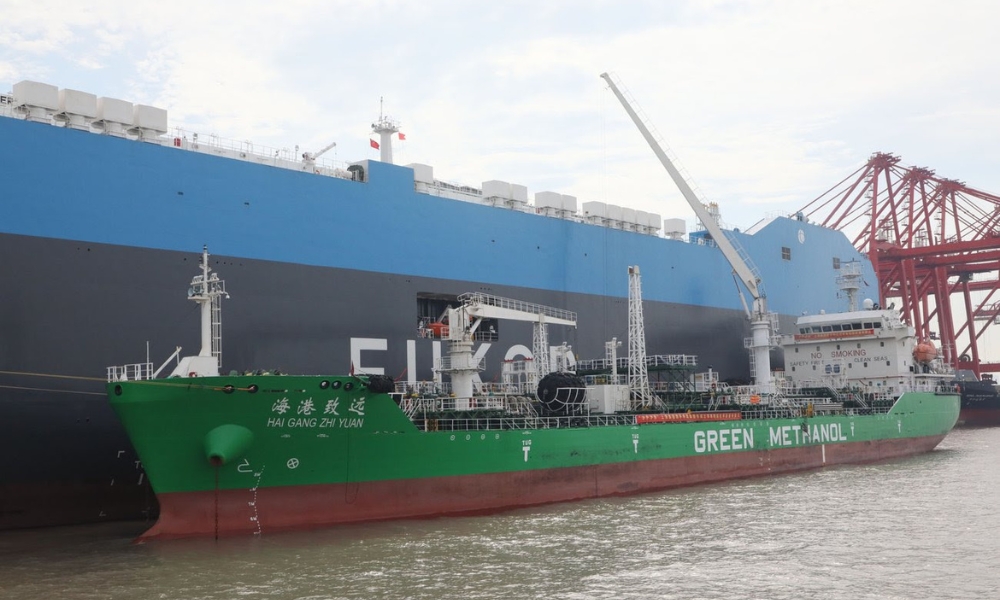
Marine fuel provider World Fuel on Tuesday (21 July) said it successfully completed the first green methanol bunkering of M/V Arctic Tern, with EUKOR Car Carriers and SIPG Energy at the Port of Shanghai. 

Arctic Tern is the first vessel in the new Shaper Class series of car carriers. 

The operation involved the delivery of approximately 2,800 MT of green methanol to Arctic Tern via a ship-to-ship transfer using SIPG Energy’s dedicated methanol bunkering vessel M/V Hai Gang Zhi Yuan, the largest vessel of its kind in operation. 

The bunkering operation was carried out at Haitong Terminal, Waigaoqiao Port Area, Shanghai Port, with cargo handling operations conducted simultaneously during bunkering.

This marks EUKOR Car Carriers’ first green methanol operation and the first time Arctic Tern has bunkered methanol since its delivery on 9 July. The operation marked the first bunkering at Shanghai Port of green methanol produced locally in Shanghai for an international PCTC operator. 

It also demonstrated the city’s integrated green methanol value chain, spanning local production, storage and bunkering, and established a replicable “Shanghai Model” for green methanol supply.

World Fuel arranged the supply and delivery of the fuel on behalf of EUKOR Car Carriers, working with SIPG Energy as the physical supplier at the Port of Shanghai.

The green methanol supplied was produced from municipal solid waste, ISCC-EU certified, and had a carbon intensity value below 25 gCO₂e/MJ.

Arctic Tern is the first of fourteen Shaper Class vessels ordered by Wallenius Wilhelmsen. With a capacity of 9,300 car equivalent units and methanol dual-fuel capability, the vessel will be operated by EUKOR Car Carriers, jointly owned by Wallenius Wilhelmsen and Hyundai Motor Group. Following her first green methanol bunkering, Arctic Tern will continue her maiden voyage from Asia to Europe.

Xavier Leroi, COO Shipping Services at Wallenius Wilhelmsen and CEO of EUKOR Car Carriers, said: “Completing Arctic Tern’s first green methanol bunkering shortly after delivery is a significant milestone towards our decarbonisation ambition for both EUKOR Car Carriers and Wallenius Wilhelmsen. It demonstrates how investments in next-generation vessel technology and fuel flexibility are being translated into real-world operations. 

“This achievement reflects the strong collaboration between all parties involved. Together, we have shown how partnerships across the maritime value chain can help make lower-emission fuels available and operationally viable at scale.”

Mark Tamsitt, SVP Global Marine Sales at World Fuel, said, “The first bunkering event with a new fuel is a significant moment for any shipowner, and our role is to make it as seamless as possible. By connecting EUKOR Car Carriers with SIPG Energy’s proven green methanol capability at the Port of Shanghai, we were able to deliver on reliable supply, fuel quality, and safe processes. As more of our customers bring methanol dual-fuel tonnage into service, we are committed to being the partner that makes these kinds of operations routine.”

Mr. Zhang Da, General Manager of SIPG Energy, said, “Welcoming Arctic Tern to the Port of Shanghai for her first green methanol bunkering demonstrates the strength and maturity of our supply capability. Building on our well-established methanol ship-to-ship bunkering services for container vessels, we have already extended such services to pure car and truck carriers (PCTCs). This bunkering sets a new record for the largest single SIMOPs green methanol bunkering for PCTCs in China, marking another step in building Shanghai’s position as a global green energy hub for international shipping.”

This operation follows Wallenius Wilhelmsen’s announcement on 9 July that Arctic Tern would complete her first methanol bunkering shortly after delivery. The vessel entered service on routes between Asia and Europe immediately following handover from China Merchants Jinling Shipyard in Nanjing.


Photo credit: World Fuel
Published: 22 July, 2026

Continue Reading

Ammonia

HPA and MB Energy develop safety concept for STS ammonia bunkering

HPA says the Port of Hamburg will become “bunker ready” for ammonia, laying the groundwork for safe and reliable ammonia bunkering in the future.
Admin

Published

on

By

HPA and MB Energy develop safety concept for STS ammonia bunkering

The Hamburg Port Authority (HPA) and integrated energy company MB Energy on Tuesday (21 July) said they have completed a comprehensive risk analysis and developed a dedicated safety concept for ship-to-ship ammonia bunkering.

MB Energy said the analysis lays the groundwork for the safe introduction of ammonia as a future marine fuel.

“With our planned ammonia import terminal in Hamburg-Blumensand, MB Energy intends to provide the reliable land side supply infrastructure needed to support this transition across northern German ports,” it said in a social media post. 

Mabanaft Group was renamed to MB Energy last year and merged over 50 existing brands under one identity. 

Separately, HPA said the Port of Hamburg will become “bunker ready” for ammonia, laying the groundwork for safe and reliable ammonia bunkering in the future.

“The focus is in particular on container ships, cruise ships as well as RoRo and ConRo (Container/RoRo) ships,” it said. 

“We expect ammonia to establish itself as an alternative marine marine fuel in the coming years. With our preparatory work, we are already creating the conditions to welcome the first ammonia-powered ships in Hamburg and to bunker them safely.:

HPA added that the import terminal for ammonia planned by MB Energy from 2029 will make a decisive contribution to ensuring the reliable availability of ammonia as a bunker fuel in northern German ports in the long term. 

“The use of an ammonia bunker barge is considered a possible addition to the landside infrastructure to enable ship bunkering in the port and beyond in the future,” it said.

Related: Mabanaft Group renames as MB Energy, merging over 50 brands under one identity


Photo credit: Hamburg Port Authority
Published: 22 July, 2026

Continue Reading

LNG Bunkering

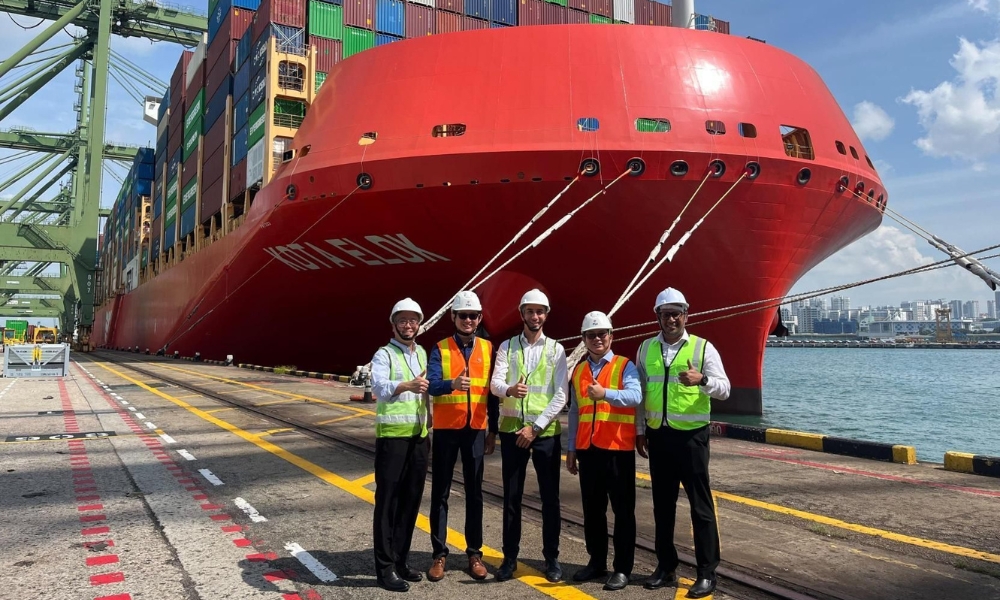
PIL’s LNG dual-fuel boxship “Kota Elok” arrives in Singapore on maiden call

As the first of 13 new 13,000 TEU vessels joining its fleet, Kota Elok is equipped to operate on LNG and low-sulphur fuel oil that helps reduce our greenhouse gas emissions.
Admin

Published

on

By

PIL's LNG dual-fuel boxship “Kota Elok” arrives in Singapore on maiden call

Singapore-based Pacific International Lines Pte Ltd on Monday (20 July) said its first 13,000 TEU LNG dual-fuel container vessel, Kota Elok, recently made her maiden call to Singapore on 15 July.

As the first of 13 new 13,000 TEU vessels joining its fleet, Kota Elok is equipped to operate on liquefied natural gas (LNG) and low-sulphur fuel oil that helps reduce our greenhouse gas emissions. 

The vessel also incorporated energy-saving features and digital technologies to reduce fuel consumption and enhance operational performance, as well as a bow windshield to improve aerodynamics, contributing to improved fuel efficiency and lower emissions over the course of long-haul voyages.

“Following Singapore, Kota Elok will continue her voyage on our East Coast Service 1 (ES1) route to South America, calling at ports in Brazil, Uruguay, and Argentina before returning to Asia,” the company said in a social media post. 

Kota Elok also became PIL’s first vessel to receive Lloyd’s Register certification for compliance with the IACS UR E26 and UR E27 cyber security requirements.

Developed by the International Association of Classification Societies (IACS), UR E26 and UR E27 are mandatory cyber resilience requirements for newbuild vessels contracted from 1 July 2024. 


Photo credit: Pacific International Lines
Published: 21 July, 2026

Continue Reading

Trending