Connect with us
DNV Decarbonization Insight Series August 2026 - What maritime professionals should know about AI Training

Biofuel

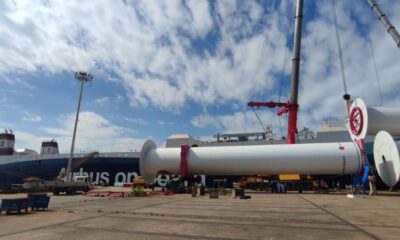
K Line subsidiary launches Japan’s first tugboat with onboard biofuel blender

Biofuel blender installed onboard the vessel, manufactured by Conhira, is capable of blending marine fuel oil and biofuel at the blending ratio of choice between 0% and 100%.

Admin

Published

on

K Line subsidiary launches Japan’s first tugboat with onboard biofuel blender

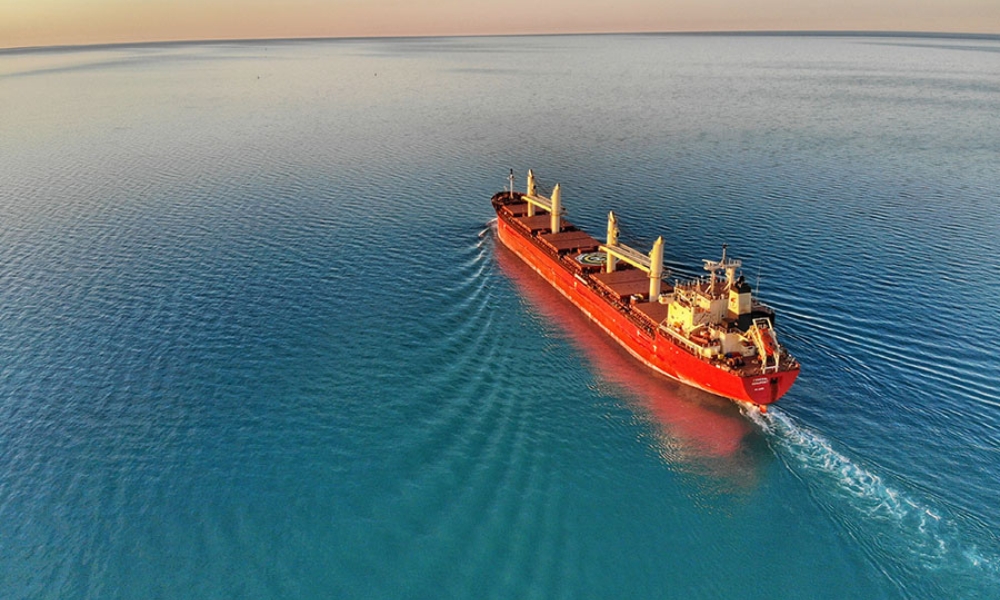
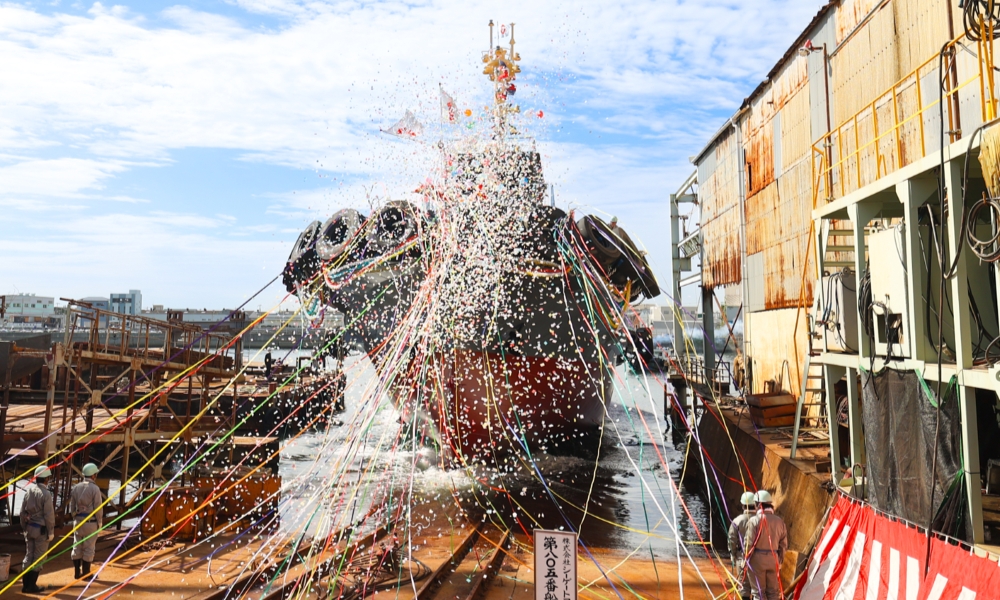
Kawasaki Kisen Kaisha’s (K Line) subsidiary Seagate Corporation, on Wednesday (22 April) launched and named a newly built tugboat, equipped with an onboard biofuel blending system at Kanagawa Dockyard in Japan. 

While it is equipped with a conventional diesel engine propulsion system using marine fuel oil, the tugboat, named Bisan Maru, is the first Japanese tugboat to be equipped with a biofuel blender and an ultrasonic hull anti-fouling system. 

The biofuel blender installed onboard the vessel, which was manufactured by Conhira, is capable of blending marine fuel oil and biofuel at the blending ratio of choice between 0% and 100%. 

“This system paves the way for the stable production of fuel that includes biofuel at the desired blending ratio onboard the vessel, even when the ship is in places where it is difficult for bunkering ships to supply blended biofuel,” K Line said in a statement. 

The ultrasonic hull anti-fouling system uses ultrasonic waves to hinder marine organisms’ adhesion to the hull and mitigate the deterioration of fuel efficiency due to hull fouling. 

This system was developed for a hybrid EV tug scheduled to be completed in 2027. To verify the system in an operational environment, it was first installed in the vessel.


Photo credit: Kawasaki Kisen Kaisha
Published: 24 April, 2026

Continue Reading

Alternative Fuels

Quadrise and Licella amend JDA to advance low-carbon marine fuel testing

Companies have been collaborating since March 2025 on the use of Licella’s bio-oil produced by HTL technology as a potential cost-effective feedstock for Quadrise’s bioMSAR™ and bioMSAR Zero™ fuels.

Admin

Published

on

By

RESIZED scott graham

Quadrise, a low emissions fuels and biofuel developer, recently announced an amendment to the Joint Development Agreement (JDA) with Australian-based Licella Holdings (Licella).

Licella is a global technology pioneer delivering scalable, low-cost and high-value fossil replacement solutions. Its proprietary Cat-HTR™ hydrothermal liquefaction (HTL” technology efficiently converts abundant biomass residues and biowastes, including wood and agricultural waste, into high-quality, sustainable bio-oil that can be blended or refined into low-carbon liquid fuels.

“HTL is globally recognised as one of the most promising pathways for producing sustainable fuels for hard-to-abate sectors such as shipping, with organisations highlighting its potential to deliver low-carbon bio-oils at the scale the maritime sector requires,” Quadrise said. 

Under the JDA entered into on 26 March 2025, Quadrise and Licella have been collaborating and seeking, inter alia, to progress the use of Licella’s bio-oil produced by HTL technology as a potential cost-effective feedstock for the Company’s  bioMSAR™ and bioMSAR Zero™ fuels.  

Under the JDA, pursuant to which lab testing has been undertaken in Australia and the UK, the parties have jointly developed a deeper understanding of the technological advancements needed to supply sustainable HTL-derived bio-oils to the maritime sector.

As a result, and prior to diesel engine testing, the Amended JDA now sets out a non-binding but more specific development focus, with an updated time schedule for the joint testing of the parties’ respective fuel technologies, with Licella providing the scalable HTL bio-oil production expertise and Quadrise providing maritime market access and fuel experience.  

Upon successful completion of final lab tests on refined Licella HTL bio-oils in H2 2026, initial marine fuel diesel engine pilot tests are planned by the parties, after which Quadrise and Licella will seek to undertake the larger scale, third-party engine testing required to move to commercial vessel tests.


Photo credit: Scott Graham
Published: 4 August, 2026

Continue Reading

Alternative Fuels

UK Chamber of Shipping releases industry-first safety evidence base for alternative bunker fuels

Publication provides preliminary, high-level risk assessments covering five key marine fuel pathways: Battery Energy Storage Systems, biofuels, methanol, hydrogen and ammonia.

Admin

Published

on

By

RESIZED Chris Pagan

The UK Chamber of Shipping on Monday (3 August) published Alternative Fuels: Building the Safety Evidence Base, a report bringing together industry expertise to identify and assess the safety considerations associated with the fuels expected to power shipping’s transition to net zero.

Developed through the Chamber’s Safety of Alternative Fuels Working Group (SAFWG), the publication provides preliminary, high-level risk assessments covering five key fuel pathways: Battery Energy Storage Systems (BESS), biofuels, methanol, hydrogen and ammonia. 

Francesco Sandrelli, Policy Director (Environment) at the UK Chamber of Shipping, said: “Shipping is on a critical pathway to net zero. New fuels and energy sources are moving from pilot projects to commercial reality, but safety, standards and operational readiness must keep pace.

“There is no single fuel that will decarbonise shipping. Different vessel types, trades and operating environments will require different solutions. What is essential is that the transition takes place safely. This publication is an important step towards achieving that goal.”

Among the report’s key findings is the need for robust design and process safety frameworks to support the commercial deployment of alternative fuels. The research also highlights a number of cross-cutting themes, including material compatibility, emergency response preparedness, crew training and competence, and the need for clearer regulatory pathways. 

The report represents a major collaborative effort by industry to build a shared understanding of the opportunities and challenges associated with alternative marine fuels. It provides practical insights into the known risks, highlights where further work is needed, and creates a foundation for future research, regulation and operational learning. 

The SAFWG was established by the UK Chamber of Shipping to support industry understanding of the safety implications associated with emerging zero and near-zero emission fuels. 

The report is the culmination of the Working Group’s first year of activity, during which more than 200 participants from over 50 organisations collaborated through a series of technical workshops delivered by Policy Director Francesco Sandrelli, supported by Robert Merrylees and Paul Markides. 

The publication forms part of the UK Chamber’s wider work to support shipping’s transition to net zero while maintaining the highest standards of safety and operational excellence. 

Future work by the SAFWG will focus on identifying regulatory and knowledge gaps, developing project-specific case studies, expanding stakeholder engagement and establishing an incident and lessons-learned database. 

Note: The report, Alternative Fuels: Building the Safety Evidence Base, can be found here


Photo credit: Chris Pagan on Unsplash
Published: 4 August, 2026

Continue Reading

Alternative Fuels

ENGINE on Fuel Switch Snapshot: B100 and LBM prices decline in Rotterdam

Rotterdam B100 premium over VLSFO narrows; Dutch ZRE A price climbs by €25/mtCO2e; B100 flips to discount to LSMGO in Singapore.

Admin

Published

on

By

ENGINE on Fuel Switch Snapshot: B100 and LBM prices decline in Rotterdam

Once a week, bunker intelligence platform ENGINE will publish a snapshot of alternative and conventional bunker fuel prices in the world’s two biggest bunkering hubs. The following is the latest snapshot:

3 August 2026

  • Rotterdam B100 premium over VLSFO narrows
  • Dutch ZRE A price climbs by €25/mtCO2e
  • B100 flips to discount to LSMGO in Singapore

Rotterdam’s B100 has remained at a premium over VLSFO for another week, although the spread has narrowed by $69/mt to $41/mt over the past week. Its discount to LSMGO has widened by $77/mt to $417/mt.

Singapore’s B100 has slipped to a $6/mt discount to LSMGO, from a $2/mt premium a week earlier.

ENGINE on Fuel Switch Snapshot: B100 and LBM prices decline in Rotterdam

Liquefied biomethane (LBM) in Rotterdam has regained its price advantage over VLSFO for vessels with Otto medium speed (Otto MS) engines. The benchmark has shifted from a $25/mt premium a week ago to a $68/mt discount.

For vessels with diesel slow speed (diesel SS) engines, Rotterdam’s LBM discount to VLSFO has widened by $93/mt to $242/mt.

In Singapore, LNG’s premium over LSMGO for Otto MS engines has narrowed by $11/mt to just $4/mt over the past week.

For vessels with diesel SS engines, Singapore LNG is priced at a $79/mt discount to LSMGO.

Liquid fuels

Rotterdam’s VLSFO and LSMGO prices have climbed by $26-34/mt over the past week.

The gains have come despite a $6.89/bbl ($51/mt) slump in front-month ICE Brent futures, to $83.92/bbl ($615/mt), and a $1.85/mtCO2e decline in Dec26 EUA prices to $93.34/mtCO2e.

Rotterdam’s HSFO price has bucked the trend, falling by $45/mt.

Fuel availability remains tight for prompt deliveries in the ARA, with suppliers recommending lead times of 5-7 days to secure stems, a trader said.

Rotterdam’s B100 price has dropped by $43/mt over the past week.

Prima Markets-assessed Dutch ZRE A ticket prices have climbed by €25/mtCO2e to €130/mtCO2e, adding downward pressure on Rotterdam’s B100 benchmark.

“Market sources had explained the strong gains by pointing out that not enough renewable fuels are blended to meet the Dutch maritime mandate this year,” Prima said.

Singapore’s VLSFO price has risen by $16/mt over the past week, while LSMGO has edged down by $4/mt.

VLSFO availability in Singapore remains very tight, with suppliers recommending lead times of 16-20 days. LSMGO availability has improved, with lead times easing to 5-8 days from 9-11 days a week earlier.

Singapore’s B100 price has fallen by $11/mt over the past week.

Liquid gases

Rotterdam’s LNG prices have fallen by $67/mt over the past week, while LBM prices have retreated by $67-68/mt.

LBM discounts to LNG in Rotterdam have remained broadly unchanged, widening slightly by $1/mt to $290-298/mt.

In Singapore, LNG prices have eased by $15/mt over the past week.

By Konica Bhatt


Photo credit and source: ENGINE
Published: 4 August, 2026

Continue Reading

Trending