Connect with us

Nuclear

HD KSOE receives DNV AiP for nuclear-powered container ship design

AiP for 15,000 TEU container vessel design powered by SMR technology represents an important first step in building the technical verification process for nuclear-powered vessels, says Geir Dugstad of DNV.

Admin

Published

on

HD KSOE receives DNV AiP for nuclear-powered container ship design

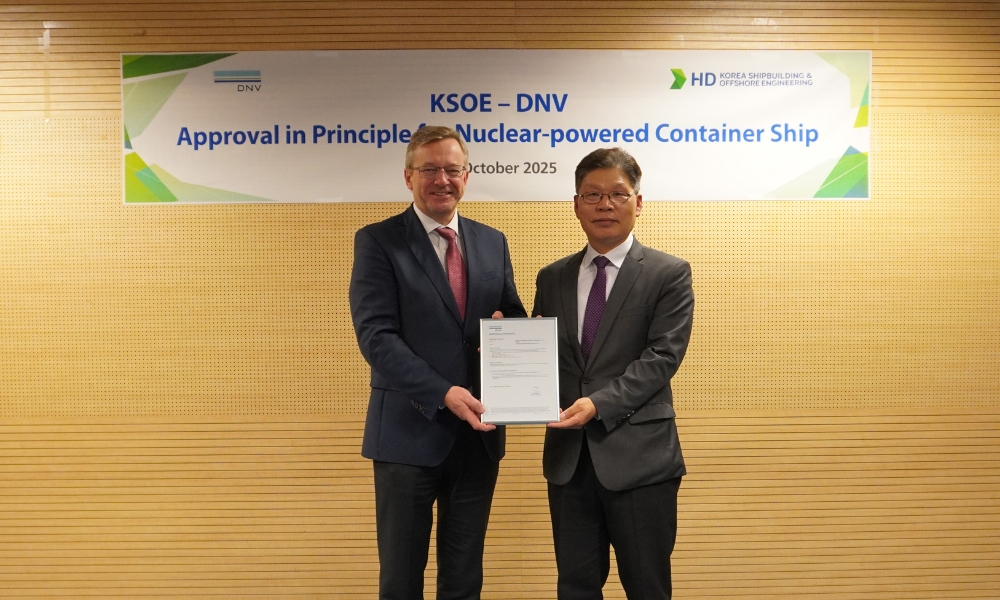
Classification society DNV on Thursday (23 October) said it has awarded HD Korea Shipbuilding & Offshore Engineering (HD KSOE) an Approval in Principle (AiP) for a new 15,000 TEU container vessel design powered by Small Modular Reactor (SMR) technology at the KORMARINE tradefair this week. 

The presentation was attended by Sungkon Han, Executive Vice President of the Green Energy Research Lab at HD KSOE, Geir Dugstad, Technical Director at DNV, and Ole Christen Reistad, Senior Principal Researcher and nuclear research lead at DNV, who discussed the outcome of the project and the potential for nuclear-powered shipping at DNV’s Busan offices.

The design demonstrates the application of SMR technology in a 15,000 TEU container vessel, capable of operating at 24 knots. The vessel concept incorporates a supercritical CO₂-based power generation system, which can provide higher thermal efficiency and a reduced equipment footprint compared to conventional steam-based systems.

DNV has reviewed the conceptual design of the nuclear-powered ship in line with the relevant rules and regulations and the safety levels as outlined in SOLAS Ch. VIII and the IMO Code of Safety for Nuclear Merchant Ships.

Dr. Kwangpil Chang, CTO of HD KSOE, said: “This SMR-powered container vessel concept represents a key milestone in our efforts to explore alternative fuels for decarbonizing shipping. The design focuses intensely on the safety of the vessel and advancing the propulsion system in the application of SMR technology. 

“In addition, we have developed a novel shielding and containment system, which is designed to maintain reactor safety and vessel survivability even in the event of collisions, groundings, or sinking accidents. We will continue to collaborate with global partners to advance marine nuclear technologies.”

During the development of the ship design concept, the DNV team worked closely with HD KSOE to assess the vessel’s overall safety and the design of the advanced power generation system. This review includes the vessel’s main functions, power supply and overall approach to safety. In May 2025, HD KSOE and DNV also conducted a HAZID (Hazard Identification) workshop at DNV’s headquarters in Oslo to identify potential risks and accident scenarios for nuclear-powered vessels and to guide improvements in the design.

Geir Dugstad, Technical Director at DNV, commented: “Shifting environmental requirements and advances in technology are reigniting interest in nuclear propulsion as a potential solution for maritime decarbonization. But with little recent experience in utilizing nuclear power for cargo vessels, this AiP represents an important first step in building the technical verification process for nuclear-powered vessels. 

“We are very pleased to award KSOE this new AiP, which is the well-deserved result of an intensive and productive cooperation, which we look forward to continuing as this exciting technology continues to develop.”

DNV recently released a new white paper on the potential of nuclear vessels for commercial shipping. It examines the reactor technologies, vessel construction and operation, fuel management, waste handling, and the oversight of nuclear supply chains.

An Approval in Principle (AiP) is an independent assessment of a concept within a defined framework of requirements. It confirms the feasibility of the design and verifies that no significant technical barriers exist to its implementation.

Related: DNV report: Shifting environmental requirements reignite interest in nuclear propulsion

Photo credit: DNV
Published: 24 October, 2025

Continue Reading

Nuclear

ABS awards AiP to Korean institute for SMR-powered container ship concept design

KRISO says AiP recognises the technical feasibility and safety of its concept design, marking an important milestone toward the development of next-generation nuclear-powered commercial ships.
Admin

Published

on

By

ABS awards AiP to Korean institute for SMR-powered container ship concept design

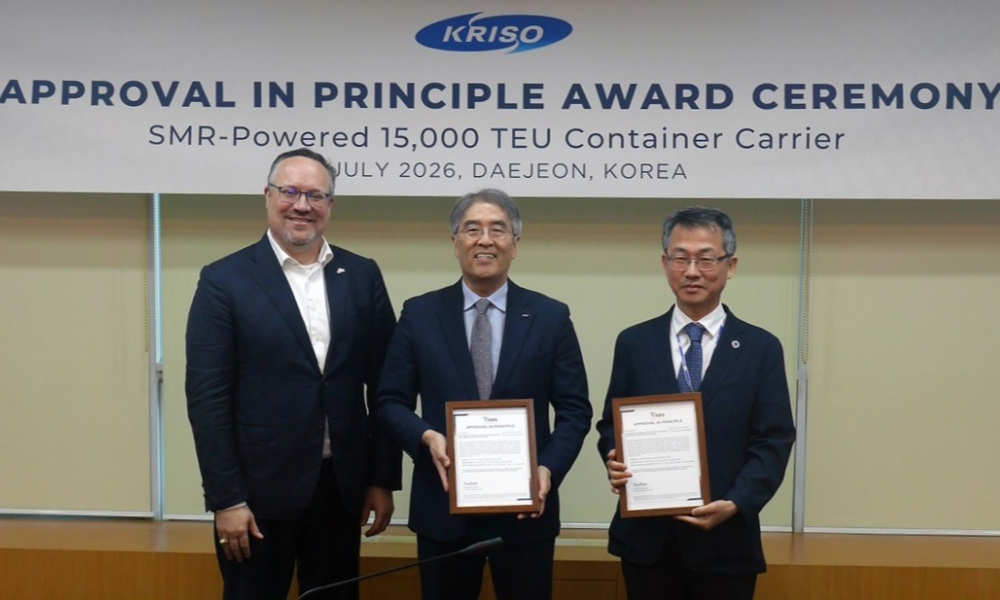
Korea Research Institute of Ships & Ocean Engineering (KRISO) on Thursday (16 July) received Approval in Principle (AiP) from the American Bureau of Shipping (ABS) for its concept design of a 15,000 TEU Small Modular Reactor (SMR)-powered container ship utilising Molten Salt Reactor (MSR) technology.

KRISO said the AiP recognises the technical feasibility and safety of its concept design, marking an important milestone toward the development of next-generation nuclear-powered commercial ships.

“This achievement demonstrates international recognition of KRISO’s technological capabilities in the rapidly evolving field of nuclear-powered shipping, supporting the transition toward low-carbon maritime transport,” it said. 

Building on this milestone, KRISO will continue advancing basic and detailed ship design, paving the way for future demonstration and commercialisation of SMR-powered vessels. 

Through continued R&D and international collaboration, KRISO remains committed to strengthening next-generation maritime technologies and contributing to the safe deployment of nuclear propulsion in the maritime industry.


Photo credit: Korea Research Institute of Ships & Ocean Engineering
Published: 21 July, 2026

Continue Reading

Nuclear

LR: Rotterdam study sets out pathway for nuclear-powered commercial ship port calls

New joint study has found that existing port safety and risk-management frameworks could provide a credible starting point for assessing nuclear-powered ship calls within a major European port environment.
Admin

Published

on

By

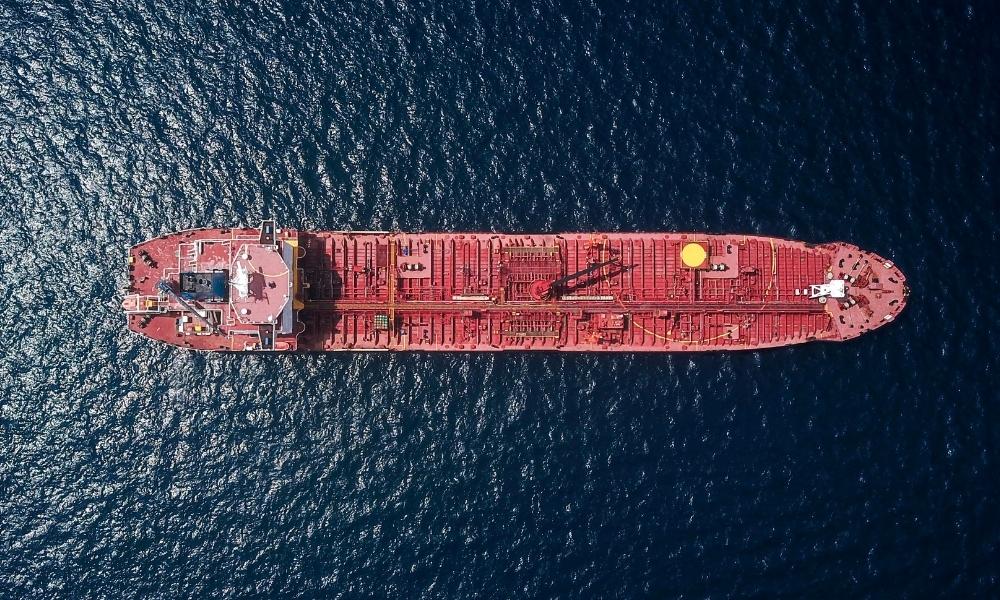
RESIZED Shaah Shahidh on Unsplash

A new joint study using the Port of Rotterdam as a case study has found that existing port safety and risk-management frameworks could provide a credible starting point for assessing nuclear-powered commercial ship calls within a major European port environment, according to Lloyd’s Register (LR) on Thursday (11 June). 

The desktop study, Enabling Nuclear-Powered Feeder Ships: A Joint Development Project on Port Call Feasibility and Regulatory Pathways, carried out through a joint development project involving LR, the Port of Rotterdam Authority, CORE POWER and A.P. Moller – Maersk, sets out the questions that ports, regulators and industry would need to answer in order to assess nuclear-powered vessels in a structured and responsible way. 

It also identified further work that would be required before routine operation could be contemplated, including regulatory alignment, emergency preparedness, security, liability and public engagement.

Its publication comes at a time of growing pressure on the shipping industry to identify even more scalable zero-emission technologies capable of meeting increasingly demanding decarbonisation requirements while preserving operational reliability, endurance and flexibility.

The report argued that maritime nuclear propulsion should be evaluated as part of the wider discussion around shipping decarbonisation, energy resilience and long-term industrial competitiveness.

While much of the current EU policy discussion has focused on alternative fuels such as hydrogen, ammonia and e-fuels, the report notes that segments of global shipping may ultimately require additional propulsion solutions capable of supporting endurance, reliability and operational flexibility at scale.

The Port of Rotterdam participated as a case study because it provides a real-world European port environment through which to examine how emerging energy and shipping technologies could interact with existing port safety frameworks, operations and regulatory processes.

Importantly, the study concluded that existing risk-based port safety frameworks already familiar to European ports could provide a credible starting point for assessing nuclear-powered vessels, provided nuclear-specific safety, security and operational considerations are systematically integrated and supported by appropriate national and international guidance.

The findings suggested that the real challenge for future maritime nuclear propulsion is likely to centre on regulatory alignment, governance, integration between nuclear and maritime safety regimes, and public and institutional preparedness.

The study identifies several key findings:

  • Existing port safety and risk-management frameworks provide a credible starting point for the assessment of nuclear-powered commercial vessels within the defined case study scenario.
  • Further work is needed on regulatory alignment, governance coordination, nuclear-specific safety and security, emergency preparedness, liability and insurance, operational integration and public engagement before routine commercial operation could be contemplated.
  • Current IMO provisions relating to nuclear-powered ships were developed for an earlier era and require modernisation to support any future civil commercial nuclear propulsion pathway.
  • Current European maritime decarbonisation discussions remain heavily focused on alternative fuels, with comparatively limited consideration of high-density, zero-emission propulsion systems capable of supporting long-range and high-utilisation shipping operations.
  • Major ports and maritime Member States may play an important role in shaping how nuclear propulsion is assessed and potentially integrated into future shipping strategies.


Photo credit: Shaah Shahidh on Unsplash
Published: 16 June, 2026

Continue Reading

Nuclear

South Korean-led nuclear car carrier design secures LR backing

LR is working with HHI, KSOE, Hyundai Glovis, G- Marine Service and KAERI on a joint development project exploring an advanced small modular reactor (SMR) installation on a PCTC.
Admin

Published

on

By

South Korean-led nuclear car carrier design secures LR backing

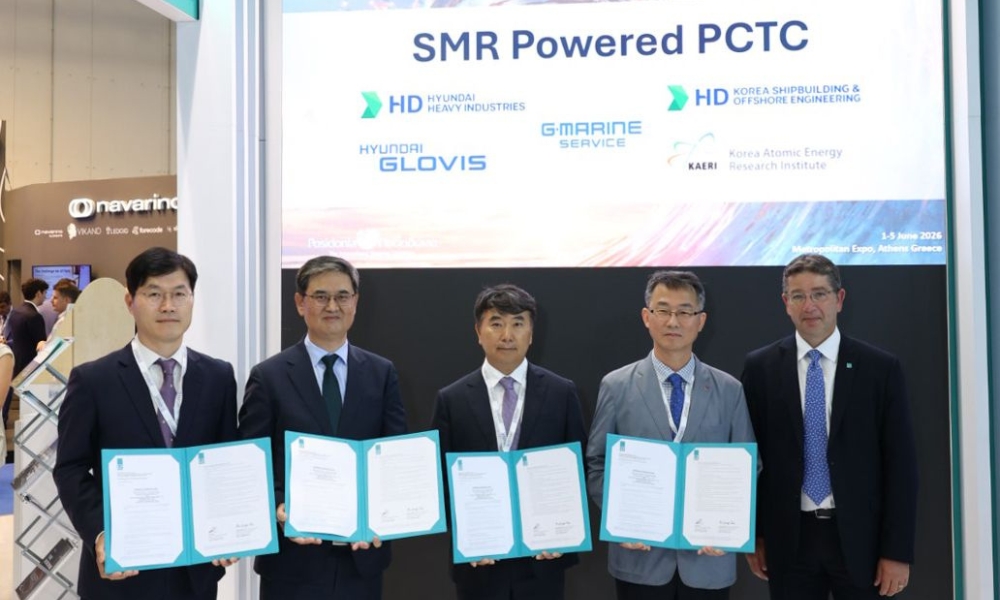
Classification society Lloyd’s Register (LR) on Tuesday (2 June) said it has teamed up with South Korean shipbuilding, marine services and nuclear research organisations to advance the development of a nuclear‑assisted car carrier concept. 

LR is working with Hyundai Heavy Industries, Korea Shipbuilding & Offshore Engineering (KSOE), Hyundai Glovis, G- Marine Service and the Korea Atomic Energy Research Institute (KAERI) on a joint development project (JDP) exploring an advanced small modular reactor (SMR) installation on a pure car and truck carrier (PCTC). 

The study focused on how a Molten Salt Reactor (MSR) could be physically and operationally integrated into a large vehicle carrier. Work examined the internal arrangement and segregation of the reactor system, shielding requirements, and the impact on cargo deck layout and vehicle capacity, alongside stability and trim implications linked to the reactor’s weight and positioning. 

The partners also assessed propulsion system configuration and power delivery, as well as operational flexibility compared with conventionally fuelled PCTCs, where trade routes and port calls can be tightly constrained. 

A key focus of the project has been safety. LR led hazard identification (HAZID) and preliminary risk assessment work, focusing on containment, onboard safety systems and potential operability constraints tied to nuclear technology at sea. 

The partners will mark the project milestone with an Approval in Principle (AiP) granting ceremony on 2 June at the LR stand during Posidonia 2026. 

Sung-Gu Park, President – North East Asia, Lloyd’s Register, said: “While nuclear propulsion is still at an early stage of development, this project shows the importance of building technical understanding now to support future progress. 

“Establishing feasibility at concept stage is a valuable step forward, particularly in areas such as cargo optimisation, vessel stability and integrated safety design.” 

Hong-Ryeul Ryu, CTO and Senior Executive Vice President at HD HHI, said: “With global environmental regulations becoming increasingly stringent and no definitive net-zero fuel yet available, SMR-powered ships can serve as a highly effective alternative, representing a pioneering next-generation maritime technology capable of complying with GHG emission regulations while allowing lifetime operation without refuelling, and HD HHI will remain at the forefront of sustainable maritime technology development.”


Photo credit: Lloyd’s Register
Published: 4 June, 2026

Continue Reading

Trending