Connect with us

LNG Bunkering

Axpo expands LNG bunkering operations in Spain to Port of Algeciras

Company completes its first LNG ship-to-ship delivery to MSC vessel “Mariacristina” in Port of Algeciras, marking the expansion of its LNG bunkering operations to a second Spanish port.

Admin

Published

on

Axpo expands LNG bunkering operations in Spain to Port of Algeciras

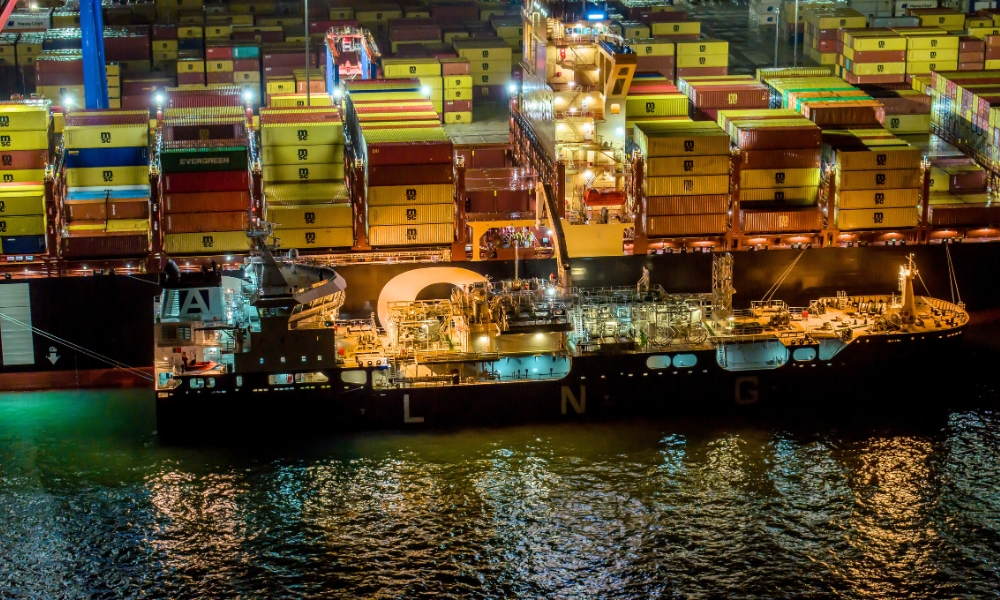
Switzerland-based energy producer Axpo on Thursday (24 April) said it has successfully completed its first LNG ship-to-ship delivery in the Port of Algeciras, marking the expansion of its LNG bunkering operations to a second Spanish port. 

Axpo’s 7,500-cubic-metre small-scale LNG vessel Avenir Aspiration delivered LNG to MSC, a leading global shipping company, reinforcing Axpo’s growing presence in key Mediterranean hubs.

Approximately 5,000 cubic metres (cbm) of LNG was transferred to the MSC vessel Mariacristina in Algeciras, Spain’s largest port. This follows the ship-to-ship bunkering last month of around 5,800 cbm of LNG to an MSC vessel in the port of Málaga. The latest delivery further consolidates Axpo’s position as a reliable provider of LNG bunkering services in the Mediterranean region.

Axpo’s Head of Small-Scale LNG Daniele Corti, said: “This successful delivery marks another important milestone for our LNG bunkering business. By expanding our operations to a second port in Spain, we continue to implement Axpo’s ambitious small-scale LNG growth strategy and strengthen our presence as a reliable LNG partner.

Spain is an important hub for Axpo’s LNG business. The company said demand for LNG is increasing, as it offers a cleaner and more cost-effective alternative to the traditional fuels used in the maritime sector. 

Active across the midstream and downstream natural gas and LNG sector both in Switzerland and internationally, Axpo trades and transports gas throughout Europe. LNG customers range from small and medium-sized enterprises to large energy-intensive industrial companies. 


Photo credit: Axpo
Published: 25 April, 2025

Continue Reading

Alternative Fuels

ICS report: LNG and biofuels seen as most viable marine fuels over next decade

This was followed closely by HFO combined with abatement technologies while methanol ranked in fourth place, according to ICS’s new Maritime Barometer Report.

Admin

Published

on

By

RESIZED william william on Unsplash

A new report by the International Chamber of Shipping (ICS), published on Tuesday (23 June) found that  LNG and biofuels are seen as the most viable marine fuels over the next decade.

This was followed closely by HFO (Heavy Fuel Oil) combined with abatement technologies while methanol ranked in fourth place. 

The report found that in 2025 to 2026, maritime leaders are displaying a preference for traditional fuels that have established supply mechanisms. 

The ICS Maritime Barometer Report 2025–2026 surveyed C-suite level leaders, shipowners, and operators worldwide to identify the key risk areas shaping shipping. 

Despite slight decline, LNG shared top spot with biofuels as one of three most viable future fuels over the next decade. 

LNG maintained its position as a joint leading fuel in the Barometer, with roughly 51.35% of leaders naming it as one of the most viable fuels over the next decade. 

“This is despite a marginal softening in sentiment amongst maritime leaders compared to last year’s survey, reflecting its continued role as the most immediately scalable alternative within the current fuel mix,” the report said. 

However, the report noted that this positioning is increasingly shaped not just by infrastructure maturity, but by how geopolitical instability translates into fuel-specific perceptions of security, routing exposure, and price volatility across global trade flows.

This is particularly evident in Asia-Pacific and the Middle East, where LNG’s role is reinforced through continued investment in import and bunkering infrastructure.

Singapore remains the world’s leading LNG bunkering hub, supported by expanding small-scale supply chains and vessel availability, while South Korea and China are rapidly scaling receiving and bunkering capacity to support both shipping and power demand growth.

Biofuels record one of the sharpest increases in sentiment across the future fuels landscape to match LNG at 51.35% in this year’s report.

“This could reflect a shift driven less by structural conviction and more by operational response to heightened uncertainty in global energy and trade systems,” it said. 

Their growing prominence could be closely linked to the increasing attractiveness of low-friction compliance options in a context where alternative fuels remain constrained by uneven infrastructure development, fragmented regulatory alignment, and delayed capital deployment across key regions.

Compared with LNG, which is shaped by infrastructure lock-in and geopolitical price exposure, biofuels offer immediate operational flexibility.

Japan has emerged as a key driver of marine biofuel adoption, with government-backed trials involving major shipping lines such as NYK testing biofuel blends on international routes. China has also expanded pilot programmes using biodiesel and waste-derived fuels in coastal shipping, reflecting a pragmatic approach to emissions reduction in regional trade flows.

Note: The ‘ICS Maritime Barometer Report 2025–2026’ can be viewed here


Photo credit: william william on Unsplash
Published: 26 June, 2026

Continue Reading

Alternative Fuels

KPI OceanConnect: Market volatility reshapes case for alternative bunker fuels

Jesper Sørensen shares how changing market dynamics are reshaping the commercial case for alternative fuels and highlighting the value of fuel flexibility in an increasingly uncertain environment.

Admin

Published

on

By

Jesper Sørensen, Global Head of Alternative Fuels and Carbon Markets at KPI OceanConnect

Recent market volatility, geopolitical disruption and tightening carbon regulations are challenging the perception that conventional fuels offer the safest path for shipowners. 

Jesper Sørensen, Global Head of Alternative Fuels and Carbon Markets of KPI OceanConnect, shared with Singapore-based bunkering publication Manifold Times how changing market dynamics are reshaping the commercial case for alternative fuels and highlighting the value of fuel flexibility in an increasingly uncertain environment:  

For years the case for conventional bunker fuels has rested, in part, on familiarity. Owners know how to procure it, use it and build voyage economics around it. Alternative fuels, by contrast, have required a leap of faith – underdeveloped supply chains, high costs and a siloed regulatory backdrop. It’s a familiar tension for many ship owners where the scales have consistently favoured conventional fuels. It was, after all, the safe, known pathway while the green transition matures at its own pace.

Recent market conditions, however, have shown that conventional fuels carry their own version of uncertainty, one that is easy to underestimate in quieter times. Since the Iran War began at the end of February, export terminals across Iraq, Oman, Bahrain and the UAE came under threat and were struck or evacuated within days of each other. The Strait of Hormuz, which carries around a fifth of global oil, has been effectively closed for over a month. Over this time, Brent crude – the global oil benchmark – has traded across a $46 range, between $73 and $119. ICE Gasoil front-month swung more than $400 per tonne in a fortnight. LSMGO briefly disappeared from the Singapore spot market. This is the broader market context every owner has been navigating. It is a difficult environment by any measure but is worth pausing on, because it also changes the conversation around alternative fuels.

Biofuel and methanol markets were also affected. But they moved within a materially narrower range and were largely decoupled from the specific geopolitical shocks driving conventional supply disruption. This meant that the spread between alternatives and conventional fuel narrowed considerably. When EU ETS and FuelEU Maritime compliance costs are also factored in, that spread reduced further still, to the point where alternatives have looked competitive on an all-in basis during this time. That is a different commercial conversation from the one the industry was having even six months ago.

Across the supply chain, the consistent feedback from suppliers, traders and charterers is that the window to lock in biofuel or methanol on terms more favourable than any point in the past eighteen months remains open. Disruption and uncertainty are likely to affect the conventional fuel market for many months after the conflict is resolved – indeed the longer disruption continues, the longer the post-conflict recovery will take – and yet most owners have not seized the biofuel opportunity open to them. 

LNG also warrants attention as the alternative fuel with the deepest fleet commitment. Disruption to Qatari export infrastructure is a significant setback, with a recovery timeline that will be measured in years rather than months. This equation is balanced however, by significant new US export capacity coming online in 2026 and 2027, which will help rebalance availability for European and Asian buyers. The harm done to LNG users highlights an issue that is less about LNG specifically and more broadly about resilience and independence from any single fuel source. Owners with flexibility across fuel types – LNG alongside biofuels, methanol and conventional – will be better equipped to absorb supply shocks wherever they arise.

New fuels are initially expensive, but as production scales, supply chains mature and regulation creates demand certainty prices can be expected to come down. We have watched this curve play out in solar power, in batteries and in biofuels for road transport. Marine alternative fuels are at an earlier stage of the same pathway, but the direction of travel is unambiguous. Today’s premiums reflect a market in its early stages of development, not the cost of a system at scale.

Carbon regulation in the maritime industry has advanced quickly, and while it faces fragmentation and disruption, it warrants attention. Under EU frameworks carbon compliance is no longer a future liability, but a direct cash cost to be settled annually, drawn from the same credit lines that fund bunker procurement and working capital. Managing that cost actively, through alternative fuel procurement during periods of narrow spreads, can have a direct impact on the carbon procurement bill. Active management will free up credit capacity and, in many cases, convert a compliance liability into a surplus that can be traded through FuelEU Maritime pooling. Finance teams need to appreciate this strong commercial argument for pursuing the energy transition now.

Carbon regulation by the International Maritime Organization determines prevailing and future conditions of global regulation, so the meaningful technical progress made at MEPC 84 has provided a clearer sense of where the international framework is heading. Technical work on fuel certification, GFI methodologies and reward mechanisms moved forward, and a broad majority of member states signalled support for the Net-Zero Framework as a foundation. But the Net-Zero Fund remains undefined, key elements of energy efficiency regulation have been delayed and further negotiation is inevitable. In the meantime, the EU’s regime is already in effect. Any owner with regular port calls in Europe is operating inside a binding compliance system today, whatever the longer-term international system looks like.

Looked at this holistically, current conditions remind us that certainty is an illusion. No single fuel can be taken for granted and global regulation that would bring simplicity and clarity for the industry is years away. The owners best positioned to navigate today’s environment are those building genuine flexibility into their fuel strategy, spreading exposure across technologies, supply sources and compliance pathways. The conditions to start doing that, or to go further than they already have, are as favourable now as they have ever been.


Photo credit: KPI OceanConnect
Published: 25 June, 2026

Continue Reading

Newbuilding

Singapore-based PIL names 13,000 TEU LNG dual-fuel vessels in Shanghai

Both “Kota Elok” and “Kota Elan” are equipped to operate on LNG as well as low-sulphur fuel oil and will be deployed on PIL’s service connecting Asia and South America.

Admin

Published

on

By

Singapore-based PIL names 13,000 TEU LNG dual-fuel vessels in Shanghai

Singapore-based Pacific International Lines (PIL) on Tuesday (23 June) said it marked a significant milestone in its fleet renewal programme with the twin naming ceremony of its newest 13,000 TEU LNG dual-fuel container vessels, Kota Elok and Kota Elan, at Hudong-Zhonghua Shipyard in Shanghai. 

Kota Elok was named by Ms Chan Wai Ching, Chief Corporate Officer of Temasek International, while Kota Elan was named by Ms Yan Zi, a former tennis Olympic bronze medallist and Grand Slam champion in doubles. Also in attendance were Mr Lars Kastrup, PIL’s CEO; Mr Eng Aik Meng, PIL’s Board Director; Mr Chen Jianliang, Chairman of Hudong-Zhonghua Shipbuilding Group; and Mr Li Wucheng, Director of Shandong Port Group Container Operations Centre.

Built by Hudong-Zhonghua Shipbuilding (Group) Co., Ltd, the two vessels are the first in a series of 13 new 13,000 TEU ships designed to elevate PIL’s operational capabilities. They form a key part of the company’s broader fleet renewal strategy, aimed at modernising its vessels, increasing competitiveness and growing capacity while enhancing efficiency and sustainability.

Kota Elok and Kota Elan will be deployed on PIL’s service connecting Asia and South America, a key trade corridor experiencing strong and sustained growth. Their introduction enables PIL to better support increasing cargo demand while facilitating smoother and more efficient trade flows between the two regions, and improves PIL’s operating efficiencies across the network.

Both ships are equipped to operate on liquefied natural gas (LNG) as well as low-sulphur fuel oil, allowing for meaningful reductions in greenhouse gas emissions. 

Mr Lars Kastrup, CEO of PIL, said: “The naming of Kota Elok and Kota Elan highlights the acceleration in PIL’s journey to modernise our fleet and strengthen our position in key trade lanes. These vessels will enable us to meet growing trade demand, expand capacity and deliver greater efficiency for our customers.”

“At the same time, they reflect our continued commitment to sustainability. By investing in LNG dual-fuel technology and advanced vessel designs, we are taking meaningful steps towards reducing our carbon footprint and achieving our net zero ambitions.”

The vessels incorporate a suite of advanced technological and energy-saving features, including an optimised hull form to improve hydrodynamic performance, energy-efficient systems and premium hull coatings that reduce fuel consumption. Both vessels are also equipped with digital technologies, including Artificial Intelligence (AI) and Internet of Things (IoT) capabilities, to enhance operational performance and enable greater automation onboard.

Kota Elok further features a bow windshield to improve aerodynamics, contributing to improved fuel efficiency and lower emissions over the course of long-haul voyages.


Photo credit: Pacific International Lines
Published: 24 June, 2026

Continue Reading

Trending