Connect with us

Ammonia

Höegh Autoliners, Sumitomo to collaborate on ammonia bunker fuel supply for PCTCs in Singapore, Jacksonville

Duo will embark on a comprehensive evaluation of the compatibility between Höegh Autoliners PCTC newbuilds and ammonia bunkering facilities at the identified bunker ports.

Admin

Published

on

Höegh Autoliners, Sumitomo to collaborate on ammonia bunker fuel supply for PCTCs in Singapore, Jacksonville

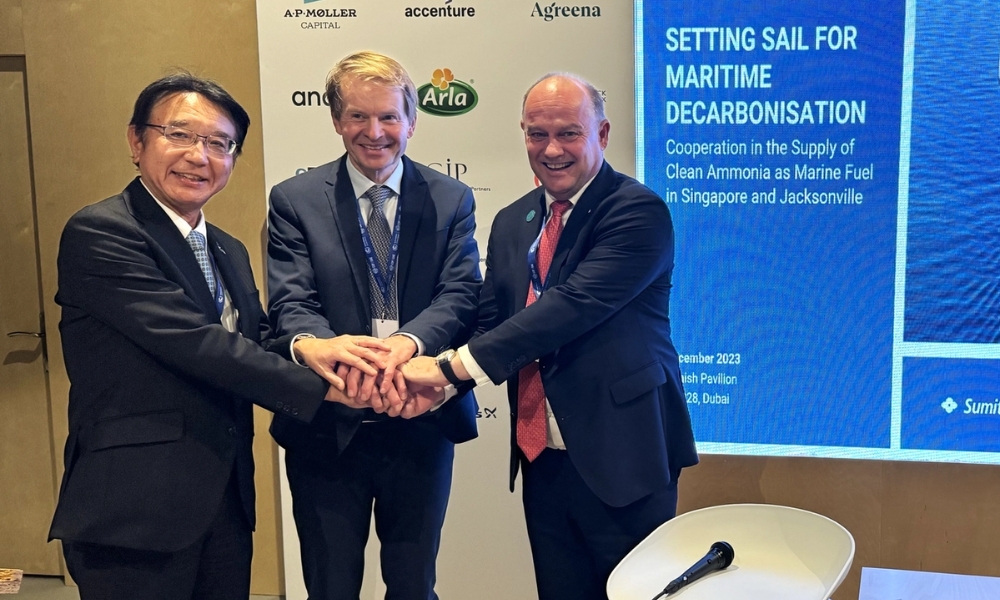
Norway-based pure Car and Truck Carriers (PCTCs) vessel owner and operator Höegh Autoliners on Tuesday (5 December) said it has agreed with Sumitomo Corporation to look into the supply of clean ammonia as a bunker fuel at the ports of Singapore and Jacksonville, USA from 2027 onwards.

The two companies have formalised their commitment through a Letter of Intent to collaborate on the supply and delivery of clean ammonia as a next-generation sustainable maritime fuel for Höegh Autoliners’ upcoming Aurora Class PCTC vessels. 

The twelve vessels are set to become the largest and most eco-friendly car carriers ever built and they will have the capability to run on zero-carbon ammonia or carbon neutral methanol. 

“The Letter of Intent symbolises a remarkable step in the realisation and development of the production and consumption of clean maritime fuels. The collaboration hopes to stimulate the upscaling of the supply and demand of clean ammonia for maritime usage,” Höegh Autoliners said in a statement. 

Both companies view clean ammonia as a promising future fuel for the maritime industry, offering substantial potential in addressing the challenges associated with greenhouse gas emissions in global shipping. 

To support this vision, both entities have launched a range of initiatives throughout the ammonia value chain, with a primary focus on making clean ammonia a viable choice for maritime fuel and thereby achieving significant reductions in emissions from the global shipping sector.

Moving forward, the companies will embark on a comprehensive evaluation of the compatibility between the PCTC vessels and the ammonia bunkering facilities at the identified bunker ports. 

They endeavour to make necessary adjustments to specifications for both “shore-to-ship” and “ship-to-ship” bunkering operations and undertake safety assessments to establish standardised operational protocols and regulations in close coordination with pertinent government agencies.

Photo credit: Höegh Autoliners
Published: 6 December, 2023

Continue Reading

Ammonia

EXMAR’s “ANTWERPEN” completes first commercial voyage using ammonia bunker fuel

During its voyage from China to India, the vessel achieved ammonia dual-fuel operation fully in line with our expectations and design, demonstrating that the technology works in commercial service.

Admin

Published

on

By

EXMAR’s “ANTWERPEN” completes first commercial voyage using ammonia bunker fuel

Belgian shipowner EXMAR on Monday (20 July) announced the successful completion of gas carrier ANTWERPEN’s first commercial voyage using ammonia as a marine fuel. 

During its voyage from China to India, the vessel achieved ammonia dual-fuel operation fully in line with our expectations and design, demonstrating that the technology works in commercial service. 

“Together with our partners, we continue to fine-tune the systems as we build on this outstanding achievement. We are proud of our crew for their excellent pioneering work,” the company said in a social media post. 

Developed in close collaboration with HD Hyundai Heavy Industries, WinGD, Nord Gas Solutions (formerly Wärtsilä Gas Solutions), and Lloyd’s Register, ANTWERPEN is capable of carrying up to 46,000 m³ of ammonia or LPG and trading with close to zero emissions when using low-carbon ammonia fuel. 

The vessel meets and exceeds current IMO emissions reduction targets, reducing greenhouse gases by up to 90% compared to conventional ships.

Manifold Times previously reported ANTWERPEN participated in a pipe-to-ship (PTS) ammonia bunkering operation in Ulsan Port.

The operation was carried out by Lotte Fine Chemical Co Ltd with 600 metric tonnes (mt) of green ammonia (NH3) supplied to ANTWERPEN.

Related: South Korea: Ulsan Port achieves ammonia PTS bunkering milestone


Photo credit: EXMAR
Published: 21 July, 2026

Continue Reading

Alternative Fuels

KR, HD Hyundai tap first ammonia dual-fuel sea trial to develop vessel operating standards

Trial generated data on the vessel’s fuel supply system and engine, which will provide a technical foundation for KR’s future development of domestic guidelines for ammonia-fuelled ships.

Admin

Published

on

By

KR, HD Hyundai tap first ammonia dual-fuel sea trial to develop vessel operating standards

Korean Register (KR) on Tuesday (14 July) said it is collaborating with HD Hyundai Heavy Industries (HHI) to establish a domestic operating environment for ammonia-fuelled vessels under the Ministry of Oceans and Fisheries’ Green Shipping Corridor Construction Support Project. 

The initiative supports the development of ammonia as one of the most promising next-generation marine fuels.

HHI recently conducted a sea trial of Korea’s first ammonia dual-fuel propulsion vessel. The trial generated operational data on the vessel’s fuel supply system and engine, which will provide a valuable technical foundation for KR’s future development of domestic guidelines for environmentally friendly vessel operations and supporting wider maritime decarbonisation efforts.

A spokesperson for HD Hyundai, said: “Drawing on our group’s R&D capabilities and on-site technical expertise, we have made meaningful progress in advancing the application of ammonia as a marine fuel. We expect this to help enhance a sustainable maritime ecosystem while strengthening the competitiveness of Korea’s shipbuilding industry.”

Kim Daeheon, Executive Vice President of KR’s R&D Division, added: “The close collaboration between KR and HD Hyundai has enabled us to build the technical foundation for introducing ammonia-fueled vessels in Korea. We will continue to drive national projects forward together with HD Hyundai and establish technical standards befitting the era of Green Shipping Corridors.”


Photo credit: HD Hyundai Heavy Industries
Published: 17 July, 2026

Continue Reading

Bunker Fuel

Singapore: Bunker fuel sales up by 1.6% on year in June 2026

4.67 million mt of various marine fuel grades were delivered at the world’s largest bunkering port in June, up from 4.59 million mt recorded during the similar month in 2025.

Admin

Published

on

By

7

Sales of marine fuel at Singapore port increased by 1.6% on year in June 2026, according to data from the Maritime and Port Authority of Singapore (MPA).

In total, 4.67 million metric tonnes (mt) (exact 4,669,100 mt) of various marine fuel grades were delivered at the world’s largest bunkering port in June, up from 4.59 million mt (4,594,700 mt) recorded during the similar month in 2025.

Deliveries of marine fuel oil, low sulphur fuel oil, ultra low sulphur fuel oil, marine gas oil and marine diesel oil in June (against on year) recorded respectively 2.03 million mt (+19.4% from 1.70 million mt), 2.20 million mt (-4.8% from 2.31 million mt), zero (-100% from 1,900 mt), 1,900 mt (-57.8% from 4,500 mt) and zero (from zero).

Bunker Jun

Bio-blended variants of marine fuel oil, low sulphur fuel oil, ultra low sulphur fuel oil, marine gas oil and marine diesel oil in June, (against on year) recorded respectively 5,300 mt (-86.3% from 38,800 mt), 30,700 mt (-73.1% from 114,300 mt), zero (from zero), zero (from zero) and zero (from zero). B100 biofuel bunkers, introduced in February last year, recorded 1,500 mt (+50% from 1,000 mt). 

LNG and methanol sales were 55,000 mt (-0.72% from 55,400 mt) and zero (from zero) respectively. There were no recorded sales of ammonia for the month and so far since 2025.


Photo credit: Maritime and Port Authority of Singapore
Published: 15 July, 2026

Continue Reading

Trending