
Business
Bunker prices up 25% in 30 days on the back of Covid-19 vaccines and OPEC+ support
VLSFO prices hit levels not seen since early March, and in Singapore rise from $305/ton to around $380/ton (up 25%) in this very short period, says Integr8 Fuels.

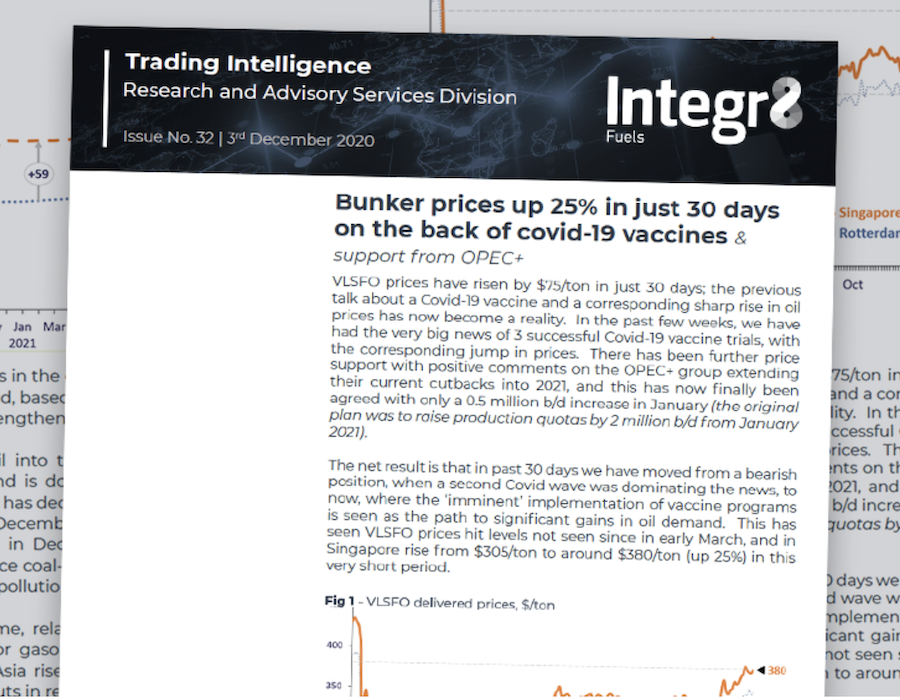
Integr8 Fuels, the bunker trading and brokerage arm of Navig8, on Thursday (3 December) published an analysis on the market forces behind the rise in bunker prices after OPEC+’s well received announcement to extend existing supply cutbacks as well as successful Covid-19 vaccine trials:
VLSFO prices have risen by $75/ton in just 30 days; the previous talk about a Covid-19 vaccine and a corresponding sharp rise in oil prices has now become a reality. In the past few weeks, we have had the very big news of 3 successful Covid-19 vaccine trials, with the corresponding jump in prices. There has been further price support with positive comments on the OPEC+ group extending their current cutbacks into 2021, and this has now finally been agreed with only a 0.5 million b/d increase in January (the original plan was to raise production quotas by 2 million b/d from January 2021).
The net result is that in past 30 days we have moved from a bearish position, when a second Covid wave was dominating the news, to now, where the ‘imminent’ implementation of vaccine programs is seen as the path to significant gains in oil demand. This has seen VLSFO prices hit levels not seen since in early March, and in Singapore rise from $305/ton to around $380/ton (up 25%) in this very short period.

At the same time forward curves have jumped higher, although they remain extremely flat through the next 18 months. The Singapore VLSFO curve at the start of November was a clear reflection of the near-term bearish concerns from the second covid-19 wave, showing a drop in December and only a gradual uplift through the outlook period. The recent news on vaccines had an immediate bullish impact on prices and now for the earlier part of next year, the VLSFO forward curve in Singapore is almost $60/ton higher than it was four weeks ago. Even looking as far out as 2022, the curve is still more than $40/ton above what it was showing at the start of November.

Another aspect to the price rise has been a widening in the VLSFO/HSFO spread. Differentials tend to widen as prices rise (and narrow as prices fall), and this has happened with this latest price increase. Although the differential between the two bunker grades is still very narrow by historical standards, the VLSFO/HSFO spread in Singapore is now around $70/ton compared with only $53/ton at the start of November.

General developments in the oil markets would indicate a further widening in this spread, based on the relative weakening of HSFO prices and relative strengthening of VLSFO as:
- Demand for fuel oil into the power-generation sector eases; Saudi Arabian demand is down after the summer peak aircon demand and Pakistan has decided not to go ahead with a 500,000 ton HSFO tender for December delivery, although LSFO demand in South Korea is up in December by around 100,000 tons as utilities move to replace coal-fired capacity that has been shut-in because of winter air-pollution issues.
- and at the same time, relative VLSFO prices strengthen with improving margins for gasoil, gasoline and jet fuel margins as product demand in Asia rises (and product supply in Europe is reduced because of cuts in refinery runs).
Any further increases in oil prices are likely to add to these general widening pressures on the VLSFO/HSFO spread, lending further support to scrubber economics.
We have always referred to the underlying movements in bunker prices being led by crude oil, and of course it is the same this time around. VLSFO has largely tracked changes in the hugely traded Brent and WTI crude futures markets, and will continue to respond to the current big stories of vaccines, the prospects for oil demand and OPEC+ outcomes.
Photo credit and source: Integr8 Fuels
Published: 4 December, 2020
FuelEU
GTT Marine partners with BetterSea on FuelEU trading, pooling integration
Integration will enable GTT Marine customers and platform users to execute FuelEU trading and pooling end-to-end, directly from the Vesper Insights platform.
Alternative Fuels
DNV on IMO CCC 12: Revised guidelines for methanol as marine fuel
CCC 12 finalized the revision of the interim guidelines for use of methyl/ethyl alcohol as fuel while work continued on guidelines for low-flashpoint oil fuels and onboard carbon capture and storage systems.

Biofuel
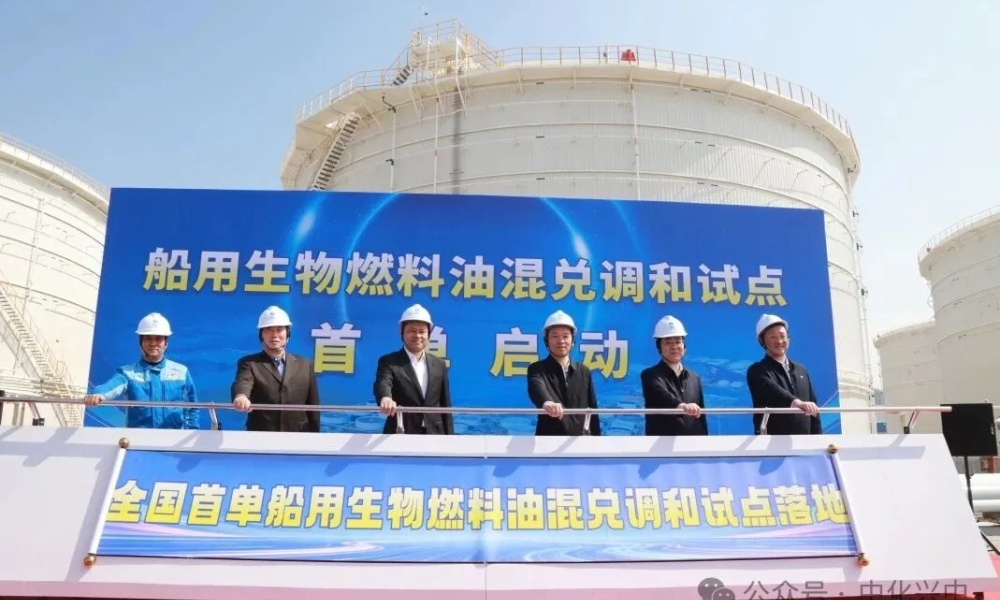
Petrochina International blends over 30,000 mt of marine biofuel since March
Company has been developing marine biofuel blending operations at China (Zhejiang) Pilot Free Trade Zone, leveraging storage and logistics facilities at its Aoshan base.

OUR INDUSTRY PARTNERS

GTT Marine partners with BetterSea on FuelEU trading, pooling integration

DNV on IMO CCC 12: Revised guidelines for methanol as marine fuel

ENGINE on Biofuel Bunker Snapshot: B30-VLSFO prices drop across global hubs

Petrochina International blends over 30,000 mt of marine biofuel since March

Singapore: Final general meetings scheduled for Dromond Shipping, related firms

NYK wraps up first STS ammonia bunkering operation in Japan

Azane secures ammonia bunker fuel supply from Yara

Singapore: Marine fuel testing firm CCIC Singapore faces winding up application

Peninsula confirms one fatality, crew member missing from bunker tanker “Hercules Star”

Singapore: MPA working with industry on next phase of digital bunkering, says Deputy CE

Amogy and LOTTE Fine Chemical to explore ammonia bunkering in South Korea

High Court of Singapore issues winding up order against Hengli Petrochemical International

China: Guangzhou completes first bio-methanol STS bunkering operation

Polaris Shipping orders WinGD engines capable of running on methanol, ethanol
-
 Winding up7 days ago
Singapore: Marine fuel testing firm CCIC Singapore faces winding up application
-
 Incident2 weeks ago
Peninsula confirms one fatality, crew member missing from bunker tanker “Hercules Star”
-
 Technology2 weeks ago
Singapore: MPA working with industry on next phase of digital bunkering, says Deputy CE
-
 Ammonia2 weeks ago
Amogy and LOTTE Fine Chemical to explore ammonia bunkering in South Korea
-
 Winding up1 week ago
High Court of Singapore issues winding up order against Hengli Petrochemical International
-
 Alternative Fuels2 weeks ago
China: Guangzhou completes first bio-methanol STS bunkering operation
-
 Engine2 weeks ago
Polaris Shipping orders WinGD engines capable of running on methanol, ethanol
-
 Technology1 week ago
APPEC 2026: Digitalisation in bunkering not merely a ‘paper-to-screen’ swap, states panellists