Connect with us

Newbuilding

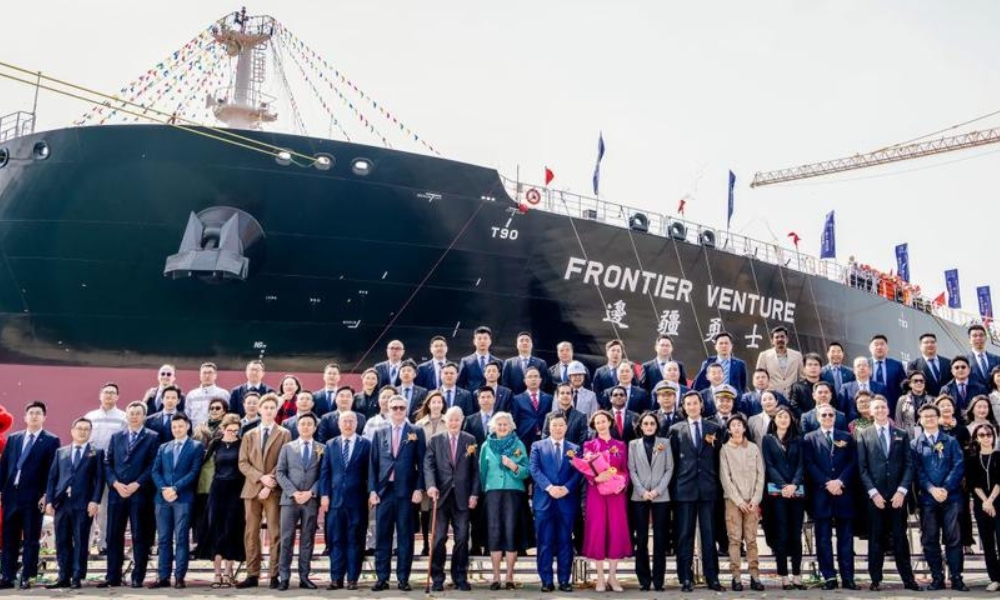
Wah Kwong and BV celebrate delivery of LNG-ready LR2 tanker “Frontier Venture”

Built by Hengli Shipyard in Dalian, the vessel is the first in the series to demonstrate Group 3 ‘augmented ship’ capabilities, integrating advanced on-board digital systems with shore-based support.

Admin

Published

on

Wah Kwong and BV celebrate delivery of LNG-ready LR2 tanker Frontier Venture

Bureau Veritas Marine & Offshore (BV) on Tuesday (31 March) said it celebrated the delivery of LNG-ready LR2 tanker Frontier Venture with Wah Kwong Maritime Transport (Wah Kwong) on 30 March. 

The vessel is the first in Wah Kwong’s new series of SMART-enabled ships, representing a significant milestone in the company’s fleet development. 

Built by Hengli Shipyard in Dalian, the vessel is the first in the series to demonstrate Group 3 “augmented ship” capabilities, integrating advanced on-board digital systems with shore-based support.

Classed by BV, the Frontier Venture has been assigned the SMART (H1,M1,EnE3,MH3) notations, recognizing its enhanced capabilities in machinery health monitoring and energy efficiency optimization. The new vessel is the latest example of industry innovation, resulting from the long-standing collaboration between Wah Kwong and BV to advance class-recognized digitalization across its fleet.

The “augmented ship” features expert-in-the-loop services that deliver timely, actionable insights to ship officers. This includes early detection of machinery anomalies and recommendations for more efficient operating profiles, a critical capability in modern maritime operations, where complex variables demand both data-driven analysis and human expertise for sound decision-making.

The Frontier Venture is the first in the series being built at Hengli Shipyard. The delivery of the second LR2 is expected to be in July 2026. The 114,000 DWT LR2 Frontier Venture is 248.8 meters long, with a breadth of 44.0 meters and a depth of 21.5 meters. It is powered by a modern Everllence B&W main engine rated at 10,800 kW SMCR, and meets EEDI Phase III requirements. 

The vessel has three cargo oil pumps, each with a capacity of 3,000 m³/h, for efficient loading and discharge.

Hing Chao, Chairman of Wah Kwong Maritime Transport, said: “The SMART notations awarded to our first LR2 mark a key milestone in our long‑term partnership with Bureau Veritas and demonstrate how we translate innovation into fleet‑wide progress. 

“BV continues to set a higher bar for the governance of digital capability, and together we have advanced through the SMART framework in recent years — ensuring that data‑driven insights are effectively embedded in operations onboard and ashore. 

“This supports a future where trusted data and digital technologies enable the sector to collaborate more closely and move faster towards an intelligent, sustainable, maritime world.”


Photo credit: Bureau Veritas Marine & Offshore
Published: 1 April, 2026

Continue Reading

Alternative Fuels

Höegh Autoliners orders six more ammonia, methanol-ready Aurora class PCTCs

Höegh Autoliner inked a contract with China Merchants Group for six additional Aurora class PCTCs, which will be built by China Merchants Heavy Industry (Jiangsu) and delivered between 2029 and 2031.
Admin

Published

on

By

Höegh Autoliners orders six more ammonia, methanol-ready Aurora class PCTCs

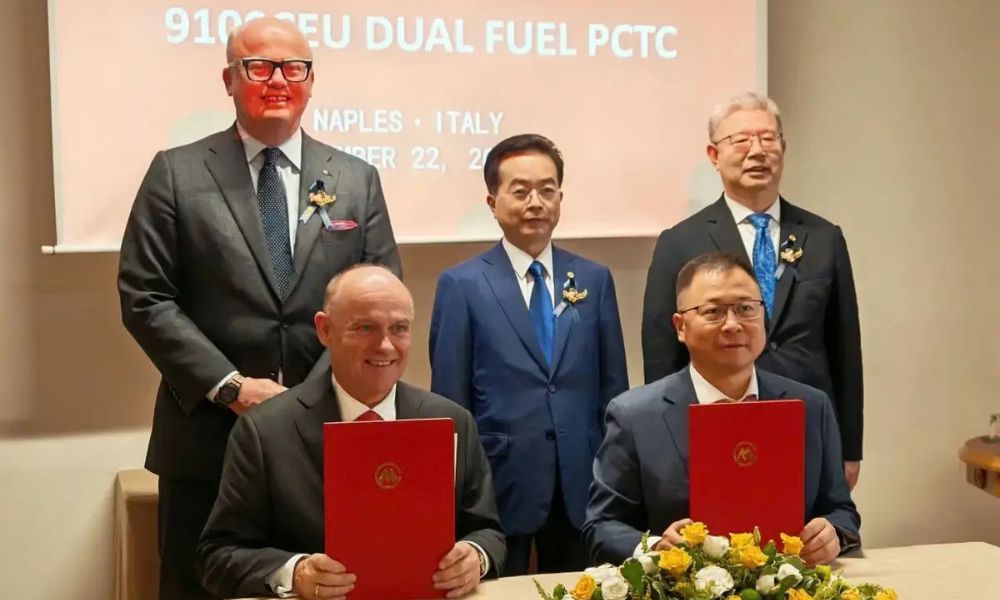
Höegh Autoliners on Tuesday (22 September) said it has formally signed a contract with China Merchants Group (CMG) for six additional Aurora class pure car and truck carriers (PCTCs). 

The contract was signed during a high-level meeting in Naples attended by senior representatives from both companies, including Miao Jianmin, Chairman of China Merchants Group. Chair of Höegh Autoliners, Leif O. Høegh, and Andreas Enger, CEO of Höegh Autoliners.

The six additional dual-fuel LNG and zero-carbon-ready vessels will be built by China Merchants Heavy Industry (Jiangsu) Co., Ltd. (CMHI) and delivered between 2029 and 2031. 

With 18 Aurora Class vessels in the programme, Höegh Autoliners is building the fleet needed for a zero- emission future and setting the pace for the transformation of deep-sea shipping.

The Aurora Class vessels can carry up to 9,100 cars and reduce carbon emissions per transported car by up to 58 per cent compared with conventional PCTCs. They have DNV’s ammonia-ready and methanol-ready notations and are designed to be converted to run on future zero-carbon fuels.

Leif O. Høegh, Chair of the Board of Directors of Höegh Autoliners, said: “For nearly 100 years, we have developed, adapted and led the way through major changes in shipping. It is in our DNA to keep moving and challenge what is possible. This signing continues that story. We are investing in the vessels that will define our fleet for decades and help move our industry towards zero emissions.”

Andreas Enger, CEO of Höegh Autoliners, said: “This is not just another vessel-building agreement. It is a statement about the future of deep-sea shipping and the role we intend to play in shaping it. The Aurora Class is at the heart of our fleet renewal and our path to a sustainable future. By expanding the programme to 18 vessels, we are securing efficient, flexible and future-ready capacity while setting the pace towards zero-emission operations.”

Miao Jianmin, Chairman of China Merchants Group, said: “Höegh Autoliners is a pioneer in international shipping and will celebrate its 100th anniversary next year. We would like to offer our congratulations in advance! Over the past century, Höegh Autoliners has achieved remarkable development and has grown into a leading company in the global RoRo shipping sector. We truly admire what you have accomplished.”


Photo credit: Höegh Autoliners
Published: 24 September, 2026

Continue Reading

Newbuilding

CLdN orders two LNG dual-fuel RoRo vessels from HD Hyundai Heavy Industries

New vessels will be built with space reserved for the future addition of larger electric shaft generators and batteries as the technology matures.
Admin

Published

on

By

CLdN orders two LNG dual-fuel RoRo vessels from HD Hyundai Heavy Industries

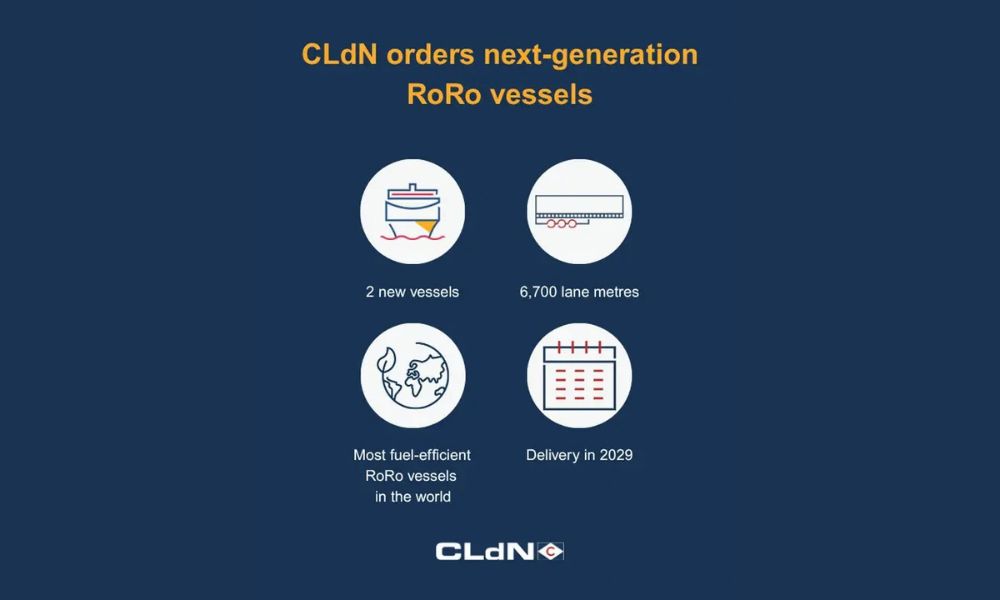
Europe’s multimodal logistics providers CLdN on Tuesday (22 September) announced it has placed an order for two new 6,700 lane-metre RoRo vessels with HD Hyundai Heavy Industries (HD Hyundai HI).

Construction of the new vessels is set to begin towards the beginning of 2028, with delivery scheduled for mid-2029. 

“The ships will be the 15th and 16th vessels ordered by CLdN from the South Korean shipbuilder over the past 10 years,” the company said on its website. 

The new vessels will be dual-fuel capable, able to run on standard marine diesel or LNG, and will be built with space reserved for the future addition of larger electric shaft generators and batteries as the technology matures.

While fuel consumption per vessel is expected to be similar to that of CLdN’s existing 5,000 lane-metre class ships, the increased cargo capacity of the new vessels is expected to deliver 30 to 40% better fuel efficiency per tonne-kilometre of cargo carried making the vessels the most fuel-efficient RoRo ships in the world.

The new vessels are designed with one additional deck and increased ground space compared to CLdN’s existing 5,000 lane-metre class ships, with a configuration specifically adapted for trailer cargo. 

“The addition of these vessels to CLdN’s fleet will ensure customers benefit from an even broader range of shipping options via CLdN’s extensive fleet of RoRo and container vessels,” the company said. 


Photo credit: CLdN
Published: 24 September, 2026

Continue Reading

Ammonia

HD HHI and HD KSOE secure ABS AiP for ammonia bunkering vessel design

ABS awarded approval in principle for the basic design of a 22,000 CBM bunkering vessel capable of supplying ammonia as marine fuel.
Admin

Published

on

By

HD HHI and HD KSOE secure ABS AiP for ammonia bunkering vessel

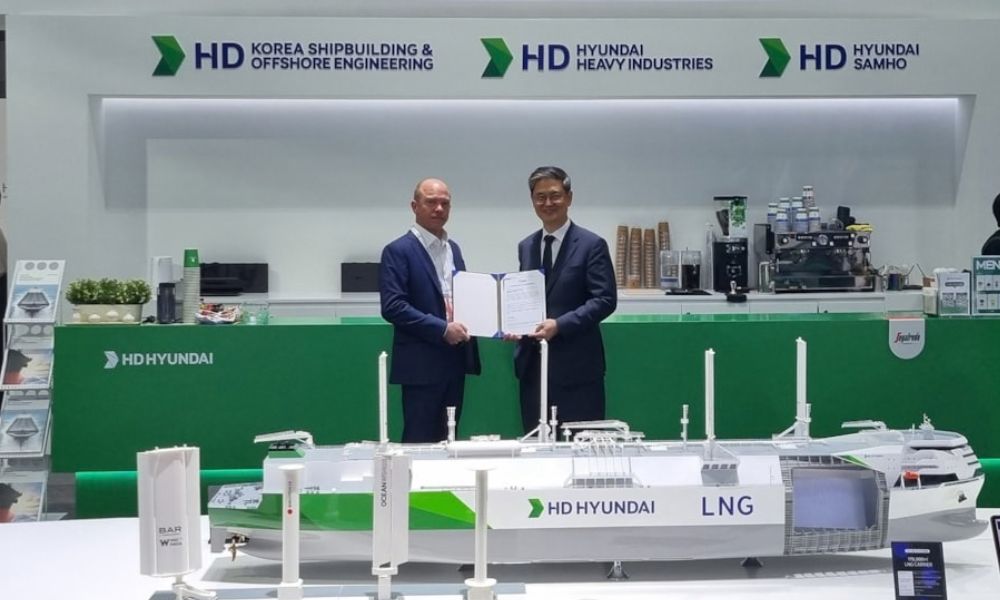
Classification society ABS on Monday (21 September) said it has awarded HD Hyundai Heavy Industries (HD HHI) and HD Korea Shipbuilding & Offshore Engineering (HD KSOE) approval in principle (AIP) for the basic design of a 22,000 CBM bunkering vessel capable of supplying ammonia as marine fuel.

The approval is the result of a joint development project initiated earlier this year. ABS reviewed the design’s general arrangement, machinery arrangement, ammonia cargo handling system and fuel supply system against applicable class and international requirements.

Gareth Burton, ABS Senior Vice President, Global Engineering, said: “Bunkering infrastructure is a critical step for any marine fuel to scale, and it has to be implemented with safety designed in from the start.

“This AIP reflects the industry’s need for fuel flexibility while advancing the safe bunkering of ammonia. ABS is proud to support HD HHI and HD KSOE as they develop technologies that expand fuel flexibility.”

Ryu Hong-Ryeul, Chief Technical Officer (CTO) of HD HHI, said: “As ammonia rapidly emerges as a viable low-carbon alternative fuel, demand for ammonia bunkering vessels is expected to grow in line with the increasing adoption of ammonia-fuelled ships. 

“This AIP marks a significant milestone toward the commercialisation of ammonia bunkering vessels.”

ABS and the HD Hyundai group have worked together across a range of technologies supporting ammonia as a marine fuel. Recent projects have included AIP for HD KSOE’s ammonia cargo handling and bunkering system and initial review for HD HHI’s machinery arrangement in engine room.


Photo credit: ABS
Published: 22 September, 2026

Continue Reading

Trending