Connect with us

Alternative Fuels

SMW 2026: Singapore explores remote operations for LNG bunkering with industry project

Senior Minister of State for Transport Murali Pillai said MPA is supporting a Joint Industry Project between DNV, Equatorial Marine Fuel Management Services and Singapore Institute of Technology.

Admin

Published

on

SMW 2026: Singapore explores remote operations for LNG bunkering with industry project

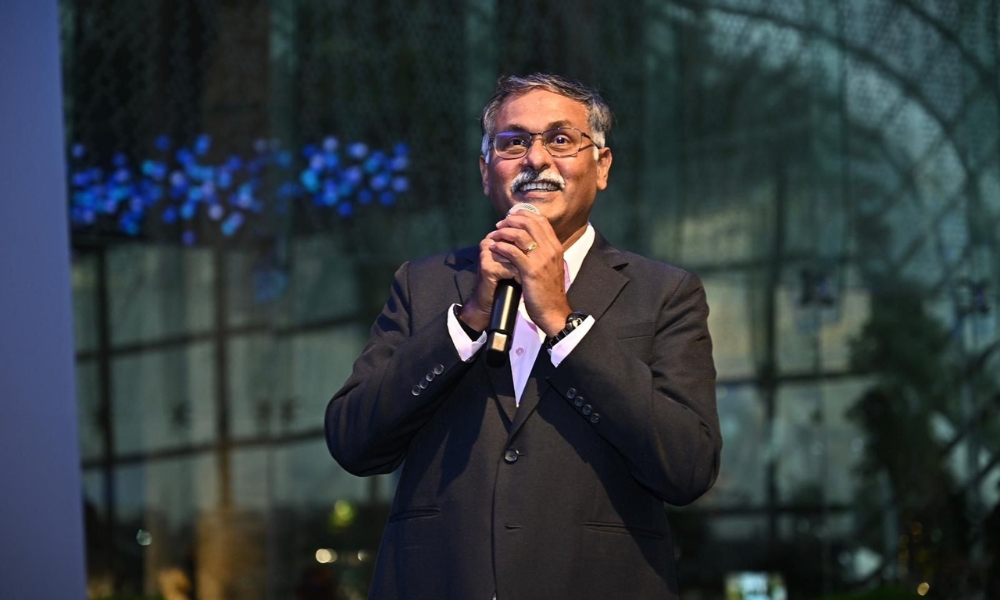
Singapore is prioritising the use of autonomous technology at its port terminals, Senior Minister of State for Transport Murali Pillai said on Wednesday (22 April), citing plans outlined in the country’s Maritime Technology and Research Roadmap.

The roadmap was announced yesterday by Acting Transport Minister Jeffrey Siow highlighting the research and development priorities Singapore will invest more than $100 million over the next five years. 

One of the initiatives include the government studying the use of remote operations for LNG bunkering. MPA is supporting a Joint Industry Project between DNV, Equatorial Marine Fuel Management Services and Singapore Institute of Technology (SIT).

Singapore will also be launching a call for design proposals for an autonomous inter-gateway container feeder — a vessel that transfers containers between terminals.

“These two initiatives will explore remote and autonomous technologies, realtime monitoring and remote vessel operations, allowing us to establish new operational frameworks,” he said.

Mr Murali also said Singapore is preparing its port for a multi-fuel future by developing operational standards for alternative marine fuels given the unique challenges and risks posed by these fuels.

He said operational standards set out safety protocols, guidelines for crew training, and regulations on the safe handling of alternative fuels. 

“By coordinating efforts across stakeholders, including shipowners, ports, and fuel suppliers, we can accelerate our collective shift towards cleaner marine fuels,” he said in his opening remarks of Day 2 of the Singapore Maritime Week (SMW) 2026 at Suntec Convention Centre. 

Over the past three years, the Maritime and Port Authority of Singapore (MPA) has conducted extensive safety studies and fuel trials to inform the standards Singapore is developing. This includes two for ammonia and four for methanol.

“Last year, we published the Technical Reference on Methanol Bunkering. We are currently developing Singapore’s first Technical Reference for Ammonia Bunkering and will share more details subsequently,” he said.

He added that the city-state is developing an electric harbour craft charging infrastructure plan, based on detailed studies of the routes and needs of crew transfer and cargo supply vessels.

Recognising that infrastructural provisions are necessary for electric harbour craft to gain traction, Singapore intends to deploy chargers at key terminals and piers such as Marina South Pier, West Coast Pier and within the Western Industrial Area in the coming years.

“By 2030, we aim to expand the network of public chargers across Singapore’s southern coastline,” he said.

“We will also trial the use of battery-powered charging solutions to provide greater flexibility for harbour craft operations.”

He acknowledged that there are challenges remaining, including the high upfront costs of electric harbour craft which the government is addressing by working closely with industry to study how to bridge this gap.

“MPA and our local shipping associations convened the Harbour Craft Decarbonisation Taskforce in October last year and the Taskforce has concluded its work. The Singapore Government looks forward to receiving the recommendations and will study them thoroughly,” he said.


Photo credit: Murali Pillai
Published: 22 April, 2026

Continue Reading

Alternative Fuels

CPN wraps up first B100 bio bunker fuel delivery to oil tanker in Hong Kong

CPN’s dedicated bunker tanker “Guo Si” delivered B100 marine biodiesel to oil tanker “TORM CORRIDO” on 8 June.

Admin

Published

on

By

CPN wraps up first B100 marine biodiesel delivery to oil tanker in Hong Kong

Hong Kong-based marine fuel supplier Chimbusco Pan Nation (CPN) on Wednesday (10 June) said it has successfully delivered B100 marine biodiesel to an oil tanker for the first time, bunkering the vessel TORM CORRIDO on 8 June. 

The operation marked a significant expansion of CPN’s B100 capability, bringing oil tankers into the range of vessel types it can serve with fully compliant, certified biodiesel supply in Hong Kong.

The achievement reflects a broader surge in market demand. Since CPN launched its B100 marine biodiesel service in January 2026, operator confidence has grown rapidly, and total volumes delivered in the second quarter of 2026 have already exceeded first-quarter totals by more than 300%. 

“Total B100 marine biodiesel volumes in Q2 2026 have already exceeded Q1 by more than 300%, driven by the trust of partners like TORM,” CPN said. 

The operation was carried out by CPN’s dedicated bunker tanker Guo Si, fully upgraded in compliance with the IMO IBC Code and Hong Kong Cap. 413E. 

“As Hong Kong’s only Type II-certified bunker tanker for B100 operations, Guo Si brings the specialist capability to handle pure biofuels safely and compliantly across vessel types,” the company added. 


Photo credit: Chimbusco Pan Nation
Published: 11 June, 2026

Continue Reading

Methanol

Agastya inks MoU with Andhra Pradesh to develop green methanol hub at Mulapeta Port

Project will establish a 1 MMTPA green methanol export-oriented unit on the East Coast of India, positioning Andhra Pradesh as a global hub for sustainable bunker fuels and green industrial products.

Admin

Published

on

By

Agastya inks MoU with Andhra Pradesh to develop green methanol hub at Mulapeta Port

India’s clean energy conglomerate Agastya Group recently said it has signed a strategic Memorandum of Understanding (MoU) with the Government of Andhra Pradesh for the development of Agastya’s green fuels hub at Mulapeta Port, Srikakulam District, Andhra Pradesh.

The project will establish a 1 million tonnes per annum (MMTPA) green methanol export-oriented unit (EOU) on the East Coast of India, positioning Andhra Pradesh as a global hub for sustainable marine fuels and green industrial products.

With an estimated investment of over ₹54,000 Crore (USD 6.5 billion), the Agastya Green Fuels Hub will integrate large-scale green hydrogen production, green methanol manufacturing, carbon capture, renewable energy, and port infrastructure.

“Strategically located in the Indian Ocean Region, the facility will serve key global markets including Japan, South Korea, Singapore, Europe, and other emerging green shipping corridors, supporting the decarbonization of international maritime transport and industrial sectors,” the firm said. 

The company added that the project represents a transformational step toward making India a net exporter of RFBNO RED III compliant green methanol to the world. 

Manifold Times previously reported Agastya Green Fuels signing a long-term green methanol offtake agreement with Sri Lankan bunker supplier SAR Maritime Agencies, a SAR Group company, for the supply of 250,000 metric tonnes (mt) per annum of EU RFNBO RED III Compliant green methanol.

Related: India’s Agastya inks green methanol offtake agreement with SAR Group


Photo credit: Agastya Group
Published: 11 June, 2026

Continue Reading

Alternative Fuels

Gasum locks in LNG capacity at Klaipeda terminal for next decade of supply

Gasum uses the Klaipeda terminal primarily as a reloading point for its own carrier and bunker vessels, but also to support the company’s natural gas operations in Finland and the Baltic countries.

Admin

Published

on

By

Gasum secures long-term LNG capacity at Klaipeda terminal from 2033 to 2040

Nordic energy company Gasum on Wednesday (10 June) said it has secured LNG terminal capacity at the Klaipeda LNG terminal in Lithuania for the period of 2033 to 2040. 

The long-term capacity reservation supports Gasum’s ability to supply the Northwestern European market with liquefied natural gas (LNG) and liquefied biomethane (bio-LNG) over the coming decade.

The Klaipeda terminal has been a part of Gasum’s supply chain for some time already. Gasum uses the Klaipeda terminal primarily as a reloading point for its own carrier and bunker vessels, but also to support the company’s natural gas operations in Finland and the Baltic countries.

Klaipeda is well located regarding the company’s own LNG terminal network in Finland, Sweden, and Norway. Gasum will also utilise the capacity to serve its maritime customers directly in and around the Danish straits.

“Securing capacity at Klaipeda supports Gasum’s strategic long-term supply capability and gives us flexibility in optimizing deliveries to our terminal network and maritime customers. It also underpins our commitment to being a dependable partner in the energy transition”, said Anders Malm, Senior Vice President, Supply & Trading, Gasum.

The capacity at Klaipeda can additionally be used for virtual liquefaction of pipeline fed biomethane into bio-LNG, through mass balancing and biomethane certificates. 

“Gasum believes this to be an important capability going forward, as a growing number of the company’s customers are seeking to reduce the lifecycle emissions of fuel further than what LNG alone can offer,” it added. 


Photo credit: KN Energies
Published: 11 June, 2026

Continue Reading

Trending