
Alternative Fuels
GoodFuels, NORDEN, Control Union and IDS Group successfully test isotopic tracer for marine biofuels
Isotopic tracer stays within the fuel throughout entire downstream of fuel delivery; it can be tracked and traced by inspectors to verify a fuel product has not been diluted or tampered with.

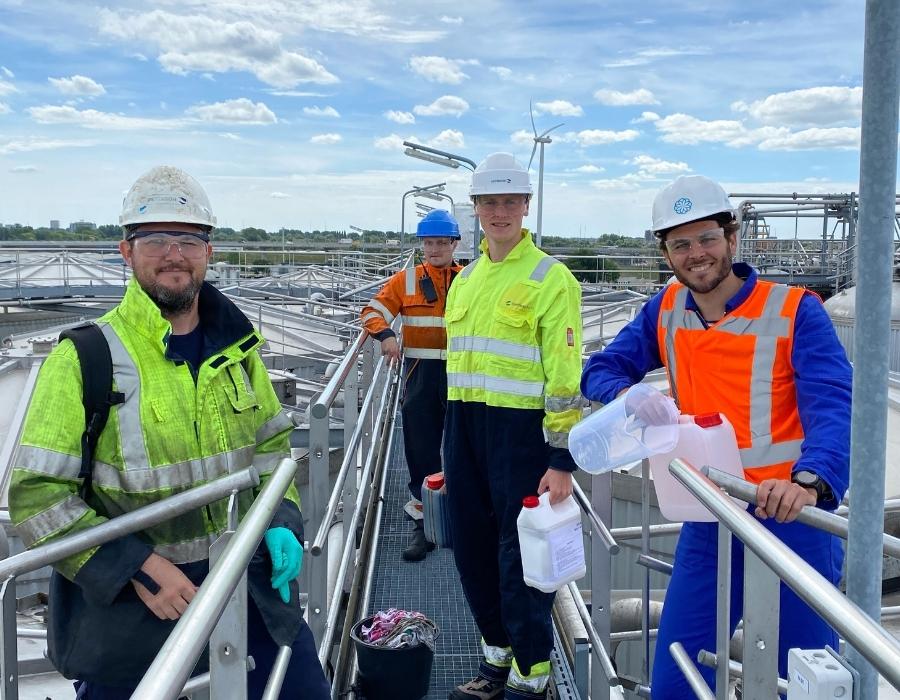
Biofuels provider GoodFuels on Thursday (27 October) announced the results of a new partnership with global certification organisation Control Union and France’s IDS Group to test the effectiveness of a unique isotopic tracer for biofuels.
A successful pilot, conducted during a recent delivery of 500 tonnes of biofuel to the NORDEN-owned tanker Nord Gardenia, has proven the effectiveness of the tracer technology in real-life applications.
The partnership, which commenced in early 2022, has seen the companies collaborate to create the new tracer, which can be added to marine fuels as a unique ‘fingerprint’ and verification tool.
The isotopic tracer stays within the fuel throughout the entire downstream of fuel delivery. It then can be tracked and traced by inspectors to verify that a fuel product has not been diluted or tampered at any stage in the supply chain. The trial has demonstrated that the tracer does not adversely impact the physical properties, quality and stability of the biofuel, and that tracing and testing activities could be performed without any impact on bunker operations.

The pilot also showed that the isotopic tracer can successfully measure for fuel dilution, when biofuels are used in a blend, for example.
The tracer can be applied at any stage in the supply chain and is based on natural elements so as not to compromise the sustainability of the biofuel product. It has been specifically designed to trace fuels at different granularity levels, making it suitable to be used within fuel products whether they are 100% biofuel or part of a blend with conventional marine fuels.
It can also be used to support carbon calculations and provide evidence for carbon pricing and tax reductions, giving shipowners and operators assurance on the amount and quality of biofuel they are deploying in their pursuit of sustainable shipping.
Commenting on the partnership, Dirk Kronemeijer, CEO of GoodFuels, said: “Being able to undisputedly trace that our fuels are sustainable and uniquely assignable to one of our clients is intrinsic to what we do at GoodFuels. Following the world’s first bunker delivery using blockchain technology in 2018, we continue to introduce cutting-edge solutions, together with our partners, to increase traceability in the shipping industry. Using a physical marker that combines with software is the likely next step in this trend. We are focused on driving even greater trust and transparency in the marine fuels supply chain – two values that are inherent to GoodFuels and GoodShipping.”
Johan Maris, CEO of the Royal Peterson and Control Union Group emphasised the importance of the successful trial: “Through this trial we have now proven this tracer technology, and that proof brings endless potential. The tracer technology can, for example, ensure that fuel doesn’t originate from banned countries but can also be used for many other purposes, in other liquids like oil or even champagne, and in almost any type of solid materials like meat, plants, and metal.”
Patrice Fauvet, CEO and R&D Director of IDS Group, said: “We are pleased to demonstrate and prove our ability to physically mark, track and trace (bio)fuel products, setting the new bar for traceability alongside the frontrunners in sustainability. We are also exploring expanding our patented marking technologies to any other hydrocarbons product.”
Henrik Røjel, Head of Fuel Efficiency & Decarbonisation at NORDEN, said: “Biofuel is a key transition fuel on NORDEN’s journey to zero-carbon shipping, as it can be used onboard our current vessels to make an immediate reduction on carbon emissions. We continue to bunker biofuel on a regular basis and support efforts of adding more transparency on the green fuels we bunker.”
GoodFuels said the tracer project is just the start of a wider partnership between the company, Control Union and IDS Group. All three companies share an ambition to increase transparency in the fuel supply chain, and the tracer will help to advance a shared vision of a standard label for biofuels that would be recognised worldwide as a sign of quality by the fuel market.
Photo credit: GoodFuels
Published: 28 October, 2022
Alternative Fuels
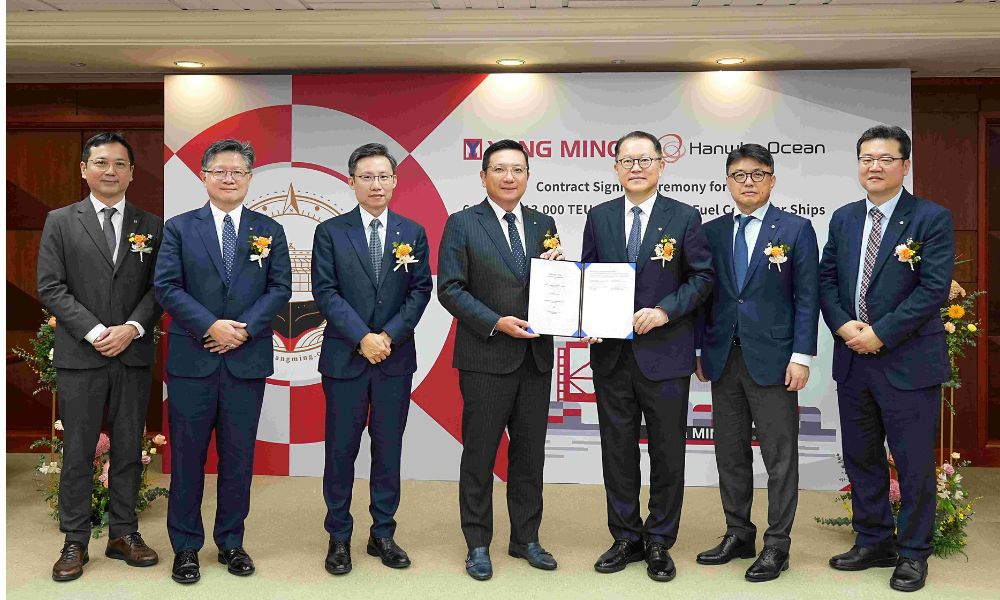
Yang Ming orders six LNG dual-fuel, ammonia-ready containerships from Hanwha Ocean
Each of the six new vessels will have a capacity of up to 13,650 TEU and feature LNG dual-fuel propulsion and Ammonia Fuel Ready specifications.
Alternative Fuels
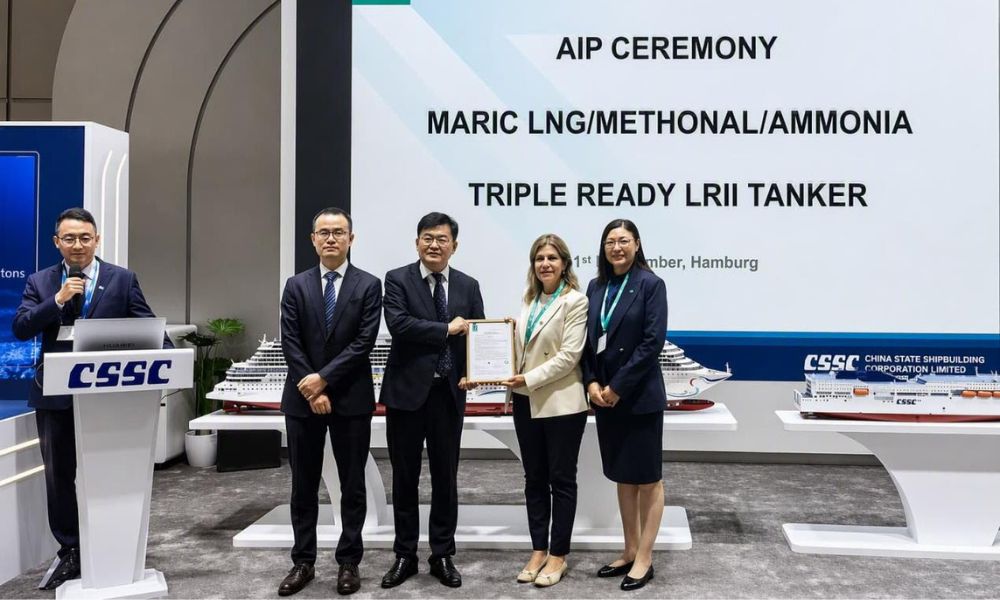
LR, China’s MARIC unveil tanker concept ready for three future bunker fuels
Both secured AiP for a new 114,000 DWT product and crude oil tanker designed to accommodate future conversion to LNG, methanol or ammonia.
Alternative Fuels
DNV: Alternative-fuelled vessel orders hit highest monthly level since October 2024
LNG-fuelled vessels accounted for the vast majority of August activity while the strong summer performance marked a significant acceleration in ordering activity after a relatively slow start to the year.
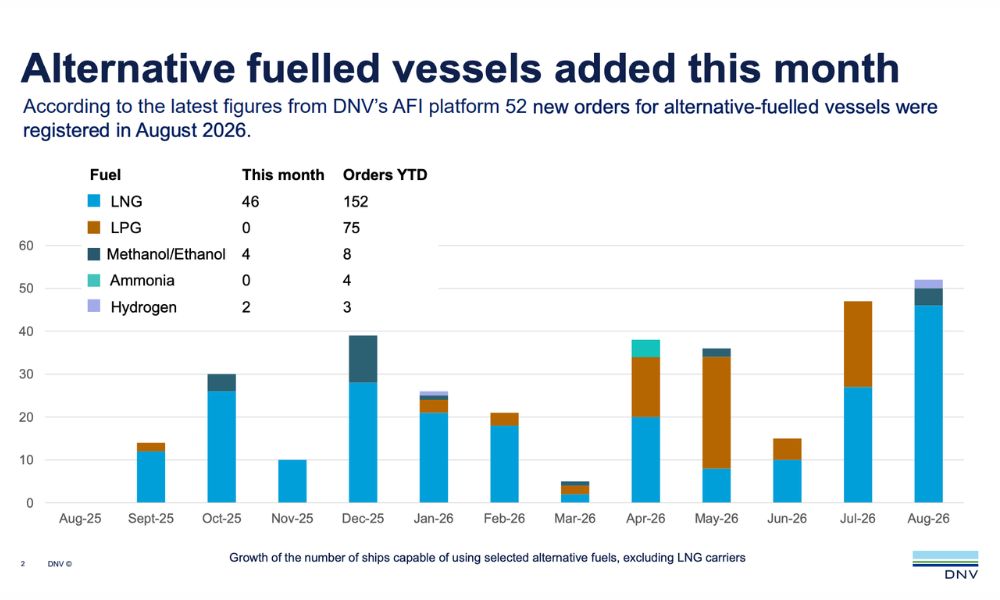
Latest data from classification society DNV’s Alternative Fuels Insight (AFI) platform alternative-fuelled vessel ordering was strong in August, with 52 new vessels added to the platform.
This is the highest monthly total since October 2024 and follows another active month in July, when 47 vessels were added to the database.
LNG-fuelled vessels accounted for the vast majority of August activity, with 46 orders recorded. The container segment led the way with 30 orders, while the car carrier segment contributed a further 12 LNG-fuelled vessels. In addition, four ethanol-fuelled bulk carriers and two hydrogen-powered bulk carriers were added during the month, as well as one LNG bunker vessel.
The strong summer performance marked a significant acceleration in ordering activity after a relatively slow start to the year. In total, 242 alternative-fuelled vessel orders have been placed in the first eight months of 2026, representing a 27% increase compared with the same period in 2025.
LNG remains the dominant fuel choice, accounting for 63% of all alternative-fuelled vessel orders registered so far this year. Container vessels represent the largest share of these LNG orders (59%), followed by car carriers (30%).
Jason Stefanatos, Global Decarbonization Director at DNV Maritime, said: “The past two months have been particularly strong for alternative-fuelled vessel ordering, with August recording the highest monthly total we’ve seen since October 2024. This has helped lift year-to-date orders to a level well above the same period last year.
“LNG remains the leading fuel choice, driven largely by activity in the container and car carrier segments. These sectors have been among the earliest adopters of alternative fuels, supported by predictable liner operations and increasing demand from cargo owners to reduce emissions across supply chains.
“For many owners, LNG offers a combination of emissions reductions, fuel availability and future flexibility while the longer-term fuel landscape continues to evolve.
“At the same time, the latest figures include orders for ethanol- and hydrogen-fuelled vessels, highlighting that owners continue to explore a range of decarbonization pathways. Different segments are making different fuel choices, but the overall level of activity demonstrates continued investment in lower-emission shipping.”
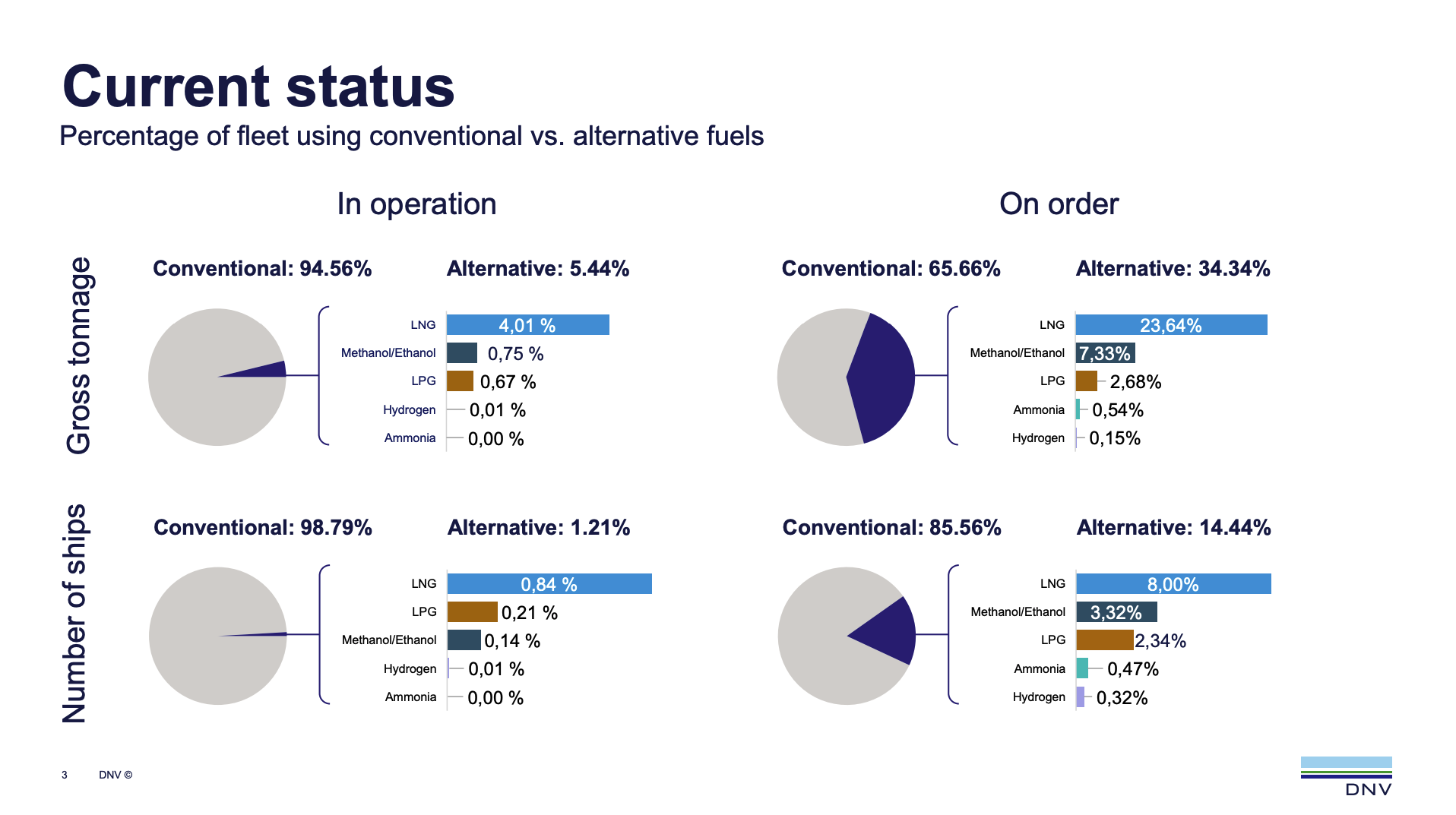
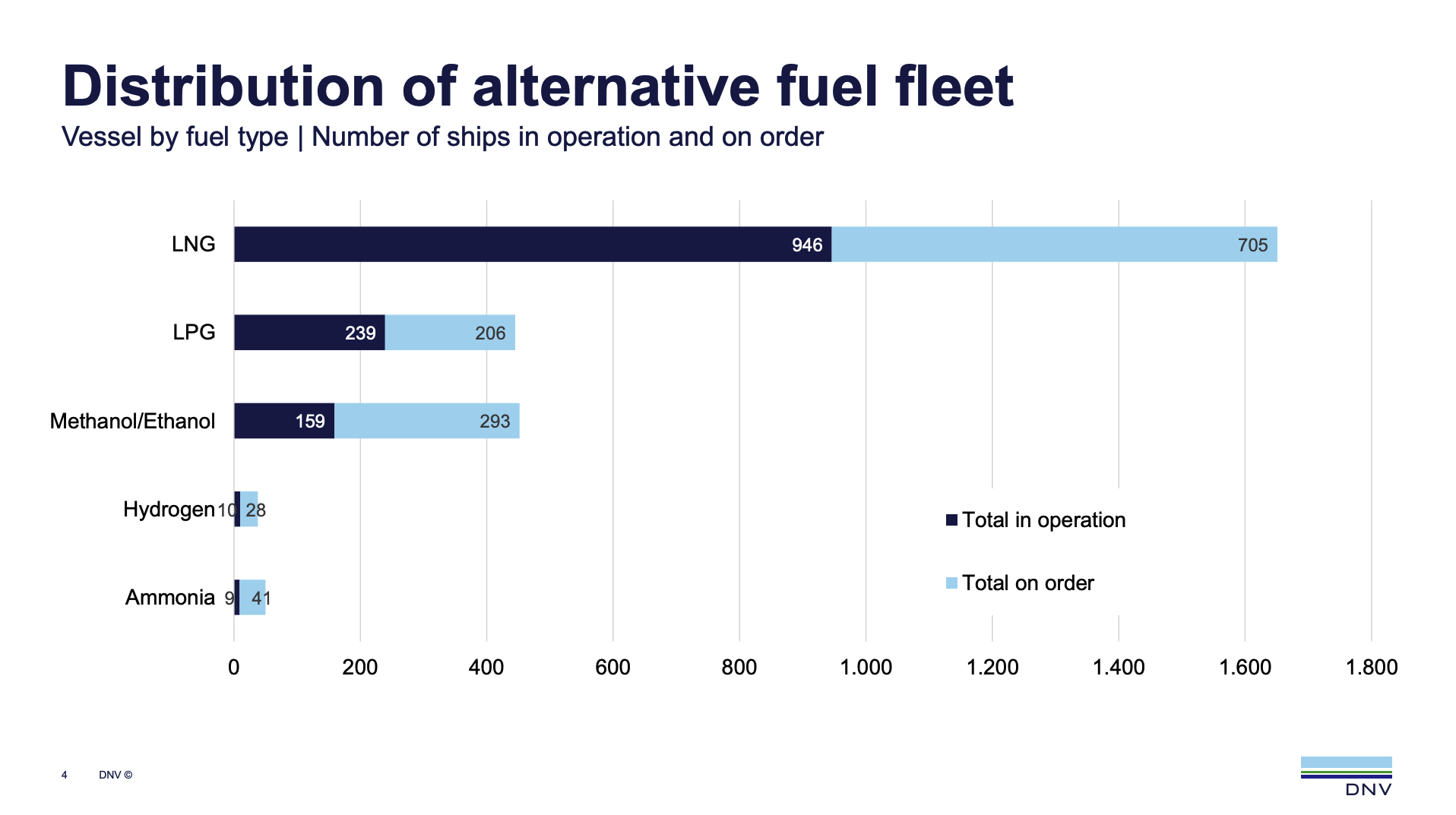
Photo credit: DNV
Published: 4 September, 2026

OUR INDUSTRY PARTNERS

Yang Ming orders six LNG dual-fuel, ammonia-ready containerships from Hanwha Ocean

LR, China’s MARIC unveil tanker concept ready for three future bunker fuels

DNV: Alternative-fuelled vessel orders hit highest monthly level since October 2024

TFG Marine advances global MFM rollout with two US Gulf bunker barges

GENA Solutions: Total renewable and low-carbon methanol project pipeline increases from 61.8 to 62.2 Mt by 2032

Baltic Exchange: Bunker Report (3 September 2026)

ENGINE: Americas Fuel Availability Outlook (3 September 2026)

Singapore-flagged tugboat “Kim Heng 3203” placed under Sheriff’s arrest

US targets five bunker companies in latest sanctions campaign against Iran

Singapore bunkering community supports Living Hope Evangelism’s 7th anniversary outreach for residents in need

China’s bunker market reshaped by tax rebates, trade flows and refining changes, says economist

Hengli Petrochemical’s ex-Singapore trading arm faces winding up application

Rajah & Tann: Bunker disputes are won in the first 48 hours

Report: GCMD outlines practical approach to quantity assurance in marine biofuel supply chains
-
 Vessel Arrest1 week ago
Singapore-flagged tugboat “Kim Heng 3203” placed under Sheriff’s arrest
-
 Sanctions2 weeks ago
US targets five bunker companies in latest sanctions campaign against Iran
-
 Events2 weeks ago
Singapore bunkering community supports Living Hope Evangelism’s 7th anniversary outreach for residents in need
-
 Interview1 week ago
China’s bunker market reshaped by tax rebates, trade flows and refining changes, says economist
-
 Winding up2 weeks ago
Hengli Petrochemical’s ex-Singapore trading arm faces winding up application
-
 Bunker Claim4 days ago
Rajah & Tann: Bunker disputes are won in the first 48 hours
-
 Biofuel1 week ago
Report: GCMD outlines practical approach to quantity assurance in marine biofuel supply chains
-
 Winding up2 weeks ago
Singapore: Notices of intended dividend issued for Ocean Bunkering Services, Hin Leong Marine