Connect with us

Alternative Fuels

Fifty-year maritime industry veteran pledges for methanol as marine fuel

President of Sea Commerce highlights advantages of using methanol as bunkers when compared to other alternatives at the Methanol as a Marine Fuel seminar.

Admin

Published

on

5dd4ce87804e9 1574227591

The President of Houston-based maritime consultancy Sea Commerce (America), Inc. firm believes the consumption of methanol as a transportation fuel will bring about increased carbon reduction and cost savings for the shipping industry when compared to liquefied natural gas (LNG).

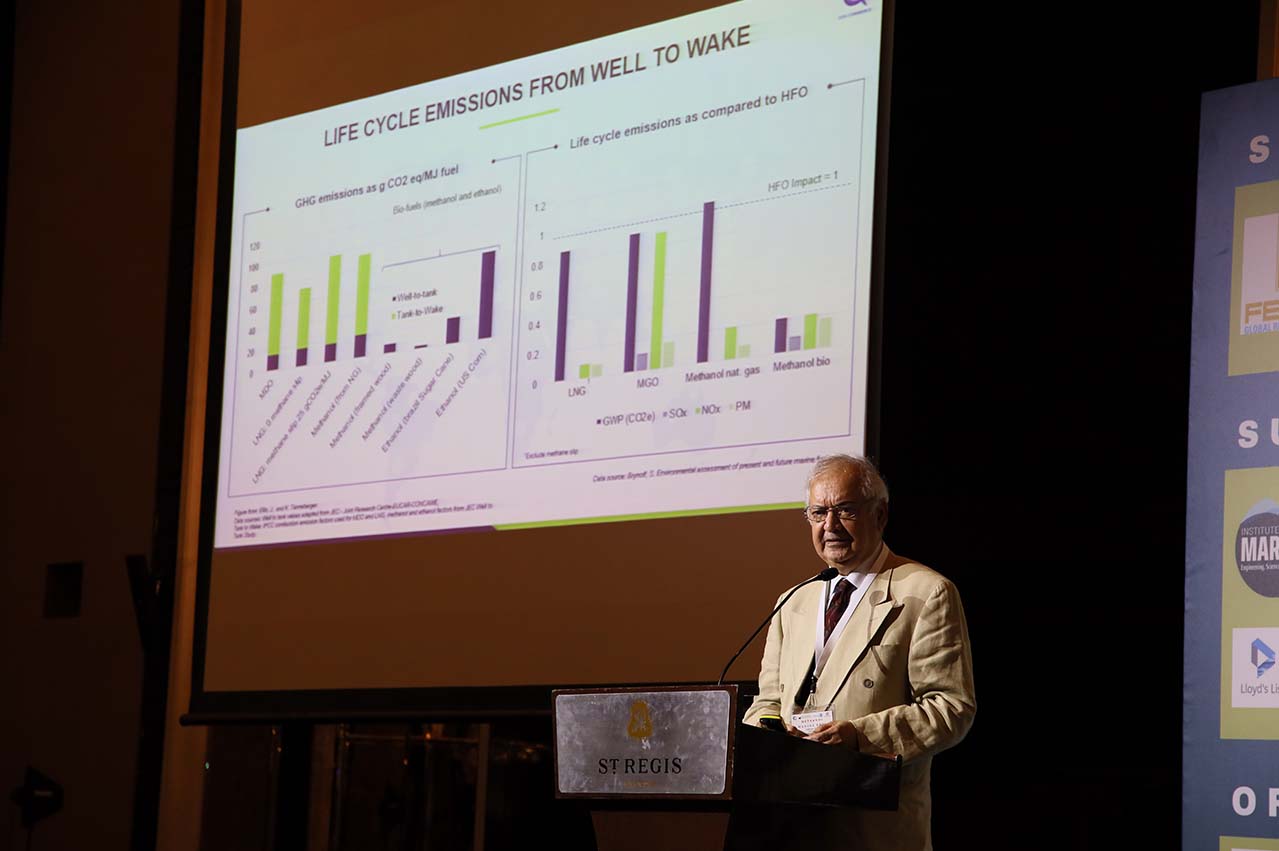
“As a 50-year maritime industry veteran, I strongly believe that, not just for the marine industry, but also, road transportation, that liquid methanol fuel is the way forward for us to achieve maritime industry’s emission reduction goals cost effectively and efficiently,” Captain Saleem Alavi told delegates during his presentation held at the commercial and technical seminar Methanol as a Marine Fuel at St. Regis hotel Singapore.

One of the questions that has been common from the audience in all five (Dubai, Mumbai, Piraeus, Rio de Janeiro and Singapore) Not-For-Profit Methanol as Marine Fuel seminars organised by Capatin Alavi and Sea Commerce over the past year is:

“Why Methanol is not known in the maritime industry?”

He opines that methanol as a marine fuel has been left behind LNG in terms of regulatory development and public awareness. It takes a number of pieces of the puzzle to be in place, such as regulatory framework, engine technologies and bunkering infrastructure for the take up of alternative fuels to begin and with that goes a need for early adopters and greater industry and public awareness.

“Regretfully the industry awareness is lacking and hence the reason I am doing these seminars. I reached out to partner with the FEDCOM (UAE), Methanol Institute and Methanex for these seminars, after I arrived at the logical conclusion that methanol produce with natural gas as feedstock is the bridging fuel of the future and bio-methanol is the sustainable and totally green fuel – best thing about methanol is being a liquid fuel (similar to existing fuel) is the ease of handling and that its ability to utilize the existing oil infrastructure with minor and cost effective modifications,” states Captain Alavi.

In an earlier presentation, Captain Alavi noted of LNG being susceptible to ageing or weathering, a process where the energy content and characteristics/specs of LNG is change due to Boil Off caused by heat ingress from its surroundings.

The temperature of LNG when freshly stored within terminals is about -162 Celsius at 1 bar, and usually increases to -130 Celsius at 8 bar when used as a fuel by clients such as vessels, he explained.

Smaller vessels such as tugs, pilot boats, ferries with a LNG bunker fuel capacity of 50m3 may experience a 5-hour duration loss in actual engine performance; however, a bigger ship such as a 10,000 m3 LNG bunker fuel capacity containership could instead see a 112-hour loss in steaming time.

LNG bunker tankers and facilities, when used frequently, are also vulnerable to complications from ice and moisture due to equipment not given time to dry by itself.

“If flanges and connectors are not warmed and dried sufficiently and if hoses not air free or filled with NG or nitrogen (inert gas) the condensed moisture, frost and ice may come into the LNG stream and into LNG tanks and further into the fuel systems,” points out Captain Alavi.

“LNG systems contain filters that shall capture ice. But if ice or moisture still gets into the LNG system, such as a tank, it will be a serious problem.”

The use of LNG as a bunker fuel will further unlikely eliminate harmful emissions to the atmosphere in the long run, he adds, quoting an example from a recent study on LNG-powered trucks commissioned by Dutch Government and produced by Transport & Environment a Netherland based firm. The study concluded that the LNG powered trucks emitted 5 times more NOx and does not eliminate PM when compared with the diesel trucks.

Captain highlighted few commercial and technical issues with LNG that have impact on time and costs.

“For example, there are accepted losses on custody transfer in LNG industry. Who will be paying for this owners, charterers or supplier? Since LNG characteristics changes due to aging/weathering, how will the LNG bunkers be traded, mass, density or energy?” He asks.

Further, the process of preparing for LNG bunkering takes more time over conventional bunkering which typically has a 3-page checklist.

Captain Alavi referenced a LNG Bunker Checklist for Ship to Ship, Truck to Ship, and Bunker Station to Ship produced by the International Association of Ports and Harbors which had page counts of 26 pages, 23 pages, and 26 pages for each respective document.

Methanol, although being a liquid fuel, is fully miscible in water and hardly poses any pollution and hazard to the environment, he informs.

It is 240 times less potent then diesel and 19,00 times less than gasoline when compared basis lethal concentration which basically results in no clean-up or any impact on marine life after a methanol spill.

“In comparison to LNG, methanol being liquid fuel (similar to existing fuel) is an easier to handle marine fuel and conversion and maintenance to use methanol as fuel is much less expensive. Methanol also has the potential to address further regulations to limit CO2 emissions to comply with IMO’s 2050 goals,” he says.

“I have worked extensively in the LNG space and understand the challenges posed on that front. I am not here to disparage one option over another, as the best option for your vessel will always be based on your trade routes, actual business and the strain on your wallet with reference to the payback period.”

“As an industry professional, this is my honest assessment. I have not been paid to arrive at this conclusion nor am I beholden to any special interests,” stated Capt. Alavi

“Shipowners need to get the complete picture and understand the fundamentals (commercial, technical and environmental of alternate fuels) before opting to spend millions on conversion,” he concludes.

Related: Methanol as Marine Fuel commercial and technical seminar held at Singapore

Photo credit: Sea Commerce (America), Inc.
Published: 20 November, 2019


Continue Reading

Biofuel

BHP and GCMD trial multi-feedstock B100 bio bunker fuel on bulk carrier

Bio-blend in the BHP and GCMD pilot is being used on a BHP-chartered bulk carrier “Berge Lyngor”, which was bunkered in Singapore in early May.

Admin

Published

on

By

BHP and GCMD trial multi-feedstock B100 bio bunker fuel on bulk carrier

BHP and the Global Centre for Maritime Decarbonisation (GCMD) on Wednesday (3 June) said they have blended biofuels from two distinct feedstocks—used cooking oil and waste animal fats —and introduced the lower-emissions marine fuel into a BHP-chartered bulk carrier as part of a pilot project.

The bio-blend in the BHP and GCMD pilot is being used on a BHP-chartered bulk carrier Berge Lyngor, owned and operated by Berge Bulk, transporting BHP iron ore from Western Australia to China. When run on bio-blend, the vessel has the potential to reduce well-to-wake greenhouse gas emissions by approximately 79 per cent per voyage compared to sailing on very low sulphur fuel oil (VLSFO).

The vessel bunkered in Singapore in early May with a B100 bio-blend comprising 50 percent tallow-derived biodiesel, sourced and supplied by HAMR Energy, and 50 per cent used cooking oil (UCOME) supplied by Mitsui & Co Energy Trading Singapore (METS).

Mitsui also blended the fuel and Dan-Bunkering coordinated and executed the bunkering operation, which was performed by Global Energy’s barge MT Maple.

The BHP and GCMD pilot will assess how biofuels from multiple feedstocks can be blended, handled, and introduced under real-world operating conditions using existing used cooking oil bunkering infrastructure.

At the same time, insights from this pilot will help identify solutions to challenges related to fuel quality, handling, traceability, and onboard vessel performance.

Biofuels for global shipping today rely heavily on used cooking oil – a feedstock whose availability is approaching its projected limits. Biofuel from waste animal fats presents a promising option to expand the supply of lower-emissions marine fuels.

The outcomes of the pilot are expected to shed light on the practical steps to integrate biofuel blends from different feedstocks into existing supply chains. The diversity of biofuels will provide shipowners and operators with greater flexibility to optimise fuel procurement based on cost, availability, and lifecycle emissions performance.

Biofuels derived from different feedstocks can exhibit varying properties that may impact operations, including potential corrosion from oxidation, fuel system clogging caused by wax formation, which this pilot aims to assess.

The pilot will trace and verify the biofuel blend’s integrity aimed at bolstering confidence in emissions reductions reporting. The pilot will also provide insights into how robust tracing can support future marine fuel supply chains where biofuels from multiple feedstocks with varying lifecycle greenhouse gas emissions footprints are blended together.

This project is co-funded by the Maritime and Port Authority of Singapore under the Maritime Innovation and Technology Fund (MINT).


Photo credit: Global Centre for Maritime Decarbonisation
Published: 3 June, 2026

Continue Reading

Biofuel

NYK starts one-year B100 bio bunker fuel trial on car carrier

In this trial, NYK will operate a car carrier continuously on B100 for one year to evaluate the impact on engines, fuel supply systems, and operational practices.

Admin

Published

on

By

NYK starts one-year B100 bio bunker fuel trial on car carrier

Japanese shipping firm NYK on Tuesday (2 June) said it has commenced a one-year long-term trial involving the continuous use of 100% biofuel (B100) on an NYK-operated car carrier. 

In this trial, NYK will operate a car carrier continuously on B100 for one year to evaluate the impact on engines, fuel supply systems, and operational practices. High-purity biofuels such as B100 are known to be susceptible to degradation from oxygen, light, and heat, raising concerns about the stability of such fuels during long-term use.

In this trial, the biofuel primarily comprises FAME (Fatty Acid Methyl Ester) derived from used cooking oil and similar feedstocks.

The initiative is designed to evaluate the fuel’s effects on the vessel’s equipment and verify operational safety under real-world conditions. 

Through this effort, NYK seeks to accumulate technical expertise that will support the broader use of high-purity biofuels and further accelerate efforts to reduce greenhouse gas (GHG) emissions.

NYK has been advancing the use of biofuels through various initiatives. In 2024, the company conducted a trial using biofuel blend B24 and subsequently expanded practical usage to B30. However, the company said there remains limited global experience with the long-term continuous use of B100.

“By collecting long-term operational data through this trial, NYK aims to accumulate valuable technical insights to support both the safe operation of vessels and the wider adoption of high-purity biofuels,” it said. 


Photo credit: NYK
Published: 3 June, 2026

Continue Reading

Ammonia

AM Green plans to build green ammonia plant at Indian port

Initiative also includes development of green ammonia handling, storage and bunkering infrastructure, pilot bunkering operations, safety procedures and training programmes, says VOC Port Authority.

Admin

Published

on

By

india flag

VO Chidambaranar (VOC) Port Authority on Friday (29 May) said it has signed a Memorandum of Understanding (MoU) with India’s ammonia producer AM Green Ammonia to collaborate in the development of a green ammonia production plant.

The plant will have a capacity of one million tonnes per annum (MTPA) at Tuticorin.

The initiative also includes development of green ammonia handling, storage and bunkering infrastructure, pilot bunkering operations, safety procedures and training programmes. 

The project is expected to support the development of green fuel corridors connecting VOC Port with major ports in Europe and Asia, thereby strengthening India’s position in the global green fuels value chain.

VOC Port also signed a Memorandum of Understanding (MoU) with Bureau Veritas (India) Pvt. Ltd., to collaborate on Green Port certification, emissions accounting, ESG reporting, safety validation, development of green bunkering practices, and establishment of a Centre of Excellence for green fuels and sustainability.

The port also plans for an upcoming 750 m³ green methanol bunkering facility.


Photo credit: Naveed Ahmed on Unsplash
Published: 3 June, 2026

Continue Reading

Trending