
Alternative Fuels
ENGINE on Fuel Switch Snapshot: Lower surplus prices dent B100 and LBM pooling values
OceanScore’s FuelEU Pooling Index drops to 2026 low; B100’s discount to VLSFO narrows to $18/mt; LBM pooling values lose up to $306/mt since May.

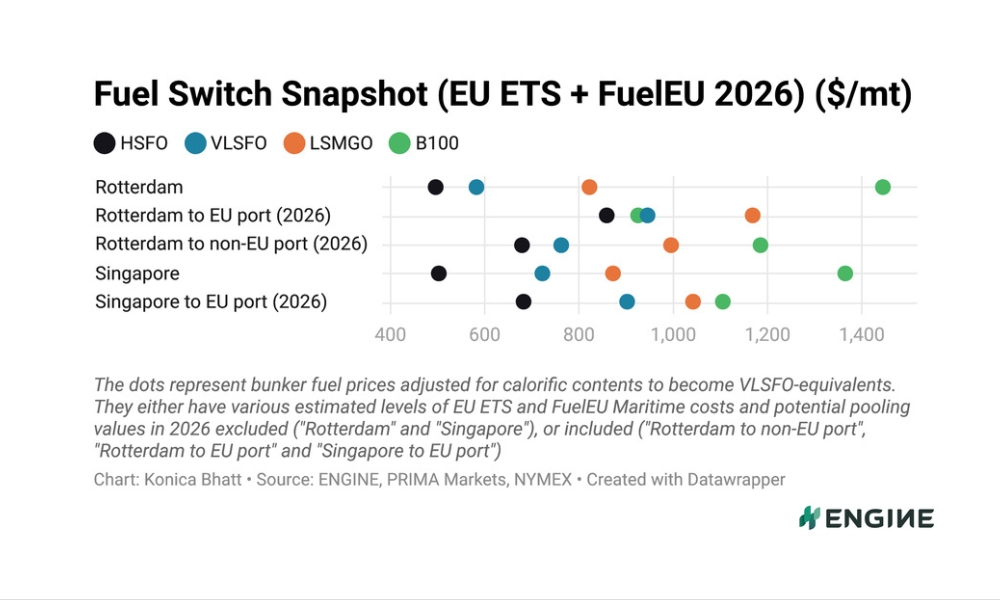
Once a week, bunker intelligence platform ENGINE will publish a snapshot of alternative and conventional bunker fuel prices in the world’s two biggest bunkering hubs. The following is the latest snapshot:
- OceanScore’s FuelEU Pooling Index drops to 2026 low
- B100’s discount to VLSFO narrows to $18/mt
- LBM pooling values lose up to $306/mt since May
OceanScore’s FuelEU Pooling Index has fallen to €169/mtCO2e ($193/mtCO2e) this week, its lowest level of the 2026 compliance cycle so far.
The benchmark has declined by €4/mtCO2e ($5/mtCO2e) over the past week. Over the same period, ENGINE-assessed FuelEU Maritime pooling values for B100 and liquefied biomethane (LBM) on EU-EU voyages have fallen by $20/mt and $29-33/mt, respectively.
While the weekly decline in pooling values has been relatively modest, the impact is more pronounced over a longer period. Market participants shifted their focus to 2026 FuelEU compliance in May after completing 2025 reporting and pooling activities by the end of April.
Since the first week of May, OceanScore’s FuelEU Pooling Index has slumped by €56/mtCO2e, from €225/mtCO2e ($263/mtCO2e) to €169/mtCO2e ($193/mtCO2e) now.
The decline in the underlying benchmark has reduced B100’s potential pooling value by $188/mt to $522/mt over the same period.
LBM pooling values have been hit even harder, falling by $261-306/mt to $724-849/mt.
“The decline suggests that sellers are becoming increasingly willing to place compliance surpluses at lower price levels than earlier in the year, and a belief that banking will not translate into better prices any time soon,” OceanScore said.
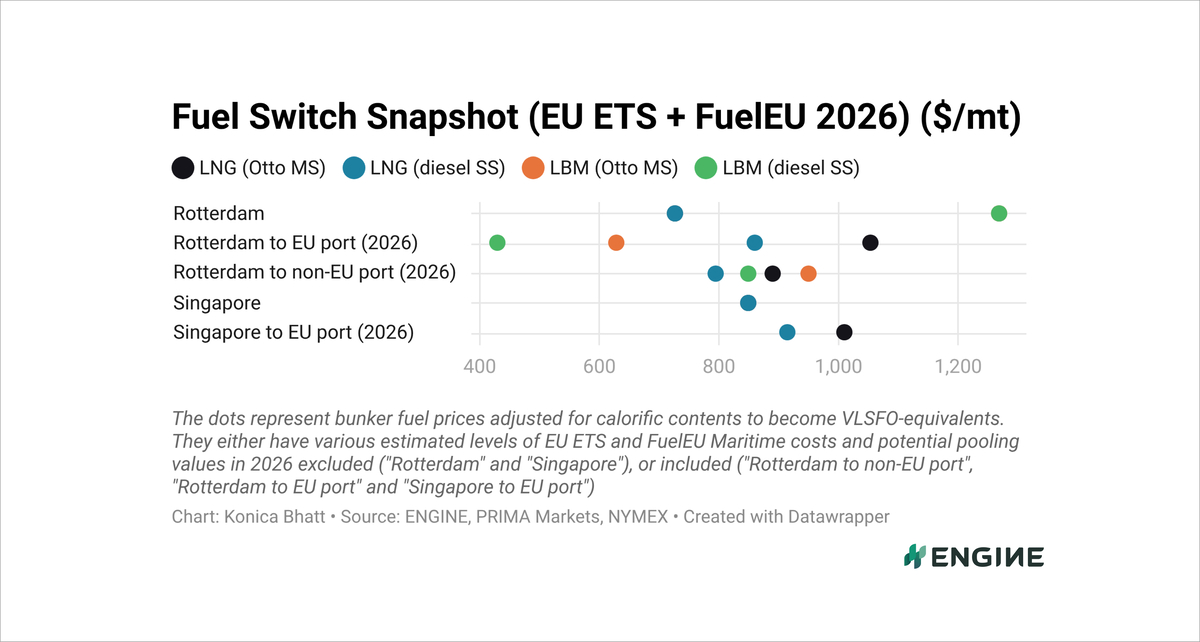
The decline in pooling values has impacted bunker spreads in Rotterdam.
On 5 May, Rotterdam’s B100 stood at a $299/mt discount to HSFO. That has since shifted to a $68/mt premium over HSFO. Its discount to VLSFO has narrowed by $395/mt to $18/mt and its discount to LSMGO has narrowed by $622/mt to $240/mt.
LBM discounts to LSMGO have narrowed by $469-509/mt, and to LNG by $132/mt over the same period.
Liquid fuels
Rotterdam’s conventional fuel prices have fallen by $32-102/mt over the past week, while its B100 price has edged up by $1/mt.
Prompt HSFO and VLSFO availability remains tight in the ARA bunkering hub, because of loading delays at the terminals, a trader said. Lead times of around 7-8 days are recommended for both grades.
Singapore’s HSFO and LSMGO prices have declined by $18-78/mt in the past week, while its VLSFO price has risen by $34/mt. Its B100 has declined by $29/mt
VLSFO availability in Singapore is still facing constraints, with suppliers recommending lead times of 10-14 days for deliveries.
HSFO availability has improved marginally, with lead times shortening to 5-12 days from 10-15 days previously. LSMGO availability has become more stretched, requiring 7-10 days of advance planning versus roughly seven days previously.
Liquid gases
Rotterdam’s LNG prices have declined by $27-33/mt in the past week. The LBM price for Otto medium-speed engines has inched lower by $2/mt, while the price for diesel slow-speed engines has inched higher by $3/mt.
Singapore’s LNG prices have plunged by $150-153/mt on the week.
By Konica Bhatt
Photo credit and source: ENGINE
Published: 23 June, 2026
Alternative Fuels
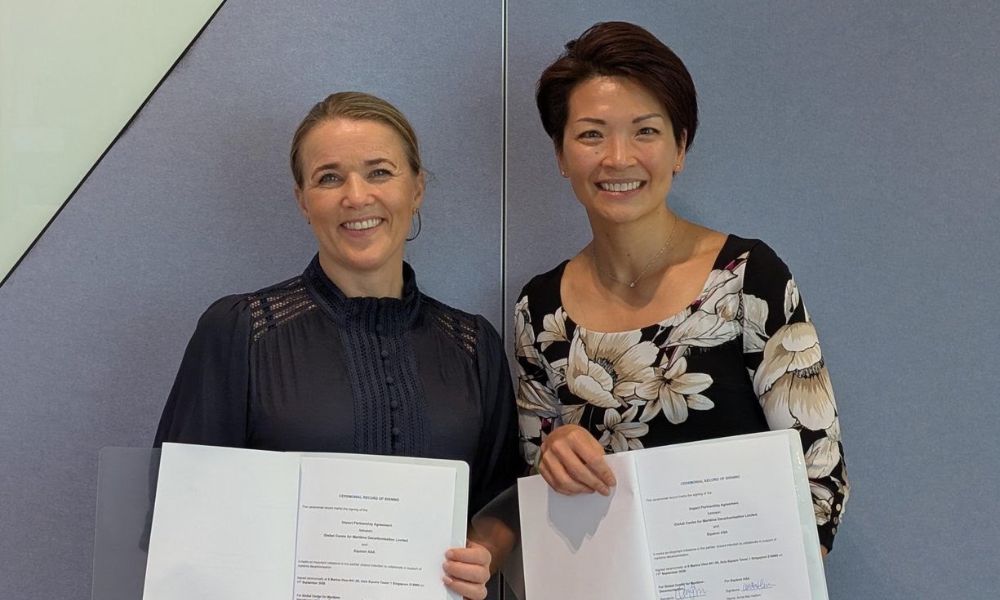
GCMD, Equinor to combine expertise on alternative bunker fuels, decarbonisation solutions
Equinor brings extensive experience to partnership as a vessel charterer and marine fuel supplier, including chartering dual-fuel LNG and methanol tankers, testing biofuels and supplying methanol.
Decarbonisation
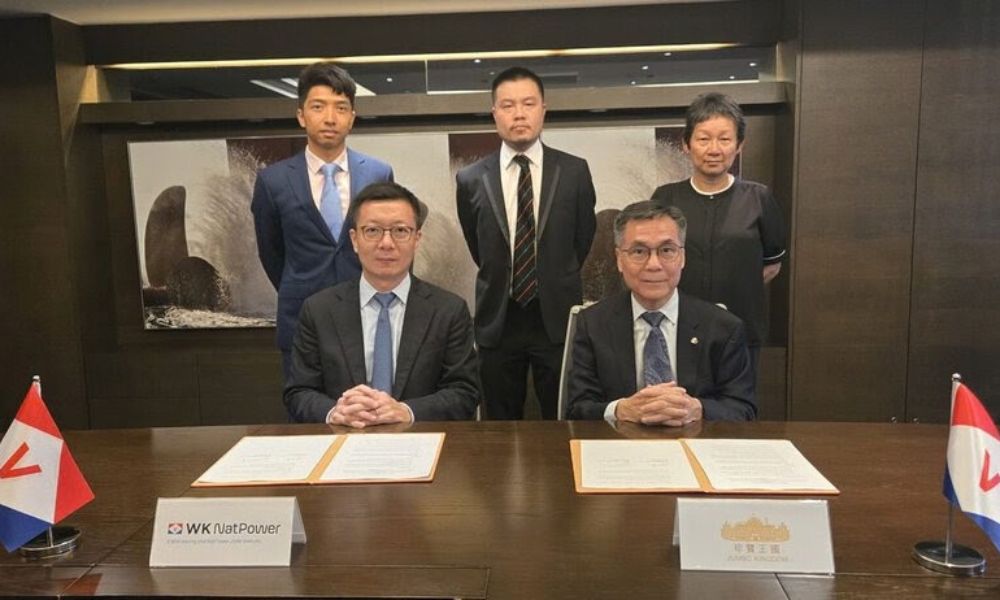
Wah Kwong NatPower, AREL partner on maritime electrification in Hong Kong
Collaboration will examine opportunities to deploy shore power facilities, vessel charging infrastructure and battery energy storage solutions, alongside the development of electric vessels.
Ammonia
IMO technical seminar examines ammonia bunkering and infrastructure
Around 800 participants exchanged technical information and experiences on the potential use of ammonia as a marine fuel, including developments in production and bunkering and infrastructure.

OUR INDUSTRY PARTNERS

MPA: 25 crew rescued after abandoning “MSC HERMES III” east of Vietnam

GCMD, Equinor to combine expertise on alternative bunker fuels, decarbonisation solutions

Wah Kwong NatPower, AREL partner on maritime electrification in Hong Kong

IMO technical seminar examines ammonia bunkering and infrastructure

Spring Marine to expand use of Sulnox Eco with four-year supply agreement

PortXchange: Rotterdam bunker volume shift offers warning as Spain adopts fuel law

ENGINE: East of Suez Fuel Availability Outlook (22 Sep 2026)

Singapore: Marine fuel testing firm CCIC Singapore faces winding up application

Peninsula confirms one fatality, crew member missing from bunker tanker “Hercules Star”

Singapore: MPA working with industry on next phase of digital bunkering, says Deputy CE

Amogy and LOTTE Fine Chemical to explore ammonia bunkering in South Korea

High Court of Singapore issues winding up order against Hengli Petrochemical International

APPEC 2026: Digitalisation in bunkering not merely a ‘paper-to-screen’ swap, states panellists

Polaris Shipping orders WinGD engines capable of running on methanol, ethanol
-
 Winding up1 week ago
Singapore: Marine fuel testing firm CCIC Singapore faces winding up application
-
 Incident2 weeks ago
Peninsula confirms one fatality, crew member missing from bunker tanker “Hercules Star”
-
 Technology2 weeks ago
Singapore: MPA working with industry on next phase of digital bunkering, says Deputy CE
-
 Ammonia2 weeks ago
Amogy and LOTTE Fine Chemical to explore ammonia bunkering in South Korea
-
 Winding up1 week ago
High Court of Singapore issues winding up order against Hengli Petrochemical International
-
 Technology1 week ago
APPEC 2026: Digitalisation in bunkering not merely a ‘paper-to-screen’ swap, states panellists
-
 Engine2 weeks ago
Polaris Shipping orders WinGD engines capable of running on methanol, ethanol
-
 Financial Result2 weeks ago
Singapore-based Uni-Fuels H1 2026 net income jumps 1,415% to USD 1.4 million