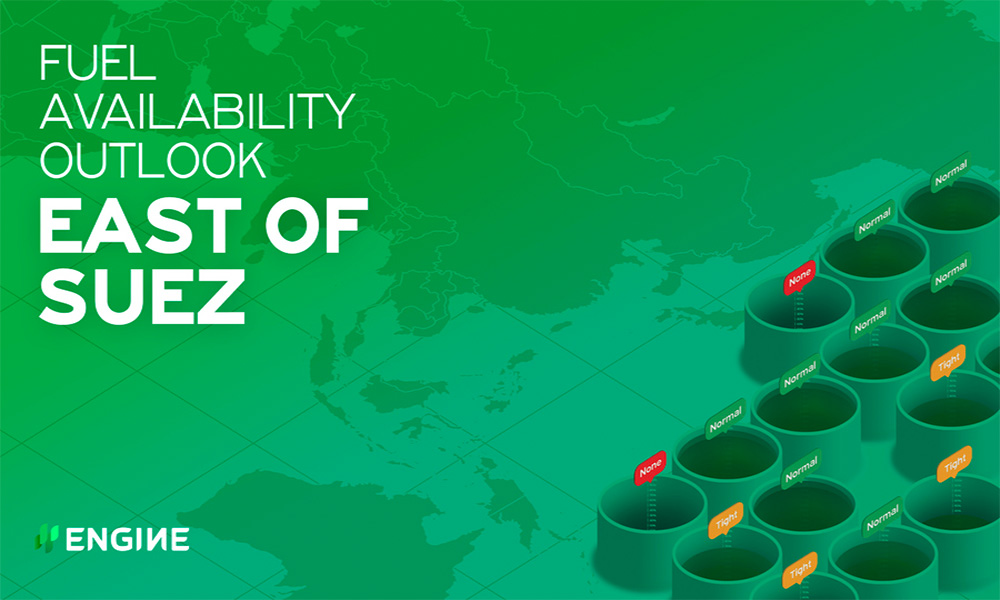
The following article regarding regional bunker fuel availability outlook for the East of Suez region has been provided by online marine fuels procurement platform ENGINE for publication on Singapore bunkering publication Manifold Times:
- VLSFO availability tight in Singapore
- VLSFO and LSMGO availability good across several Taiwanese ports
- Availability tight across all grades in Fujairah
Singapore and Malaysia
Singapore’s bunker market remains tight, with recommended lead times for VLSFO at 13-17 days, almost unchanged from 13-16 days a week earlier. Most suppliers are holding low stock levels, while delays in cargo arrivals linked to the conflict in the Middle East have added further pressure to availability, according to a Singapore-based source.
HSFO availability has improved slightly, with advised lead times easing to 9-12 days from 10-19 days last week. LSMGO supply has also strengthened, with lead times narrowing to 5-7 days from 6-8 days previously.
Singapore’s residual fuel oil stocks have averaged 7% higher so far this month compared with August, according to the latest Enterprise Singapore data. Stocks have climbed above 20 million bbls, supported by an 18% increase in net fuel oil imports so far in September. Both imports and exports have declined during the period, with imports falling by 167,000 bbls and exports decreasing more sharply by 643,000 bbls.
Middle distillate inventories have also risen by 3% this month to 8.46 million bbls.
At Malaysia’s Port Klang, bunker supply remains constrained. Prompt VLSFO availability is particularly tight, while LSMGO supply remains limited and HSFO availability continues to face pressure.
East Asia
In Zhoushan, VLSFO lead times remain at around 10 days, unchanged from last week, as several suppliers are running low on stocks and delays in replenishment cargoes are limiting availability, according to a source. LSMGO and HSFO supply has improved, with lead times falling to around seven days from 10 days previously.
Supply conditions remain mixed across other Chinese ports. Dalian and Qingdao have adequate VLSFO and LSMGO stocks, although HSFO remains tight in Qingdao. Tianjin is facing shortages across all three major grades, while Shanghai has limited availability of VLSFO and HSFO but relatively stable LSMGO supply.
Pressure is also evident in southern China. Suppliers in Fuzhou and Xiamen are short of VLSFO and LSMGO, while supplies of both grades remain constrained in Yangpu and Guangzhou.
Bunkering activity is expected to remain muted at several Chinese ports during the Mid-Autumn Festival from 25-27 September. Deliveries against existing orders will continue as usual during the holiday period, while 22 September is the final day for placing stem orders at most ports for delivery during the holidays, according to a China-based source.
In Hong Kong, the bunker market is broadly unchanged, with suppliers maintaining lead times of around seven days for the major grades.
In Taiwan, VLSFO and LSMGO lead times remain at around two days at Keelung, Taichung, Hualien and Kaohsiung, showing little change from last week.
In South Korea, lead times for all major grades at southern ports, including Busan, Ulsan, Masan, Onsan, Yeosu and Kwangyang, have settled at around nine days, compared with 6-10 days a week earlier. Western ports, including Incheon, Daesan, Dangjin, Pyeongtaek and Taean, are seeing a similar trend, with VLSFO, LSMGO and HSFO lead times also at around nine days, versus 6-10 days previously.
Meanwhile, weather-related disruptions are possible in the coming days. Bunkering operations at Busan, Ulsan and Yeosu could remain affected until 23 September due to bad weather, while Daesan may face disruptions from 25-26 September.
In Japan, recent operational issues have been resolved, but the September loading schedule remains fully committed, leaving prompt supply virtually exhausted. Some October availability is beginning to emerge, although suppliers are accepting inquiries strictly on a firm-inquiry basis, subject to confirmation. Early inquiries are therefore advised to secure prompt allocations.
“September prompt spot remains extremely tight with minimal fresh offers. October inquiries are being reviewed on a case-by-case basis as supply schedules normalise,” a Japan-based trader said.
The trader also recommended arranging bunker requirements well in advance, citing the Silver Week holiday from 19-23 September and exceptionally tight market conditions.
Availability of VLSFO, LSMGO and HSFO has tightened across several Japanese ports, including Tokyo, Chiba, Kawasaki, Nagoya, Yokkaichi, Osaka, Kobe, Mizushima, Tokuyama and Oita. Supplies of all three grades are virtually unavailable this month, while October and later stems remain subject to inquiry. Kashima continues to face tight availability of VLSFO and HSFO.
By contrast, Indonesia continues to have healthy bunker fuel availability. Suppliers at Jakarta, Surabaya, Balikpapan and Cigading are generally recommending VLSFO lead times of just 2-3 days.
Oceania
Bunker fuel supply in Western Australia remains stable, with VLSFO readily available at Kwinana and Fremantle. Suppliers at both ports are quoting lead times of around seven days. Each port is served by a single supplier, with all deliveries carried out by barge.
Supply conditions are more mixed along Australia’s east coast. At Port Kembla, VLSFO supply is normal and can be delivered by truck or pipeline, while VLSFO and LSMGO availability in Sydney is adequate. HSFO supply is comparatively tighter in Sydney, with suppliers generally requiring around seven days’ notice.
Further north, Brisbane and Gladstone have ample VLSFO and LSMGO availability, with delivery lead times of roughly one week. Suppliers in Melbourne and Geelong also have comfortable VLSFO stocks, although both ports rely on a single bunker barge, keeping lead times at around seven days. HSFO availability has tightened further in both Melbourne and Brisbane.
Separately, one supplier is offering VLSFO, LSMGO and HSFO at Brisbane, Sydney and Melbourne with shorter lead times of approximately five days.
In Western Australia, pipeline bunkering at Dampier Cargo Wharf (DCW) is expected to remain suspended until around the end of September as repair work continues. Limited truck deliveries are available, depending on vessel size. During the disruption, the supplier has designated the Toll Supply Base (TSB) in Dampier as the preferred bunkering point, according to a source.
Across the Tasman, New Zealand’s bunker market remains broadly stable. VLSFO is readily available at Tauranga and Auckland, with suppliers quoting lead times of around four days. At Marsden Point, vessels can receive both VLSFO and LSMGO directly via pipeline.
Weather remains the main operational risk in New Zealand, with Wellington and ports across the South Island particularly susceptible to bunker delivery delays when adverse conditions disrupt marine operations.
South Asia
Bunker lead times of around 3–4 days are recommended for VLSFO, HSFO and LSMGO at several major Indian ports, including Mumbai, Cochin, Paradip, Visakhapatnam, Kakinada, Haldia, Chennai, Tuticorin and New Mangalore. This is broadly unchanged from the previous week, an India-based source said.
Weather conditions could, however, put some pressure on bunker deliveries in the coming days. Rough weather is expected to disrupt operations at Sikka on 25–26 September and Kandla on 24–26 September, while rough waves are forecast off Visakhapatnam from 22–26 September.
In Sri Lanka, adverse weather is also expected at Colombo and Trincomalee from 22–26 September, potentially causing delays to bunker deliveries.
Middle East
Bunker fuel availability in Fujairah remains severely constrained as ongoing US-Iran tensions continue to disrupt shipping through the Strait of Hormuz. Supply of all major fuel grades is described as “super tight”, while fuel oil imports have fallen sharply amid heightened regional uncertainty.
Similar supply pressure is being reported at nearby Khor Fakkan, where availability of all grades remains limited, according to a Middle East-based source.
In Saudi Arabia, VLSFO and LSMGO availability at Jeddah remains steady. However, adverse weather could intermittently disrupt bunkering operations at Jeddah on 25–26 September and Yanbu on 24–26 September.
At Qatar’s Ras Laffan, supplies of both VLSFO and LSMGO remain restricted.
In Oman, “the conflict is still ongoing, and prices have increased significantly. However, from the operations side, supply is continuing as normal with no major challenges so far,” an Oman-based trader said.
LSMGO supply remains stable at key Omani ports, including Salalah, Muscat, Duqm and Sohar, with suppliers recommending lead times of around one day.
In Egypt, bunker inventories at Port Suez have dropped to critically low levels across all three conventional fuel grades. Further south, Djibouti is also experiencing limited availability across major fuel grades.
By Tuhin Roy
Photo credit and source: ENGINE
Published: 23 September, 2026









 Financial Result2 weeks ago