Connect with us

Biofuel

ENGINE on Biofuel Bunker Snapshot: Conventional prices push B30 prices higher

Rotterdam’s B30-VLSFO and B30-LSMGO sharply higher on the week; Antwerp’s bio-bunker sales increase 89% on quarter; Nippon Biofuel selected for Japan-backed Jatropha biofuel project.

Admin

Published

on

ENGINE on Biofuel Bunker Snapshot: Conventional prices push B30 prices higher

Once a week, bunker intelligence platform ENGINE will publish a snapshot of biofuel bunker prices in Europe, Fujairah and Singapore. The following is the latest snapshot:

  • Rotterdam’s B30-VLSFO and B30-LSMGO sharply higher on the week
  • Antwerp’s bio-bunker sales increase 89% on quarter
  • Nippon Biofuel selected for Japan-backed Jatropha biofuel project

ARA and Europe

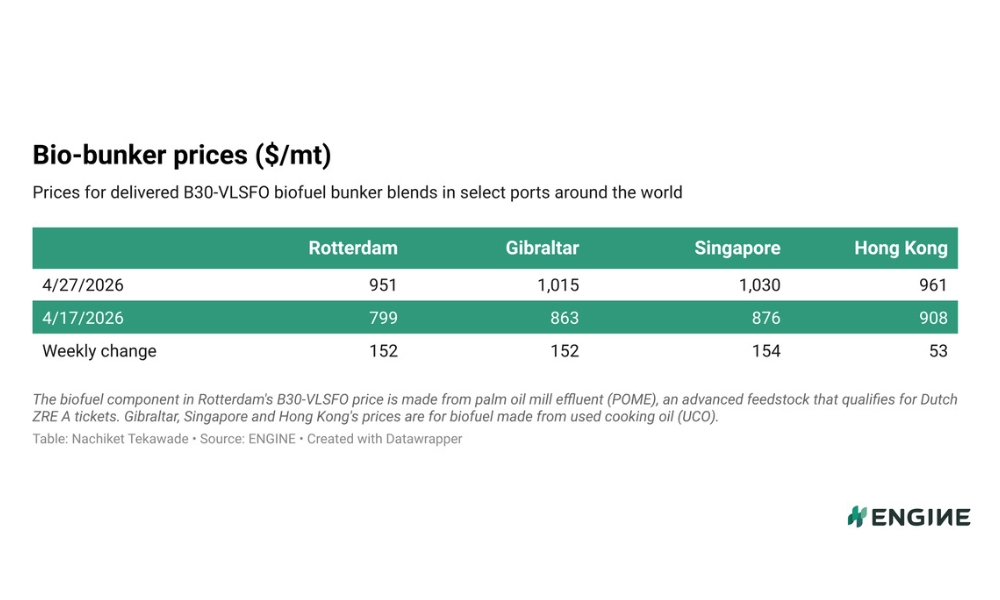
Rotterdam’s B30-VLSFO (POMEME) grade has surged around $152/mt through the past week, since Friday 17 April.

This rise was mainly supported by the surge in conventional VLSFO price. VLSFO price in Rotterdam has gained by around $119/mt in the same duration.

Meanwhile, Prima Markets assessed POMEME feedstock price gained by just $9/mt in the past week.  

A $163/mt gain in Rotterdam’s conventional LSMGO price has also pushed up the port’s B30-LSMGO blend price by around $185/mt in the past week.

Separately, sales of bio-bunkers at the Port of Antwerp-Bruges in first quarter 2026 have rebounded strongly by around 89% to 21,000 mt, from a low of 11,000 mt reached in Q4 2025.

Despite the rise, Antwerp’s biofuel sales significantly trail Rotterdam’s bio-bunker sales which were at 112,000 mt in the first quarter, despite a 33% drop.

Meanwhile, Gibraltar’s B30-VLSFO (UCOME) price gained by around $152/mt during the past week. Its price premium over the port’s conventional VLSFO grade has gained by $50/mt in the same period.

Securing biofuel deliveries in the ARA and in the Gibraltar, strait requires around 7-10 days of lead time, a trader said.

Asia

Singapore’s B30-VLSFO (UCOME) price has gained by around $154/mt through the last week since 17 April.

The port’s conventional VLSFO price has also increased around $121/mt during the same period.

The blend’s price premium over the conventional price has increased by around $33/mt in the past week to $267/mt. The premium has widened around $100/mt in the last month.

Most suppliers have now restarted biofuel supplies after pausing them early in the Middle East conflict to take advantage of the high VLSFO premiums.

Hong Kong’s B30-VLSFO price has increased by just $53/mt in the past week.

Consequently, Hong Kong’s blend is now offered at a $69/mt discount to Singapore, compared to a $32/mt premium seen on 17 April.

In other biofuel news this week:

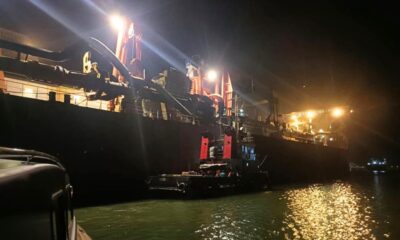
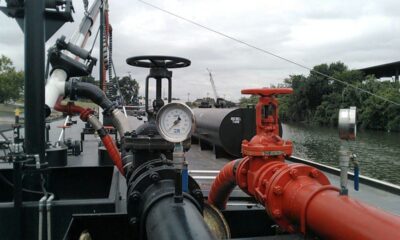
Seagate Corporation, a subsidiary of Kawasaki Kisen Kaisha (K Line), said it has launched a tugboat fitted with an onboard biofuel blending system at the Kanagawa Dockyard in Japan.

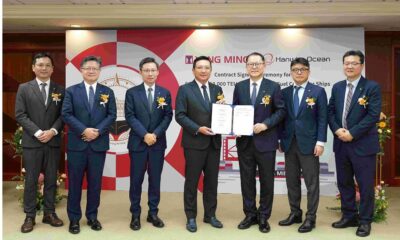
Nippon biofuel has been selected for a Japanese government-backed project to build and demonstrate a production and supply model for jatropha-based marine biofuel from Africa to Asia. Under the project, Nippon Biofuels targets to 400,000 mt/year of biofuel by 2032 from jatropha cultivated in Mozambique and Ghana.

By Nachiket Tekawade


Photo credit and source: ENGINE
Published: 28 April, 2026

Continue Reading

Biofuel

Burando Energies holds 30% of Rotterdam’s biofuel blend market in H1 2026

Company supplied approximately 30% of all biofuel blended marine fuel and B100 volumes bunkered in the Port of Rotterdam in the first half of 2026, based on data from the Rotterdam Port Authority.

Admin

Published

on

By

Burando Energies holds 30% of Rotterdam's biofuel blend market in H1 2026

European marine fuel supplier Burando Energies on Wednesday (29 July) said it supplied approximately 30% of all biofuel blended marine fuel and B100 volumes bunkered in the Port of Rotterdam in the first half of 2026, based on data from the Rotterdam Port Authority. 

This excludes alternative fuels such as methanol, ethanol and LNG.

The company said Rotterdam remains one of the most cost-competitive locations in Europe to bunker biofuels.

The Netherlands is currently the only major bunkering hub in the ARA region where RED III has been transposed for marine, creating an ERE-based discount mechanism that makes blended fuels in Rotterdam meaningfully cheaper than equivalent products in other ports outside the Netherlands.

For shipowners focused on EU ETS and FuelEU Maritime compliance, the economics of bunkering biofuels in Rotterdam are the most cost-effective.

“We have positioned ourselves to capture this demand through deliberate infrastructure investment, including our dedicated, company-owned biofuel blending terminal at AFT Amsterdam,” it added. 

Backed by its wholly owned fleet of biofuel barges, the company said it ensures reliable and timely delivery, while its in-house sustainability team issues all compliance documentation accurately and promptly.

Burando Energies supply an array of biofuel blends across all Dutch and Belgian ports, including Zeebrugge.

Its portfolio includes HSFO, VLSFO and Marine Gasoil/Diesel-based blends alongside B100 FAME, B100 HVO and B100 FAME Residue products.

“We are extremely proud to see the trust of our new and repeat customers supporting the growth of our operation and enabling us to continuously improve both our physical products and associated compliance documents,” said Nick de Haan, Head of Decarbonisation Strategies at Burando Energies.

Biofuel uptake in Rotterdam is growing and Burando Energies expects that trajectory to continue as FuelEU Maritime obligations increase and the EU ETS cost of conventional fuel rises.

“Among other initiatives, we continue to invest in shore- and water-based logistics capacity for low-carbon methanol,” the firm added. 

“Our ambition is to continue to grow and further diversify our market position while continuing to deliver the reliability and documentation quality our clients depend on.” 


Photo credit: Burando Energies
Published: 30 July, 2026

Continue Reading

Bunker Fuel

Port of Rotterdam publishes bunker fuel sales data for Q2 2026

Ethanol as a bunker fuel was reported in Rotterdam for the first time with 1,025 mt delivered in Q2 2026, following an ethanol-methanol blend bunkering operation of container vessel Eco Levant in May.

Admin

Published

on

By

RESIZED port of rotterdam

The Port of Rotterdam Authority recently published bunker fuel sales data for the second quarter (Q2) of 2026.

Deliveries of ultra low sulphur fuel oil, very low sulphur fuel oil, high sulphur fuel oil, marine gas oil and marine diesel oil in Q2 2026 (against on year) recorded respectively 123,190 metric tonnes (mt) (+33%  from 162,142 mt), 354,448 mt (-9.1% from 439,804 mt), 704,637 mt (+10.9% from 619,010 mt), 266,570(+18% from 273,696 mt), 64,777 mt (-8.2% from 86,821 mt). 

Bio-blended variants of ultra low sulphur fuel oil, very low sulphur fuel oil, high sulphur fuel oil, marine gas oil and marine diesel oil in Q2 2026 (against on year) recorded respectively 22,032 mt (-28.3% from  24,573 mt), 144,665 mt (-57% from 68,271 mt), 30,191 mt (+15.3% from 38,490 mt), 34,574 mt (+627.7% from 31,663 mt) and 8,413 mt (-30.2% from 2,223 mt).

Port data showed 273,021 m3 of liquefied natural gas (LNG) being delivered as a marine fuel in Q2 2026, down by 17.4% from 207,658 m3 in Q2 2025. Bio-methanol and bio-blended LNG recorded 2,845 mt and 7,506 m3 respectively in Q2 2026.

Ethanol as a bunker fuel was reported in Rotterdam for the first time with 1,025 mt delivered in Q2 2026,  following an ethanol-methanol blend bunkering operation of container vessel Eco Levant in May.

Manifold Times previously reported Evos Rotterdam holding a ground-breaking ceremony for its methanol and ethanol expansion project at the Port of Rotterdam, formally starting the construction phase of a major investment in additional terminal capacity.

Once operational in early 2028, the expansion will give Evos Rotterdam greater capacity to handle methanol and ethanol for industrial customers, as well as for the developing market in cleaner, low-carbon marine fuels and bunkering.

Shipping giant A.P. Moller – Maersk (Maersk) recently announced a new milestone in its marine fuel trials, with its dual-fuel feeder vessel Laura Maersk successfully operating on 100% ethanol for a second time.

The latest trial marked a significant step forward from earlier tests, as the vessel was supplied through a larger-scale bunkering operation conducted by barge in Rotterdam.

Related: X-Press Feeders, METHANAVE complete first ethanol-methanol bunkering op in Rotterdam
Related: Maersk advances ethanol fuel trials with larger-scale Rotterdam bunkering


Photo credit: Port of Rotterdam
Published: 29 July, 2026

Continue Reading

Biofuel

Argus Media: Rotterdam 2Q biomarine sales overtake Singapore

It is the first quarter this has happened since the EU imposed anti-dumping duties (ADDs) on Chinese-origin biodiesel in the third quarter of 2024, according to Argus.

Admin

Published

on

By

resized argusmedia

Rotterdam marine biodiesel blend sales in the second quarter were above those in Singapore, according to official data from both ports, the first quarter this has happened since the EU imposed anti-dumping duties (ADDs) on Chinese-origin biodiesel in the third quarter of 2024.

Marine biodiesel blend sales in the Port of Rotterdam were up sharply on the year and more than double the previous quarter (see table).

Market participants reported firmer demand following the start of the US-Iran war. The war changed pricing dynamics between marine biodiesel blends and conventional fuels, leading to discounts for the former. These initially failed to support significant demand growth, evidenced by declining sales in the first quarter. Then, volatility weighed on overall trading activity and buyers were hesitant to make significant changes to their procurement strategy based on what was perceived as an acute price spread at the time.

But demand rose as the war extended, which led to higher blend sales in the second quarter.

An initial agreement to end the war was signed on 18 June by the US and Iran, which led to easing conventional fuel prices and a return to traditional dynamics, with fossil bunker fuels back at a discount to marine biodiesel blends.

But this agreement collapsed and hostilities resumed, leading to sharp increases in oil futures prices and a return to discounts for some marine biodiesel blends.

B100 Advanced fatty acid methyl ester (Fame) dob Netherlands has averaged a discount of about $86/t to marine gasoil (MGO) dob ARA since hostilities restarted, when accounting for EU emissions trading system (ETS) costs for an intra-EU voyage.

In that time, Singapore marine biodiesel prices — which had been mostly cheaper than EU equivalents — posted sharp gains and sales fell as a result.

EU ADDs on Chinese-origin biodiesel supported flows into Singapore, which ended up in the bunker pool, resulting in cheaper prices and higher sales than Rotterdam for more than 18 months. B24 dob Singapore prices averaged $753/t when accounting for EU ETS costs from August 2024 to February 2026, compared with $803/t for the cheapest European option, B30 Advanced Fame and VLSFO dob Netherlands. The latter averaged $1,080/t in March-June this year, compared with $1,110/t for B24 Singapore.

This change is reflected in sales data. Marine biodiesel blend sales in Singapore fell sharply on the year and on the quarter in April-June (see table).

Another reason for the sharp increase in sales could be attributed to changes stemming from the EU’s renewable energy directive (RED III). The Netherlands unilaterally implemented RED III mandates for international maritime starting this year.

Participants have pointed to diminishing demand in the Mediterranean region for marine biodiesel blends, particularly from non-passenger vessel segments, some of which may have been absorbed into Rotterdam because of more competitive pricing.

Bio-LNG volumes continued to rise, as it has become a popular option for generating FuelEU Maritime compliance due to a very competitive abatement cost.

Biomethanol sales more than doubled on the quarter, but down on the year. Volumes for ethanol as a bunker fuel were reported in Rotterdam port official data for the first time, following an initial ethanol-methanol blend bunkering operation in May. Ethanol is seen as an option to decarbonise maritime transport and meet regulations, and companies have been trialling its use. Danish shipowner Maersk completed its first voyage using 100pc ethanol in the first quarter on a dual-fuel methanol engine and is investing in further tests.

By Hussein Al-Khalisy

Note: Tables mentioned in the article can be found here


Photo credit and source: Argus Media
Published: 29 July, 2026

Continue Reading

Trending