Connect with us

Business

ENGINE: Americas Bunker Fuel Availability Outlook

Bunker supply remains tight in Panama; VLSFO supply tight in Montevideo; bad weather hinders bunker deliveries in GOLA.

Admin

Published

on

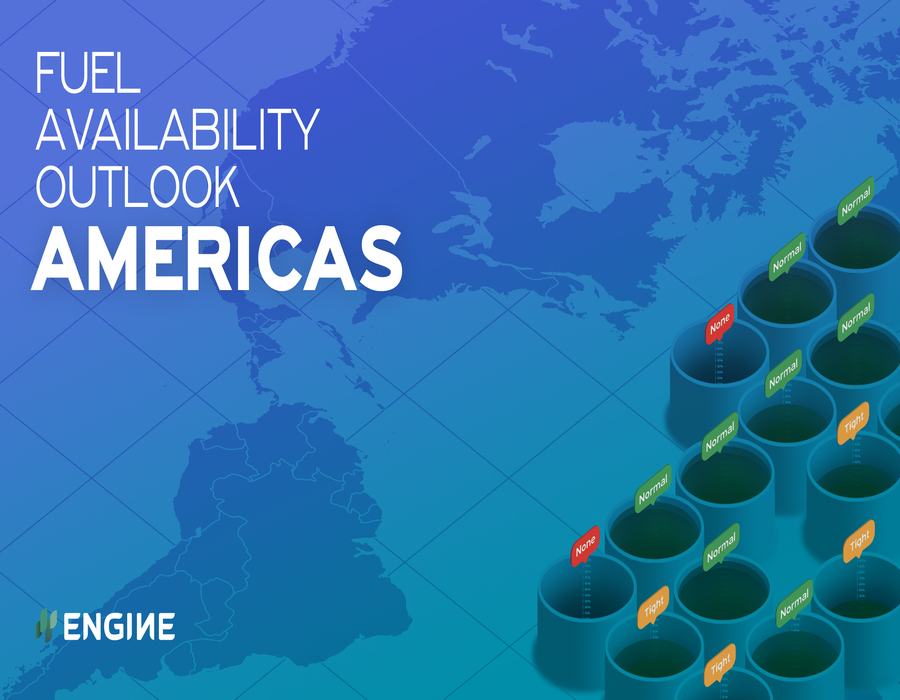
Resized Americas Bunker Fuel Availability Outlook image for Manifold Times

The following article regarding bunker fuel availability in the Americas region has been provided by online marine fuel procurement platform ENGINE for post on Singapore bunkering publication Manifold Times:

17 November 2022

  • Bunker supply remains tight in Panama
  • VLSFO supply tight in Montevideo
  • Bad weather hinders bunker deliveries in GOLA


North America

VLSFO and LSMGO availability is normal in the Houston area and off the US Gulf Coast, but can be tight for very prompt dates (0-3 days) in Houston. The earliest delivery dates with a supplier are about five days out.

Bunker fuel availability is normal in Bolivar Roads. Recommended lead times for VLSFO and LSMGO are about 4-5 days.

Bad weather has disrupted bunker deliveries in the Galveston Offshore Lightering Area (GOLA) this week. Some suppliers are trying to deliver stems as and when the weather allows, but have mostly halted deliveries otherwise, sources say. The weather is forecast to remain rough through the weekend in GOLA.

VLSFO and LSMGO availability is tight at the Davant anchorage in Louisiana. Some suppliers are hesitant to confirm delivery dates due to tight availability. One supplier can supply both grades from 27 November onwards.

Prompt VLSFO availability is tight in San Francisco. One supplier is running low on VLSFO stock but can manage to accommodate smaller stem sizes. LSMGO availability is slightly better.

All grades remain tight for prompt dates in the twin ports of Long Beach and Los Angeles on the US West Coast. A longer lead time of at least 10 days is generally recommended to ensure full coverage from all suppliers. Securing HSFO can be tricky for both prompt and dates further out as the grade is offered by fewer suppliers.

Bunker availability remains steady for all fuel grades in Mexico’s Manzanillo. Recommended lead times for HSFO, VLSFO and LSMGO are about five days out, while prompt stems can be accommodated, sources say.


Caribbean and Latin America

All grades are tight for prompt dates in Panama’s Balboa and Cristobal. Several suppliers in both ports are hesitant to confirm delivery dates for VLSFO and LSMGO due to tight product availability and busy schedules.

HSFO deliveries can be even trickier to secure in Balboa and Cristobal. The earliest delivery date with a supplier in Balboa stretches out to the beginning of next month, sources say. Others are fully booked for the remaining days of November.

Bunker demand has been roughly steady in Colombian ports so far in November, a trader says. One supplier can supply VLSFO and LSMGO for prompt dates in Cartagena and Santa Marta. Another requires at least three days of lead time.

Prompt VLSFO supply is tight in Uruguay’s Montevideo and some suppliers are hesitant to confirm delivery dates due to tight barge schedules and availability. Sources say that VLSFO availability could tighten further amid low supply from local refiners. LSMGO is more readily available.

VLSFO and LSMGO are in normal availability at Argentina’s Zona Comun anchorage. Recommended lead times are about 5-6 days.

By Nithin Chandran


Photo credit and source: ENGINE
Published: 18 November, 2022

Continue Reading

Business

MPA: Singapore named Best Global Seaport at 2026 AFLAS Award

‘This recognition reflects the collective efforts of the entire maritime community in strengthening Singapore’s position as a leading global hub port,’ says Mr Ang Wee Keong, Chief Executive of MPA.

Admin

Published

on

By

Swapnil Bapat on Unsplash

The Maritime and Port Authority of Singapore (MPA) on Thursday (25 June) said the Port of Singapore has been awarded the “Best Global Seaport” for the 5th time at the 2026 Asian Freight, Logistics and Supply Chain (AFLAS) Awards held in Shanghai, China on 24 June 2026.

The AFLAS Awards recognise leading logistics and supply chain service providers for excellence in service quality, reliability, and innovation. 

MPA said award winners are determined through nomination and votes by international freight and logistics companies and clients who are readers of the publication.

Mr Ang Wee Keong, Chief Executive of MPA, said: “We thank the global shipping and logistics community for their continued confidence in Singapore. 

“This recognition reflects the collective efforts of the entire maritime community in strengthening Singapore’s position as a leading global hub port. As supply chains evolve and new challenges emerge, we will continue to invest in innovation, infrastructure, and talent to keep Singapore resilient, connected, and future-ready.”


Photo credit: Swapnil Bapat on Unsplash
Published: 25 June, 2026

Continue Reading

Bunker Fuel

FOBAS: Summary of marine fuel oil sulphur requirements

FOBAS publishes a bulletin to provide ship operators with an updated reminder of marine fuel oil sulphur regulations under various regulatory frameworks.

Admin

Published

on

By

Louis Reed from Unsplash

Lloyd’s Register Fuel Oil Bunkering Analysis and Advisory Service (FOBAS) on Wednesday (24 June) published a bulletin to provide ship operators with an updated reminder of marine fuel oil sulphur regulations under various regulatory frameworks: 

MARPOL Annex VI

Ships operating inside or outside Emission Control Areas (ECA) for Sulphur Oxides (SOx) i.e., ECA-SOx, are

required to comply with specific sulphur limits in respect of the fuel oils as used unless the particular

combustion systems (engine, boiler, other) in use have in operation an approved exhaust gas cleaning system as per MARPOL Annex VI regulation 4. These fuel oil limits are as follows;

  • Inside ECA-SOx: Max sulphur content of 0.10% m/m
  • Outside ECA-SOx: Max sulphur content of 0.50% m/m

MARPOL Annex VI regulation 14.3 currently gives the following as ECA-SOx together with the respective geographic limits:

  • Baltic Sea;
  • North Sea;
  • North American (which includes an area around the Hawaiian Islands);
  • US Caribbean Sea;
  • Mediterranean Sea;
  • Canadian Arctic; and
  • Norwegian Sea

Additionally, MEPC 84 adopted the North-East Atlantic as an ECA-SOx which will come into effect from 1 September 2028.

European initiatives

For EU, UK, and Turkish ports situated outside ECA-SOx, ships must switchover to a fuel with a maximum sulphur content of 0.10% m/m when at berth. Similarly, Norway and Iceland have also 0.10% m/m requirements for ships at berth and operating in Fjords (territorial / internal waters).

Other initiatives

Due to increasing concerns around the environmental impact from shipping on local air quality, there are a number of national and local regulations which require the use of low sulphur fuel oils, typically maximum sulphur content 0.10% m/m, or other measures by all or certain ships within defined areas. Examples of these are China, California (CARB), South Korea and Sydney. Furthermore, there can be other related restrictions, for example, on the discharges to sea from exhaust gas cleaning systems.

However, whereas with the MARPOL Annex VI ECA-SOx, there is a single point of reference as to which areas are covered, there is no such central registry for these regional, national or local initiatives taken outside MARPOL Annex VI. Consequently, in all the cases, it is important for ships to check with the relevant authorities beforehand in order to confirm the current status as regards SOx and related emission requirements in order to avoid any penalties – which can be substantial.


Photo credit: Louis Reed from Unsplash
Published: 25 June, 2026

Continue Reading

Biofuel

ExxonMobil completes first sea trial of bio bunker fuel blend made from FAME

Firm supplied a B30 VLSFO, made using FAME Distillation Residue, to Wallenius Wilhelmsen’s vehicle carrier “Titus” in Zeebrugge.

Admin

Published

on

By

ExxonMobil completes first sea trial of bio bunker fuel blend made from FAME

US oil major ExxonMobil on Tuesday (23 June) said it has successfully supplied a B30 0.50% sulphur marine residual fuel blend (B30 VLSFO), made using fatty acid methyl ester (FAME) Distillation Residue, to Wallenius Wilhelmsen. 

The bio marine fuel blend was bunkered by the vehicle carrier Titus in Zeebrugge ahead of the sea trial, marking a significant milestone in ExxonMobil’s journey towards supplying the marine industry with lower GHG emission fuels. 

The B30 VLSFO fuel meets the RMG380 residual fuel oil classification and complies with ISO 8217:2017 with the exception of the bio blend component. It shares similar drop-in properties to a B30 VLSFO made with FAME produced from used cooking oil (UCOME). 

The fuel has the potential to reduce lifecycle GHG emissions compared to conventional fuels. 

Importantly, marine fuels made with FAME Distillation Residue have a major advantage over FAME itself, as there is currently no competition for this material from other transport sectors. 

Additionally, when compared to FAME in VLSFO blends, several key properties of the FAME Distillation Residue are closer to the VLSFO component, such as density and viscosity. This is beneficial as users will see a lower reduction in viscosity than that of a FAME in VLSFO blend, which makes it comparatively easier to handle onboard ships. Further, extensive lab testing has shown good compatibility between petroleum-based VLSFOs and this B30 VLSFO made with FAME Distillation Residue. 

The sea trial was successfully completed with no operational concerns. The B30 VLSFO batch was bunkered without issue. The onboard storage and handling of B30 VLSFO did not result in any filtration or purification issues. Engine performance remained stable, as confirmed by comparing key parameters recorded in the performance and condition monitoring reports before, during and after the trial. 

“This successful sea trial highlights a practical, cost-effective pathway for customers to reduce their lifecycle greenhouse gas emissions while maintaining operational performance. By leveraging FAME Distillation Residue, ExxonMobil can offer a drop-in solution that supports compliance with evolving EU regulations and helps operators advance their lower GHG emission goals confidence,” said Gideon Simmelink, Account Manager Marine Fuels, ExxonMobil. 

“Wallenius Wilhelmsen has a long-standing collaboration with ExxonMobil. This trial supports our efforts to assess new fuel options and advance our decarbonization ambitions,” said Kari Haugen, Senior Manager Energy Sourcing, Wallenius Wilhelmsen. 

Subject to regional availability, ExxonMobil offers a range of bio marine fuel blends (Bio VLSFO, Bio ULSFO, Bio MGO and Bio HSFO), which we have supplied into the ARA (Amsterdam-Rotterdam-Antwerp) region (VLSFO and USLFO), the UK (MGO and HSFO) and Singapore (VLSFO). 

These solutions are designed to help meet the diverse needs of the shipping industry while helping support GHG emission reductions. Always consult with engine manufacturers as OEMs may limit bio blend percentages or specific bio components for certain engine designs.


Photo credit: ExxonMobil
Published: 25 June, 2026

Continue Reading

Trending