Connect with us

Bunker Fuel

ENGINE: Americas Bunker Fuel Availability Outlook (23 April 2026)

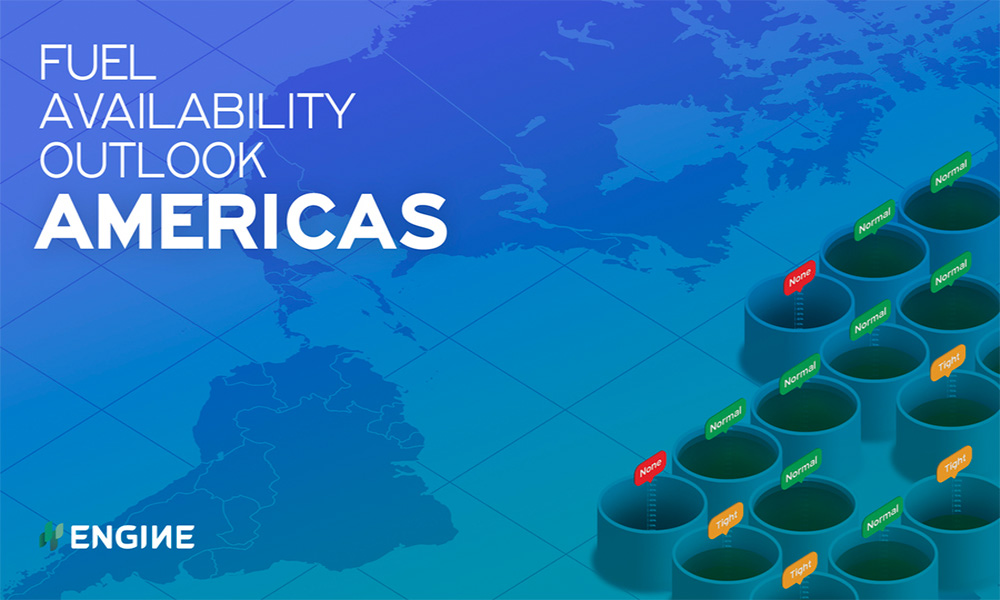
New York weather stable for bunkering; strong bunker demand in Panama; VLSFO and LSMGO tight in Rio Grande.

Admin

Published

on

RESIZED ENGINE Americas

The following article regarding bunker fuel availability in the Americas region has been provided by online marine fuel procurement platform ENGINE for post on Singapore bunkering publication Manifold Times:

  • New York weather stable for bunkering
  • Strong bunker demand in Panama
  • VLSFO and LSMGO tight in Rio Grande

North America

In the US Gulf Coast, the port of Houston is seeing steady bunker demand this week. Prompt supply for HSFO and VLSFO is tight, with recommended lead times of 5–7 days for both grades this week.

LSMGO has better availability and can be delivered in around 4 days, a trader tells ENGINE.

The region is nearing the end of fog season, which has continued to cause some operational disruptions, although conditions have improved since March.

Overall, sea fog and visibility across key Gulf Coast ports this week are expected to remain largely favourable. However, intermittent periods of reduced visibility may still occur at ports such as New Orleans, Port Fourchon and Mobile, potentially causing brief delays, particularly during early morning and late evening hours.

In the Galveston Offshore Lightering Area (GOLA), bunkering operations have resumed after being suspended on Monday. Deliveries are currently being carried out on a first-come, first-served basis and remain subject to weather conditions.

Typical lead times at the anchorage for VLSFO and LSMGO have been around 7–9 days over the past week, a trader said.

At the Port of New Orleans, high wind gusts could temporarily disrupt bunkering operations between 23 and 25 April. Availability is okay at the bunker spot, with suppliers able to deliver VLSFO and LSMGO within 6-7 days.

Further along the US Gulf Coast, the Sabine-Neches Waterway, which connects the Gulf of Mexico to inland ports in southeast Texas, is currently open, although some operational constraints are in place.

An air draft restriction of 135 feet (41.1 metres) has been imposed due to high water levels, a ship agency informed.

Additionally, a scheduled river fest-related channel closure on the Neches River between 1–3 May may cause intermittent disruptions to vessel movements, the agency added.

In New York, lead times for VLSFO and HSFO stand at 5–7 days, while LSMGO is more readily available with shorter lead times of 2–3 days.

However, LSMGO prices remain significantly higher compared to Houston, with a price difference of over $150/mt, according to ENGINE data.

Weather conditions are expected to remain conducive for bunkering through the week.

On the US West Coast, VLSFO and LSMGO supply is okay at the ports of Los Angeles and Long Beach, with most suppliers able to deliver all conventional fuel grades within lead times of around 7–8 days.

In Canada’s Vancouver, HSFO can be secured within 5–7 days, while VLSFO and LSMGO deliveries require slightly longer lead times of 6–8 days, a trader said.

Latin America and the Caribbean

In Panama, bunker demand is on the rise across all three conventional fuel grades.

Availability at Balboa and Cristobal remains steady, with most suppliers able to deliver HSFO, VLSFO and LSMGO within lead times of 3–6 days.

Bunkering in Balboa is proceeding on a first-come, first-served basis, with priority given to vessels with confirmed Panama Canal transit schedules.

Earlier this week, Hapag-Lloyd introduced additional surcharges across the Caribbean and South America to offset rising third-party feeder costs.

In Bahamas’ Freeport, high winds could impact bunkering operations, with potential delays to anchorage deliveries.

Cruise vessels are being prioritized, which may further constrain bunker barge availability during busy periods. Lead times for VLSFO and LSMGO are around 5–7 days.

Offshore Trinidad, bunkering operations continue without any severe disruptions, with deliveries carried out while vessels are underway, meaning the vessel is moving rather than anchored or alongside, and no congestion is reported, a source said.

In Brazil’s Santos, VLSFO and LSMGO are available with lead times of around 4–5 days, although congestion persists. HSFO is no longer available across all Brazilian ports.

Availability in Rio de Janeiro and Paranaguá is okay, with lead times of around 4–5 days for VLSFO and LSMGO.

In contrast, Rio Grande is experiencing tighter supply conditions, with lead times extending beyond 7 days and deliveries subject to enquiry.

Further north, Belém and Vila do Conde continue to see stable availability, with typical lead times of 4–5 days.

In Argentina, operations at Necochea remain disrupted as independent truckers continue to block access to the port, preventing cargo deliveries by road after mediation efforts broke down.

Meanwhile, truck access to Bahia Blanca has resumed, and some vessels have reportedly shifted there, potentially supporting bunker demand, a source said.

In Zona Común, VLSFO and LSMGO availability is normal, with lead times of around 5–6 days. High wind gusts are expected through 26 April and could disrupt bunkering, with operations likely to be suspended if wind speeds exceed 20 knots.

By Gautamee Hazarika


Photo credit and source: ENGINE
Published: 24 April, 2026

Continue Reading

Alternative Fuels

MOL inks bio-LNG bunker fuel supply deals with Titan and Axpo for car carriers in Europe

Titan, part of Amsterdam-based Molgas, will continue to supply bio-LNG fuel in Northwest Europe, while Axpo will take charge of supply in the Mediterranean region.

Admin

Published

on

By

MOL inks bio-LNG bunker fuel supply deals with Titan and Axpo for car carriers in Europe

Mitsui OSK Lines (MOL) on Thursday (18 July) said it has signed new supply agreements in Northern Europe and the Mediterranean region to expand the use of bio-LNG marine fuel on MOL-operated LNG-fuelled car carriers.

Titan, part of Amsterdam-based Molgas, will continue to supply bio-LNG fuel in Northwest Europe, while Axpo will take charge of supply in the Mediterranean region.

MOL said the agreement makes it possible for its company to supply bio-LNG fuel for automobile carriers in the Mediterranean region, specifically Port of Malaga and Barcelona in Spain, following the bio-LNG fuel supply agreement in Western Europe, which commenced in March last year.

The bio-LNG fuel to be supplied in this initiative has a lifecycle carbon intensity (carbon dioxide emissions per unit of energy consumption) of -15 g-CO2/MJ or less, from production through consumption. Furthermore, this bio-LNG fuel has obtained International Sustainability and Carbon Certification (ISCC-EU). 

“Through this supply agreement, MOL has established a framework that ensures a continuous and stable supply of bio-LNG fuel not only in Northern Europe but also in the Mediterranean,” the company said.

As part of the group’s efforts to adopt alternative fuels and achieve net-zero greenhouse gas (GHG) emissions, it is utilising LNG-fuelled vessels as a bridge solution to facilitate the transition to carbon-neutral fuels such as bio-LNG and synthetic LNG (e-methane).

In 2025, MOL signed a bio LNG fuel supply agreement in Northwest Europe with Titan, part of the Molgas, and MOL has continued this bio LNG fuel supply agreement with the same company in 2026 as well.


Photo credit: Mitsui OSK Lines
Published: 19 June, 2026

Continue Reading

Biofuel

Kvasir Technologies lands EUR 10 million to scale bio bunker fuel production

The Danish biofuel startup raised the fund in a Series A investment round, which will provide capital to develop and design a new commercial production plant and scale climate-neutral drop-in marine fuel.

Admin

Published

on

By

Kvasir Technologies lands EUR 10 million to scale bio bunker fuel production

Danish biofuel startup Kvasir Technologies on Thursday (18 June) said it has raised EUR 10 million (USD 11.4 million) in a Series A investment round with participation from European Energy as a new investor, alongside existing investors EIFO, Maersk Growth and Footprint Fund. 

The Series A round provides capital to develop and design a new commercial production plant and scale climate-neutral drop-in fuel to be used in existing vessels.

At the same time, European Energy and Kvasir Technologies are entering into a strategic partnership by establishing the company KVEEN Biofuels, which is working towards the construction of a commercial-scale plant to produce biofuels using Kvasir Technologies’ patented technology.

“This investment round enables us to take the next crucial steps in developing and scaling our technology. At the same time, it underlines that there is still strong support for solutions that can deliver real climate impact in the maritime sector,” said Joachim Bachmann Nielsen, Ph.D. in Chemical Engineering and CEO of Kvasir Technologies.

Kvasir Technologies, a spin-out from research at the Technical University of Denmark (DTU), has developed a new technology to convert a wide range of non-edible lignin- based residues from agriculture and forestry into refined biofuels for shipping.

The climate-neutral biofuel can serve as an immediate replacement for fossil marine fuel without the need to modify ship engines or change existing infrastructure.

The new funding will be used, among other things, to scale the technology at Kvasir Technologies’ test facility in Fredericia, which can produce up to 2 metric tonnes (mt) of biofuel per day.

At the same time, development work will begin on the first commercial plant in the city of Aabenraa in the southern part of Jutland, which will demonstrate the technology on an industrial scale.


Photo credit: Kvasir Technologies
Published: 19 June, 2026

Continue Reading

ECA

DNV: North-east Atlantic joins expanding network of ECAs

DNV highlighted key information on the new North-East Atlantic ECA, which will enter into force on 1 September 2027, following recent amendments MARPOL Annex VI adopted at MEPC 84.

Admin

Published

on

By

RESIZED william william on Unsplash

Classification society DNV on Wednesday (17 June) highlighted key information on the new North-East Atlantic ECA, which will enter into force on 1 September 2027 following recent amendments MARPOL Annex VI adopted at MEPC 84, creating a continuous emissions control area across much of the North Atlantic: 

Need to Know

  • The new North-East Atlantic ECA will enter into force on 1 September 2027, creating a continuous emissions control area across much of the North Atlantic.
  • SOx limits (0.10% sulphur) will apply from 1 September 2028.
  • Ships meeting the MARPOL “three‑date” criteria (from 1 January 2027 onward) must comply with Tier III NOx limits for engines above 130 kW when operating in the ECA.

North-East Atlantic ECA

In general, the ECAs are designed to reduce air pollution from NOx, SOx and PM, and play a vital role in protecting sensitive marine environments as well as improving air quality for nearby communities.

The latest addition is the North-East Atlantic ECA, covering the Exclusive Economic Zones (EEZs) and territorial seas of Portugal, Spain, France, Ireland, Iceland, the Faroe Islands, Greenland and mainland UK that are not already included in existing ECAs. The EEZs surrounding Madeira, the Azores and the Canary Islands will be excluded. The precise ECA boundaries are defined by exact coordinates in Appendix VII of the revised MARPOL Annex VI.

Once in force, this designation will create a continuous ECA across the North-East Atlantic, linking the Canadian Arctic, Norwegian Sea, North Sea and Mediterranean Sea ECAs into a single, connected regulatory area.

eca map 2026 1

Application

The North-East Atlantic ECA, as part of the next amendments to Annex VI of MARPOL, will enter into force on 1 September 2027. The effective dates will be as follows:

SOx requirements

The sulphur limits for new North-East Atlantic ECA take effect 12 months after entry into force, in other words on 1 September 2028. From that date onwards, ships must use fuel with a sulphur content of no more than 0.10%.

Alternatively, compliance may be achieved using exhaust gas cleaning systems (EGCS) when operating on higher-sulphur fuels. However, it should be noted that restrictions on the use of open-loop EGCSs are becoming increasingly stringent, particularly in the coastal waters of northern Europe under OSPAR (please refer to our Technical and Regulatory News No. 26/2025), thereby limiting this as a practical compliance option in the region.

Note: The full article by DNV can be read here


Photo credit: william william on Unsplash and DNV
Published: 19 June, 2026

Continue Reading

Trending