Connect with us

Bunker Fuel

Baltic Exchange: Bunker Report (23 April 2026)

Bunker report panellists include Island Oil Limited, Cockett Marine Oil Pte, Monjasa A/S and KPI OceanConnect, NSI Marine and Transparensea Fuels.


Admin

Published

on

Baltic Exchange logo

The following bunker report has been provided by freight market information provider Baltic Exchange for post on Singapore bunkering publication Manifold Times:
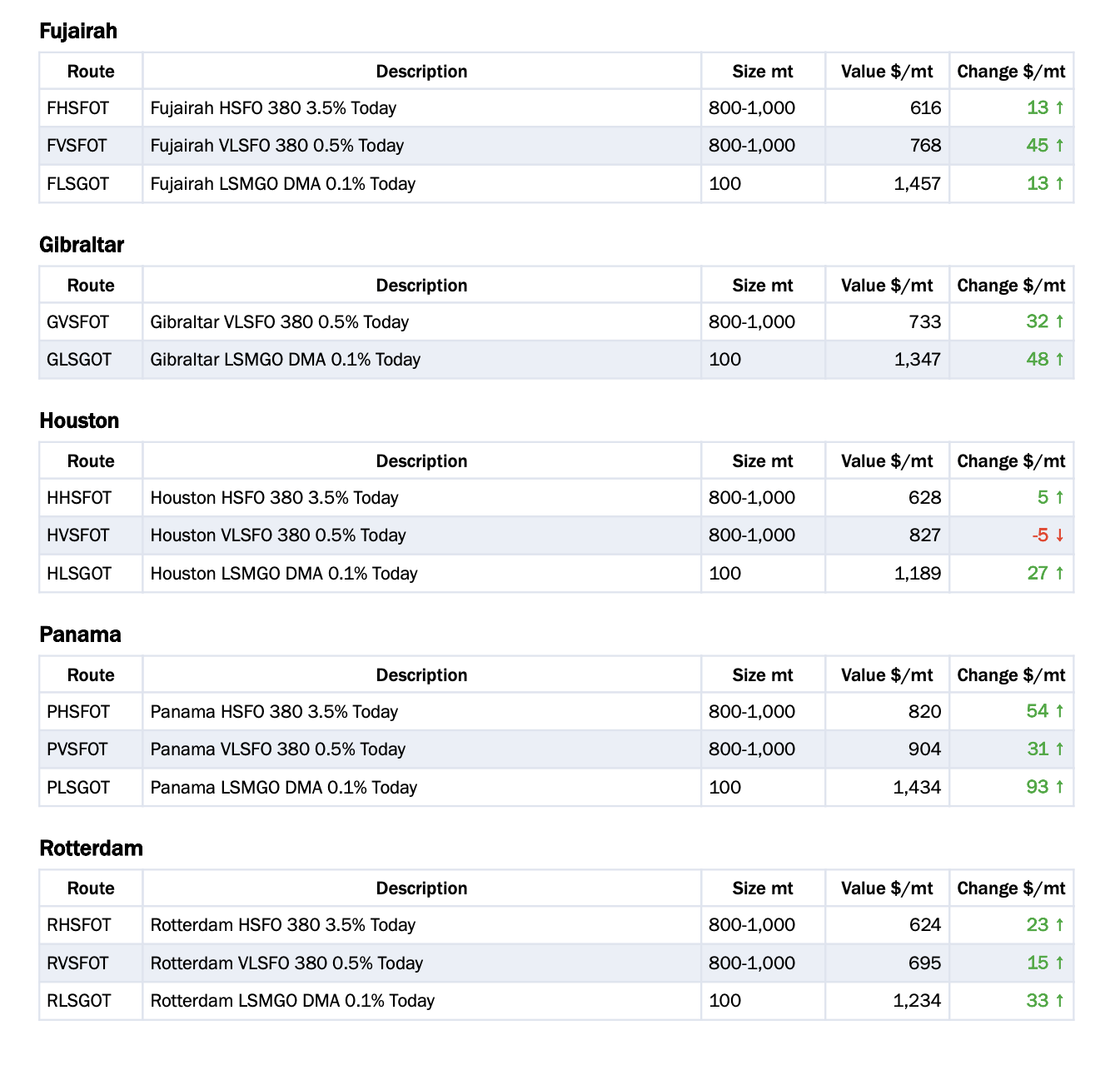
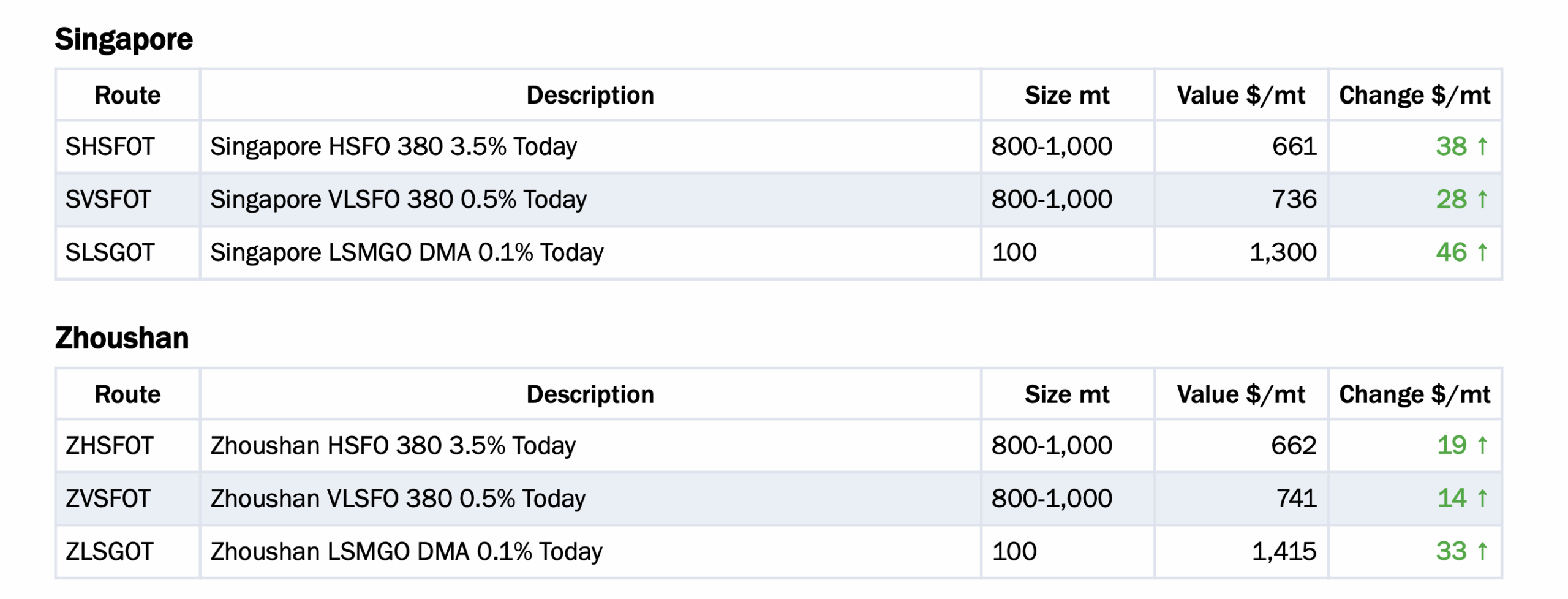
Baltic Exchange: Bunker Report (23 April 2026)

Baltic Exchange: Bunker Report (23 April 2026)

All values are in US$/metric ton, all-in (invoice price), delivered on board
Delivery in 7-10 days
ISO 8217:2010
IFO 380 3.5% Sulphur
IFO 380 0.5% Sulphur
DMA 0.1% Sulphur

Fujairah – Offshore Anchorage Area
Gibraltar – Anchorage area
Houston – Houston Harbor
Panama – (Pacific) dangerous cargo area, Balboa
Rotterdam – Waalhaven Maasvlakte range
Singapore – Anchorage, under SBA Scheme
Zhoushan – Southern anchorage area

Submitted weekly at Close of Business UK time Daily

Panellists:
Cockett Marine Oil Pte, Island Oil Limited, KPI OceanConnect, Monjasa A/S, NSI Marine and Transparensea Fuels


Photo credit and source: Baltic Exchange
Published: 24 April, 2026

Continue Reading

Alternative Fuels

Höegh Autoliners orders six more ammonia, methanol-ready Aurora class PCTCs

Höegh Autoliner inked a contract with China Merchants Group for six additional Aurora class PCTCs, which will be built by China Merchants Heavy Industry (Jiangsu) and delivered between 2029 and 2031.
Admin

Published

on

By

Höegh Autoliners orders six more ammonia, methanol-ready Aurora class PCTCs

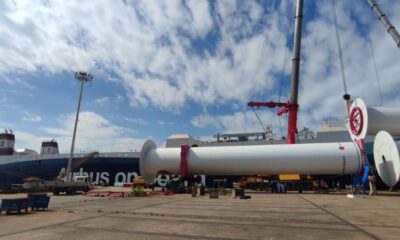
Höegh Autoliners on Tuesday (22 September) said it has formally signed a contract with China Merchants Group (CMG) for six additional Aurora class pure car and truck carriers (PCTCs). 

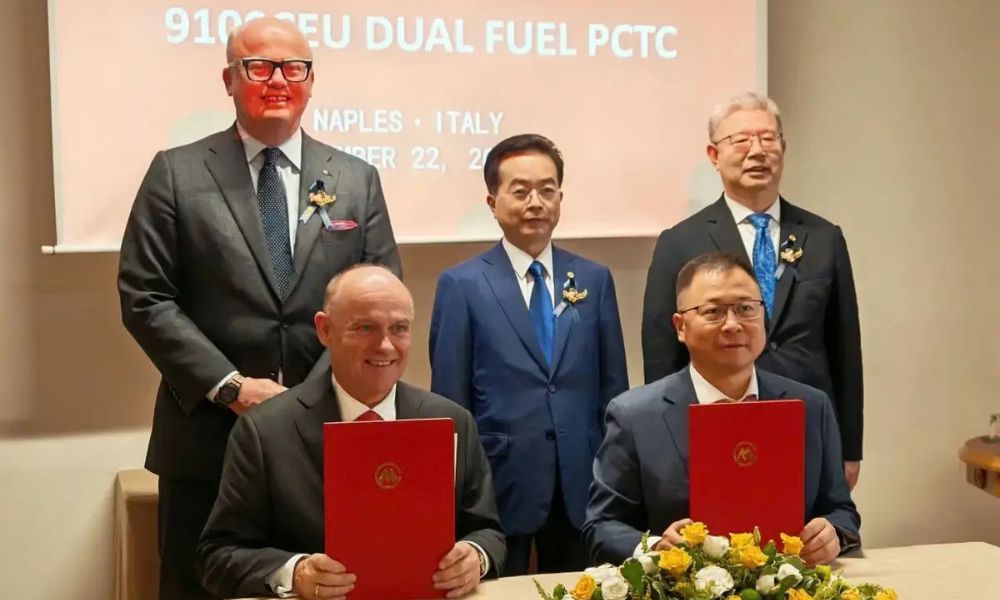
The contract was signed during a high-level meeting in Naples attended by senior representatives from both companies, including Miao Jianmin, Chairman of China Merchants Group. Chair of Höegh Autoliners, Leif O. Høegh, and Andreas Enger, CEO of Höegh Autoliners.

The six additional dual-fuel LNG and zero-carbon-ready vessels will be built by China Merchants Heavy Industry (Jiangsu) Co., Ltd. (CMHI) and delivered between 2029 and 2031. 

With 18 Aurora Class vessels in the programme, Höegh Autoliners is building the fleet needed for a zero- emission future and setting the pace for the transformation of deep-sea shipping.

The Aurora Class vessels can carry up to 9,100 cars and reduce carbon emissions per transported car by up to 58 per cent compared with conventional PCTCs. They have DNV’s ammonia-ready and methanol-ready notations and are designed to be converted to run on future zero-carbon fuels.

Leif O. Høegh, Chair of the Board of Directors of Höegh Autoliners, said: “For nearly 100 years, we have developed, adapted and led the way through major changes in shipping. It is in our DNA to keep moving and challenge what is possible. This signing continues that story. We are investing in the vessels that will define our fleet for decades and help move our industry towards zero emissions.”

Andreas Enger, CEO of Höegh Autoliners, said: “This is not just another vessel-building agreement. It is a statement about the future of deep-sea shipping and the role we intend to play in shaping it. The Aurora Class is at the heart of our fleet renewal and our path to a sustainable future. By expanding the programme to 18 vessels, we are securing efficient, flexible and future-ready capacity while setting the pace towards zero-emission operations.”

Miao Jianmin, Chairman of China Merchants Group, said: “Höegh Autoliners is a pioneer in international shipping and will celebrate its 100th anniversary next year. We would like to offer our congratulations in advance! Over the past century, Höegh Autoliners has achieved remarkable development and has grown into a leading company in the global RoRo shipping sector. We truly admire what you have accomplished.”


Photo credit: Höegh Autoliners
Published: 24 September, 2026

Continue Reading

Newbuilding

CLdN orders two LNG dual-fuel RoRo vessels from HD Hyundai Heavy Industries

New vessels will be built with space reserved for the future addition of larger electric shaft generators and batteries as the technology matures.
Admin

Published

on

By

CLdN orders two LNG dual-fuel RoRo vessels from HD Hyundai Heavy Industries

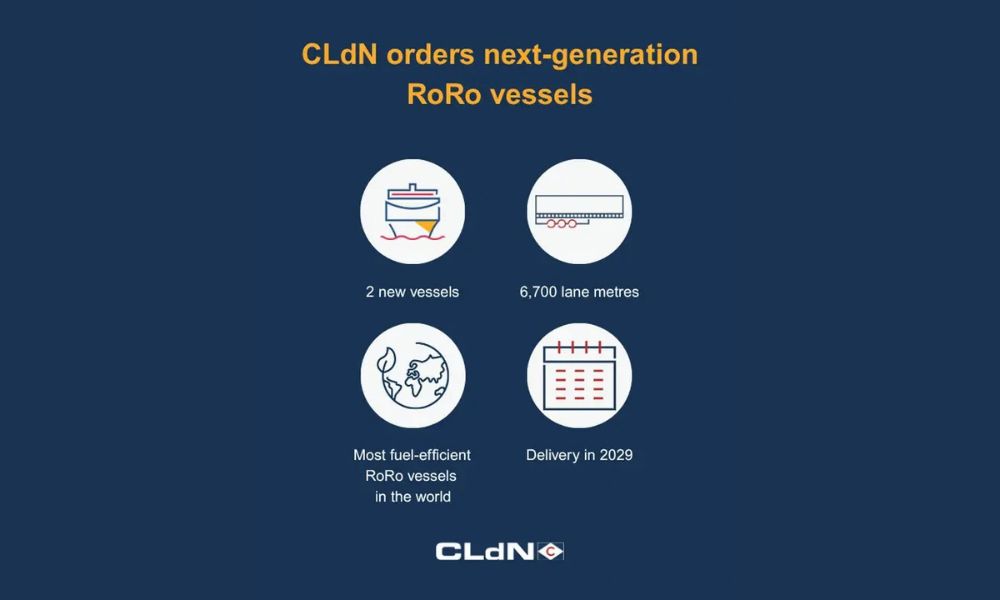
Europe’s multimodal logistics providers CLdN on Tuesday (22 September) announced it has placed an order for two new 6,700 lane-metre RoRo vessels with HD Hyundai Heavy Industries (HD Hyundai HI).

Construction of the new vessels is set to begin towards the beginning of 2028, with delivery scheduled for mid-2029. 

“The ships will be the 15th and 16th vessels ordered by CLdN from the South Korean shipbuilder over the past 10 years,” the company said on its website. 

The new vessels will be dual-fuel capable, able to run on standard marine diesel or LNG, and will be built with space reserved for the future addition of larger electric shaft generators and batteries as the technology matures.

While fuel consumption per vessel is expected to be similar to that of CLdN’s existing 5,000 lane-metre class ships, the increased cargo capacity of the new vessels is expected to deliver 30 to 40% better fuel efficiency per tonne-kilometre of cargo carried making the vessels the most fuel-efficient RoRo ships in the world.

The new vessels are designed with one additional deck and increased ground space compared to CLdN’s existing 5,000 lane-metre class ships, with a configuration specifically adapted for trailer cargo. 

“The addition of these vessels to CLdN’s fleet will ensure customers benefit from an even broader range of shipping options via CLdN’s extensive fleet of RoRo and container vessels,” the company said. 


Photo credit: CLdN
Published: 24 September, 2026

Continue Reading

Bunker Fuel

ENGINE: Europe & Africa Bunker Fuel Availability Outlook (23 Sep 2026)

Prompt availability tight in ARA ports; busy summer cruise season increases lead times in Piraeus; increase in demand tightens availability in South African ports.
Admin

Published

on

By

RESIZED ENGINE Europe and Africa

The following article regarding Europe and Africa bunker fuel availability has been provided by online marine fuel procurement platform ENGINE for post on Singapore bunkering publication Manifold Times:

  • Prompt availability tight in ARA ports
  • Busy summer cruise season increases lead times in Piraeus
  • Increase in demand tightens availability in South African ports

Northwest Europe

Fuel availability in the ARA is tight for prompt delivery dates, and buyers are recommended lead times of 5-7 days to secure supplies at competitive prices, a trader told ENGINE.

The ARA’s independently held fuel oil stocks have averaged 17% higher in September so far compared with August’s monthly average, according to Insights Global data.

The ARA hub has imported around 297,000 b/d of fuel oil in September so far, down from around 342,000 b/d in August, according to Vortexa cargo flows data.

Most shipments have arrived from Mexico (24%), Benin (19%) and France (15%).

The region’s independent gasoil inventories – which include diesel and heating oil – have risen by 2% in September so far, compared to August, according to the Insights Global data.

The region has imported around 141,000 b/d of gasoil in September so far, down from an average of around 155,000 b/d imported in August, according to Vortexa data. A majority of shipments have arrived from the US (28%), Germany (13%) and the UK (11%).

Fuel availability in Hamburg is steady, with five days’ notice recommended to secure any grade in the German port, a trader told ENGINE.

Bunker availability remains tight off Skaw and in Gothenburg, and buyers are asked to give around 10-14 days for delivery of any grade in the Scandinavian hubs, a trader said.

Mediterranean

Prompt fuel availability at ports in the Gibraltar Strait is tight, with lead times of 10-12 days recommended for reliable coverage, a trader told ENGINE.

Gibraltar is seeing slight congestion, with around eight vessels currently awaiting bunkers, port agent MH Bland said. Bunkering delays of around 4-8 hours can be expected in the port. Some suppliers in Algeciras can be delayed by around 18-24 hours, the port agent added.

In the Spanish port of Ceuta, barge and ex-pipe deliveries are running on schedule now, after slight delays seen last week, the port agent said.

Fuel availability is tight in Las Palmas, and buyers are recommended lead times of around 10-12 days to secure deliveries, a trader noted.

LSMGO is seeing high demand off Malta. Fuel availability is comparatively stable compared to last week, and lead times have reduced to 3-4 days for LSMGO, VLSFO and ULSFO, compared to 5-7 days last week, a trader said.

Fuel availability in Greece’s Piraeus is tight for HSFO, VLSFO and ULSFO, and buyers are recommended lead times of around 5-7 days for those grades, a trader said. LSMGO deliveries are more prompt, with a notice of three days sufficient, according to the trader.

The port is seeing a busy summer cruise season, and barge availability is an issue in Piraeus, especially for HSFO, the trader added.

Istanbul fuel availability is stable, with every grade obtainable on 1-4 days of notice, a trader said.

Africa

In Senegal’s Dakar, fuel availability is stable and stems can be delivered promptly by at least one supplier.

In the Togolese port of Lome, prompt VLSFO and LSMGO supply is a bit tight due to high demand, and buyers are recommended to book with lead times of at least a week, a trader told ENGINE.

In Nigeria’s Lagos anchorage, VLSFO fuel supplies are tight with buyers recommended at least nine days’ notice for deliveries, a local supplier told ENGINE.

Off Namibia’s Walvis Bay, prompt fuel availability is tight, and buyers have been advised to book with lead times between 5-7 days for VLSFO and LSMGO deliveries, a trader told ENGINE.

Increasing demand has tightened fuel availability in South African hubs like Durban, Algoa Bay, Richards Bay and Cape Town, a trader said. Some suppliers in these ports need at least 10-15 days of lead time to arrange deliveries of HSFO, VLSFO and LSMGO, the trader added.

Fuel availability remains very tight in Port Louis, with buyers recommended to book around 10-14 days ahead to get deliveries of VLSFO and LSMGO, a trader said. HSFO availability is very limited in the port.

VLSFO availability remains tight for prompt supplies at the Mozambican ports of Nacala and Maputo, where notice of seven days is recommended, a trader told ENGINE.

By Nachiket Tekawade


Photo credit and source: ENGINE
Published: 24 September, 2026

Continue Reading
Advertisement

OUR INDUSTRY PARTNERS


Trending