Connect with us

LNG Bunkering

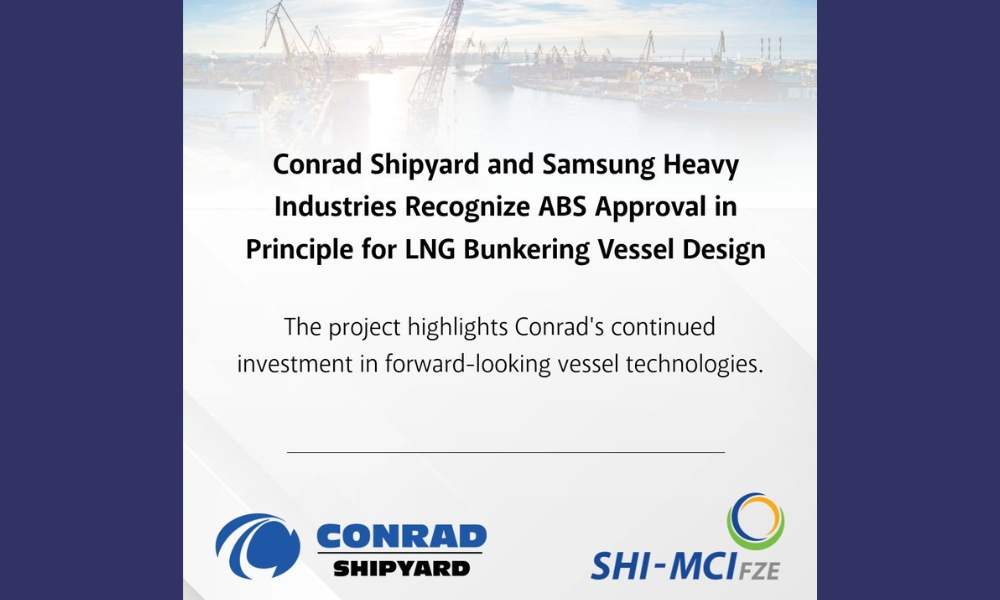
Conrad Shipyard and SHI secure ABS AiP for LNG bunkering vessel design

Both companies received an AiP from the American Bureau of Shipping for the design of a 12,000-cbm LNG bunkering articulated tug and barge, intended for construction in the United States.

Admin

Published

on

Conrad Shipyard and SHI secure ABS AiP for LNG bunkering vessel design

US-based Conrad Shipyard recently announced the joint receipt of an Approval in Principle (AiP) with Samsung Heavy Industries (SHI) from the American Bureau of Shipping (ABS) for the design of a 12,000-cbm LNG bunkering articulated tug and barge (ATB). 

The achievement was announced as part of the Korea-U.S. Shipbuilding Partnership Center (KUSPC) opening event attended by government and industry representatives from both the United States and Korea on 23 July.

Conrad Shipyard said the AiP reflects the successful development of a vessel concept intended for construction in the United States and builds upon the cooperation framework established between Conrad and Samsung Heavy Industries for LNG bunkering vessel development.

“This achievement reflects Conrad’s commitment to combining proven shipbuilding expertise with innovative engineering and strong strategic partnerships,” said Cecil Hernandez, President and CEO of Conrad Shipyard. 

“By collaborating with global technology leaders while building capability here in the United States, we continue to strengthen American shipbuilding and advance practical solutions for the evolving needs of the maritime industry.”


Photo credit: Conrad Shipyard
Published: 28 July, 2026

Continue Reading

Alternative Fuels

ENGINE on Fuel Switch Snapshot: Pooling party cools for B100 and LBM

Rotterdam B100 flips to $110/mt premium over VLSFO; Singapore B100 loses cost edge against LSMGO; LBM swings to $25/mt premium over VLSFO for Otto MS engines.

Admin

Published

on

By

ENGINE on Fuel Switch Snapshot: Pooling party cools for B100 and LBM

Once a week, bunker intelligence platform ENGINE will publish a snapshot of alternative and conventional bunker fuel prices in the world’s two biggest bunkering hubs. The following is the latest snapshot:

27 July 2026

  • Rotterdam B100 flips to $110/mt premium over VLSFO
  • Singapore B100 loses cost edge against LSMGO
  • LBM swings to $25/mt premium over VLSFO for Otto MS engines

OceanScore’s FuelEU pooling price index has fallen to €131.75/mtCO2e ($150/mtCO2e), down by around €28/mtCO2e ($32/mtCO2e) over the past week.

Over the same period, ENGINE-assessed FuelEU Maritime pooling values for B100 and liquefied biomethane (LBM) on EU-EU voyages have decreased by $86/mt and $120-140/mt, respectively.

ENGINE on Fuel Switch Snapshot: Pooling party cools for B100 and LBM

The retreat has been steeper over the past month, but most of it has come in the past week.

OceanScore’s FuelEU pooling price index has slumped by €40/mtCO2e ($46/mtCO2e) since 29 June, with roughly 70% of that fall coming in the past week.

The drop in the underlying benchmark has cut B100’s potential pooling value by $123/mt in the past month to $405/mt.

LBM has been hit even harder, with its pooling values sliding by $171-201/mt over the same period to $562-659/mt.

Liquid fuels

The decline in B100’s pooling value for EU-EU voyages has hurt the fuel’s affordability in Rotterdam, where its bunker price has climbed by $144/mt over the past week.

As a result, B100 has moved to a $110/mt premium over Rotterdam’s VLSFO from a $105/mt discount seen the week before.

B100’s discount to LSMGO has narrowed by $201/mt to $340/mt over the past week, with a $57/mt decline in Rotterdam’s LSMGO price adding to the contraction.

Singapore’s HSFO and VLSFO benchmarks have edged down by $6-7/mt, while its LSMGO price has declined by $17/mt over the past week.

The port’s B100 benchmark has gained $91/mt, driven by a rise in the outright price and a $43/mt drop in B100’s pooling value for EU-nonEU voyages. Singapore’s B100 has shifted to a $2/mt premium over its LSMGO, from a $106/mt discount in the prior week.

Liquid gases

The decline in LBM’s pooling values for EU-EU voyages has erased the fuel’s price advantage over VLSFO in Rotterdam for dual-fuel vessels with Otto medium-speed (Otto MS) engines.

LBM has flipped to a $25/mt premium over VLSFO for vessels with Otto MS engines, from a $203/mt discount a week earlier.

For vessels with diesel slow-speed (diesel SS) engines, LBM maintains a discount to VLSFO in Rotterdam. But that discount has narrowed by $248/mt over the past week to $149/mt.

LBM discounts to LSMGO in Rotterdam have also narrowed by $215-234/mt over the past week to $424-598/mt, depending on the engine type.

Its discounts to LNG have narrowed by $114-115/mt over the past week to $289-297/mt.

By Konica Bhatt


Photo credit and source: ENGINE
Published: 28 July, 2026

Continue Reading

Newbuilding

James Fisher names LNG dual-fuel chemical tanker in London

Sealife class vessels combine dual-fuel LNG capability with technologies that reduce fuel consumption, improve operational performance and enhance safety.

Admin

Published

on

By

James Fisher names LNG dual-fuel chemical tanker in London

Shipowner and marine engineering solutions provider James Fisher and Sons on Wednesday (22 July) said it has marked another milestone with the naming of Orca Fisher, the first of its new Sealife class chemical tankers to enter service, on the River Thames in London. 

Orca Fisher is the first of four Sealife class vessels, alongside Narwhal Fisher, Tiger Fisher and Dolphin Fisher.

As customers across the energy and industrial sectors seek to reduce emissions across their supply chains without compromising reliability, the Sealife class vessels combine dual-fuel LNG capability with technologies that reduce fuel consumption, improve operational performance and enhance safety. 

The vessels incorporate a range of engineering innovations to improve efficiency both at sea and in port. An optimised hull form, propulsion optimisation systems and integrated rudder and propeller design enhance performance underway, while waste heat recovery technology captures energy from cooling water, exhaust gases and onboard systems to improve energy efficiency alongside. 

The naming ceremony also follows the recent appointments of Rob Hales as Head of Maritime Transport and Guy Barker, Product Line Director for James Fisher Tankships who will lead the next phase of the Fleet of the Future programme. 

Rob Hales, Head of Maritime Transport at James Fisher and Sons, said: “The naming of Orca Fisher represents far more than the introduction of a new vessel. Our customers are looking for partners who can help them move essential cargo safely, reliably and with a lower environmental footprint. 

“The Sealife class has been developed around those needs, combining operational resilience with technologies that improve efficiency and reduce emissions.

“By investing in a modern fleet today, we’re helping ensure coastal shipping remains fit for the future while continuing to deliver the expertise and dependable service our customers trust us to deliver.”

Jean Vernet, Chief Executive Officer at James Fisher and Sons, said: “The future of coastal shipping will be shaped by operators that can improve efficiency while reducing environmental impact. 

Orca Fisher and her sister vessels are an important step in that journey, reflecting our commitment to investing in vessels that are ready to meet the evolving needs of our customers and the markets we serve.

“Fleet renewal is central to our strategy, enabling us to provide more efficient, lower-emission transport solutions while creating long-term value for customers, our people and our business.”


Photo credit: James Fisher and Sons
Published: 27 July, 2026

Continue Reading

LNG Bunkering

Stabilis Solutions targets Q3 2028 launch for Galveston LNG bunkering facility

Firm received a LOR from US Coast Guard following a review of a LNG Facility and associated waterfront LNG loading, marine transportation, and LNG bunkering operations in the Port of Galveston.

Admin

Published

on

By

Stabilis Solutions targets Q3 2028 launch for Galveston LNG bunkering facility

Clean energy production solutions provider Stabilis Solutions (Stabilis) on Friday (24 July) said the proposed Stabilis Galveston LNG Facility is anticipated to be in production by the third quarter of 2028. 

It will come complete with the delivery of the first new-build, dedicated Jones Act-compliant LNG bunker barge in the Galveston/Houston area.

“This is a significant regulatory and project milestone for Stabilis,” the company said. 

This comes following Stabilis receiving a Letter of Recommendation (LOR) from the US Coast Guard following their formal review of the proposed Stabilis Galveston LNG Facility and associated waterfront LNG loading, marine transportation, and LNG bunkering operations in the Port of Galveston.

“This critical endorsement of our project from the USCG Captain of the Port to the Port of Galveston and the Galveston Fire Marshal comes after a rigorous safety and security review process,” it said.

“This included a comprehensive evaluation of the potential risks, including navigation hazards, vessel traffic density impacts, emergency response capabilities, maritime security threats, and application of appropriate mitigation measures.” 

Manifold Times previously reported Stabilis terminating a previously announced 10-year agreement with a leading investment-grade global marine operator to supply LNG from the company’s proposed 350,000 gallon-per-day Galveston liquefaction facility.

As a result, the company expected delays to the anticipated final investment decision, project financing, and development timeline for the Galveston LNG facility. 

Related: Stabilis Solutions terminates 10-year LNG supply deal, expects delay in Galveston project


Photo credit: Stabilis Solutions
Published: 24 July, 2026

Continue Reading

Trending