Connect with us

Business

Argus Media: Fujairah bunker suppliers mull return to HSFO

Some traders think returning suppliers may struggle to compete on price, while others note medium-term regional politics could lead to changes, it said.

Admin

Published

on

5e16c2fc7aa8e 1578550012 1

Elshan Aliyev of the global energy and commodity price reporting agency Argus Media on Thursday (10 December) published an analysis on the market forces driving some bunker fuel suppliers to consider returning to selling HSFO despite the numerous preparations made previously to supply LSFO:

Some marine fuel suppliers in the Middle East’s major bunkering and storage centre of Fujairah, the UAE, are considering a return to selling high-sulphur fuel oil (HSFO) as bunker fuel.

The majority of Fujairah suppliers abandoned the grade last year, ahead of International Maritime Organisation (IMO) sulphur restrictions that came into effect in January. They put a ceiling of 0.5pc sulphur in marine fuels, although vessels fitted with exhaust-gas removal systems known as scrubbers can continue to burn HSFO.

Most of Fujairah’s bunker sellers converted their barges to exclusively store and deliver IMO-compliant very low-sulphur fuel oil (VLSFO). Only two suppliers at the port, Akron and Lotus, have been selling only high-sulphur marine fuel with 3.5pc sulphur content this year, and two others, Mediterranean Eastern Enterprise (MEE) and Al Arabian Bunkering (ABC) offered three grades — HSFO, VLSFO and low-sulphur marine gasoil (LSMGO). The rest focused exclusively on selling IMO-compliant fuels, rarely renting HSFO-delivering barges from others.

But rising HSFO uptake by shipping firms in recent months has prompted others to reconsider their positions.

Fujairah does not publish official statistics, but the amount of HSFO fuels involved in deals reported to Argus have risen in successive months to 40,700t in November from 33,600t in October, 29,360t in September, and 23,220t in August. Deals for 15,000t of HSFO were submitted by bunker market participants for assessment in the 1-9 December period, 35pc of the total. For comparison, HSFO made up only 18pc of submitted deals in October and 20pc in November.

Argus receives deals from suppliers, traders and buyers on a daily basis, which indicate a snapshot of general market trends.

 “Two big suppliers could be returning to HSFO next year,” a senior bunker manager said. “HSFO sales have been steadily rising in the past months and November was a good month. We received enquiries for 45,000t of HSFO on spot basis but probably as much is sold on term contract basis.” 

A rise in the number of scrubber-equipped vessels, particularly among dry-bulk carriers, is behind this firming HSFO demand. Shipping association Bimco said that 47pc of all newbuild dry bulk carriers delivered this year were fitted with scrubbers.

Some traders think the returning suppliers may struggle to compete on price, while others note that the medium-term regional political situation could lead to changes. If the new US administration lifts or eases sanctions on Iran this could lead to extra supply becoming available later next year. Before the reimposition of the US-led sanctions in 2018, Iran was a major supplier of marine fuels to Fujairah suppliers, accounting for 60-70pc of HSFO sold from the port.

US president-elect Joe Biden has said he will lift sanctions on Iran and rejoin the nuclear deal, otherwise known as the Joint Comprehensive Plan of Action (JCPOA), on the condition that Tehran complies with all of the required restrictions on its nuclear program.


Photo credit and source:
Argus Media
Published: 11 December, 2020

Continue Reading

FuelEU

GTT Marine partners with BetterSea on FuelEU trading, pooling integration

Integration will enable GTT Marine customers and platform users to execute FuelEU trading and pooling end-to-end, directly from the Vesper Insights platform.
Admin

Published

on

By

GTT Marine partners BetterSea to integrate FuelEU trading, pooling into Vesper Insights

BetterSea, provider of a FuelEU compliance platform and marketplace, and GTT Marine, a business unit of the GTT Group, on Monday (21 September) announced a white-label integration partnership to accelerate FuelEU Maritime compliance for shipping companies.

Under the partnership, GTT Marine will integrate BetterSea’s platform into its own Vesper Insights platform offering, enabling GTT Marine customers and platform users to execute FuelEU trading and pooling end-to-end, directly from the Vesper Insights platform. 

Through this white-label integration, customers will gain access to BetterSea’s full FuelEU infrastructure, including marketplace access, simulation tools, pooling and post-trade workflows, as well as streamlined Thetis reporting capabilities, all within the Vesper Insights environment. 

This creates a uniquely aligned offering for customers seeking a single, trusted route to FuelEU compliance and execution.

As FuelEU Maritime moves into operational reality, shipping companies need more than visibility into compliance exposure. They need the ability to assess options, execute transactions, and complete workflows reliably and at scale. 

The BetterSea-GTT Marine partnership addresses that need by combining BetterSea’s execution-ready FuelEU platform with GTT Marine’s strong position in vessel performance and maritime innovation.

Through the BetterSea-GTT Marine partnership, customers will gain:

  • access to FuelEU trading and pooling execution directly within GTT Marine Vesper Insights platform
  • access to BetterSea’s FuelEU marketplace
  • simulation tools to compare compliance pathways across different regulations and evaluate cost exposure
  • pooling and post-trade workflows supported by standardized legal and financial structures
  • pool tracking and Thetis reporting capabilities to support the full FuelEU execution process
  • fully streamlined and connected route to end-to-end FuelEU compliance

Maximilian Schroer, Co-CEO, BetterSea, said: “This partnership with GTT Marine marks an important step in our mission to make FuelEU compliance and pooling easier to access and execute, while underlining BetterSea’s position as the market leading FuelEU marketplace. 

“By embedding our platform into GTT Marine Vesper Insights offering, we are giving customers a seamless and efficient path from compliance understanding to full trading and pooling execution, all within an environment they already know and use.”

Christian Treu, VP Revenue, GTT Marine, said: “At GTT Marine, we are committed to equipping our customers with practical and high-value solutions for the decarbonisation transition. 

“Through this partnership with BetterSea, we can offer our users direct access to a complete FuelEU execution framework, from simulation to trading, pooling, and reporting, directly via our platform.” 


Photo credit: GTT Marine
Published: 22 September, 2026

Continue Reading

Alternative Fuels

DNV on IMO CCC 12: Revised guidelines for methanol as marine fuel

CCC 12 finalized the revision of the interim guidelines for use of methyl/ethyl alcohol as fuel while work continued on guidelines for low-flashpoint oil fuels and onboard carbon capture and storage systems.
Admin

Published

on

By

RESIZED Chris Pagan

Classification society DNV on Monday (21 September) highlighted progress made on several regulatory and technical matters at the 12th session of the IMO Sub-Committee on Carriage of Cargoes and Containers (CCC 12), held from 14 to 18 September. 

This includes alternative fuels, cargo securing, onboard carbon capture systems, and battery carriage: 

Amendments to the IGF Code and development of guidelines for alternative fuels and related technologies

Methyl/ethyl alcohols

CCC 12 finalized the revision of the Interim Guidelines for the Safety of Ships Using Methyl/Ethyl Alcohol as Fuel (MSC.1/Circ.1621). The amendments revise all sections of the existing guidelines, taking into account experience gained to date.

The revised guidelines:

  • provide more flexibility in fuel tank placement and leakage-handling arrangements;
  • introduce a new concept for ventilation of fuel spaces;
  • expand guidance on the design of bunkering stations and fire extinguishing; and
  • add new guidance on bunkering operations and personal protective equipment.

Low-flashpoint oil fuels

CCC 12 continued work on the interim guidelines for ships using low-flashpoint oil fuels (fuel with a flashpoint between 52°C and 60°C). It was agreed not to develop detailed provisions for the “temperature-controlled engine room concept” but focus on a safety concept more aligned with the existing guidelines under the IGF code, however with major simplifications of the safety barriers. Work on the interim guidelines will continue in a Correspondence Group aiming for finalization at CCC 13 in 2027.  

Fuel cell power installations and IGF Code amendments

The revision of the Interim Guidelines for the Safety of Ships Using Fuel Cell Power Installations (MSC.1/Circ.1647), and other proposals for amendments to the IGF Code were not discussed in detail, but work will continue in a Correspondence Group reporting to CCC 13 in 2027.  

Development of a safety regulatory framework to support the reduction of GHG emissions from ships using new technologies and alternative fuels

Onboard carbon capture and storage (OCCS)

CCC 12 started the discussion to develop guidelines for the safety of ships fitted with OCCS. The guidelines should contain a technology-neutral main body for common ship-level requirements, while technology-specific safety requirements will be placed in individual annexes. Work on the guidelines will continue in a Correspondence Group reporting to CCC 13 in 2027. The guidelines are expected to be finalized in 2028.

Note: The full technical and regulatory news by DNV can be found here


Photo credit: Chris Pagan on Unsplash
Published: 22 September, 2026

Continue Reading

Biofuel

Petrochina International blends over 30,000 mt of marine biofuel since March

Company has been developing marine biofuel blending operations at China (Zhejiang) Pilot Free Trade Zone, leveraging storage and logistics facilities at its Aoshan base.
Admin

Published

on

By

Zhoushan completes China’s first batch of marine biofuel blending under pilot programme

Petrochina International Co Ltd recently said it has blended more than 30,000 metric tonnes (mt) mt of biofuel since completing the country’s first biofuel marine fuel blending operation on 13 March.

The company said the milestone demonstrates its ability to conduct continuous and large-scale biofuel marine fuel blending operations.

The company has been developing marine biofuel blending operations at China (Zhejiang) Pilot Free Trade Zone, leveraging storage and logistics facilities at its Aoshan base.

Its latest product, B24 marine fuel containing 24% biofuel component, meets relevant International Maritime Organization (IMO) requirements and marine fuel standards, according to the company. It said the product can be supplied for bunkering vessels operating on international routes.

It has used its global trading network to secure feedstock supplies and support cost control and supply security for the blending operations, it added.

The company said the large-scale blending of its marine biofuel products marks a development in China’s marine biofuel blending market.

It plans to work with upstream and downstream businesses within its group to support the development of Zhoushan Port as a major bonded marine fuel bunkering hub and contribute to its parent group’s transition towards lower-carbon energy.

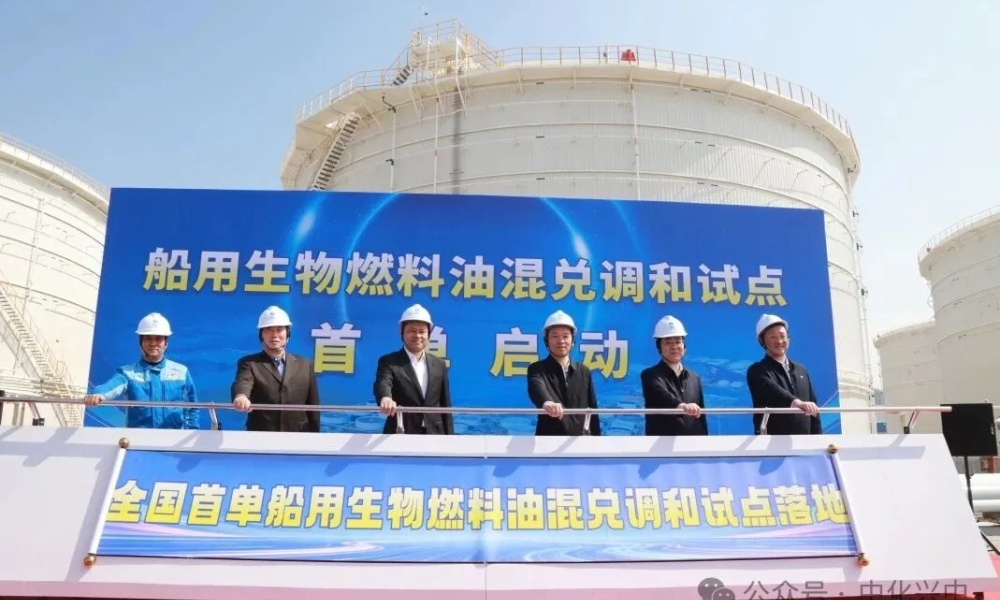
Manifold Times previously reported China (Zhejiang) Pilot Free Trade Zone launching the first pilot programme for marine biofuel blending in China with the completion of the first batch of B24-HSFO. 

The launch was marked with the blending of 2,000 mt of biodiesel and 6,300 mt of high sulphur fuel oil (HSFO) in storage tank F-02 of Sinochem-Xingzhong Oil Staging (Zhoushan), producing 8,300 mt of B24-HSFO. 

Manifold Times also reported the first cross-regional bonded bunkering operation of blended biofuel in East China was successfully completed at the Meishan Port Area of ​​Ningbo-Zhoushan Port. 

The B24-HSFO used in the bunkering operation was supplied by the Aoshan Petroleum Base in Zhoushan from the first pilot programme for marine biofuel blending in China. 

Related: Zhoushan completes China’s first batch of marine biofuel blending under pilot programme
Related: Ningbo wraps up East China’s first cross-regional biofuel blending and bunkering
Related: China debuts first marine biofuel blending pilot programme in Zhoushan
Related: China’s first batch of domestically blended marine biofuel delivered to Qingdao for bunkering


Photo credit: Sinochem-Xingzhong Oil Staging (Zhoushan)
Published: 21 September, 2026

Continue Reading

Trending