Connect with us

Alternative Fuels

Acceleron: Asia Pacific illuminating cross-sector e-fuel pathways for maritime decarbonisation

Asia Pacific is actively demonstrating how the critical elements of a future e-fuel system can operate together and across sector boundaries, linking ports, industrial clusters and bunkering infrastructure.

Admin

Published

on

Acceleron: Asia Pacific illuminating cross-sector e-fuel pathways for maritime decarbonisation

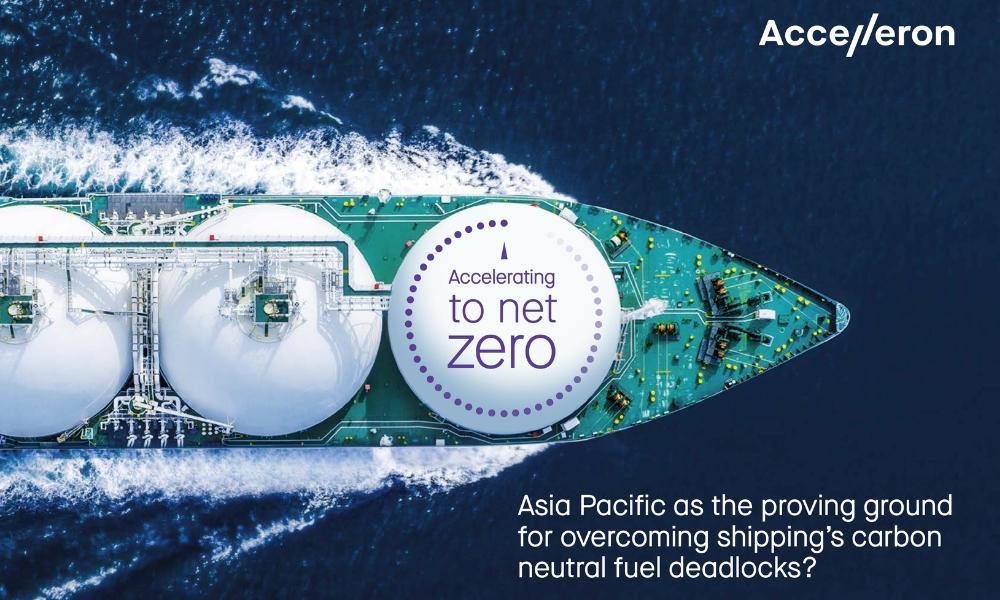
Accelleron on Wednesday (3 December) released its second report in its Accelerating to Net Zero series, highlighting the Asia Pacific market’s critical role as the proving ground for much-needed e-fuel networks.

Daniel Bischofberger, Chief Executive Officer at Accelleron, said: “The ships are ready. The net-zero technology is ready. The fuels are still missing.”

“Our customers are preparing ships to run on e-ammonia and e-methanol, and there is broad agreement that green hydrogen-based e-fuels will be essential for reaching net-zero. Even with delays to global net-zero regulation, progress is visible. We wrote this report to bring clarity to that progress and support the industry with evidence it can use. Developments in Asia Pacific show green hydrogen and e-fuel infrastructure beginning to take shape in ways that could inform similar efforts in other regions.”

With the economic scale and distinctive political environment to support early progress in green hydrogen and e-fuel development, the Asia Pacific region has emerged as an advanced testbed for these systems.

Key findings from the report reveal that while the recent postponement of the International Maritime Organization’s Net-Zero Framework has caused uncertainty within the shipping industry, the drive for maritime decarbonization across the region continues at pace.

A driving force behind this progress is Asia Pacific’s view of green hydrogen and e-fuels as a pillar of both decarbonization and long-term, cross-sector energy security. In addition, the region boasts some of the world’s most extensive renewable energy and industrial resources to stimulate green hydrogen and e-fuel production. Several countries are already developing “book and claim” systems to overcome early gaps in e-fuel distribution infrastructure, while smaller-scale, modular e-fuel production models are emerging that enable incremental buildout and directly accelerate early supply. Targeted government supply-side incentives support that acceleration by reducing costs across the e-fuel value chain.

These conditions create a strong cross-sector foundation for e-fuel production, matched by a natural upstream/downstream supply/demand dynamic for e-fuels that is unparalleled in other regions around the world. Asia Pacific is actively demonstrating how the critical elements of a future e-fuel system can operate together and across sector boundaries, linking ports, industrial clusters and bunkering infrastructure.

Despite this progress, maritime demand for e-fuels is currently not high enough to mobilize production at the scale required to decarbonize the sector. Why?

Accelleron’s report identifies vital deadlocks still to be overcome to accelerate missing e-fuel demand, as well key points that the global market can take from developments in the Asia Pacific region.

This includes:

  • Viable ecosystems don’t need a global regulatory trigger. The Asia Pacific market has shown that if national governments and industry formalize cross-sector programs that link port development, green hydrogen and e-fuel production clusters, industrial offtakers, and maritime demand, early ecosystems can progress in advance of global regulatory alignment.
  • Inter-country harmonization. National energy agencies and port authorities can accelerate progress by harmonizing cross-sector hydrogen and e-fuel strategies, certification, storage, handling, and bunkering development with neighboring countries, so that regional supply and demand flows are strengthened.
  • Leverage existing cross-sector trade corridors. Governments, ports, and industry can use existing high-traffic trade corridors, like the Australia-Singapore-China iron route, as the backbone for early e-fuel deployment, coordinating fuel availability, bunkering readiness, cross-sector offtake, and shipping use along the same routes.
  • Think small to aim big. The Asia Pacific market reveals that smaller scale, modular production concepts – linking renewable power, storage, electrolyzers, and ammonia or methanol synthesis in integrated units – can build out incrementally to supply cross-sector offtake. This allows for smaller upfront offtake commitments, accelerating early market formation.
  • Get the other half of the job done: generating demand. In contrast to the wealth of cross-sector, supply-side incentives for green hydrogen and e-fuel production and infrastructure, maritime carbon pricing and demand-side incentives for e-fuels are virtually absent across the Asia Pacific region, signaling a clear expectation that these must come from global maritime regulation.

Allan-Qingzhou Wang, Chairman of Accelleron China, concluded: “Our first Accelerating to Net Zero report highlighted the central role that green hydrogen–based e-fuels will play in shipping’s energy transition. This new report shows how that transition is beginning to take shape on the ground. Across Asia Pacific, different approaches to early e-fuel development are emerging, offering evidence of how e-fuel networks can develop in practice and laying the foundations for future scale-up.”

Note: Download the full report here.


Photo credit: Accelleron
Published: 3 December, 2025

Continue Reading

LNG Bunkering

PIL’s LNG dual-fuel boxship “Kota Elok” arrives in Singapore on maiden call

As the first of 13 new 13,000 TEU vessels joining its fleet, Kota Elok is equipped to operate on LNG and low-sulphur fuel oil that helps reduce our greenhouse gas emissions.
Admin

Published

on

By

PIL's LNG dual-fuel boxship “Kota Elok” arrives in Singapore on maiden call

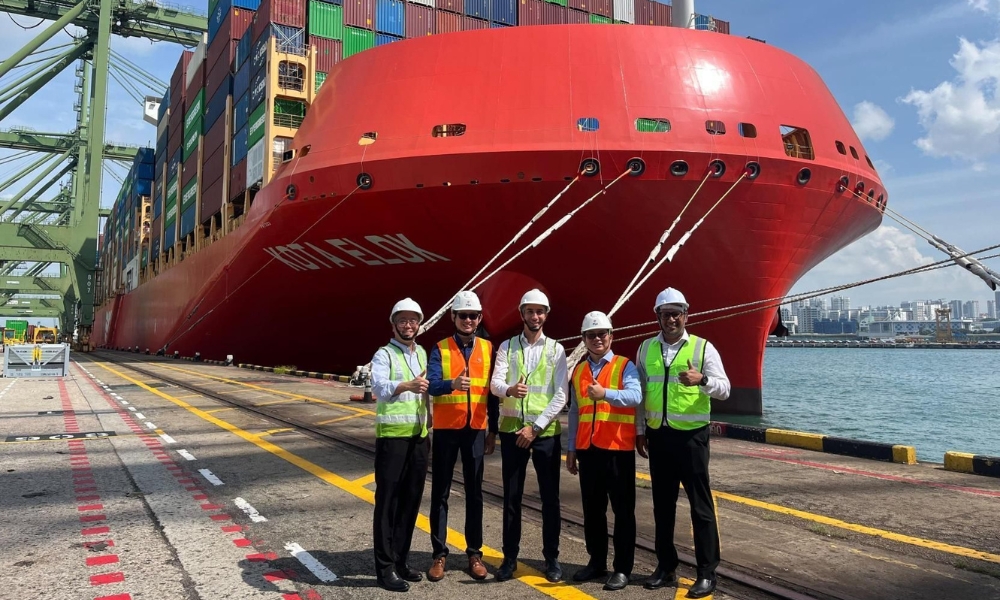
Singapore-based Pacific International Lines Pte Ltd on Monday (20 July) said its first 13,000 TEU LNG dual-fuel container vessel, Kota Elok, recently made her maiden call to Singapore on 15 July.

As the first of 13 new 13,000 TEU vessels joining its fleet, Kota Elok is equipped to operate on liquefied natural gas (LNG) and low-sulphur fuel oil that helps reduce our greenhouse gas emissions. 

The vessel also incorporated energy-saving features and digital technologies to reduce fuel consumption and enhance operational performance, as well as a bow windshield to improve aerodynamics, contributing to improved fuel efficiency and lower emissions over the course of long-haul voyages.

“Following Singapore, Kota Elok will continue her voyage on our East Coast Service 1 (ES1) route to South America, calling at ports in Brazil, Uruguay, and Argentina before returning to Asia,” the company said in a social media post. 

Kota Elok also became PIL’s first vessel to receive Lloyd’s Register certification for compliance with the IACS UR E26 and UR E27 cyber security requirements.

Developed by the International Association of Classification Societies (IACS), UR E26 and UR E27 are mandatory cyber resilience requirements for newbuild vessels contracted from 1 July 2024. 


Photo credit: Pacific International Lines
Published: 21 July, 2026

Continue Reading

LNG Bunkering

CIMC SOE secures order for 12,000-cbm LNG bunkering vessel from Sinopec Clean Energy

Once operational, the vessel is expected to strengthen Sinopec’s domestic coastal LNG bunkering network and help address gaps in China’s alternative fuel bunkering infrastructure.
Admin

Published

on

By

CIMC SOE secures order for 12,000-cbm LNG bunkering vessel from Sinopec Clean Energy

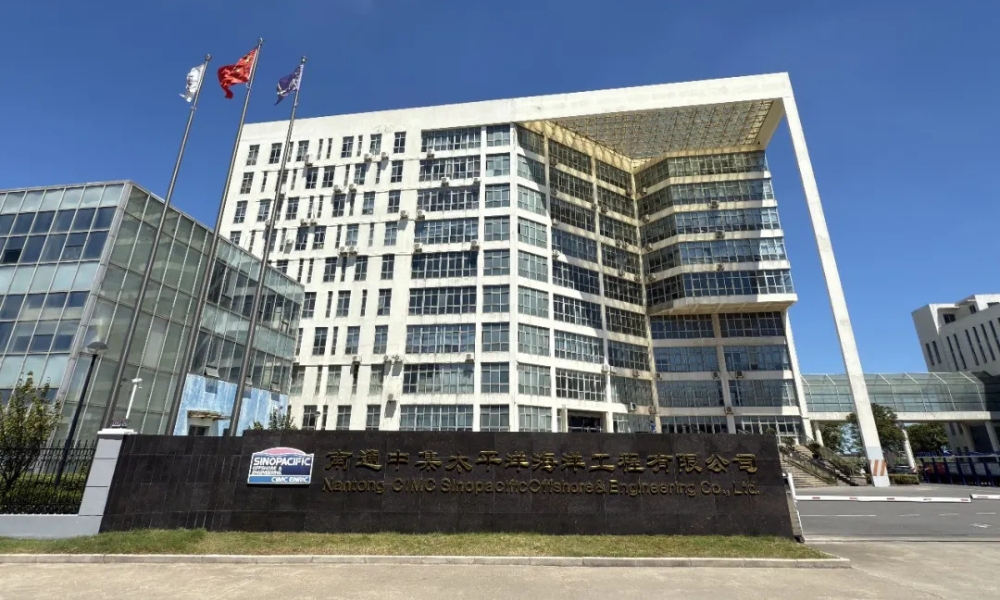
China’s Nantong CIMC Sinopacific Offshore & Engineering Co., Ltd. (CIMC SOE) recently signed a contract with Sinopec (Beijing) Clean Energy Co., Ltd. to build a 12,000-cubic metre (m3) LNG bunkering vessel, according to Chinese maritime media.

The vessel is scheduled for delivery in 2028 and will support Sinopec’s efforts to expand its presence in the marine clean energy sector.

Once operational, the vessel is expected to strengthen Sinopec’s domestic coastal LNG bunkering network and help address gaps in China’s LNG bunkering infrastructure.

With this signing , CIMC Pacific Offshore Engineering’s LNG bunkering vessel orderbook is further strengthened, maintaining its leading position in the global market for small and medium-sized LNG bunkering vessels.

The contract also marked another milestone for CIMC SOE, which has seen a sharp increase in orders and business performance this year amid a surge in domestic LNG vessel demand.


Photo credit: Nantong CIMC Sinopacific Offshore & Engineering
Published: 21 July, 2026

Continue Reading

Nuclear

ABS awards AiP to Korean institute for SMR-powered container ship concept design

KRISO says AiP recognises the technical feasibility and safety of its concept design, marking an important milestone toward the development of next-generation nuclear-powered commercial ships.
Admin

Published

on

By

ABS awards AiP to Korean institute for SMR-powered container ship concept design

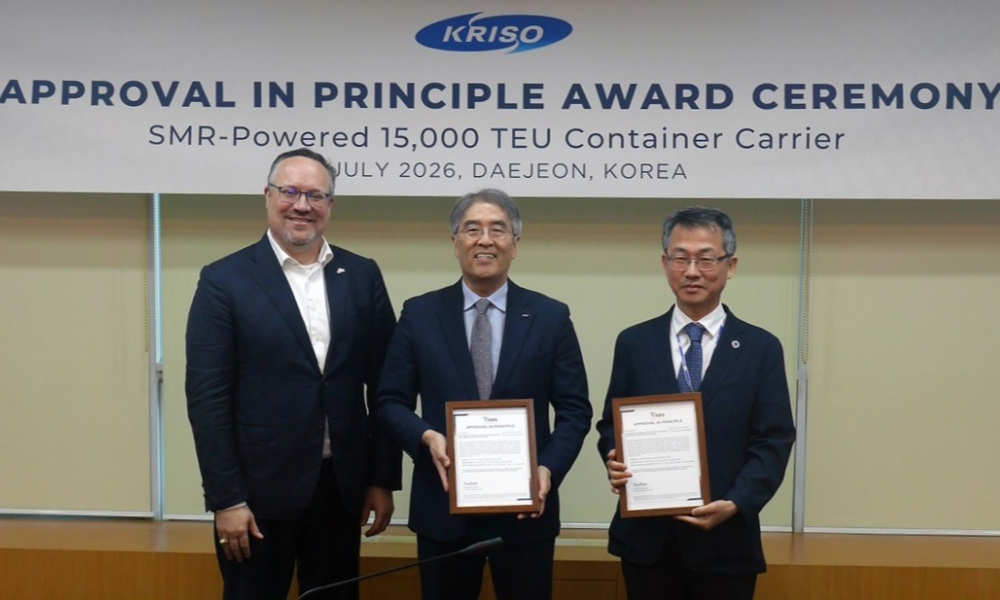
Korea Research Institute of Ships & Ocean Engineering (KRISO) on Thursday (16 July) received Approval in Principle (AiP) from the American Bureau of Shipping (ABS) for its concept design of a 15,000 TEU Small Modular Reactor (SMR)-powered container ship utilising Molten Salt Reactor (MSR) technology.

KRISO said the AiP recognises the technical feasibility and safety of its concept design, marking an important milestone toward the development of next-generation nuclear-powered commercial ships.

“This achievement demonstrates international recognition of KRISO’s technological capabilities in the rapidly evolving field of nuclear-powered shipping, supporting the transition toward low-carbon maritime transport,” it said. 

Building on this milestone, KRISO will continue advancing basic and detailed ship design, paving the way for future demonstration and commercialisation of SMR-powered vessels. 

Through continued R&D and international collaboration, KRISO remains committed to strengthening next-generation maritime technologies and contributing to the safe deployment of nuclear propulsion in the maritime industry.


Photo credit: Korea Research Institute of Ships & Ocean Engineering
Published: 21 July, 2026

Continue Reading

Trending