Connect with us

Biofuel

Kvasir Technologies lands EUR 10 million to scale bio bunker fuel production

The Danish biofuel startup raised the fund in a Series A investment round, which will provide capital to develop and design a new commercial production plant and scale climate-neutral drop-in marine fuel.

Admin

Published

on

Kvasir Technologies lands EUR 10 million to scale bio bunker fuel production

Danish biofuel startup Kvasir Technologies on Thursday (18 June) said it has raised EUR 10 million (USD 11.4 million) in a Series A investment round with participation from European Energy as a new investor, alongside existing investors EIFO, Maersk Growth and Footprint Fund. 

The Series A round provides capital to develop and design a new commercial production plant and scale climate-neutral drop-in fuel to be used in existing vessels.

At the same time, European Energy and Kvasir Technologies are entering into a strategic partnership by establishing the company KVEEN Biofuels, which is working towards the construction of a commercial-scale plant to produce biofuels using Kvasir Technologies’ patented technology.

“This investment round enables us to take the next crucial steps in developing and scaling our technology. At the same time, it underlines that there is still strong support for solutions that can deliver real climate impact in the maritime sector,” said Joachim Bachmann Nielsen, Ph.D. in Chemical Engineering and CEO of Kvasir Technologies.

Kvasir Technologies, a spin-out from research at the Technical University of Denmark (DTU), has developed a new technology to convert a wide range of non-edible lignin- based residues from agriculture and forestry into refined biofuels for shipping.

The climate-neutral biofuel can serve as an immediate replacement for fossil marine fuel without the need to modify ship engines or change existing infrastructure.

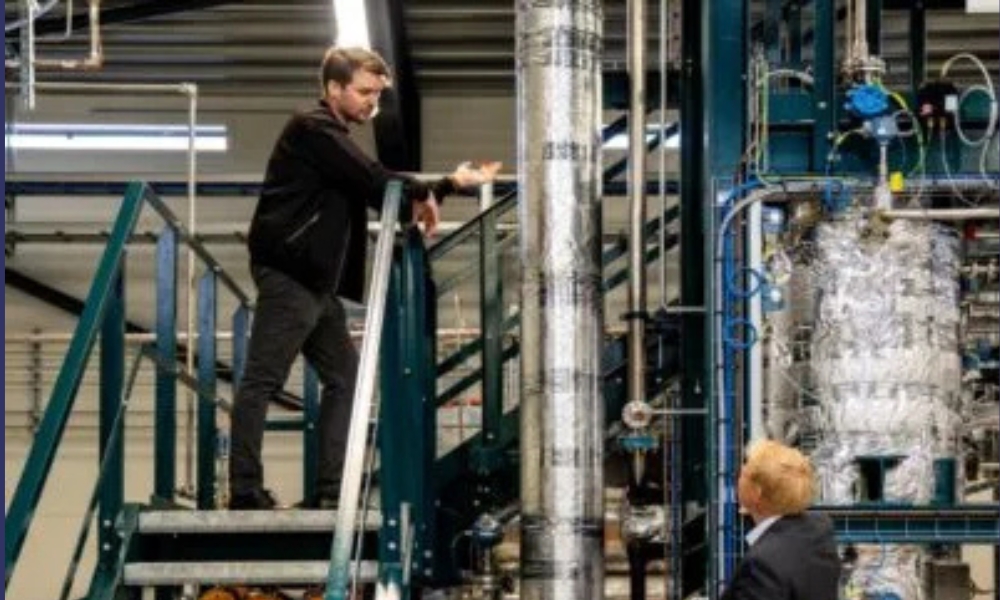
The new funding will be used, among other things, to scale the technology at Kvasir Technologies’ test facility in Fredericia, which can produce up to 2 metric tonnes (mt) of biofuel per day.

At the same time, development work will begin on the first commercial plant in the city of Aabenraa in the southern part of Jutland, which will demonstrate the technology on an industrial scale.


Photo credit: Kvasir Technologies
Published: 19 June, 2026

Continue Reading

Alternative Fuels

MOL inks bio-LNG bunker fuel supply deals with Titan and Axpo for car carriers in Europe

Titan, part of Amsterdam-based Molgas, will continue to supply bio-LNG fuel in Northwest Europe, while Axpo will take charge of supply in the Mediterranean region.

Admin

Published

on

By

MOL inks bio-LNG bunker fuel supply deals with Titan and Axpo for car carriers in Europe

Mitsui OSK Lines (MOL) on Thursday (18 July) said it has signed new supply agreements in Northern Europe and the Mediterranean region to expand the use of bio-LNG marine fuel on MOL-operated LNG-fuelled car carriers.

Titan, part of Amsterdam-based Molgas, will continue to supply bio-LNG fuel in Northwest Europe, while Axpo will take charge of supply in the Mediterranean region.

MOL said the agreement makes it possible for its company to supply bio-LNG fuel for automobile carriers in the Mediterranean region, specifically Port of Malaga and Barcelona in Spain, following the bio-LNG fuel supply agreement in Western Europe, which commenced in March last year.

The bio-LNG fuel to be supplied in this initiative has a lifecycle carbon intensity (carbon dioxide emissions per unit of energy consumption) of -15 g-CO2/MJ or less, from production through consumption. Furthermore, this bio-LNG fuel has obtained International Sustainability and Carbon Certification (ISCC-EU). 

“Through this supply agreement, MOL has established a framework that ensures a continuous and stable supply of bio-LNG fuel not only in Northern Europe but also in the Mediterranean,” the company said.

As part of the group’s efforts to adopt alternative fuels and achieve net-zero greenhouse gas (GHG) emissions, it is utilising LNG-fuelled vessels as a bridge solution to facilitate the transition to carbon-neutral fuels such as bio-LNG and synthetic LNG (e-methane).

In 2025, MOL signed a bio LNG fuel supply agreement in Northwest Europe with Titan, part of the Molgas, and MOL has continued this bio LNG fuel supply agreement with the same company in 2026 as well.


Photo credit: Mitsui OSK Lines
Published: 19 June, 2026

Continue Reading

Biofuel

STR plans 100,000 m³ biofuels storage project in Rotterdam

Service Terminal Rotterdam is Rotterdam’s bunker facility, which is currently focused on the storage of fuels, mostly for the marine market.

Admin

Published

on

By

STR plans 100,000 m³ biofuels storage project in Rotterdam

Service Terminal Rotterdam (STR) on Wednesday (17 June) said it is launching project GreenSTR focused on biofuels storage in Rotterdam.

STR is Rotterdam’s bunker facility which is currently focused on the storage of fuels, mostly for the marine market. 

The company said the terminal lies in the heart of the Port of Rotterdam, and is well connected through its jetties suitable for a range of vessel sizes as well as barges. 

“STR’s core capabilities lie in its flexibility to handle various grades of fuel oil, as well as bioblending,” the company said. 

“Project GreenSTR fills the gap of needed infrastructure tailored at the storage and blending of marine fuels.”

The project will build approximately 100,000 cubic metre (m3) of storage tanks on a vacant plot of land adjacent to the current terminal and able to store a range of products including biodiesel, ethanol and methanol.


Photo credit: Service Terminal Rotterdam
Published: 18 June, 2026

Continue Reading

Alternative Fuels

SunGas Renewables halts development of US biomethanol project

Company says the decision reflects a combination of factors that affected Beaver Lake’s ability to advance, including slower-than-expected market adoption of low-carbon marine fuels.

Admin

Published

on

By

SunGas Renewables halts development of US biomethanol project

SunGas Renewables Inc. (SunGas) recently announced that it will cease further development of the Beaver Lake Biofuels project, a proposed wood fiber-to-low carbon methanol facility in Central Louisiana near Alexandria.

Beaver Lake’s design contemplated the integration of three SunGas S1000 syngas production systems together with downstream technologies to produce approximately 553,000 metric tonnes (mt) per year of low carbon methanol and geological storage of approximately 1.1 million mt per year of biogenic CO2. 

This combination of scale and low product carbon intensity supported a globally competitive bio-methanol offering, illustrating the potential viability of this technology pathway as decarbonization requirements become more stringent.

“This decision reflects a combination of factors that affected Beaver Lake’s ability to advance on the timetable required, including slower-than-expected market adoption of low-carbon marine fuels (specifically low carbon methanol), uncertainty regarding the carbon capture and storage pathway for the project and clarity on the available regulatory support and financing conditions needed to support a project of this scale,” the company said. 

Robert Rigdon, Chief Executive Officer of SunGas, said: “We continue to believe low carbon methanol can help decarbonize the maritime, aviation and chemicals industries. However, given the current regulatory uncertainty, slower customer uptake and broader financing and infrastructure constraints, we do not believe the conditions are in place to move the project forward successfully. 

“We are grateful to the many public and private partners who supported the project, and today’s announcement does not change our confidence in the long-term potential of SunGas’ technology to produce low-cost, low carbon molecules, including methanol, SAF, other transportation fuels and methane.”

Manifold Times previously reported SunGas Renewables announcing that the Central Louisiana facility would produce green methanol for Maersk.

At the time, the facility was expected to generate nearly 400,000 metric tonnes (mt) of green methanol per year for marine fuel.

Related: SunGas Renewable to build its first facility to produce green methanol bunker fuel for Maersk
Related: Maersk and SunGas Renewables sign letter of intent for strategic green methanol production


Photo credit: SunGas Renewables
Published: 18 June, 2026

Continue Reading

Trending