
Methanol
GENA Solutions: Total renewable and low-carbon methanol project pipeline rises from 59.6 to 61 Mt by 2031
Information shared by the Methanol Institute meant to assist the maritime industry in the adoption of methanol as a mainstream marine fuel heading into IMO 2030/2050.

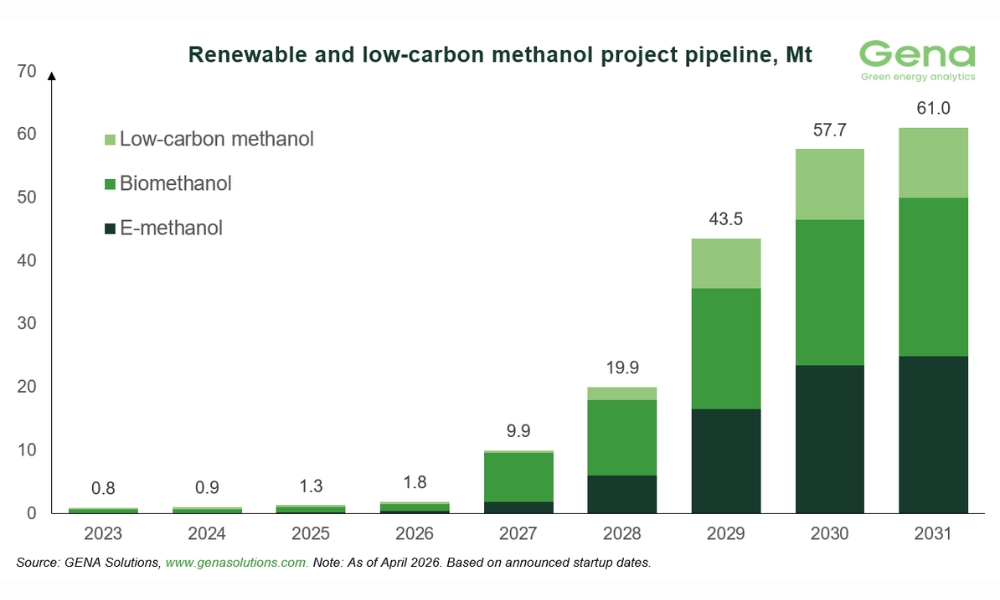
The Methanol Institute recently shared with Manifold Times the renewable and low-carbon methanol project pipeline April 2026 release produced by GENA Solutions Oy.
Information from the release is meant to provide the bunkering publication’s readers with insight on renewable methanol availability, and to assist the maritime industry in the adoption of methanol as a mainstream marine fuel heading into IMO 2030/2050.
Key highlights from GENA’s April 2026 Methanol release are as follows:
- Six renewable methanol projects in China, with a total capacity of 1.9 Mt, held groundbreaking ceremonies over the past month. However, our analysis shows that three of them are not ready to start construction soon.
- Eight new projects were added to Project Navigator, while eight frozen projects were excluded. Due to the larger average capacity of the new projects, the project pipeline increased by 1.4 Mt month on month.
- As of the end of April 2026, Project Navigator tracks 281 renewable and low-carbon methanol projects, representing 61 Mt of capacity by 2031, including 24.9 Mt of e-methanol, 25 Mt of biomethanol, and 11.2 Mt of low-carbon methanol.
- China and Europe are the most active centers globally for renewable methanol industry development, together accounting for about 82% of the project pipeline. China accounts for about 30 Mt, while Europe accounts for 11 Mt.
- In the medium-term perspective, renewable methanol capacity could grow from 0.9 Mt in 2025 to about 1.5 Mt in 2026 and 2.2–2.4 Mt in 2027.
- In the longer-term perspective, considering project development progress and possible market development scenarios, GENA estimates that global renewable methanol capacity could range from 5 Mt to 12 Mt by 2030.
Note: The full article can be viewed here.
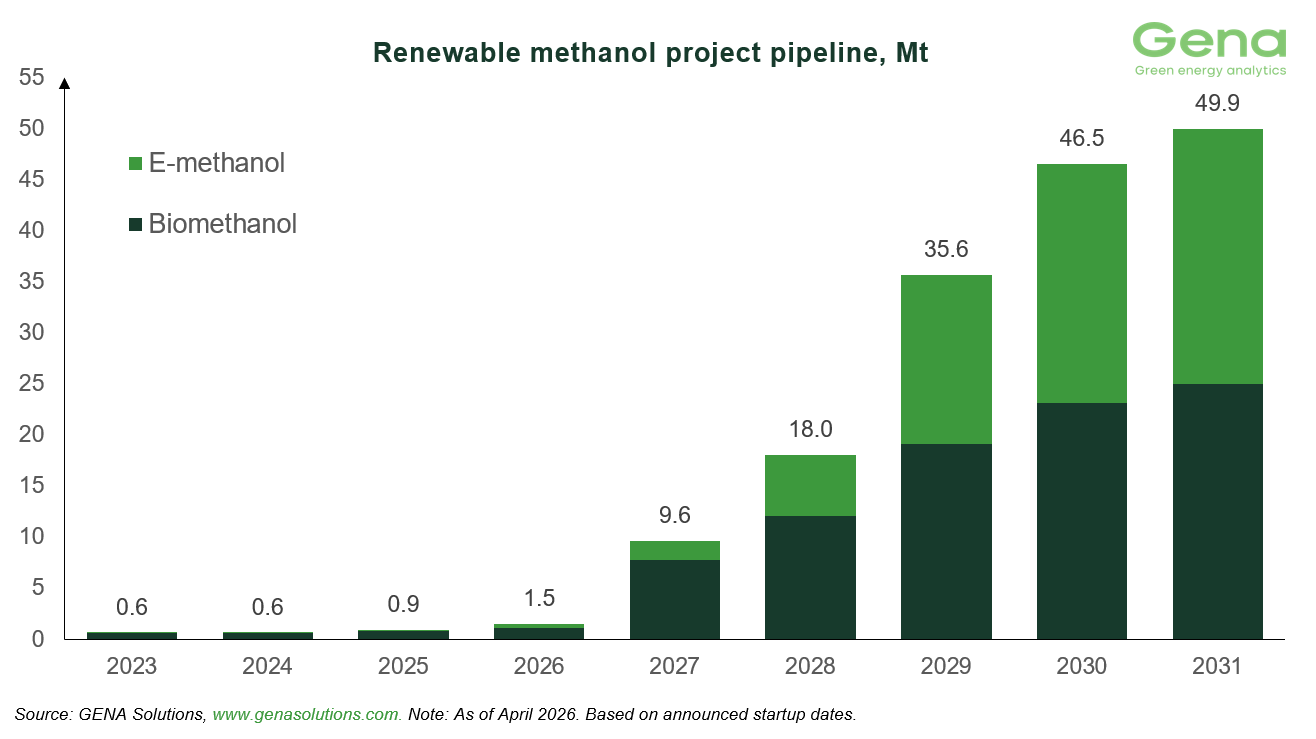
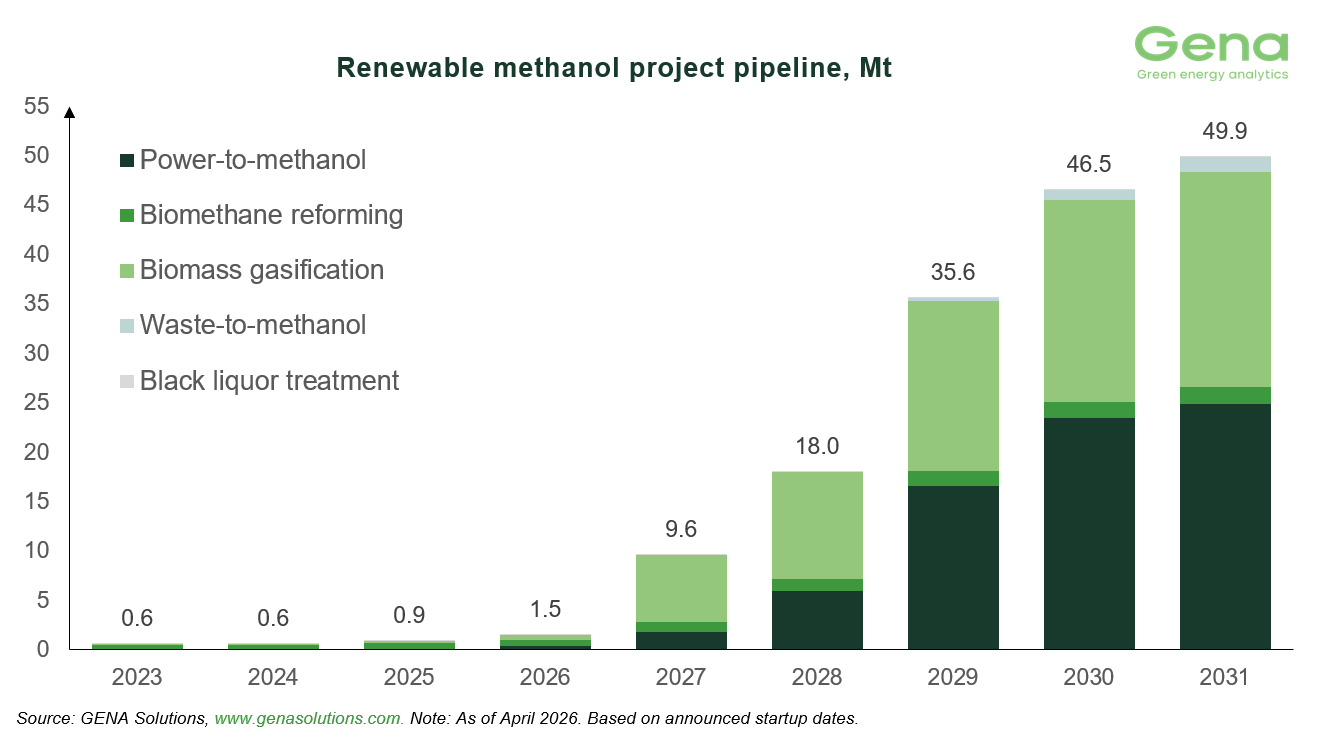
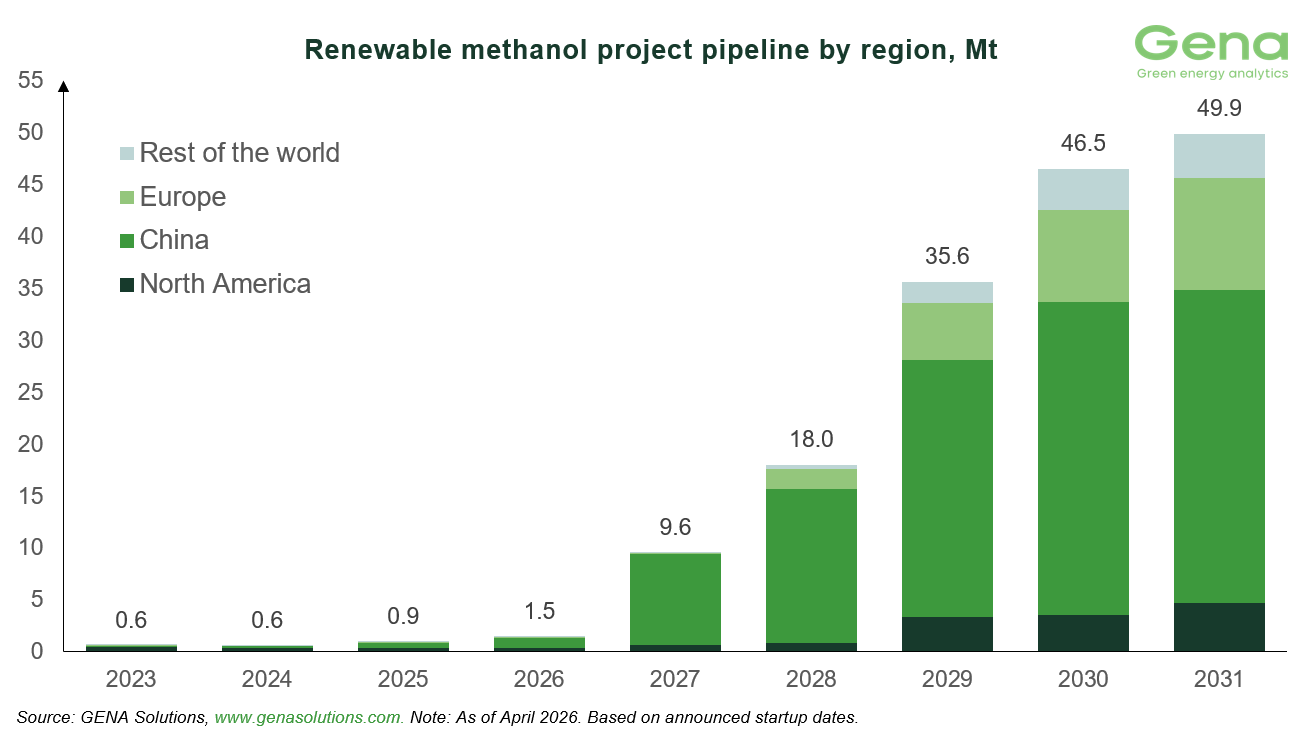
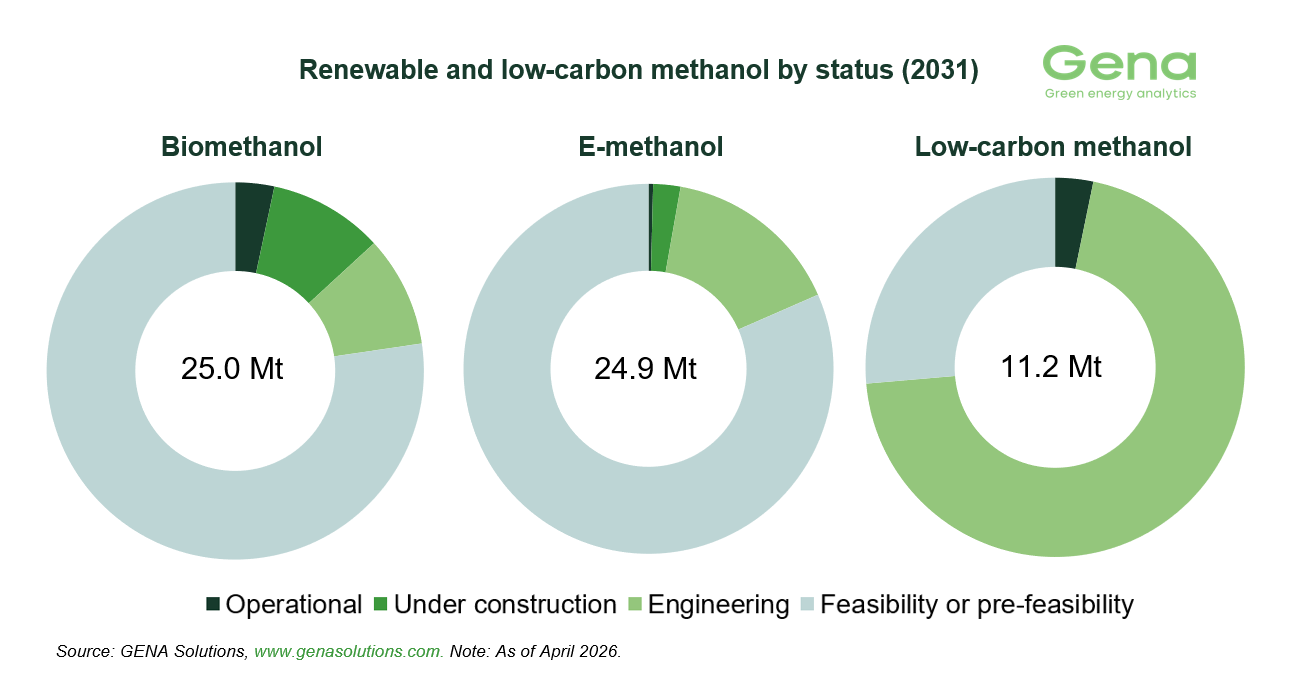
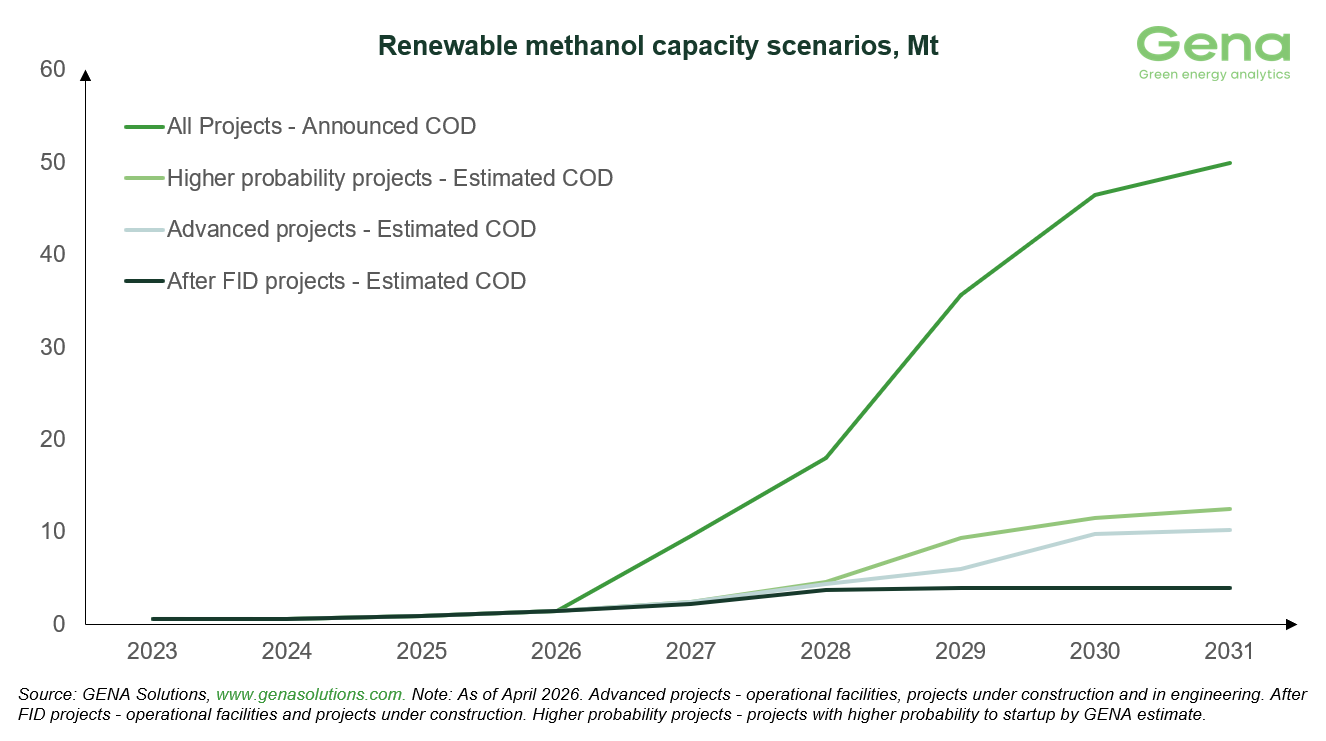
Photo credit: GENA Solutions
Published: 4 May, 2026
Alternative Fuels
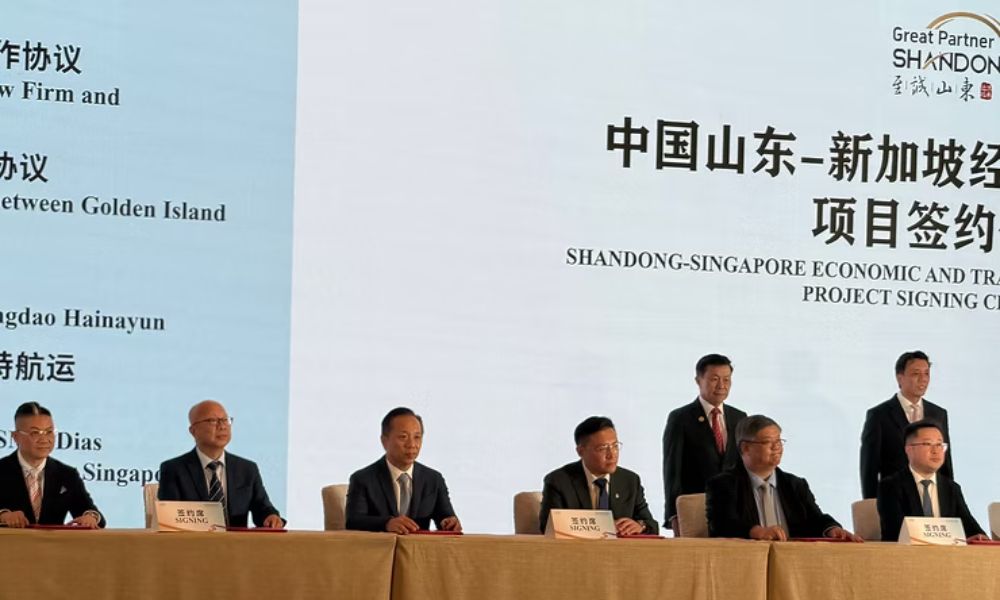
Singapore-based Golden Island, Qingdao Port team up on alternative bunker fuels
Agreement covers green methanol, green ammonia and bio-LNG, with cooperation spanning fuel production and transportation through to storage, sales and bunkering.
Alternative Fuels
DNV on IMO CCC 12: Revised guidelines for methanol as marine fuel
CCC 12 finalized the revision of the interim guidelines for use of methyl/ethyl alcohol as fuel while work continued on guidelines for low-flashpoint oil fuels and onboard carbon capture and storage systems.
Alternative Fuels
DNV: How ethanol is expanding shipping’s fuel choices
DNV examines why interest in ethanol is growing, drawing on insights from cargo owners, engine manufacturers, and other industry stakeholders.

OUR INDUSTRY PARTNERS

Singapore-based Golden Island, Qingdao Port team up on alternative bunker fuels

HD HHI and HD KSOE secure ABS AiP for ammonia bunkering vessel design

J-ENG completes land-based testing of hydrogen-fuelled marine engine

Trafigura launches Volare Shipping with six VLCCs, eight newbuilds on order

Bunkering firm Eleven Energy establishes presence in Greece with two trading hires

GTT Marine partners with BetterSea on FuelEU trading, pooling integration

DNV on IMO CCC 12: Revised guidelines for methanol as marine fuel

Singapore: Marine fuel testing firm CCIC Singapore faces winding up application

Peninsula confirms one fatality, crew member missing from bunker tanker “Hercules Star”

Singapore: MPA working with industry on next phase of digital bunkering, says Deputy CE

Amogy and LOTTE Fine Chemical to explore ammonia bunkering in South Korea

High Court of Singapore issues winding up order against Hengli Petrochemical International

China: Guangzhou completes first bio-methanol STS bunkering operation

Polaris Shipping orders WinGD engines capable of running on methanol, ethanol
-
 Winding up1 week ago
Singapore: Marine fuel testing firm CCIC Singapore faces winding up application
-
 Incident2 weeks ago
Peninsula confirms one fatality, crew member missing from bunker tanker “Hercules Star”
-
 Technology2 weeks ago
Singapore: MPA working with industry on next phase of digital bunkering, says Deputy CE
-
 Ammonia2 weeks ago
Amogy and LOTTE Fine Chemical to explore ammonia bunkering in South Korea
-
 Winding up1 week ago
High Court of Singapore issues winding up order against Hengli Petrochemical International
-
 Alternative Fuels2 weeks ago
China: Guangzhou completes first bio-methanol STS bunkering operation
-
 Engine2 weeks ago
Polaris Shipping orders WinGD engines capable of running on methanol, ethanol
-
 Technology1 week ago
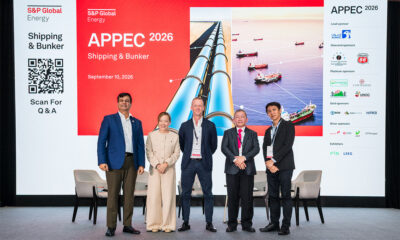
APPEC 2026: Digitalisation in bunkering not merely a ‘paper-to-screen’ swap, states panellists