Connect with us
DNV Decarbonization Insight Series August 2026 - What maritime professionals should know about AI Training

Newbuilding

Wah Kwong and BV celebrate delivery of LNG-ready LR2 tanker “Frontier Venture”

Built by Hengli Shipyard in Dalian, the vessel is the first in the series to demonstrate Group 3 ‘augmented ship’ capabilities, integrating advanced on-board digital systems with shore-based support.

Admin

Published

on

Wah Kwong and BV celebrate delivery of LNG-ready LR2 tanker Frontier Venture

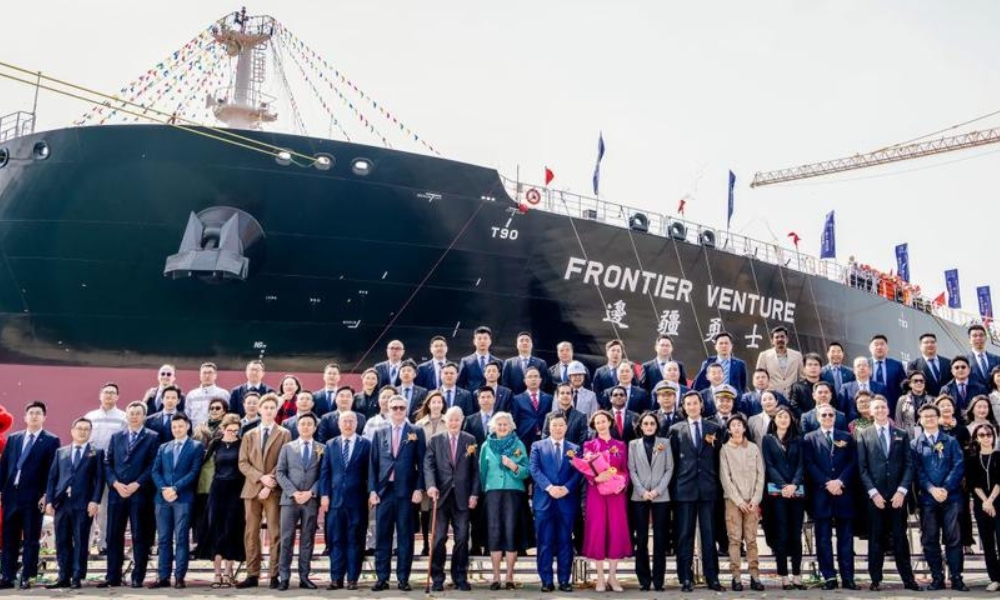
Bureau Veritas Marine & Offshore (BV) on Tuesday (31 March) said it celebrated the delivery of LNG-ready LR2 tanker Frontier Venture with Wah Kwong Maritime Transport (Wah Kwong) on 30 March. 

The vessel is the first in Wah Kwong’s new series of SMART-enabled ships, representing a significant milestone in the company’s fleet development. 

Built by Hengli Shipyard in Dalian, the vessel is the first in the series to demonstrate Group 3 “augmented ship” capabilities, integrating advanced on-board digital systems with shore-based support.

Classed by BV, the Frontier Venture has been assigned the SMART (H1,M1,EnE3,MH3) notations, recognizing its enhanced capabilities in machinery health monitoring and energy efficiency optimization. The new vessel is the latest example of industry innovation, resulting from the long-standing collaboration between Wah Kwong and BV to advance class-recognized digitalization across its fleet.

The “augmented ship” features expert-in-the-loop services that deliver timely, actionable insights to ship officers. This includes early detection of machinery anomalies and recommendations for more efficient operating profiles, a critical capability in modern maritime operations, where complex variables demand both data-driven analysis and human expertise for sound decision-making.

The Frontier Venture is the first in the series being built at Hengli Shipyard. The delivery of the second LR2 is expected to be in July 2026. The 114,000 DWT LR2 Frontier Venture is 248.8 meters long, with a breadth of 44.0 meters and a depth of 21.5 meters. It is powered by a modern Everllence B&W main engine rated at 10,800 kW SMCR, and meets EEDI Phase III requirements. 

The vessel has three cargo oil pumps, each with a capacity of 3,000 m³/h, for efficient loading and discharge.

Hing Chao, Chairman of Wah Kwong Maritime Transport, said: “The SMART notations awarded to our first LR2 mark a key milestone in our long‑term partnership with Bureau Veritas and demonstrate how we translate innovation into fleet‑wide progress. 

“BV continues to set a higher bar for the governance of digital capability, and together we have advanced through the SMART framework in recent years — ensuring that data‑driven insights are effectively embedded in operations onboard and ashore. 

“This supports a future where trusted data and digital technologies enable the sector to collaborate more closely and move faster towards an intelligent, sustainable, maritime world.”


Photo credit: Bureau Veritas Marine & Offshore
Published: 1 April, 2026

Continue Reading

Methanol

CMA CGM names new 15,000 TEU methanol-powered vessel “ROI ARTHUR”

Joining the company’s REX2 service, the ship will strengthen its fleet of new-generation vessels designed to support the decarbonisation of shipping.

Admin

Published

on

By

8 1

French shipping giant CMA CGM on Monday (3 August) said its new 15,000 TEU methanol-powered vessel, CMA CGM ROI ARTHUR, has officially been named and is ready to begin its journey at sea.

Joining the company’s REX2 service, the ship will strengthen its fleet of new-generation vessels designed to support the decarbonisation of shipping. 

“Powered by methanol, she contributes to reducing atmospheric emissions and advancing the energy transition of our industry,” the company said in a social media post. 

The vessel was welcomed by her Master, Captain Roman DIDENKO, and her godmother, Ms. Sun Lijun, Vice Chairman of Tianjin Bridge Welding Materials Group Co., Ltd. and Vice President of the Tianjin Women Entrepreneurs Association.

In January, the company announced the arrival in its fleet of its 400th owned vessel, the CMA CGM MONTE CRISTO, the first in a series of six methanol container ships.

The Group is preparing to operate, by 2031, around 200 dual-fuel LNG and methanol container ships that can be powered with low-carbon energy.

Related: CMA CGM marks 400-vessel milestone as methanol-powered boxship joins fleet


Photo credit: CMA CGM
Published: 4 August, 2026

Continue Reading

Methanol

China’s first domestically developed Ultramax methanol dual-fuel bulker pair named

SDARI says two 65,000 dwt methanol dual-fuel bulk carriers, “LEM AZALEA” and “LEM PLUMERIA”, were named on 27 July at Guangzhou’s Nansha district.

Admin

Published

on

By

China's first domestically developed Ultramax methanol dual-fuel bulker pair named

Shanghai Merchant Ship Design and Research Institute (SDARI) on Wednesday (29 July) said two 65,000 dwt methanol dual-fuel bulk carriers, LEM AZALEA and LEM PLUMERIA, were named on 27 July at Guangzhou’s Nansha district.

The vessels were designed by the SDARI, part of China State Shipbuilding Corporation (CSSC), for Cyprus-based Lemissoler Navigation and built by CSSC Huangpu Wenchong Shipbuilding.

According to SDARI, the vessels are the institute’s first methanol dual-fuel bulk carrier design and China’s first domestically developed Ultramax methanol dual-fuel bulk carriers.

The bulk carriers are equipped with a methanol dual-fuel propulsion system comprising a conventional fuel tank and two dedicated high-capacity methanol fuel tanks, allowing operators to switch flexibly between fuels while meeting current and anticipated IMO requirements on carbon reduction and sulphur emissions.

The vessels are also fitted with an auxiliary lithium battery system to supply onboard lighting power, reducing overall energy consumption.

Compared with conventionally fuelled bulk carriers, the methanol dual-fuel design is expected to significantly reduce carbon dioxide, sulphur oxide, nitrogen oxide and particulate matter emissions.

SDARI said the project fills a gap in China’s domestically developed methanol dual-fuel bulk carrier segment in the 65,000 dwt class and provides a mature and scalable design that can be replicated for future vessels.


Photo credit: CSSC Huangpu Wenchong Shipbuilding
Published: 3 August, 2026

Continue Reading

Alternative Fuels

EC clears EUR 103 mil Dutch funding for renewable methanol and hydrogen-powered ships

Scheme will support purchase of vessels powered by renewable methanol or renewable hydrogen and retrofitting of existing vessels to enable them to use renewable methanol and renewable hydrogen.

Admin

Published

on

By

Guillaume Périgois on Unsplash

The European Commission recently said it has approved a EUR 103 million (USD 119 million) State aid scheme by the Netherlands to accelerate the greening of the Dutch maritime fleet. 

The scheme will support the purchase of new clean and zero-emission vessels powered by renewable methanol or renewable hydrogen and the retrofitting of existing vessels to enable them to use renewable methanol and renewable hydrogen. 

It covers different types of vessels, including passenger, cargo and work vessels, mainly operating in the short-sea shipping segment. The support will take the form of direct grants awarded under an open, transparent and non-discriminatory selection process.

The scheme aims to help companies overcome high upfront investment costs and limited market incentives that currently slow the uptake of clean shipping technologies. The aid will be granted between 2027 and 2031 and will help bridge the investment gap in line with the objectives of EU legislation such as the FuelEU Maritime and the EU Emission Trading System.

The Commission assessed the measure under EU State aid rules, in particular Article 107(3)(c) of the Treaty on the Functioning of the EU and the 2022 Climate, Environmental Protection and Energy Aid Guidelines (CEEAG). 

“The Commission concluded that the scheme is necessary and appropriate as the supported investments would not take place without public support at the same scale and within the same timeframe. The measure is also proportionate as it has limited effects on competition and trade in the internal market,” it said. 


Photo credit: Guillaume Périgois on Unsplash
Published: 3 August, 2026

Continue Reading

Trending