Connect with us

Hydrogen

Moeve approves FID for Southern Europe’s largest green hydrogen project

First phase of the Andalusian Green Hydrogen Valley will involve a total investment of more than EUR 1 billion and include development of a plant which will produce green hydrogen for marine transport fuel.

Admin

Published

on

Moeve approves FID for Southern Europe’s largest green hydrogen project

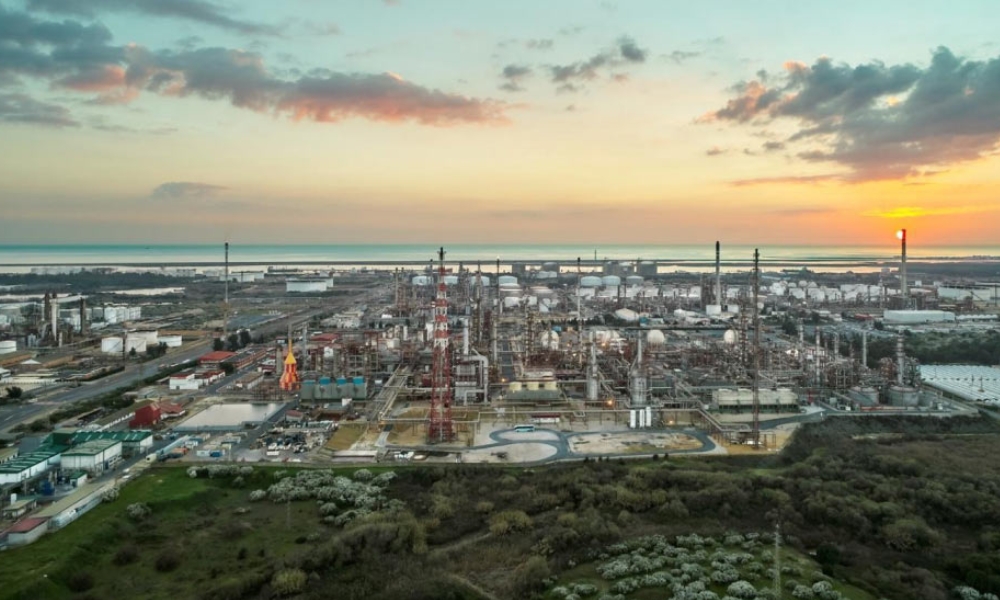
Moeve on Monday (2 March) said its Board of Directors has approved the final investment decision to begin construction on the Andalusian Green Hydrogen Valley. 

The first phase, known as Onuba, will be the largest in Southern Europe with 300 MW of capacity and the option to expand by an additional 100 MW.

Onuba entails a total global investment of more than EUR 1 billion (USD 1.17 billion), including associated infrastructure and the development of a self consumption photovoltaic plant. 

The green hydrogen from the plant will be used for aviation, road and marine transport fuels, in addition to supplying energy to decarbonise the chemical and fertiliser industries.

The project, led by Moeve with a majority stake (51%), will also include participation from Masdar, a global clean energy leader, and Enalter (majority owned by Enagás Renovable, a pioneering company in the development of renewable gases).

“This decision to launch Southern Europe’s largest green hydrogen plant marks a defining step in Moeve’s Positive Motion transformation strategy. Onuba will anchor a world-class hub for green molecules in Spain, supplying renewable fuels to hard-to-abate sectors while reinforcing Europe’s energy and industrial resilience. By partnering with other leaders in renewable energy, we are creating an ecosystem to build at scale,” said Maarten Wetselaar, CEO of Moeve.

Mohamed Jameel Al Ramahi, Chief Executive Officer of Masdar, said: “As an early mover in this sector, we have long recognised green hydrogen’s role in decarbonising hard-to-abate sectors. This partnership, under the leadership of Moeve, reflects our strategy of advancing commercially viable green hydrogen projects in markets where demand is clear. We are also pleased to be advancing our support for Spain’s clean energy ambitions.”

Antón Martínez, CEO of Enagás Renovable, said: “The Onuba project represents a significant step forward for the development of green hydrogen in Spain. At Enagás Renovable we continue to support projects that drive energy independence, foster new industrial opportunities and contribute to job creation. The Andalusian Green Hydrogen Valley is a clear example of how collaboration between companies and institutions can accelerate decarbonization while generating long-term economic and social value.”

The initiative has been designated as a Project of Common European Interest (PCI) by the European Commission and has received EUR 304 million from the Government of Spain under the Recovery, Transformation and Resilience Plan, financed by the European Union’s NextGenerationEU program, through the Hydrogen Valleys scheme, for the development of 400 MW of the Andalusian Green Hydrogen Valley.

The execution of the additional 100 MW of Onuba is subject to obtaining additional grid capacity and board approval.

At 300 MW, Onuba will have the capacity to produce around 45,000 tonnes of green hydrogen per year, avoiding about 250,000 tonnes of CO2 annually — the equivalent of reducing more than all the emissions generated by passenger vehicles with internal combustion engines in the Spanish cities of Huelva, Cádiz, and Jaén.


Photo credit: Moeve
Published: 3 March, 2026

Continue Reading

Technology

Genevos and Koedood Marine Group team up on maritime hydrogen fuel cell deployment

Collaboration will explore how ready-to-use marine fuel cell systems can support shipowners and shipyards in the transition towards zero-emission operations.

Admin

Published

on

By

Genevos and Koedood Marine Group team up on maritime hydrogen fuel cell deployment

Marine fuel cell systems provider Genevos recently said the company signed a Letter of Intent (LOI) with engine supplier Koedood Marine Group to explore the deployment of hydrogen fuel cell systems for inland and coastal maritime transport. 

The LOI was signed by Phil Sharp, co-founder and CTO of Genevos, and Mühlheim, Business Development Director of Koedood Marine Group during the 2026 Advanced Maritime Technology Show in Amsterdam.

Building on Koedood’s proven experience in hydrogen maritime projects – including its ongoing work with Mitsubishi Heavy Industries and TNO on hydrogen engine development – the collaboration will explore how ready-to-use marine fuel cell systems can support shipowners and shipyards in the transition towards zero-emission operations. 

“Koedood has a strong reputation in the maritime sector and a deep understanding of vessel operators’ needs. This LOI is an important step in exploring how Genevos’ hydrogen fuel cell systems can be deployed more widely across inland and maritime applications, helping shipowners reduce onboard emissions with robust, practical and scalable clean power solutions,” said Sharp.

The collaboration aligns with growing market demand for rapidly deployable hydrogen solutions and the wider need to accelerate the adoption of zero-emission technologies across the maritime sector. 

“With this collaboration, we are further strengthening our portfolio of maritime energy solutions. Together with Genevos, we are exploring how we can support our customers in the adoption of hydrogen technology,” said Mühlheim.


Photo credit: Genevos
Published: 20 July, 2026

Continue Reading

Alternative Fuels

Samskip container vessel become new demonstrator for HyShip project

HyShip project is entering a new phase as Samskip’s SeaShuttle container vessel becomes the project’s new demonstrator on the Oslo–Rotterdam route.

Admin

Published

on

By

Samskip container vessel become new demonstrator for HyShip project

Maritime CleanTech recently said the HyShip project is entering a new phase as Samskip’s SeaShuttle container vessel becomes the project’s new demonstrator on the Oslo–Rotterdam route.

The move gives HyShip a real-world application on a keyfreight route between Oslo and Rotterdam, linking liquid hydrogen innovation to vessels already under construction for commercial operation. 

By integrating onboard hydrogen storage systems with quayside bunkering systems, the project tackles one of the key challenges in scaling hydrogen-powered shipping: connecting fuel supply and port infrastructure with vessel operations. 

“This brings zero-emission freight transport one step closer to commercial deployment,” it said.

The company said connecting the ports of Oslo and Rotterdam, both part of the TEN-T network, is more than a project milestone. 

“It demonstrates how Europe can turn policy into practice by linking zero-emission vessels, hydrogen supply and bunkering infrastructure along one of the continent’s key freight corridors,” it said. 

It is exactly the kind of cross-border collaboration needed to accelerate the deployment of clean shipping, in line with the European Commission’s ambitions for the Trans-European Transport Network and the recently launched EU Ports Strategy.

As the project coordinator, Maritime CleanTech said it is proud to work with leading European partners to reduce risk, validate solutions and build the confidence needed to accelerate the deployment of hydrogen-powered shipping across Europe.

“We’re also pleased to welcome LH2 Shipping to the consortium. Their expertise in liquid hydrogen systems and bunkering solutions will further strengthen the project and help establish the infrastructure needed for future green shipping corridors,” it said. 

With support from the Clean Hydrogen Partnership, HyShip is helping connect Europe through zero-emission shipping. 

The consortium also includes Maritime CleanTech, LMG Marin France, sus.lab at ETH Zurich, DNV SE, PERSEE, NCSR Demokritos, University of Strathclyde, Wilh. Wilhelmsen Holding, DianaShipping Services S.A., and NAV-Tech.

Together, the partners bring expertise from across the hydrogen, maritime, research, and regulatory value chain to accelerate the development of practical, scalable solutions for liquid hydrogen shipping.

“The market needs projects that reduce uncertainty, align partners, and make future investment decisions easier. This collaboration is strategically important because it helps build confidence in liquid hydrogen as a viable fuel for shipping,” said Tore Boge, Head of EU Projects at Maritime CleanTech.        

HyShip is a European innovation project supported by the Clean Hydrogen Partnership, aimed at accelerating the use of liquid hydrogen as a zero-emission fuel for shipping.


Photo credit: Samskip
Published: 13 July, 2026

Continue Reading

Alternative Fuels

DNV: Alternative-fuelled vessel orders down 11.6% in H1 2026

In total, 137 alternative-fuelled vessels were ordered in the first half of 2026 compared to 155 in the same period in 2025.

Admin

Published

on

By

DNV: Alternative-fuelled vessel orders down 11.6% in H1 2026

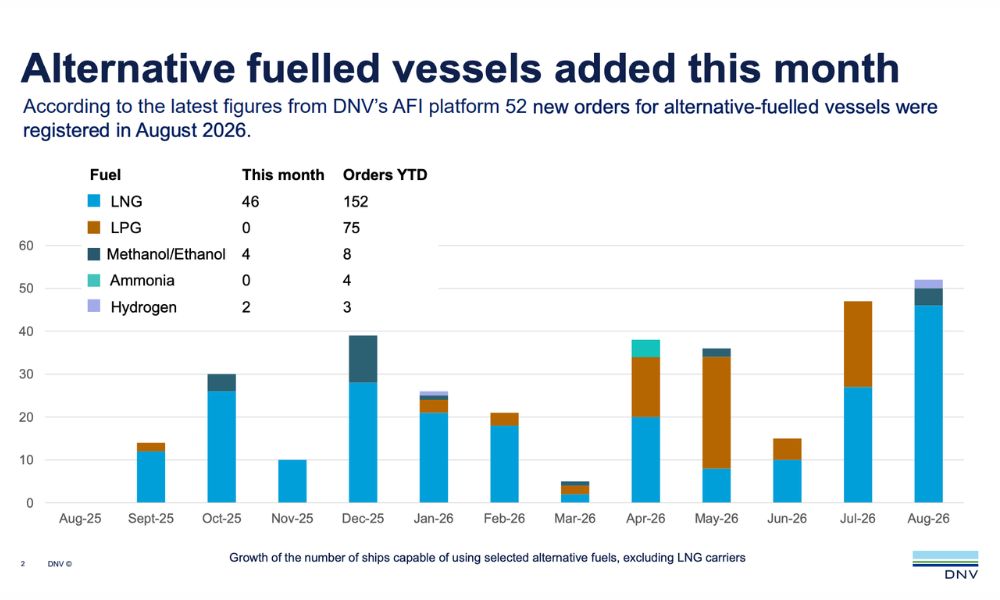
Latest data from classification society DNV’s Alternative Fuels Insight (AFI) platform showed a total of 15 new orders for alternative-fuelled vessels were placed in June 2026.

This consisted of 10 orders for LNG-fuelled vessels, nine of which were car carriers and one a CO2 carrier. The remaining five orders were for LPG/ethane carriers.

Two LNG-bunker vessels were also ordered in June, bringing the total in this segment to seven so far in 2026.

In total, 137 alternative-fuelled vessels were ordered in the first half of 2026, down 11.6% from 155 in the same period in 2025. 

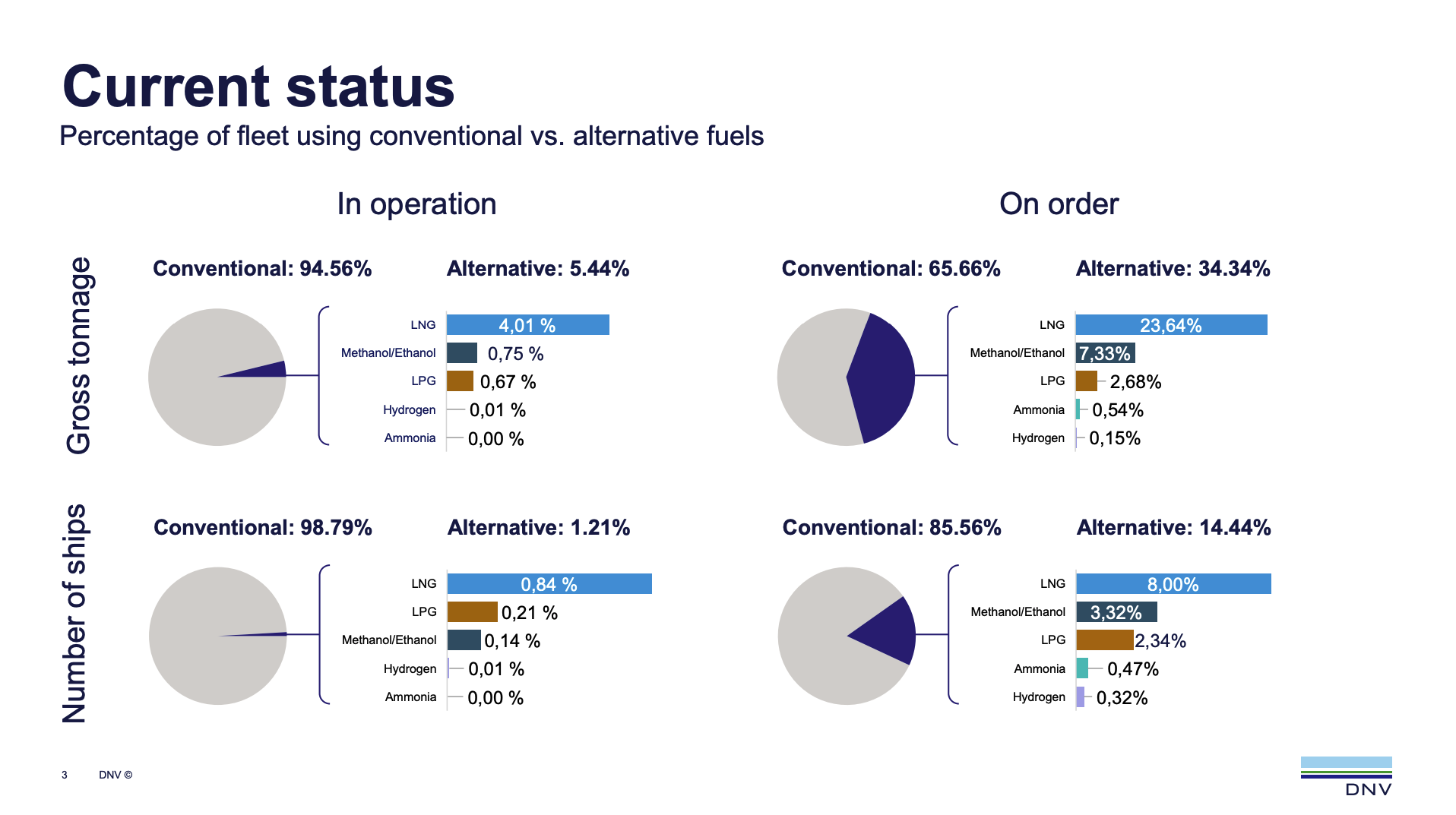
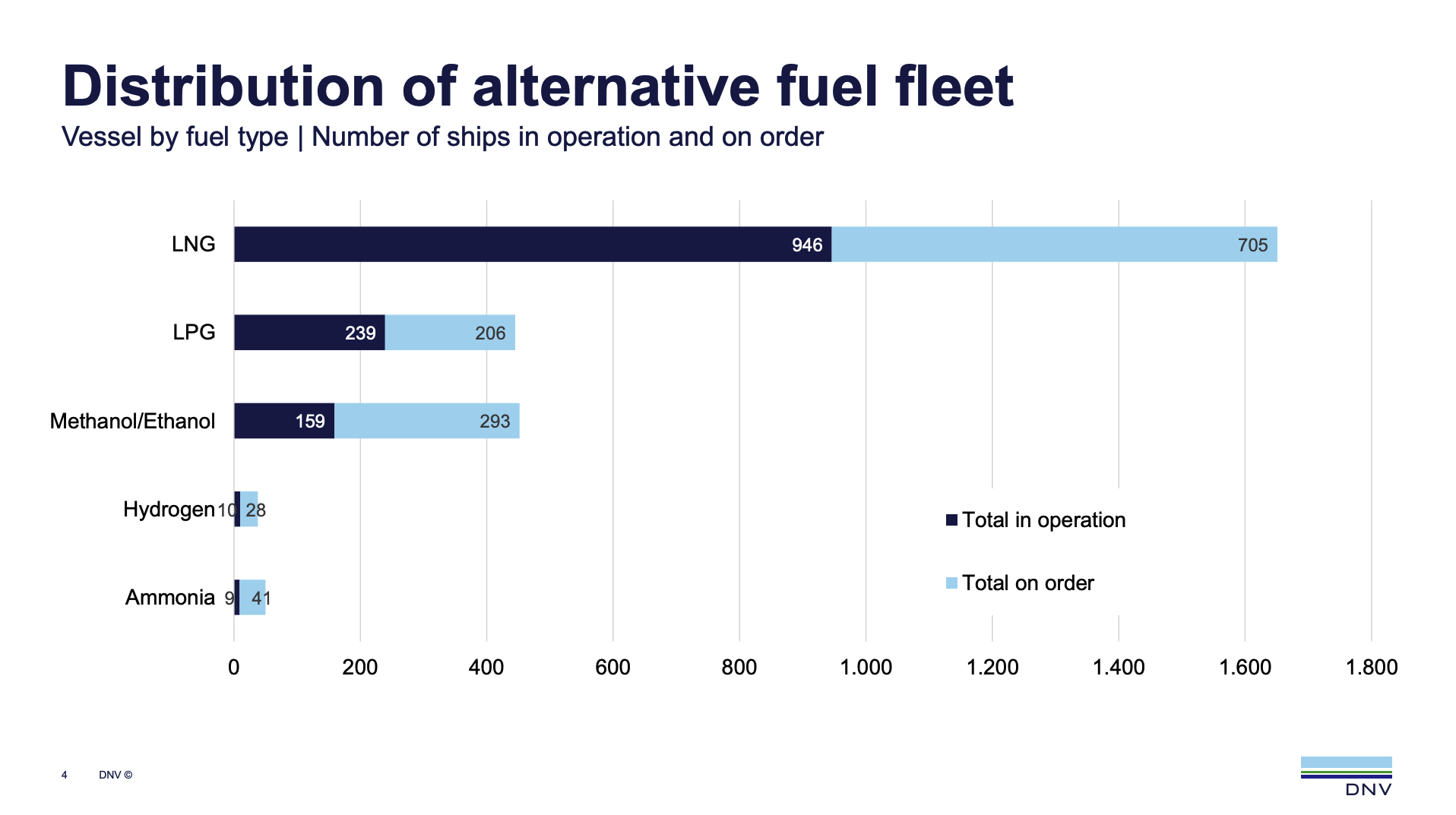
Over half of these (73) were for LNG-fuelled vessels, with most coming from the container (42) and car carrier (21) segments. LPG/ethane carriers were also prominent, with 55 new orders, a significant uptick compared to the first half of 2025 (15). The remaining orders were for vessels fuelled by methanol (2), ethanol (2), ammonia (4), and hydrogen (1).

Deliveries in the first half of the year point to continued uptake of alternative-fuelled tonnage across several segments, with 61 LNG-fuelled vessels and 38 methanol-fuelled vessels delivered so far in 2026.

More recently, Exmar took delivery of what it described as the first oceangoing dual-fuel ammonia vessel, marking a step beyond earlier ammonia-fuelled deliveries, which have largely been associated with pilot or demonstration projects rather than commercial deployment.

DNV: Alternative-fuelled vessel orders down 11.6% in H1 2026

Jason Stefanatos, Global Decarbonization Director at DNV Maritime, said: “What we can take away from the first half of 2026, in terms of the alternative-fuels orderbook, is that we have a market progressing at different speeds depending on segment economics, fuel availability, and the regulatory landscape. Shipowners and other stakeholders are pursuing different pathways based on their individual priorities and requirements.

“LNG remains the leading near-term fuel option, with order activity continuing to be led by containers and car carriers. LPG and ethane carriers have also accounted for a significant share of activity in the first half of the year, while developments in areas such as ammonia and ethanol show that multiple pathways continue to be explored.”


Photo credit: DNV
Published: 3 July, 2026

Continue Reading

Trending