Connect with us

Shipping Corridor

China: Shanghai partners with Europe and Australia ports for green shipping corridors

Shanghai is co-founding a green Ro-Ro shipping corridor together with Barcelona in Spain and Antwerp-Bruges in Belgium while also establishing a green shipping corridor with Melbourne.

Admin

Published

on

China: Shanghai partners with Europe and Australia ports for green shipping corridors

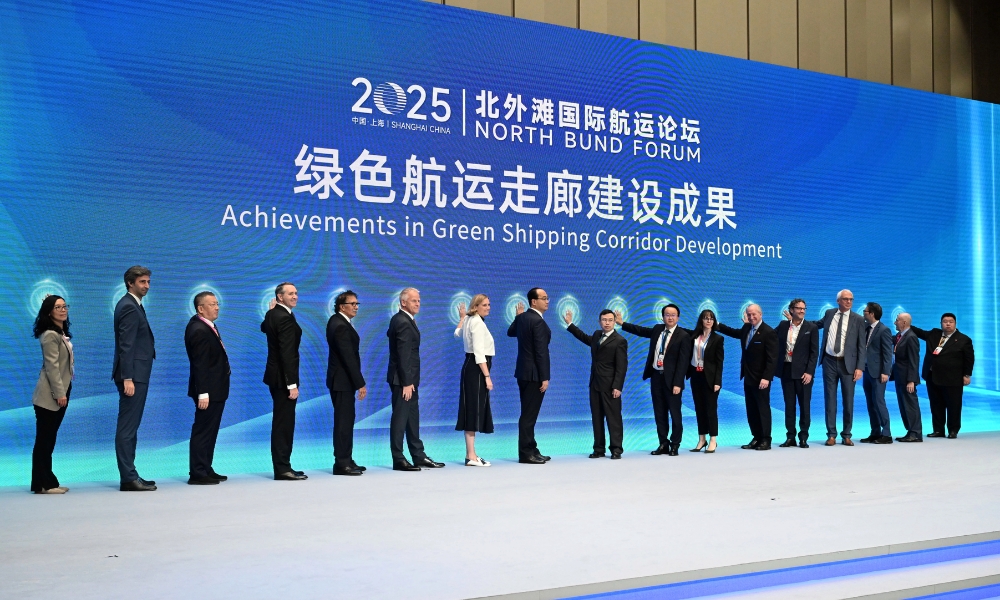
Shanghai caught much attention from global attendees with its endeavors to build more green shipping corridors with overseas partners at the opening of 2025 North Bund Forum, according to Xinhua Silk Road on Tuesday (21 October).

Currently, the green shipping corridors built together with several European and American ports are advancing intensive application of emission-reduction technologies and multiple-party participation to establish a testing field for global shipping industry transformation.

For instance, Shanghai port is co-founding a green Ro-Ro shipping corridor together with Port of Barcelona in Spain and Port of Antwerp-Bruges in Belgium. Other Chinese ports are building similar green shipping corridors with German and French ports.

After a year-long operation, the Shanghai-Hamburg green shipping corridor unveiled in 2024, has forged ahead in sustainable development.

Apart from the regular shore power service, Shanghai port’s container berths can now refuel LNG and green methanol, while Hamburg port’s berths with 100 percent green shore power service plans to start methanol injection service this year, ready to co-craft an emission-reduction model for Eurasian shipping routes. 

Meanwhile, Port of Melbourne announced it has joined forces with Port of Shanghai, with an aim to establish a Green Shipping Corridor between the two ports. The agreement was formalised at the 2025 North Bund Forum in Shanghai, China, on 19 October.

This joint initiative, supported by the C40 Cities Climate Leadership Group (C40), brings together Port of Melbourne and Shanghai Municipal Transportation Commission (SMTC) in response to the Clydebank Declaration and the broader decarbonisation of the maritime supply chain.

Under the Memorandum of Understanding (MoU), the parties will seek to:

  • Collaborate with industry partners – including Shanghai International Port Group (SIPG), COSCO SHIPPING Lines, HAMR Energy, and ABEL Energy – to explore avenues to implement measures to reduce the environmental impact of the shipping industry.
  • Focus on environmentally sustainable practices, such as the adoption of cleaner technologies, use of renewable energy sources, and implementation of best practices to minimise the ecological footprint of shipping activities.
  • Work closely with shipping lines seeking to promote the adoption of clean fuels, with the goal of increasing the usage of clean-energy-powered ships operating between Shanghai and Melbourne.
  • Explore opportunities with energy suppliers to accelerate breakthroughs in production technology, improve efficiency and cost control, and establish an integrated supply chain system covering production, transportation, and storage to boost low carbon fuel supply capacity.

Saul Cannon, Chief Executive Officer of Port of Melbourne, said: “This MoU is a significant development in our work towards decarbonising the supply chain. Given Australia’s position as an island-nation that heavily relies on sea freight, we have a key role in global efforts to decarbonise shipping.”

“As Australia’s largest container port working together with the world’s largest container port, we are well-placed to lead by example towards a greener future for our industry. We look forward to working with our industry partners to progress this initiative,” Mr Cannon added.

China is Port of Melbourne’s largest trading partner, accounting for 50 percent of total container imports and 20 percent of container exports. With the high volume of trade between both ports, this partnership has the potential to provide material benefits for the environment.

This milestone is a culmination of a nearly two-decade-long partnership between Port of Melbourne and SMTC, which commenced in 2006.


Photo credit: Port of Melbourne
Published: 22 October, 2025

Continue Reading

Shipping Corridor

BV and Shenzhen Port Group to advance green shipping corridor development

Through resource sharing and complementary capabilities, they will jointly develop green shipping projects to deliver replicable and scalable outcomes.

Admin

Published

on

By

BV and Shenzhen Port Group to advance green shipping corridor development

Bureau Veritas Marine & Offshore (BV) on Tuesday (30 June) said it signed a strategic cooperation agreement with Shenzhen Port Group on 29 June in Shenzhen, China.

The two parties engaged in in-depth discussions on strengthening collaboration across key sectors and jointly advancing the development of green shipping corridors.

Under the agreement, both parties will leverage their respective strengths and resources to deepen collaboration focused on the development of green shipping corridors and related businesses. Through resource sharing and complementary capabilities, they will jointly develop green shipping projects to deliver replicable and scalable outcomes.

Bureau Veritas will provide professional technical support to Shenzhen Port Group and industry players at large, helping them navigate evolving maritime regulatory policies and translate emerging international rules into practical, implementable measures to align domestic and global industry standards.

Backed by its comprehensive global business footprint, BV offers end-to-end testing, inspection and certification services covering the entire green fuel industrial chain, spanning renewable energy production to bunkering infrastructure for marine fuels. It has also built extensive hands-on experience in numerous domestic green fuel projects.

Alex Gregg-Smith, President of Bureau Veritas Marine & Offshore, said: Global decarbonization of the shipping industry requires concerted efforts and in-depth collaboration across the entire industrial value chain. 

“As a world-class port conglomerate, Shenzhen Port Group boasts strengths that are highly complementary to Bureau Veritas’s expertise in technical services and standard-setting. Deepening our partnership is of great significance for the green transition of the shipping sector. We hope this collaboration will serve as a catalyst to align domestic and international standards and jointly develop viable pathways for low-carbon maritime trade.”

Hu Zhaoyang, Secretary of the Party Committee and Chairman of the Board at Shenzhen Port Group, stated: “Bureau Veritas Marine & Offshore is a globally recognized authoritative body in the maritime sector, with a wealth of decarbonization solutions and practical experience for the global shipping industry. Its vision aligns perfectly with Shenzhen Port Group’s green development strategy. 

“Building on this agreement, we will further expand all-round cooperation across relevant fields, and maximize the combined value of Shenzhen Port Group’s diverse industrial application scenarios and BV’s authoritative technical certification capabilities to achieve mutual benefit through complementary strengths.”


Photo credit: Bureau Veritas Marine & Offshore
Published: 2 July, 2026

Continue Reading

Alternative Fuels

Ports of Barcelona and Shanghai team up to develop green ports, alternative bunker fuels

Agreement officially establishes the ‘sister ports’ relationship between Shanghai and Barcelona and aims to boost cooperation in areas such as developing green ports and alternative fuels.

Admin

Published

on

By

Ports of Barcelona and Shanghai team up to develop green ports, alternative bunker fuels

The Port of Barcelona on Thursday (11 June) said it signed a new strategic cooperation agreement with the Shanghai Municipal Transportation Commission (SMTC) and Shanghai International Port Group (SIPG).

The agreement officially establishes the “sister ports” relationship between Shanghai and Barcelona and aims to boost cooperation in areas such as the digitalisation and security of port operations; developing green ports and alternative fuels; intermodality and fostering sustainable maritime corridors between the Far East and the Mediterranean. 

The agreement was signed by José Alberto Carbonell, president of the Port of Barcelona; Xiao Hui, general director of the SMTC, and Yang ZhiYong, vice president of SIPG, in the presence of Jaume Duch, Regional Minister for European Union and Foreign Action. 

The relationship between the Port of Barcelona and the Port of Shanghai has intensified in recent years. In late July 2025, a preliminary agreement was signed between both port authorities, which led to a technical visit in September 2025 by a delegation from Shanghai led by Wang Haijian, Vice President and Director of Operations of SIPG, to advance the development of the Green Shipping and Digital Corridor between both ports. 

“This new institutional visit and the signing of the new agreement consolidates the Port of Barcelona’s position as a Euro-Mediterranean logistics hub and strengthens its links with one of the main ports and economic centres in the world,” the port said. 


Photo credit: Port of Barcelona
Published: 12 June, 2026

Continue Reading

Shipping Corridor

Industry partners launch Brazil-Belgium e-fuel green shipping corridor initiative

A new consortium facilitated by the Global Maritime Forum and RMI will work to establish a green shipping corridor between the Port of Açu in Brazil and the Port of Antwerp-Bruges in Belgium.

Admin

Published

on

By

RESIZED william william on Unsplash

A new consortium facilitated by the Global Maritime Forum and RMI will work to establish a green shipping corridor between the Port of Açu in Brazil and the Port of Antwerp-Bruges in Belgium, according to Global Maritime Forum on Thursday (4 June). 

In addition to the port teams on both ends of the corridor, the consortium includes HIF Global, Fuella, NYK Line, Höegh Autoliners, and Wallenius Wilhelmsen. 

The consortium will assess infrastructure, vessels, and business models to create a roadmap for transporting zero-carbon fuels produced in Açu, such as e-ammonia or e-methanol. The transport itself would also be powered by the same zero- or near-zero-emission fuels.

“We’re thrilled to be working with these partners to take these important steps towards Brazil’s e-fuel production and bunkering opportunity, whilst supporting the growing demand for e-fuels in Europe,” said Eleanor Wells, a senior project manager at the Global Maritime Forum.

The new consortium builds on a pre-feasibility study developed by RMI and the Global Maritime Forum in November 2025. 

The study highlighted the competitive projected costs of e-fuel produced in Açu, due to Brazilian policies supportive of green hydrogen production, the country’s largely renewable electricity grid, its abundance of renewable energy sources, and a relatively low cost of capital. A 2024 report from the same two organisations, Oceans of Opportunity, identified the Port of Açu as a high-potential e-fuel export hub.

Green shipping corridors are dedicated trade routes where the feasibility of zero-emission shipping is catalysed by public and private action. These routes are seen as central to delivering on the shipping industry’s goal of having zero-emission fuels account for 5% of all fuels by 2030. 

While green corridors have rapidly expanded in popularity worldwide, and a handful of initiatives have now reached the realisation stage, the most recent edition of the Annual Progress Report on Green Shipping Corridors warned that progress is being stalled by a ‘feasibility wall’ created by the cost gap between conventional and zero-emission fuels.

The Global Maritime Forum and RMI will continue to facilitate the realisation of the Açu-Antwerp green corridor, with work already moving at pace to progress beyond pre-feasibility and develop a feasibility analysis for the corridor. The feasibility analysis is expected to be published by the end of the year, with the consortium meeting regularly in the meantime.


Photo credit: william william on Unsplash
Published: 5 June, 2026

Continue Reading

Trending