
Biofuel
Moeve deal with Armas marks its largest bio bunker fuel supply, first in Canary Islands
Moeve signs an agreement with Armas Trasmediterránea to supply 2G marine biofuels, with 40,000 mt to be delivered through December 2025 – marking Moeve’s first biofuel supply in Canary Islands.

Bunker Fuel
Alkagesta highlights key insights of Malta bunkering market in 2026
Darren Lee Axisa discusses the key trends influencing Malta’s bunkering market and the factors that will determine Malta’s long-term competitiveness as a regional bunkering hub.
Alternative Fuels
ENGINE on Fuel Switch Snapshot: LSMGO surges to greater premium over biofuel
B100 discount to LSMGO widens to $541/mt in Rotterdam; Singapore’s B100 drops to $106/mt below LSMGO; Rotterdam LBM at $639-833/mt discounts to LSMGO.
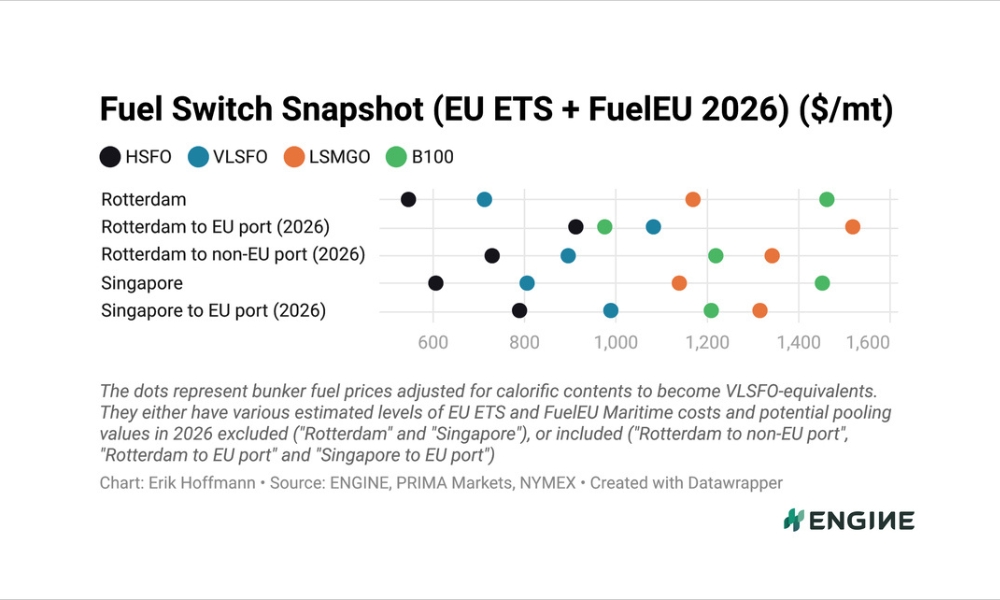
Once a week, bunker intelligence platform ENGINE will publish a snapshot of alternative and conventional bunker fuel prices in the world’s two biggest bunkering hubs. The following is the latest snapshot:
20 July 2026
- B100 discount to LSMGO widens to $541/mt in Rotterdam
- Singapore’s B100 drops to $106/mt below LSMGO
- Rotterdam LBM at $639-833/mt discounts to LSMGO
B100’s premium over HSFO in Rotterdam has narrowed by $50/mt over the past week to $64/mt, while its discount to VLSFO has widened by $83/mt to $105/mt.
B100 has become far more competitive against LSMGO in Rotterdam, with its discount widening by $180/mt over the past week to $541/mt, as a surge in conventional fuel prices left B100 broadly unchanged by comparison.
B100’s price has risen by $109/mt in Singapore, but its discount to LSMGO has still widened by $102/mt to $106/mt, as LSMGO surged by an even greater $211/mt.
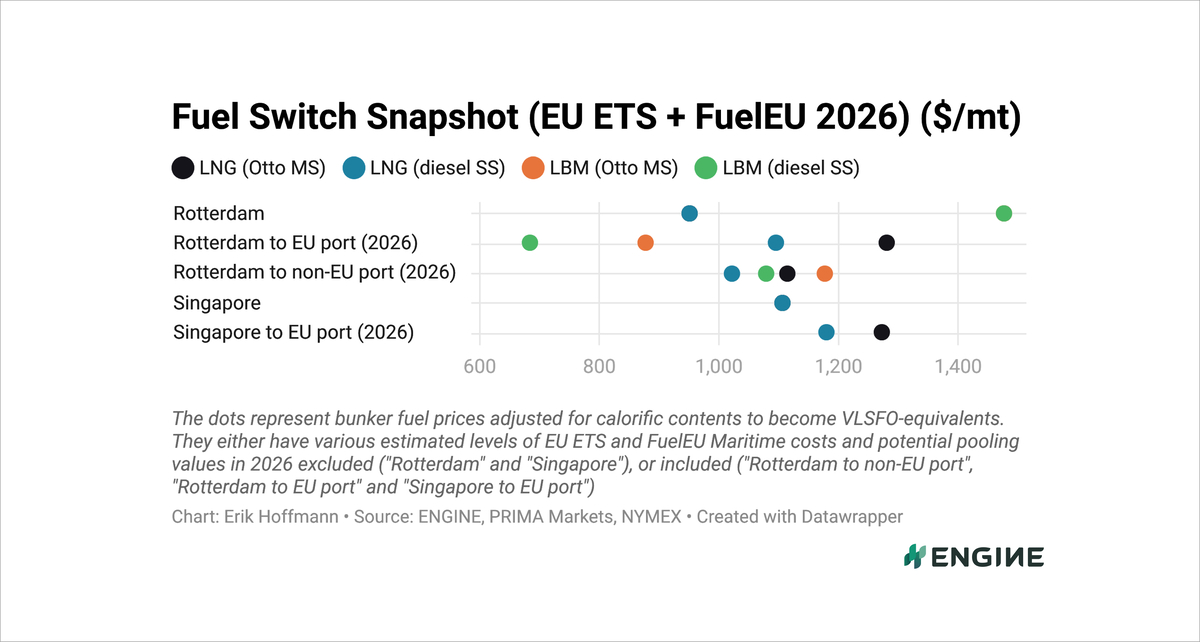
Rotterdam’s LNG premium over VLSFO has widened by $35/mt to $201/mt for vessels with Otto medium speed (Otto MS) engines. For vessels with diesel slow speed (diesel SS) engines, LNG has flipped to a $15/mt premium over VLSFO, from a $22/mt discount the prior week.
Liquefied biomethane (LBM) discounts to VLSFO in Rotterdam have narrowed by $50-52/mt to $203-396/mt over the past week. Against LSMGO, LBM discounts have widened by $45-47/mt to $639-833/mt, depending on engine type.
In Singapore, LNG is now $42/mt cheaper than LSMGO for vessels with Otto MS engines, and $134/mt cheaper for vessels with diesel SS engines.
Liquid fuels
HSFO and VLSFO prices in Rotterdam have jumped by $66/mt and $99/mt respectively over the past week, while LSMGO has surged by an even steeper $196/mt. A $9.69/bbl ($71/mt) rise in front-month ICE Brent futures, to $87.94/bbl ($645/mt), drove bunker prices sharply higher across the board.
Bunker fuel availability is tight for prompt delivery dates in the ARA ports, with buyers advised to enquire about stems between 5-7 days ahead to get good coverage, a trader said.
Rotterdam’s B100 price has risen by $16/mt over the past week. Dutch ZRE A ticket prices were unchanged at €107.50/mtCO2e.
Singapore’s HSFO and VLSFO prices have risen by $130/mt and $132/mt respectively, while its LSMGO price has gained an even steeper $211/mt over the past week.
VLSFO availability in Singapore has been tight, with several suppliers reporting low stock levels. Recommended lead times have widened from 13–17 days last week to 14–19 days now.
Liquid gases
Rotterdam’s LNG prices have surged by $134-136/mt over the past week, while its LBM prices have climbed by $149-151/mt.
LBM discounts to LNG in Rotterdam have narrowed by $15/mt to $404-411/mt.
Singapore’s LNG bunker benchmarks have surged by $196-197/mt over the past week.
By Erik Hoffmann
Photo credit and source: ENGINE
Published: 21 July, 2026
Alternative Fuels
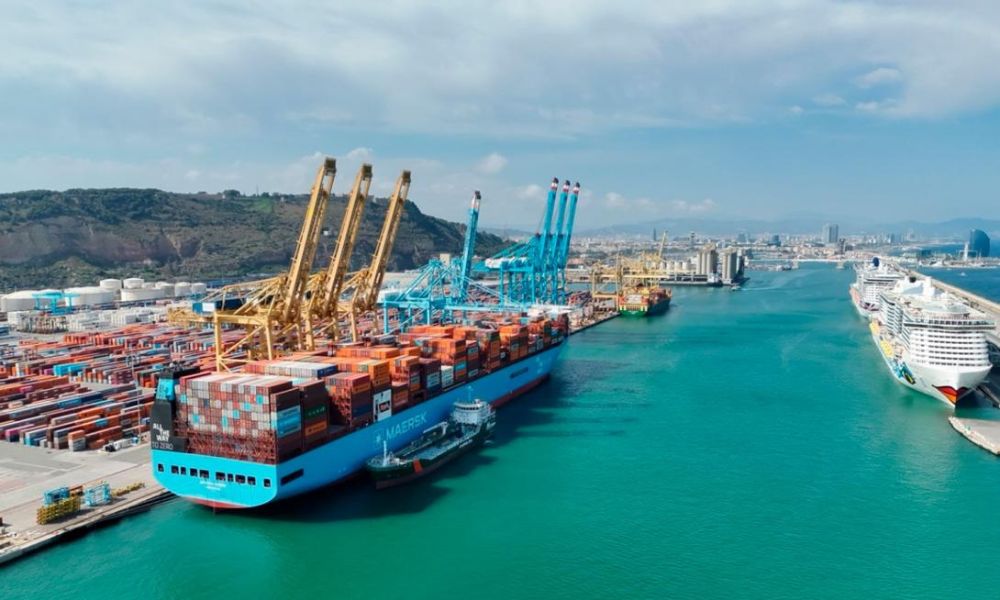
Repsol and Maersk wrap up first bioethanol bunkering operation in Port of Barcelona
Repsol supplied 2,800 mt of bioethanol to a Maersk container vessel, “Antonia Maersk”, in the first bunkering operation of its kind in the Port of Barcelona and one of the first in the Mediterranean.

OUR INDUSTRY PARTNERS

Singapore: High Court to hear Norvic Shipping Asia winding up application on 31 July

World Fuel and partners complete first green methanol bunkering of car carrier in Shanghai

HPA and MB Energy develop safety concept for STS ammonia bunkering

GCMD: Project CAPTURED achieves two regulatory milestones for onboard captured CO2

Alkagesta highlights key insights of Malta bunkering market in 2026

ENGINE: East of Suez Fuel Availability Outlook (22 July 2026)

Singapore: Ofiniti, ONE trial direct platform integration to streamline bunker workflows

Malaysia: Maharani Freeport to implement MFM and e-BDN technologies for enhanced bunkering transparency

ENGINE: Europe and Africa Fuel Availability Outlook (8 July 2026)

Evergreen Marine director questioned, offices searched in Taiwan insider trading probe

Singapore retains world’s leading maritime centre ranking in 2026 ISCD Index

Singapore: MPA issues circular on resolutions adopted by IMO MEPC 84

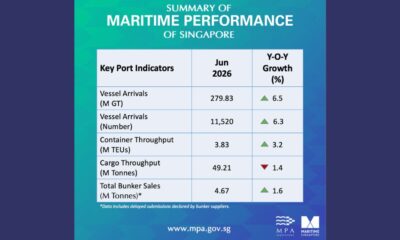
Singapore: Bunker fuel sales up by 1.6% on year in June 2026

Malaysia: MMEA detains tugboat with undocumented 10,000 litres of diesel in Kuala Langat
-
 Technology1 week ago
Malaysia: Maharani Freeport to implement MFM and e-BDN technologies for enhanced bunkering transparency
-
 Bunker Fuel Availability2 weeks ago
ENGINE: Europe and Africa Fuel Availability Outlook (8 July 2026)
-
 Legal2 weeks ago
Evergreen Marine director questioned, offices searched in Taiwan insider trading probe
-
 Business2 weeks ago
Singapore retains world’s leading maritime centre ranking in 2026 ISCD Index
-
 Port & Regulatory1 week ago
Singapore: MPA issues circular on resolutions adopted by IMO MEPC 84
-
 Bunker Fuel1 week ago
Singapore: Bunker fuel sales up by 1.6% on year in June 2026
-
 Vessel Arrest1 week ago
Malaysia: MMEA detains tugboat with undocumented 10,000 litres of diesel in Kuala Langat
-
 Alternative Fuels1 week ago
Port of Santos hosts Brazil’s first bioethanol bunkering of deep-sea containership