Connect with us

Shipping Corridor

Ports of Tyne and IJmuiden launch Green North Sea Shipping Corridor project

Success of the project will drive the development of port infrastructure for electrification and the bunkering of clean powered vessels, says Matt Beeton, CEO at Port of Tyne.

Admin

Published

on

Ports of Tyne and IJmuiden launch Green North Sea Shipping Corridor

Port of Tyne on Tuesday (3 December) said it launched a new project to create the Green North Sea Shipping Corridor, between the Port of Tyne in North East England and the Port of IJmuiden, situated directly by the sea at the entrance to the North Sea Canal Area and close to Amsterdam. 

The port said the project is part of a GBP 9million (USD 11.4 million) investment announced by Maritime Minister Mike Kane in October, to decarbonise shipping and turbocharge green jobs, from which the port was successful in winning the International Green Corridors Fund.

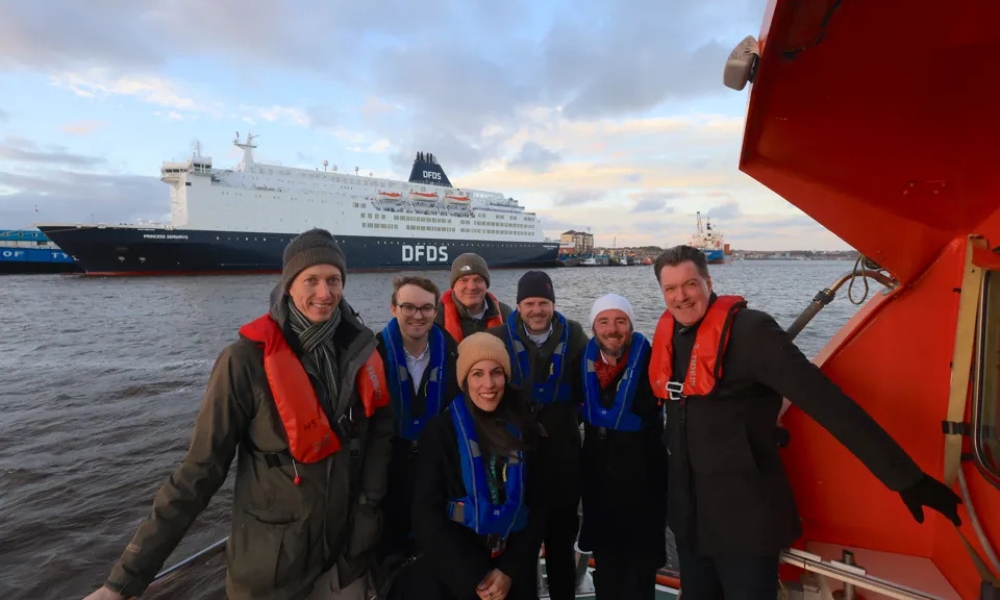
During a visit, representatives from each organisation which includes the two ports as well as Copenhagen-listed transport and logistics company DFDS, London-listed environmental, engineering and strategic consulting company Ricardo plc and maritime data and communication provider KSVA, set in motion the scheme.

“This initiative aligns with the partners’ commitment to sustainability and plans for DFDS to target a significant reduction in CO2 emissions, by transitioning to methanol-fuelled RoRo/RoPax vessels, driving the shift towards a greener future for global trade,” Port of Tyne said in a social media post. 

Separately, Ricardo said it will be the lead environmental consultancy in the next phase of the development of the green corridor project. 

“Ricardo will provide its expertise and insight in sustainable shipping and low-carbon fuels choice to help determine a viable path for decarbonisation between the two ports,” the firm said. 

Matt Beeton, CEO at the Port of Tyne, said: “This initiative represents another step forward for the port in our sustainability journey. By establishing this green corridor between the Port of Tyne and the Port of IJmuiden, we aim to significantly reduce carbon emissions between the Northeast of England and northern Europe, with the aim of saving up to 850,000 tonnes of CO2 annually.”

“The success of this project will bring more green jobs to the region and drive the development of port infrastructure for electrification and the refuelling of state-of-the-art clean powered vessels.”

Peter van de Meerakker, Managing Director of Zeehaven IJmuiden N.V. – Port of IJmuiden, said: “With the ‘zero emission’ new tonnage of DFDS, we are taking an important step forward, since a lot still needs to be done on both sides of the North Sea and this project helps enormously speed up and achieve our goals.”


Photo credit: Ricardo
Published: 4 December, 2024

Continue Reading

Alternative Fuels

SMW 2026: Singapore, LA, and Long Beach Ports renew Green, Digital Shipping Corridor MoU

All three ports have advanced their alternative fuels bunkering capabilities since the corridor’s launch which will prepare them for green fuel trials in the next phase of their partnership.

Admin

Published

on

By

Singapore, LA, and Long Beach Ports renew Green and Digital Shipping Corridor MoU

The Maritime and Port Authority of Singapore (MPA) on Monday (20 April) said it has renewed a Memorandum of Understanding (MoU) with Port of Los Angeles (POLA), and Port of Long Beach (POLB), with the support of C40 Cities, on the Green and Digital Shipping Corridor for another three years.

First signed in 2023, the renewal reinforces the ports’ commitment to decarbonisation and digitalisation along the Trans-Pacific route, one of the world’s busiest container trade lanes. It also supports efforts to strengthen supply chain resilience and energy security.

Since the corridor’s launch, several milestones have been achieved. These include the completion of a baseline study in 2024, onboarding of industry partners to explore potential pilot trials, and establishment of workstreams to advance pilot initiatives in alternative fuels, digitalisation, and energy efficiency. 

These initiatives support the development of more diversified and resilient energy pathways for international shipping.

All three ports have also advanced their alternative fuels bunkering capabilities. MPA completed methanol bunkering trials in 2023 and subsequently awarded three methanol bunkering supply licences. POLA and POLB have commissioned a Clean Fuels Study and are preparing for a methanol pilot in 2026. 

These developments prepare the three ports for green fuel trials in the next phase of their partnership. The partners have also conducted port-to-port data exchange testing and started pilot collaborations with Mitsui O.S.K. Lines.

Under the renewed MoU, the partners will continue working with industry to deploy low- and zero-emission fuels and digital solutions. This includes supporting fuel supply and infrastructure, developing pilot and demonstration projects, strengthening port-to-port data connectivity, and promoting interoperability, cybersecurity, and common standards.

The MoU was signed ahead of the Singapore Maritime Week 2026 by Mr Ang Wee Keong, Chief Executive of MPA; Mr Gene Seroka, Executive Director of POLA; and Dr Noel Hacegaba, Chief Executive Officer of POLB. C40 Cities will continue to serve as a facilitator to convene partners, coordinate collaboration and provide communications support. 

Mr Ang Wee Keong, Chief Executive, MPA, said: “The Singapore-Los Angeles-Long Beach Green and Digital Shipping Corridor has made good progress, transitioning from intent to implementation. 

“The renewal of our partnership paves the way towards more sustainable shipping along the Trans-Pacific route. This gives industry greater confidence to plan investments and diversify energy options for greener shipping.”

Port of Los Angeles Executive Director Gene Seroka, said: “Decarbonising goods movement between the largest ports in the United States and Asia requires international cooperation and that’s exactly what we’re doing through our work on the Green and Digital Shipping Corridor. 

“We are committed to working toward the deployment of zero lifecycle carbon container ships on the corridor by 2030. This important corridor is the foundation upon which we’ll build the future of maritime shipping.”

Port of Long Beach CEO Dr. Noel Hacegaba, said: “Seaports sit at the intersection of trade, geopolitics, climate and technology. This convergence is what makes partnerships like the Green and Digital Shipping Corridor so impactful as a tool to decarbonise maritime shipping. 

“We call it the ‘green print’ for decarbonising the trans-Pacific route, the busiest trade route on Earth. It will be particularly important in the years ahead as we tackle our largest source of emissions, from cargo vessels, by accelerating the use of clean fuels such as methanol.”


Photo credit: Maritime and Port Authority of Singapore
Published: 21 April, 2026

Continue Reading

Shipping Corridor

South Korea passes Green Shipping Corridor Support Act

While Korean NGO SFOC welcomed the move, it noted with concern that the final version of the Act broadened the definition of “green vessels” to include low-carbon fuels.

Admin

Published

on

By

Lauren Seo on Unsplash

South Korea has passed the Green Shipping Corridor Support Act in the National Assembly, a law intended to help the maritime sector move toward carbon neutrality and promote green vessel operations, according to Korean media Energy Daily on Thursday (12 March). 

The National Assembly passed the bill with amendments at the plenary session of the 433rd extraordinary session.

The legislation focuses on creating an institutional framework to support the development of green shipping routes. These routes will rely on green vessels and ports, with the goal of reducing greenhouse gas emissions across the shipping industry

The revised bill requires the Minister of Oceans and Fisheries to develop and carry out a plan for developing green shipping routes every five years. It also authorises the government to officially designate routes linking two or more eco-friendly ports—served by green vessels—as designated green shipping routes.

Korean non-government organisation Solutions for Our Climate (SFOC) welcomed the passing of the bill, calling it “a move that advances efforts to decarbonise the shipping sector”.

“In 2024, SFOC provided policy recommendations on reducing greenhouse gas emissions from the shipping sector, and we view the passage of this Act as a highly meaningful step forward,” it added.

However, it noted with concern that the final version of the Act broadened the definition of “green vessels” to include low-carbon fuels.

“This adjustment may risk prolonging reliance on these fuels, locking in emissions rather than accelerating the transition to zero-carbon solutions,” SFOC explained. 

“It is essential to establish clear safeguards to ensure that fuels such as LNG and bio-LNG — which are not fundamental zero-emission solutions — do not become entrenched within public support frameworks. 

“Achieving net-zero emissions by 2050 ultimately requires a decisive shift toward zero-carbon fuels and renewable-based propulsion systems.”

Related: SFOC report proposes green methanol-fuelled Korea-Europe shipping corridor


Photo credit: Lauren Seo on Unsplash
Published: 17 March, 2026

Continue Reading

Alternative Fuels

Viking Line secures 50% biogas supply to cover its fuel needs for H1 2026

Biogas is used alongside liquefied natural gas on the company’s newest ships, “Viking Glory” and “Viking Grace”, which operate daily between Turku and Stockholm.

Admin

Published

on

By

Viking Line secures 50% biogas supply to cover its fuel needs for H1 2026

Viking Line on Tuesday (3 February) said it is starting 2026 by renewing its offer of travel and transport powered by a high share of renewable European biogas. 

After multiplying the use of biofuel tenfold last year, the Åland-based shipping company has now secured another year at the same ambitious level.

The biogas is used alongside liquefied natural gas on the company’s newest ships, Viking Glory and Viking Grace, which operate daily between Turku and Stockholm. This combination results in very low sulphur and particle emissions, as well as a greatly reduced climate footprint.

“Last year, our greenhouse gas emissions on Glory and Grace were reduced by nearly 50,000 tonnes. For the first half of 2026, we have secured 50 percent biogas to cover our fuel needs, and our ambition is to maintain a high level throughout the entire year,” said Dani Lindberg, Head of Sustainability at Viking Line.

By choosing Viking Lines vessels on the Turku – Stockholm route, passenger and freight customers influence the amount of biogas used in ship operations and thereby directly contribute to further emission reductions in the Baltic Sea. 

Viking Line has been developing a green shipping corridor between Turku  and Stockholm in cooperation with Ports of Stockholm and the Port of Turku. The objective is for the corridor to be completely fossil-free by 2035.

“Globally, there is no lack of initiatives to create fossil-free sea lanes, but most are still in the planning stages. Our investment in biogas and energy-efficient vessels is one of the clearest and largest-scale examples of how shipping can transition in practice,” said Marcus Risberg, CEO of Viking Line.


Photo credit: Viking Line
Published: 4 February, 2026

Continue Reading

Trending