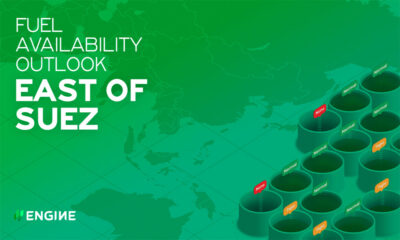
The following article regarding regional bunker fuel availability outlook for the East of Suez region has been provided by online marine fuels procurement platform ENGINE for publication on Singapore bunkering publication Manifold Times:
- VLSFO and HSFO availability is tight in Singapore
- Taiwanese ports brace for Typhoon Gaemi’s impact
- Bunker demand is low in Fujairah
Singapore and Malaysia
Despite low bunker demand in Singapore, lead times for VLSFO have increased from 5–14 days last week to 12–18 days now due to limited barge availability, according to a source.
HSFO availability also remains tight for both prompt and non-prompt delivery dates in Singapore, with recommended lead times of 11–13 days for the grade. Lead times for LSMGO have experienced significant fluctuations recently. Most suppliers are now advising 12 days for LSMGO, while some can accommodate stems within as little as two days.
According to Enterprise Singapore, the port’s residual fuel oil stocks have averaged 5% lower so far in July compared to June. Singapore’s fuel oil stocks have dropped below 19 million bbls despite a 14% increase in the port’s net fuel imports this month. Both imports and exports have declined this month, with fuel oil exports decreasing by 606,000 bbls, significantly more than the 149,000-bbl decline in imports. In contrast, the port’s middle distillate stocks have risen, averaging 7% higher this month.
In Malaysia’s Port Klang, VLSFO and LSMGO grades are abundantly available, with some suppliers offering prompt deliveries for smaller stem sizes, but HSFO supply is mostly limited.
East Asia
VLSFO and LSMGO grades are readily available in Zhoushan, with suppliers recommending lead times of 5-7 days. HSFO availability has improved, with lead times dropping from 7-10 days last week to 5-7 days now.
Bunker deliveries in Zhoushan have been halted since Monday due to bad weather induced by Typhoon Gaemi. The typhoon is currently located 470 kilometres southeast of Cape Eluanbi, Taiwan’s southernmost point, and moving north-northwest, according to the Chinese weather agency Central Weather Administration (CWA).
The typhoon is expected to make landfall in China’s Fujian province in the early hours of Friday. Wind gusts of 31–41 knots and waves over one meter are forecast to hit Zhoushan between Thursday and Friday. Most suppliers are uncertain about when bunkering operations will resume in Zhoushan.
The Taiwanese ports of Hualien, Kaohsiung, Taichung, and Keelung can offer VLSFO and LSMGO with short lead times of around two days, consistent with last week. A typhoon land warning has been issued for New Taipei and Yilan, Hualien, and Taitung counties in eastern Taiwan in anticipation of Typhoon Gaemi, which is expected to make landfall on the northeast coast of the country between Wednesday night and the early hours of Thursday, the CWA added. Bunkering operations in Taiwanese ports are likely to be suspended on Wednesday and Thursday due to Typhoon Gaemi, according to another source.
In Northern China, VLSFO and LSMGO grades are easily accessible in Dalian, Qingdao, and Tianjin, although HSFO supply is limited in Qingdao and Tianjin. Shanghai has a good supply of VLSFO and LSMGO, but HSFO remains scarce. In Fuzhou and Xiamen, VLSFO and LSMGO grades are readily available, while prompt availability is restricted in Guangzhou and Yangpu.
Hong Kong has an ample supply of all bunker fuel grades, with typical lead times of approximately seven days. Strong wind gusts of 24-27 knots and swells of more than a meter influenced by Typhoon Gaemi are predicted to hit Hong Kong this week, which might affect bunker deliveries at the port.
In South Korean ports, the availability of all fuel grades remains good. Most suppliers are recommending lead times of approximately three days for VLSFO and LSMGO across the country, almost unchanged from last week. For HSFO, lead times of around three days are advised in western South Korean ports, while suppliers in southern ports require a slightly longer 3–8 days. Rough weather conditions may intermittently affect bunker operations in the South Korean ports of Ulsan, Onsan, Busan, Daesan, Taean, and Yeosu between Thursday and Sunday.
In Japan, LSMGO and HSFO supply remains good in the major ports of Tokyo, Chiba, Yokohama, Kawasaki, Osaka, Kobe, Sakai, Nagoya, Yokkaichi, Mizushima, and Oita. On the contrary, VLSFO availability has tightened across all major Japanese ports. VLSFO supply in Tokyo, Chiba, Yokohama, Kawasaki, Nagoya, and Yokkaichi has tightened due to certain unknown technical issues at Japanese refineries. Most suppliers are anticipating VLSFO availability to remain tight until early August, a source says.
Japanese petroleum company Idemitsu Kosan shut its Yamaguchi refinery this March. The refinery had a crude oil processing capacity of 120,000 b/d, according to Reuters. This has constrained supply in Oita, necessitating advance orders, the source added.
Additionally, adverse weather conditions are predicted in the Thai ports of Koh Sichang and Laem Chabang between 23-29 July, in the Philippine port of Subic Bay between 23-26 July, and the Vietnamese port of Ho Chi Minh between 23-29 July, posing potential challenges for bunker deliveries.
Oceania
In Western Australia, VLSFO and LSMGO grades are available at ports including Kwinana, Fremantle, and Kembla, with typical lead times of 7-8 days. In New South Wales, LSMGO is readily available in Sydney, while prompt HSFO supply depends on the enquiry.
Victoria’s ports of Melbourne and Geelong have good availability of VLSFO and LSMGO, though prompt HSFO deliveries can be challenging. In Queensland, Brisbane and Gladstone have ample stocks of VLSFO and LSMGO, with lead times around 7-8 days, but HSFO availability is limited in Brisbane.
In New Zealand, Tauranga and Auckland have ample VLSFO supply, with Auckland also having good LSMGO availability. However, Tauranga is expected to experience rough weather conditions on Wednesday, which may impact bunker operations.
South Asia
In several Indian ports, including Kandla, Mumbai, Tuticorin, Chennai, Cochin, Visakhapatnam, and Haldia, VLSFO and LSMGO availability is currently limited due to supply shortages. A supplier in Paradip is nearly out of stock for both fuel grades.
Additionally, Kandla, Sikka, Mumbai, and Visakhapatnam ports are forecast to experience rough weather conditions intermittently this week, potentially disrupting bunker operations.
In contrast, the Sri Lankan port of Colombo has ample supplies of VLSFO, LSMGO, and HSFO grades, with lead times of around two days.
Middle East
Prompt availability of all grades remains tight in Fujairah, with most suppliers recommending lead times of 7–10 days, consistent with last week. A similar situation is observed in the other UAE port of Khor Fakkan, where lead times remain unchanged at 7–10 days.
In Iraq’s Basrah, VLSFO and LSMGO are readily available, while the supply of both grades is nearly depleted in Qatar’s Ras Laffan.
Supply of VLSFO and LSMGO remains good in the Saudi Arabian port of Jeddah. In Djibouti, LSMGO availability remains good, but VLSFO supply is tight. The Omani ports, including Sohar, Salalah, Muscat, and Duqm, have ample LSMGO available.
By Tuhin Roy
Photo credit and source: ENGINE
Published: 24 July, 2024