
Bunker Fuel
JLC China Bunker Market Monthly Report (August 2023)
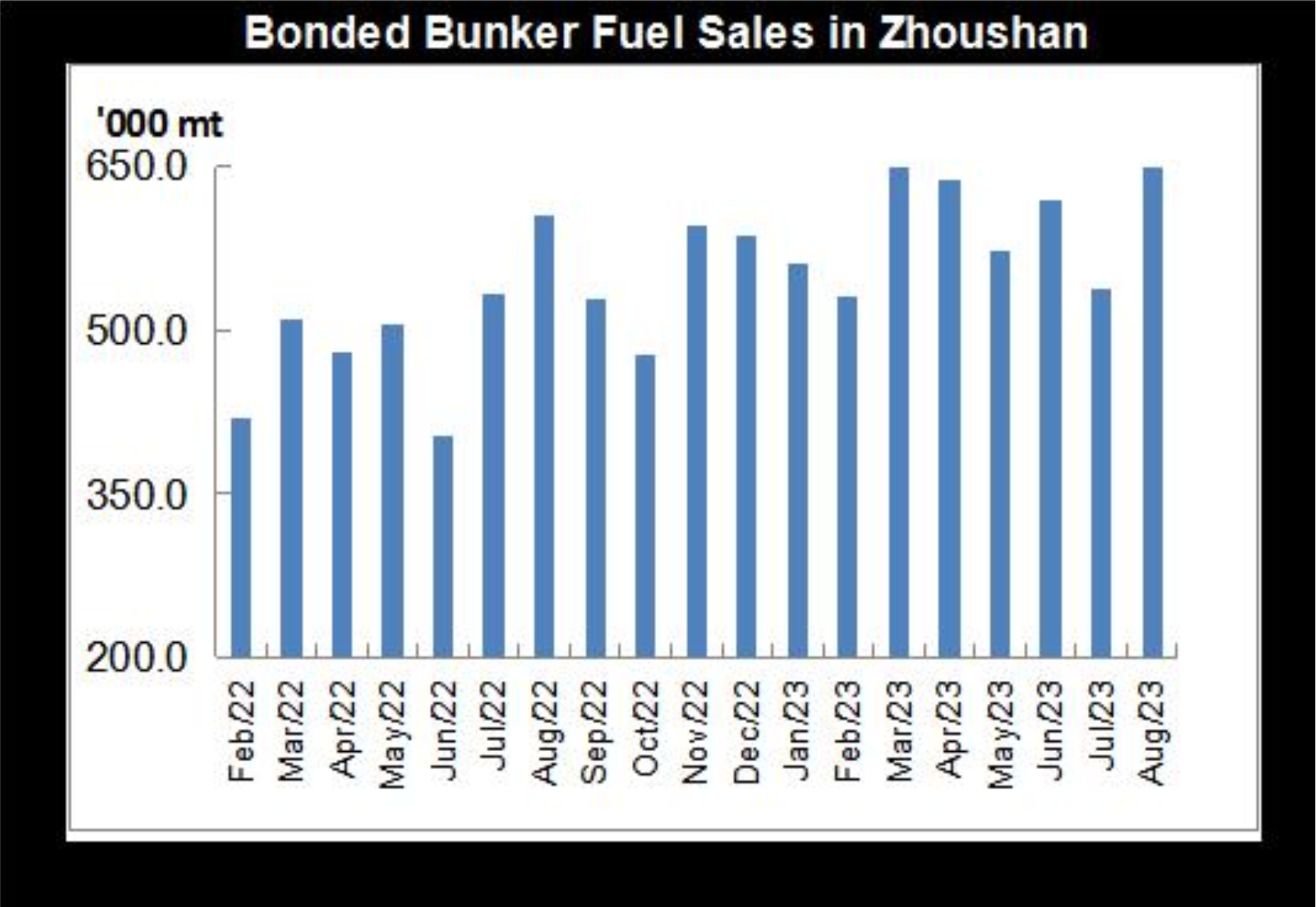
Country sold roughly 1.80 million mt of bonded bunker fuel in the month, with the daily sales rebounding by 11.80% from the previous month to about 58,065 mt, JLC’s data indicates.

Beijing-based commodity market information provider JLC Network Technology Co. recently shared its JLC China Bunker monthly report for August 2023 with Manifold Times through an exclusive arrangement:
Bunker Fuel Demand
China’s bonded bunker fuel sales rally in August
China’s bonded bunker fuel sales rallied in August, because of multiple factors.
The country sold roughly 1.80 million mt of bonded bunker fuel in the month, with the daily sales rebounding by 11.80% from the previous month to about 58,065 mt, JLC’s data indicates.
The sales by Chimbusco, Sinopec Zhoushan, SinoBunker and China ChangJiang Bunker (Sinopec) were 580,000 mt, 650,000 mt, 80,000 mt and 40,000 mt, respectively. Meanwhile, suppliers with regional bunkering licenses tallied about 450,000 mt of bonded bunker fuel sales.
Though the negative impact of bad weather lingered in Zhoushan and Ningbo, more shipowners came to refuel as bonded bunker fuel prices in the two regions were more competitive than those in Singapore. Meanwhile, the barging capacity at Shandong ports recovered to some degree, which also drove up the sales. On the other hand, however, the barging capacity at southern ports was insufficient amid tighter customs inspections, leading to a dip in the sales in South China.
China’s bonded bunker fuel exports drop in July
China’s bonded bunker fuel exports dropped in July, because of inclement weather and some other factors, despite a modest increase in domestic low-sulfur fuel oil (LSFO) production.
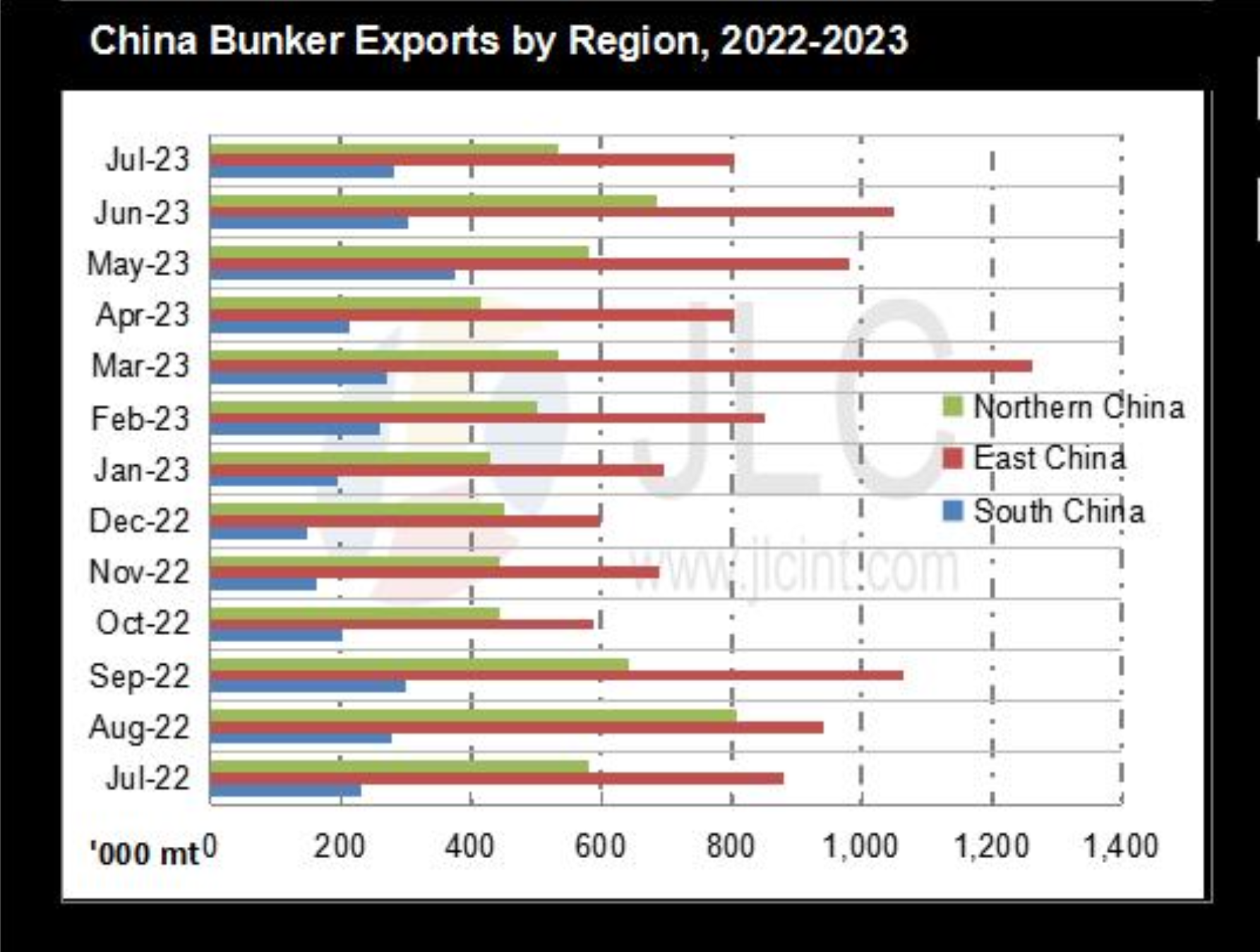
The country exported about 1.62 million mt of bonded bunker fuel in the month, down by 20.82% month on month and 4.63% year on year, JLC estimated, with reference to data from the General Administration of Customs of PRC (GACC).
Specifically, heavy bunker fuel exports amounted to about 1.53 million mt, accounting for 94.70% of the total, while light bunker fuel exports settled at 85,700 mt, making up 5.30%.
Regarding the exports by supplier, enterprises with national bunkering licenses exported roughly 1.30 million mt, accounting for 80.73% of the country’s total, with Sinopec Fuel Oil and Chimbusco taking 71.68%. Meanwhile, enterprises with regional licenses exported 311,500 mt, accounting for 19.27%, with PetroChina Fuel Oil (Zhoushan, Shanghai and Guangzhou) taking 194,800 mt which occupied 12.07% of China’s exports and 62.54% of regional suppliers’ total.
Bunkering business at some Chinese ports was disturbed by rains and typhoons, dragging down China’s bonded bunker fuel exports. Meanwhile, some shipowners’ refueling demand was also depressed by bad weather, which added to the downward pressure on the exports.
On the other hand, domestic bunker fuel supply increased moderately amid larger LSFO production, putting a cap on the decline in the exports. China produced about 1.35 million mt of LSFO in July, up by 61,000 mt or 4.73% month on month, with the daily output up by 1.35% to 43,548 mt, JLC’s data shows.
In the first seven months, China’s bonded bunker fuel exports totaled about 12.03 million mt, growing by 6.38% from the same months in 2022, slowing down from a boost of 8.32% in the first six months.

Domestic-trade heavy bunker fuel demand climbs further in Aug
Domestic-trade heavy bunker fuel demand climbed further in August, as most shipowners resumed voyages after typhoons and bullish sentiment popped up in the shipping market. Domestic-trade heavy bunker fuel demand increased to 330,000 mt in the month, up by 20,000 mt or 6.45% from the previous month, JLC’s data shows.
On the contrary, domestic-trade light bunker fuel demand shrank as continuously rising prices somewhat deterred buyers. Domestic-trade light bunker fuel demand settled at 130,000 mt in August, descending by 10,000 mt or 7.14% month on month.
Bunker Fuel Supply
China boosts bonded bunker fuel imports from Russia in July
China sharply boosted its bonded bunker fuel imports from Russia in July, because of large discounts on Russian cargoes.
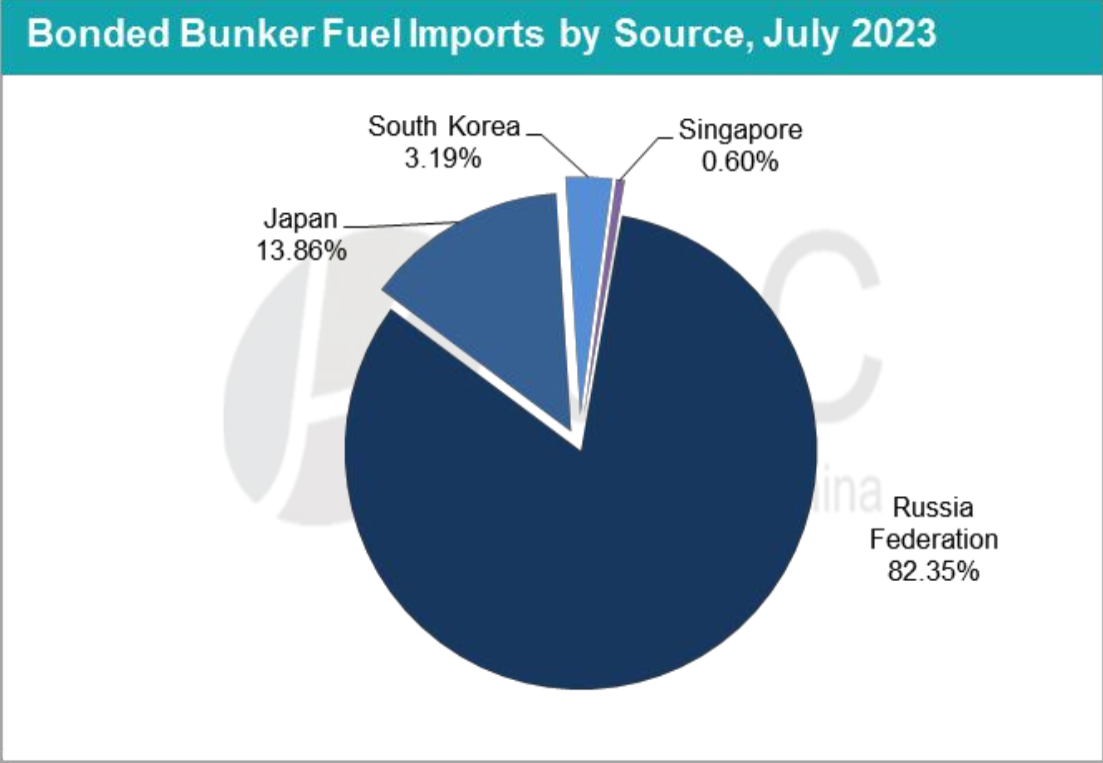
Russia became the biggest bonded bunker fuel supplier to China in the month, supplying 275,000 mt to the latter, surging by 253.02% year on year and accounting for 82.34% of China’s total imports, JLC estimated, with reference to data from the General Administration of Customs of PRC (GACC). Chinese importers placed more orders for cargoes from Russia, because of significant price advantages for Russian cargoes.
Japan replaced Singapore as the second largest supplier by shipping 46,300 mt of bonded bunker fuel to China, rising by 18.72% month on month and accounting for 13.86% of China’s total.
South Korea remained in the third place with 10,700 mt, accounting for 3.20%, despite a plunge from 70,900 mt in June 2023. Meanwhile, inflows from Singapore tumbled to 2,000 mt, rapidly down from 140,100 mt in the previous month, sending the country to the fourth place. The imports accounted for 0.60% of the total.
Despite an upsurge in imports from Russia and Singapore, China’s total bonded bunker fuel imports dropped to 334,000 mt in July, a cut of 26.33% month on month and 5.28% year on year. Underlying the decline was an increase in domestic low-sulfur fuel oil (LSFO) output and relatively high freight rates for imported cargoes.
Domestic LSFO supply increased as Chinese refiners ramped up their production to quicken the utilization of export quotas, and production basically met demand for low-sulfur bunker fuel. China’s LSFO output settled at 1.35 million mt in the month, gaining 61,000 mt or 4.73% month on month, with the daily output up by 1.35% to 43,548 mt, JLC’s data shows.
Domestic-trade heavy bunker fuel supply increases in Aug
Chinese blenders supplied about 370,000 mt of domestic-trade heavy bunker fuel in August, an increase of 10,000 mt or 2.78% from a month earlier, JLC’s data shows. Blenders bought more low-sulfur residual oil as blendstock amid lower prices, and they continued to raise their bunker fuel output when downstream buyers increased purchases with a bullish attitude.
At the same time, domestic-trade marine gas oil (MGO) supply stabilized at 170,000 mt. Light bunker fuel supply was still relatively abundant amid good coking margins.

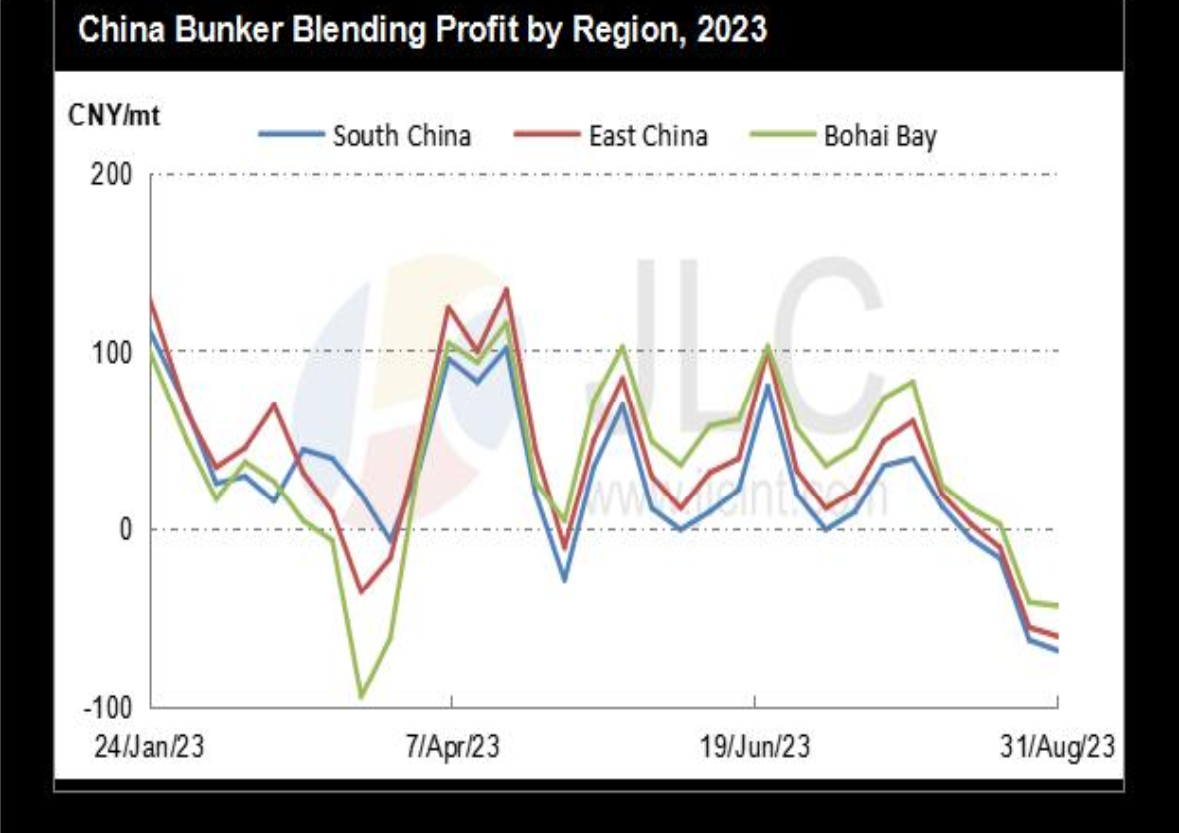
Bunker Prices, Profits

Editor
Yvette Luo
+86-020-38834382
[email protected]
Sales (Beijing)
Tony Tang
+86-10-84428863
[email protected]
Sales (Singapore)
Ginny Teo
+65-31571254
[email protected]
[email protected]
JLC Network Technology Co., Ltd is recognized as the leading information provider in China. We specialized in providing the transparent, high-value, authoritative market intelligence and professional analysis in commodity market. Our expertise covers oil, gas, coal, chemical, plastic, rubber, fertilizer and metal industry, etc.
JLC China Bunker Fuel Market Monthly Report is published by JLC Network Technology Co., Ltd every month on China bunker market, demand, supply, margin, freight index, forecast and so on. The report provides full-scale & concise insight into China bunker oil market.
All rights reserved. No portion of this publication may be photocopied, reproduced, retransmitted, put into a computer system or otherwise redistributed without prior authorization from JLC.
Related: JLC China Bunker Market Monthly Report (July 2023)
Related: JLC China Bunker Market Monthly Report (June 2023)
Related: JLC China Bunker Fuel Market Monthly Report (May 2023)
Related: JLC China Bunker Market Monthly Report (March 2023)
Related: JLC China Bunker Market Monthly Report (February 2023)
Related: JLC China Bunker Market Monthly Report (January 2023)
Related: JLC China Bunker Market Monthly Report (December 2022)
Related: JLC China Bunker Market Monthly Report (November 2022)
Related: JLC China Bunker Market Monthly Report (October 2022)
Related: JLC China Bunker Market Monthly Report (September 2022)
Related: JLC China Bunker Market Monthly Report (August 2022)
Related: JLC China Bunker Market Monthly Report (July 2022)
Related: JLC China Bunker Market Monthly Report (June 2022)
Related: JLC China Bunker Market Monthly Report (May 2022)
Related: JLC China Bunker Market Monthly Report (April 2022)
Related: JLC China Bunker Market Monthly Report (March 2022)
Related: JLC China Bunker Market Monthly Report (February 2022)
Related: JLC China Bunker Market Monthly Report (January 2022)
Note: China-based commodity market information provider JLC Technology has been providing Singapore bunkering publication Manifold Times China bunker volume data since 2020. Data from that period is available here.
Photo credit: JLC Network Technology
Published: 13 September, 2023
Methanol
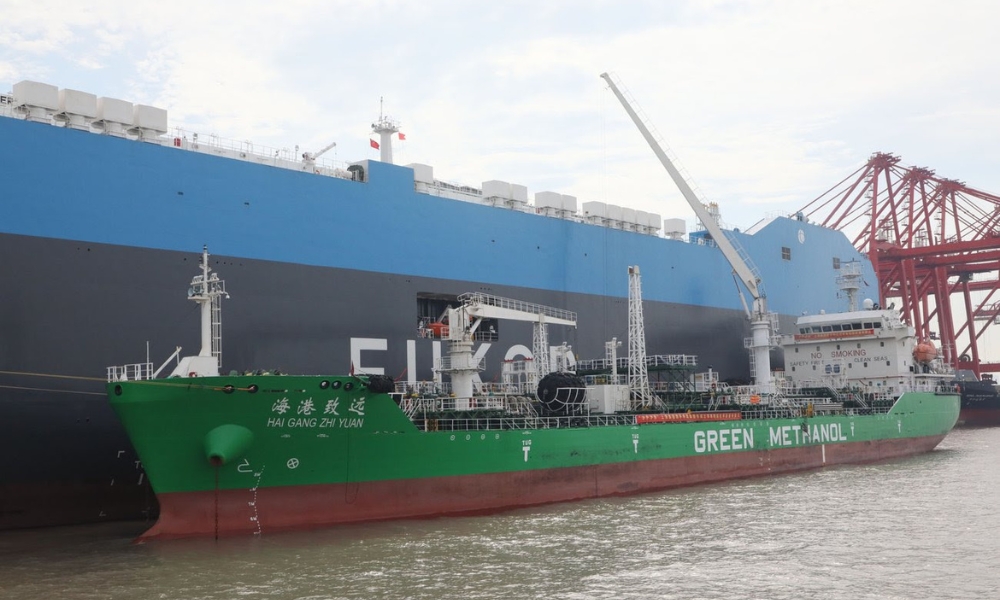
World Fuel and partners complete first green methanol bunkering of car carrier in Shanghai
Operation involved the delivery of approximately 2,800 MT of green methanol to “Arctic Tern” via a ship-to-ship transfer using SIPG Energy’s dedicated methanol bunkering vessel “M/V Hai Gang Zhi Yuan”.
Ammonia
HPA and MB Energy develop safety concept for STS ammonia bunkering
HPA says the Port of Hamburg will become “bunker ready” for ammonia, laying the groundwork for safe and reliable ammonia bunkering in the future.
Bunker Fuel
Alkagesta highlights key insights of Malta bunkering market in 2026
Darren Lee Axisa discusses the key trends influencing Malta’s bunkering market and the factors that will determine Malta’s long-term competitiveness as a regional bunkering hub.

OUR INDUSTRY PARTNERS

Singapore: High Court to hear Norvic Shipping Asia winding up application on 31 July

World Fuel and partners complete first green methanol bunkering of car carrier in Shanghai

HPA and MB Energy develop safety concept for STS ammonia bunkering

GCMD: Project CAPTURED achieves two regulatory milestones for onboard captured CO2

Alkagesta highlights key insights of Malta bunkering market in 2026

ENGINE: East of Suez Fuel Availability Outlook (22 July 2026)

Singapore: Ofiniti, ONE trial direct platform integration to streamline bunker workflows

Malaysia: Maharani Freeport to implement MFM and e-BDN technologies for enhanced bunkering transparency

ENGINE: Europe and Africa Fuel Availability Outlook (8 July 2026)

Evergreen Marine director questioned, offices searched in Taiwan insider trading probe

Singapore retains world’s leading maritime centre ranking in 2026 ISCD Index

Singapore: MPA issues circular on resolutions adopted by IMO MEPC 84

Singapore: Bunker fuel sales up by 1.6% on year in June 2026

Malaysia: MMEA detains tugboat with undocumented 10,000 litres of diesel in Kuala Langat
-
 Technology1 week ago
Malaysia: Maharani Freeport to implement MFM and e-BDN technologies for enhanced bunkering transparency
-
 Bunker Fuel Availability2 weeks ago
ENGINE: Europe and Africa Fuel Availability Outlook (8 July 2026)
-
 Legal2 weeks ago
Evergreen Marine director questioned, offices searched in Taiwan insider trading probe
-
 Business2 weeks ago
Singapore retains world’s leading maritime centre ranking in 2026 ISCD Index
-
 Port & Regulatory1 week ago
Singapore: MPA issues circular on resolutions adopted by IMO MEPC 84
-
 Bunker Fuel1 week ago
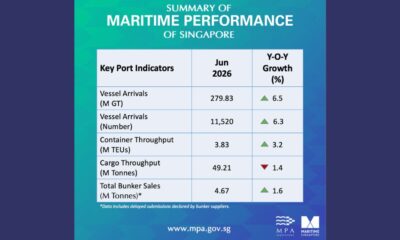
Singapore: Bunker fuel sales up by 1.6% on year in June 2026
-
 Vessel Arrest1 week ago
Malaysia: MMEA detains tugboat with undocumented 10,000 litres of diesel in Kuala Langat
-
 Bunker Fuel1 week ago
ENGINE: East of Suez Fuel Availability Outlook (14 July 2026)